

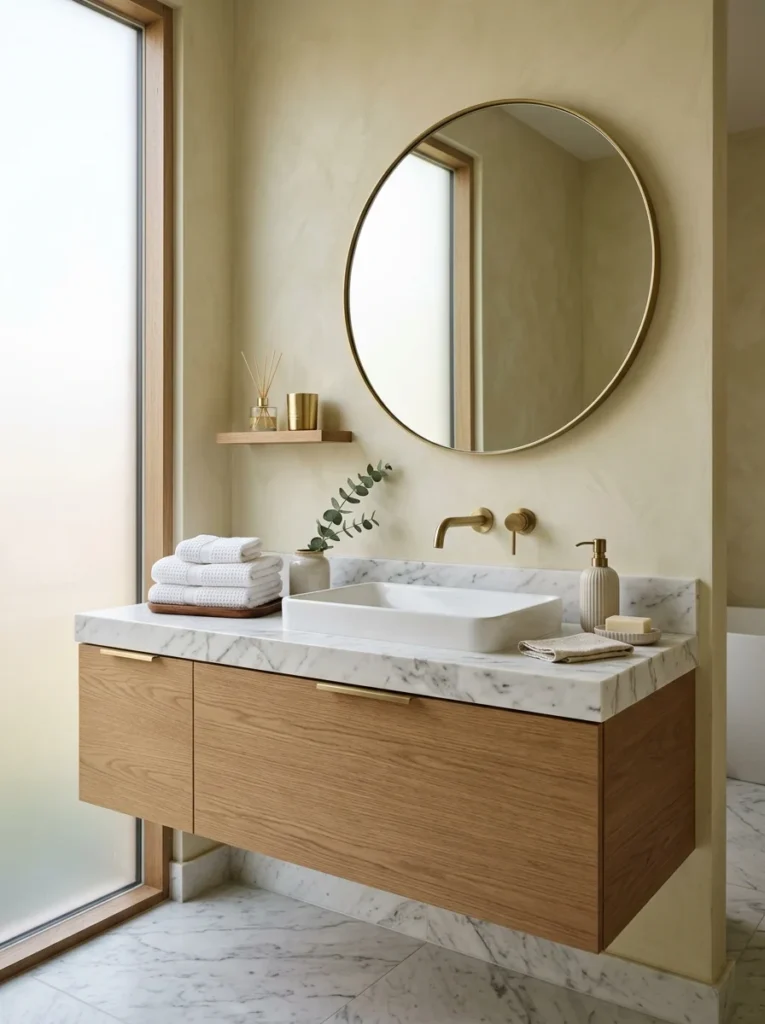
Most vanity styling advice produces vanities that look styled. Here’s what actually makes a bathroom vanity look intentional, calm, and personal — without the checklist feel.Most vanity styling advice starts with a product list: a soap dispenser, a tray, a small plant, a candle, a decorative object. Follow this advice carefully and you’ll end up with exactly what it produces — a vanity that looks like it was styled using a checklist. Recognizable. Safe. And missing the specific quality that makes a beautifully styled vanity feel personal and settled rather than assembled from a formula.
The “overdone” feeling that most people are trying to avoid isn’t caused by having too many things on the vanity, though that certainly contributes. It’s caused by styling that is visible as styling — where the effort shows, where each item is clearly there for decorative rather than functional reasons, where the whole arrangement reads as curated for a photo rather than lived in.
A vanity that avoids this quality doesn’t look unstyled. It looks unconsidered in the best possible sense — like it arrived at its current state through use and care rather than deliberate placement. Getting there requires understanding what creates the “overdone” signal and making specific choices that produce the opposite.
What “Overdone” Actually Looks Like
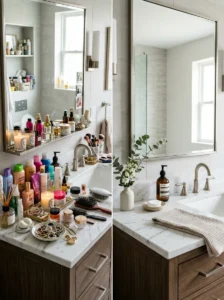
Before fixing a problem, it helps to recognize it precisely. An overdone vanity typically shares several specific characteristics:
Too many items at the same scale. A collection of similarly-sized objects — several small bottles, a few similarly-sized containers, a candle the same height as the soap dispenser — reads as a collection rather than a composition. The eye has no anchor, no variation to move through, and the whole arrangement collapses into visual noise.
Decoration that has no function. A small ceramic figurine, a decorative stone, an ornament placed specifically because it looks nice — these items announce themselves as decoration and produce the feeling that someone tried to make the vanity look beautiful. Items that look beautiful while being genuinely useful don’t carry this announcement.
More than one scent source. A candle and a diffuser and a hand lotion in a noticeable fragrance in the same small space creates olfactory conflict that the body registers even before the eye processes the clutter.
Color or material variety that wasn’t managed. A white dispenser, a gold tray, a green plant in a terracotta pot, a blue candle, a pink hand lotion, and a silver soap dish is not a styled vanity — it’s a gathering of objects that each arrived from a different decision.
Items that are clearly there to be seen rather than used. If the arrangement would need to be entirely moved to use the sink properly, the styling is working against the space rather than with it.
The Sequence That Changes Everything: Function Before Styling
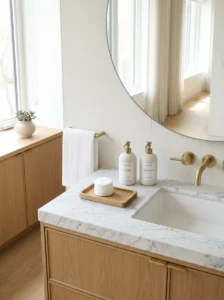
The starting point for any vanity that avoids the overdone quality is to reverse the usual sequence. Instead of beginning with “what should I put here that looks nice,” begin with “what actually needs to be here to serve daily use,” and then make those functional items as beautiful as they can be.
In most daily-use bathrooms, the items that genuinely earn vanity placement are:
- Hand soap — used at the sink every time it’s visited
- Hand lotion — used frequently enough that drawer retrieval creates real friction
- A container for items in active daily use — cotton pads, a razor, whatever is reached for every morning
Everything else — the candle, the decorative dish, the small object, the additional product — should earn its place through a clear answer to: does this being on the vanity make daily use of the sink genuinely easier or better in some way?
If the honest answer is no, the item belongs in a cabinet or drawer, not on the surface. When the styling starts with function and adds only what genuinely supports it, the overdone quality disappears because nothing on the surface is clearly there for decoration alone.
The Material and Color Limit
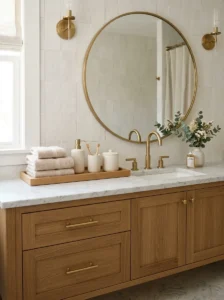
This is where most vanities that feel overdone reveal the underlying cause. Every item on the vanity was chosen because it’s beautiful individually, without enough attention to whether it agrees with what’s already there.
A useful ceiling for vanity surfaces: two materials, maximum three. A ceramic dispenser, a wooden tray, and a metal container is three materials. Add a glass candle holder, a ceramic pot, and a rattan tissue box cover and the surface starts reading as a materials fair rather than a styled space.
The same principle applies to color. Warm neutrals throughout — cream, white, warm beige, natural wood — read as a coherent palette. Introduce a strong accent color and the eye goes to it; introduce two accent colors and the surface reads as mixed-up.
This doesn’t mean everything must match. Variation within a consistent family — different shades of warm white, different textures of natural material — reads as layered rather than matched. What reads as overdone is variation across different families: cool tones next to warm tones, highly polished next to very rustic, multiple strong colors.
The Soap Dispenser: The Highest-Return Single Item
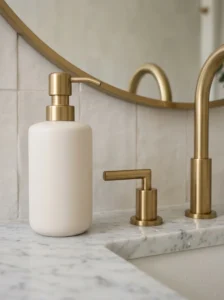
If there is one item on a bathroom vanity that does more visual work per dollar than any other, it’s the soap dispenser. It’s the item touched most frequently, positioned most prominently, and most likely to either confirm or contradict the quality of the space as a whole.
A builder-provided soap dish with a bar soap in packaging, or a plastic pump dispenser from the grocery store, reads at a certain quality level no matter what surrounds it. A ceramic or stone-effect dispenser, a glass pump in a metal finish, or a solid material dispenser in a color that agrees with the vanity’s palette reads differently — it signals that the space has been thought about at the level of touch as well as appearance.
The soap dispenser is also an item where the investment is modest and the daily visibility is extremely high. This is the right place to spend a little more relative to surrounding items, not because it’s a luxury item but because it’s the item that gets used and noticed at every visit to the sink.
Trays: What They Should and Shouldn’t Do
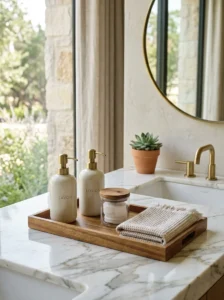
Trays appear in most styled vanity images and are genuinely useful — with a specific qualification. A tray that organizes items already on the vanity into a contained visual unit is doing real work. A tray placed on the vanity purely to have something to group other decorative items on is adding an object to justify other objects, which is circular and visible.
The test for a tray: would the items currently in the tray still be on the vanity if the tray weren’t there? If yes, the tray is organizing items that earn their place. If no — if some of the items exist specifically to fill the tray — the tray is generating rather than organizing a styling decision, and the items filling it should be reconsidered.
A tray also defines a zone, which has a practical value beyond aesthetics. Items within the tray’s boundary belong to one activity or function. Items outside the tray are either separate functional elements or they don’t belong on the surface. This zoning logic prevents the gradual drift — the accumulation of items that join the vanity one at a time — that eventually produces the “overdone” feeling without any single decision causing it.
Scent: Less Than You Think
A scented candle on a bathroom vanity looks beautiful in every styled bathroom photograph. In a real bathroom used daily, scent layering is the fastest path to an environment that feels cloying rather than pleasant.
The bathroom already has the scent of hand soap and whatever personal care products are used in it. Adding a candle on top of these creates a layered scent that can quickly become overpowering in the small, enclosed space a bathroom represents.
If a scent element is desired on the vanity, one source only — a candle, a reed diffuser in a clean scent with minimal throw, or strongly-scented hand soap (but not all three). The scent should complement the background of the space rather than compete with it, which means choosing something that doesn’t announce itself.
A candle that’s present primarily as a visual object — for its vessel, its scale, its material — rather than as an active scent source is usually the most successful vanity scent approach. Lit occasionally, it contributes scent as a special-occasion addition rather than a constant presence.
The Living Element: One, Placed With Intention
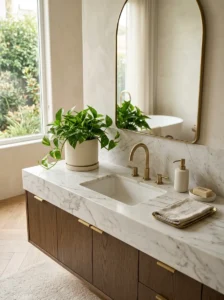
A plant or fresh flower on a vanity does something that no inanimate object can fully replicate — it signals active tending, which reads as care. A well-maintained plant in a bathroom says that someone looks after this space as a matter of daily attention, which contributes to the feeling of luxury more efficiently than most decorative purchases.
The limit is one. A single plant, appropriate in size to the vanity surface, in a vessel that agrees with the vanity’s material palette. The plant should be a species that genuinely tolerates bathroom humidity and indirect light — a pothos cutting in a glass of water, a small succulent in adequate light, a vase of fresh flowers changed weekly.
Multiple plants on a vanity produces a greenhouse effect rather than a curated one. One plant, clearly tended, is the ceiling of what works on most vanity surfaces.
The Guest Bathroom Exception
Everything above applies primarily to a daily-use bathroom — a space organized around routine and lived-in function. A guest bathroom operates on different principles because it’s used infrequently, looked at more than used, and closer to a display environment than a functional daily space.
In a guest bathroom, a somewhat more styled vanity — one with slightly more decorative elements, more clearly arranged, closer to the “magazine” version — is appropriate precisely because the daily friction concern doesn’t apply. Guests using the space once or twice don’t need to move a styling arrangement to use the sink every morning.
The items appropriate for a guest bathroom vanity that wouldn’t belong on a daily-use vanity: a small decorative dish for jewelry, a more elaborate candle, a small piece of art leaning against the mirror, fresh flowers. The guest bathroom is the appropriate venue for the visual fantasy version of bathroom styling. The daily bathroom is not.
The Reset Practice That Prevents Drift
Styled vanities don’t maintain themselves. The gradual accumulation of items — a product added from a shopping bag, a gift left out because there’s nowhere obvious for it to go, an item moved from somewhere else and never moved back — is the normal trajectory of any surface without active management.
A monthly reset takes ten minutes: everything off the vanity, wipe it clean, return only items that pass the function test. The edit is fast because the categories are already known — what belongs here and what doesn’t is a decision already made. The purpose of the reset isn’t to rethink the system, it’s to enforce the existing one against the natural drift that happens between resets.
A vanity reset is also useful as an early signal that the storage situation inside the cabinet needs attention. When items start consistently ending up on the surface that belong inside, the under-sink organization or medicine cabinet has become inadequate and is overflowing onto the counter. The reset reveals this before it becomes a significant problem.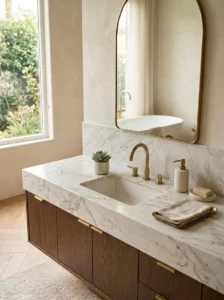
Key Takeaways
- Overdone styling reads as visible effort — items that are clearly there to be seen rather than used, decoration for its own sake, a formula followed rather than a space lived in
- The correct sequence is function first: identify what genuinely belongs on the vanity through daily use, then make those items as beautiful as possible
- Two to three materials maximum; one color palette direction — variation within a family reads as layered, variation across families reads as mixed
- The soap dispenser is the highest-return single vanity item — it’s the most-used, most-visible object and worth investing in relative to what surrounds it
- A tray organizes items that already earn their place; it should not be the reason items are there
- One scent source in a small bathroom; active scent is a special-occasion addition, not a constant presence
- One plant, genuinely tended, is the ceiling of living elements that works on most vanity surfaces
- Guest bathrooms operate on different styling principles than daily-use bathrooms — more display is appropriate where daily friction isn’t a factor
- A monthly ten-minute reset prevents the drift that gradually produces the overdone quality without any single decision causing it
Frequently Asked Questions
How do I make a bathroom vanity look styled without it looking like I tried too hard? The quality of “not trying too hard” comes from items that have genuine function alongside their appearance, materials that agree with each other rather than compete, and enough clear surface visible that the eye can rest. If every inch of the vanity is occupied and every item is clearly decorative, it reads as effort. If most items are beautiful functional objects with one or two intentional aesthetic additions, it reads as considered living.
Should everything on my bathroom vanity match? Not match exactly, but agree in family — the same material direction (all warm, all natural, or all one finish of metal) and a single color palette direction. Exact matching reads as store-bought set rather than curated. Careful variation within a palette reads as individual taste. Variation across different palette directions reads as unsettled.
What’s the right number of items for a bathroom vanity? For a single-sink daily-use vanity, three to five items is the range where most vanities read as styled rather than either bare or overdone. These would typically include the soap dispenser, a tray with two or three contained items, and one additional element — a small plant, a candle, or a single decorative piece that agrees with everything else. Beyond five items, most vanity surfaces start reading as crowded.
Is it okay to have products visible on the vanity, or should all products be hidden? Products in attractive packaging, decanted into matching containers, or displayed in holders can absolutely be part of a styled vanity. Products in original packaging — with brand logos, pharmaceutical fonts, and promotional design — should generally live in a drawer or cabinet rather than on the surface, because they carry the visual language of a store shelf rather than a home. The product itself is fine to display; the packaging often isn’t.
How do I style a vanity when I share the bathroom with someone whose products are different from mine? Containing each person’s daily items in a designated section of the vanity — or in matching pouches or small baskets that can be set out and put away — maintains the visual coherence of a styled surface without requiring everyone to use the same products. A tray for each person’s essentials, in the same tray material, produces a unified look with individual contents. Alternatively, moving all daily products inside the cabinet with only one or two genuinely attractive items left out works for households where the “displayed” approach creates disagreement.