

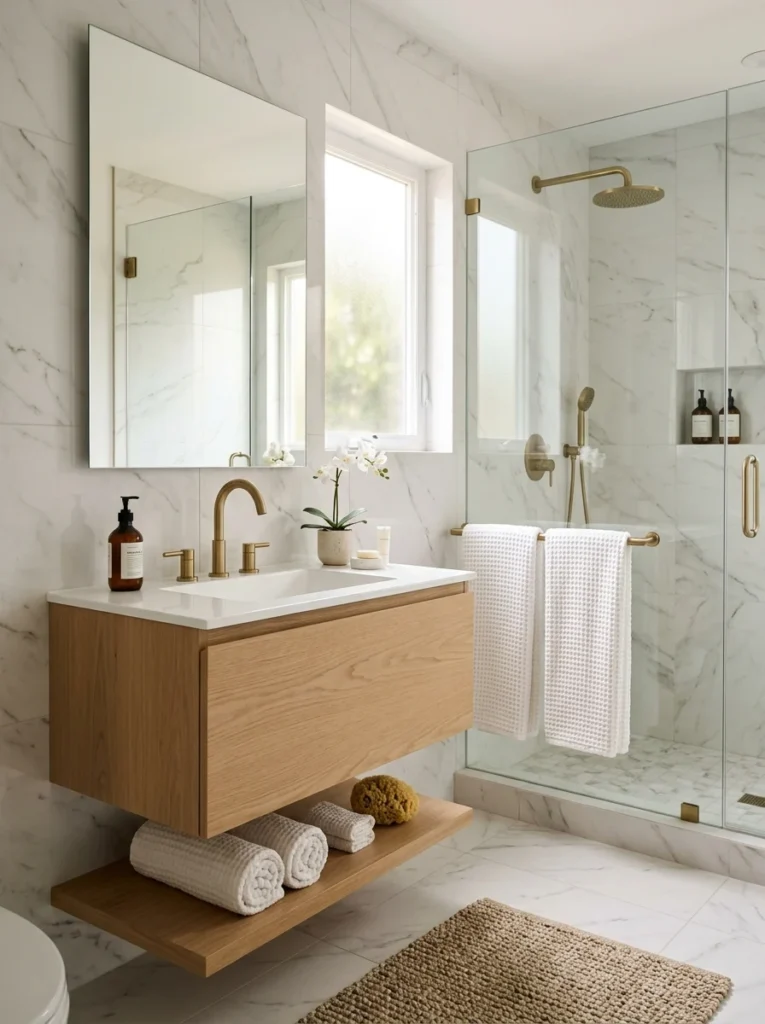
An all-white bathroom can feel like a spa or a hospital corridor — the difference has nothing to do with adding color. Here’s exactly what separates the two and how to move from one to the other.Two all-white bathrooms can sit in buildings on the same street and feel completely different. One reads as a spa — serene, clean, intentional, the kind of room where staying in the shower a few minutes longer than necessary feels like a reasonable decision. The other reads as a hospital corridor, or an empty apartment waiting for its next tenant. Both are entirely white. The difference is not the white.
This distinction is worth understanding precisely, because the instinct when an all-white bathroom feels cold is to add color — a warm paint tone, a colored towel, something not-white to relieve the monotony. Color can help, but it isn’t usually the core problem. The bathrooms that feel clinical despite being beautifully maintained and thoughtfully lit are almost always missing something more fundamental: the physical and visual qualities that white surfaces cannot generate on their own.
White is not warm by nature. It’s neutral — it reflects and amplifies whatever the surrounding environment provides. In a room with texture, natural material, warm light, and living elements, white amplifies all of those warm qualities and reads as serene. In a room without them, white amplifies nothing and reads as empty.
Texture First — Before Anything Else
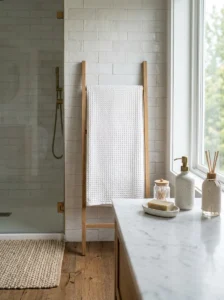
The fastest, most significant shift available in an all-white bathroom that reads as cold is adding physical texture to surfaces that currently have none.
A flat, smooth, white tile wall reflects light evenly in all directions, which creates a bright but characterless surface. A textured white tile — one with a matte, slightly uneven surface, a handmade quality, a dimensional face — catches light differently across its surface, creating small highlights and shadows that make the wall read as alive rather than manufactured. Both are white. Both are tile. The experience of being in a room with the second version is meaningfully different from the first.
This principle extends beyond tile:
A woven or loop-pile bath mat instead of a flat rubber-backed one introduces both visual and physical texture at foot level — the first surface encountered when leaving the shower.
Linen or waffle-weave towels read differently than the smooth, thin cotton of budget towels. The weave pattern creates a textured surface that reads as warmer than a smooth one at the same color and approximately the same cost.
A wooden stool, shelf, or accessory in a white bathroom introduces not just warmth of color tone but warmth of material texture — grain, variation, the slight roughness of wood — that no painted or tiled surface replicates.
A ceramic or stone accessory with a handmade quality — slightly irregular, slightly imperfect — reads as different from a mass-produced smooth container, and that difference is warmth.
The operating principle: a white bathroom that reads as warm almost always has multiple surface textures present simultaneously. A white bathroom that reads as cold almost always has only one texture — smooth — repeated across every surface.
Wood: The Single Most Reliable Warmth Addition in Any White Bathroom
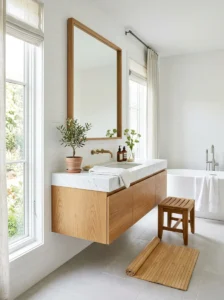
This appears in the cold modern kitchen article for the same reason it belongs here: wood is warm by definition in a way that no painted surface is, and its presence in a room built of white hard surfaces creates a contrast that the eye and the body respond to immediately.
The white bathroom’s relationship to wood is particularly productive because the contrast is so clean. Dark wood grain against white tile reads as intentional and composed in a way that it might not in a room with more visual complexity.
Specific wood elements that work well:
A teak or bamboo bath mat positioned between the shower and the bath mat. This is a different object from a fabric mat — a wooden grate that sits above the floor surface, has visible grain, and brings a spa-quality material into the bathroom’s daily routine. Used in a white bathroom, it reads immediately as the element that anchors the warmth.
A wooden shelf — whether wall-mounted floating shelves in a warm-toned wood or a simple bath tray across the tub — brings a horizontal wooden surface into a room of white verticals and provides a visual resting point.
A wooden framed mirror above the vanity. As discussed in the mirror article, the frame changes how the mirror reads in the room. A warm wood frame in an all-white bathroom is one of the most composition-shifting single changes available.
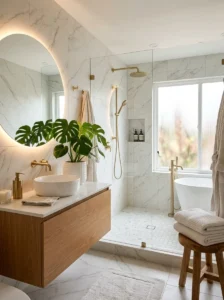
A wooden vanity or a vanity with wood-effect doors. In a white bathroom where the walls, tile, and sanitaryware are all white, a vanity in a warm wood tone is the element that brings the room’s material range into a more livable place. This is a more significant change than accessories, but it’s among the most impactful single decisions available.
Lighting: The Difference Between a Spa and a Surgery Room
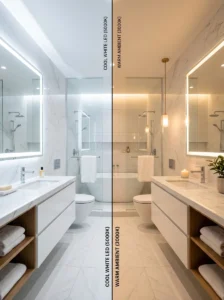
The lighting in most all-white bathrooms is the primary reason they read as clinical. White surfaces reflect light strongly — they amplify whatever the light source provides. Under cool-white or daylight-temperature lighting, white tile amplifies that coolness back into the room. The room becomes a cool-white echo chamber.
Under warm-to-neutral white light at a lower intensity, the same white tile reflects warmth instead. The surfaces that were cold become soft. The room that felt like an inspection environment becomes the spa version of itself.
The specific lighting changes that make the most difference in an all-white bathroom:
Replace any cool-white or daylight bulbs with warm-to-neutral white. This is the lowest-cost, highest-impact change available in any all-white bathroom. A bulb swap — from 5000K or 6000K down to 2700K or 3000K — changes every surface in the room simultaneously and takes less than ten minutes.
Add a second light source at a different height. A single overhead fixture in a white bathroom means the light comes from one flat direction and creates one flat reading of every surface. A mirror light, a sconce, a small pendant — any second source at a different height — creates the variation in light that turns flat surfaces into dimensional ones.
A dimmable circuit allows the bathroom to shift between its functional bright mode and a softer, warmer mode for other uses — an evening bath, a wind-down routine — where the full overhead brightness would feel harsh rather than clean.
Towels and Textiles: The Warmth Variable Most Easily Adjusted
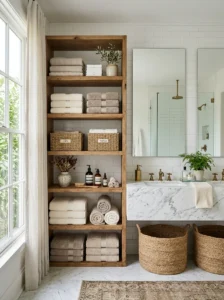
The towels hanging in a white bathroom are among the most visible elements in the room, particularly from the doorway where the bathroom is read at a glance. Their color, texture, and condition communicate the room’s quality level as much as the tile or the fixtures.
In an all-white bathroom, towels don’t need to be white to look right — in fact, an all-white bathroom with white towels can flatten the room by removing the only obvious opportunity for warm tone. Towels in natural linen, warm cream, stone, or terracotta introduce tone without the disruption of a strong accent color, and they soften the all-white palette by occupying the category of “warm white and natural” rather than “colored element.”
The texture of the towels matters alongside the tone. Thick, woven-cotton towels with visible texture read as warm and substantial. Thin, smooth towels in the same color read as functional and inexpensive. In a white room where every element is amplified, the quality of the textiles reads clearly.
Folded and displayed consistently — same color, same fold, stacked or hung in a way that reads as intentional rather than piled — towels in a white bathroom become part of the composition rather than just functional objects.
Plants: The Contrast Principle at Its Most Effective
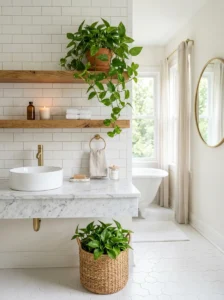
Green against white is one of the most visually satisfying combinations in any room, and a bathroom’s humidity is genuinely favorable to the plants that tolerate it well. A white bathroom with one thriving green plant looks very different from the same bathroom without one — the contrast is starker, the reading of “living and tended” is stronger, and the warmth contribution is immediate.
The plant choices that work best in bathrooms with indirect light and consistent humidity:
- Pothos — trailing form looks particularly good from a shelf in a white bathroom
- Peace lily — white flowers against white tile, deep green leaves, genuine warmth contribution
- Boston fern — lush, full, genuinely loves bathroom humidity, softens the hard lines of a tiled room
- ZZ plant — very low light tolerant, upright form adds height without sprawl
The vessel matters in a white bathroom more than in a room with more visual complexity. A terracotta pot against white tile reads as warm and earthy. A white ceramic pot in the same setting blends rather than contrasts. A woven basket pot cover adds texture alongside the greenery. The choice of vessel is a design decision, not a default.
Hardware Finish: Warm vs Cool

Chrome fixtures — still the most common bathroom hardware finish — read as cool. Not badly so, but cool. In an all-white bathroom where every surface is reflective, chrome contributes to the cool reading by reflecting cool-toned light consistently.
Brushed gold, unlacquered brass, or warm-toned bronze fixtures change the room’s metal contribution from cool to warm without requiring any structural change. These finishes reflect light in a way that reads as warmer and adds a material note to the bathroom that chrome doesn’t.
A complete hardware change — faucet, shower head, towel rails, toilet flush mechanism — is a significant project but produces a significant result. A partial change — towel rails and visible accessories, with the plumbing fixtures remaining for a future update — produces much of the same visual effect for less total cost.
What Not to Do First
The first instinct when an all-white bathroom feels cold is to add an accent color — a bright towel, a colorful bath mat, a decorative element in a warm hue. This can work, but it’s often the wrong starting point because it addresses the symptom rather than the cause.
An all-white bathroom that’s cold because it has smooth surfaces, cool lighting, and no natural materials will remain fundamentally cold even with a terracotta towel or a colored vase. The accent elements read as additions rather than as part of the room’s character, and they rarely move the warmth needle as far as the changes described above.
The correct sequence for warming an all-white bathroom:
- Change the lighting temperature first — this affects everything simultaneously
- Add wood in at least one specific element
- Introduce texture through towels and accessories
- Add a plant
- Consider hardware finish if budget allows
After these changes, assess whether accent color is still needed. In many cases, the room reads as warm enough through texture and material without requiring any specific color addition. When color is added on top of this foundation, it reads as part of the design rather than as compensation for coldness.
Key Takeaways
- An all-white bathroom reads as cold when it has only one surface texture, cool-toned light, and no natural materials — white amplifies the environment around it rather than generating warmth on its own
- Texture is the primary warmth mechanism: textured tile, woven textiles, wood grain, handmade ceramic surfaces all read warmer than smooth equivalents at the same color
- Wood is the single most reliable warmth addition — the contrast between warm grain and white tile reads as intentional and immediately changes the room’s character
- Lighting temperature is the lowest-cost, highest-impact change: replacing cool-white bulbs with warm-to-neutral white transforms every surface in the room simultaneously
- Towels in warm neutral tones (linen, cream, stone) rather than white add tone without introducing a competing accent color
- A single thriving plant against white tile creates one of the most effective contrasts available in any bathroom
- The correct sequence: lighting first, then wood, then texture through textiles, then plants, then hardware if budget allows — not accent color first
Frequently Asked Questions
Do I need to add color to warm up a white bathroom, or can it stay white? It can absolutely stay white and read as warm. The bathrooms that feel genuinely spa-like are almost always based primarily in white — what makes them feel warm is texture, natural material, warm light, and living elements, not color. Adding color to a white bathroom before addressing these fundamentals typically produces an addition that reads as stuck on rather than as part of the room’s character.
What’s the best wood tone for an all-white bathroom? Medium-to-warm wood tones — teak, walnut, warm oak, bamboo — read most strongly against white because the contrast is clear. Very pale woods like bleached ash or white oak read as complementary to the white palette and warm the room more subtly. Very dark woods like ebony or very dark walnut create a high-contrast effect that suits specific aesthetics. The choice depends partly on personal preference and partly on how strong a warmth statement is desired.
Does a white bathroom with warm elements still feel clean? Yes — warmth and cleanliness are not competing qualities in a bathroom. The spa aesthetic, which is the reference point for warm-feeling white bathrooms, is characterized by both warmth and cleanliness simultaneously. The combination of white surfaces (which read as clean) and warm materials (which read as intentional) produces both qualities together. The “clean” feeling in a bathroom comes primarily from the condition of surfaces, not from the absence of warm elements.
How many warm elements does a white bathroom need before it reads differently? In most white bathrooms, three consistent warm additions are enough to shift the room’s reading significantly: warm lighting, one wood element, and textured or warm-toned textiles. These three together change the fundamental character of the room. Additional elements — a plant, warm hardware, a textured accessory — reinforce and complete the shift, but the core change happens with the first three.
Should the grout in a white tiled bathroom be white or a warmer tone? A warmer-toned grout — ivory, warm gray, or a light greige — reads as warmer than pure white grout in a white bathroom, because it introduces a warm tone at the lines that divide every tile. The effect is subtle in isolation but visible across a full tiled surface. The practical advantage is that warm-toned grout also shows staining less dramatically than white grout, which is a meaningful maintenance benefit in a bathroom used daily.