


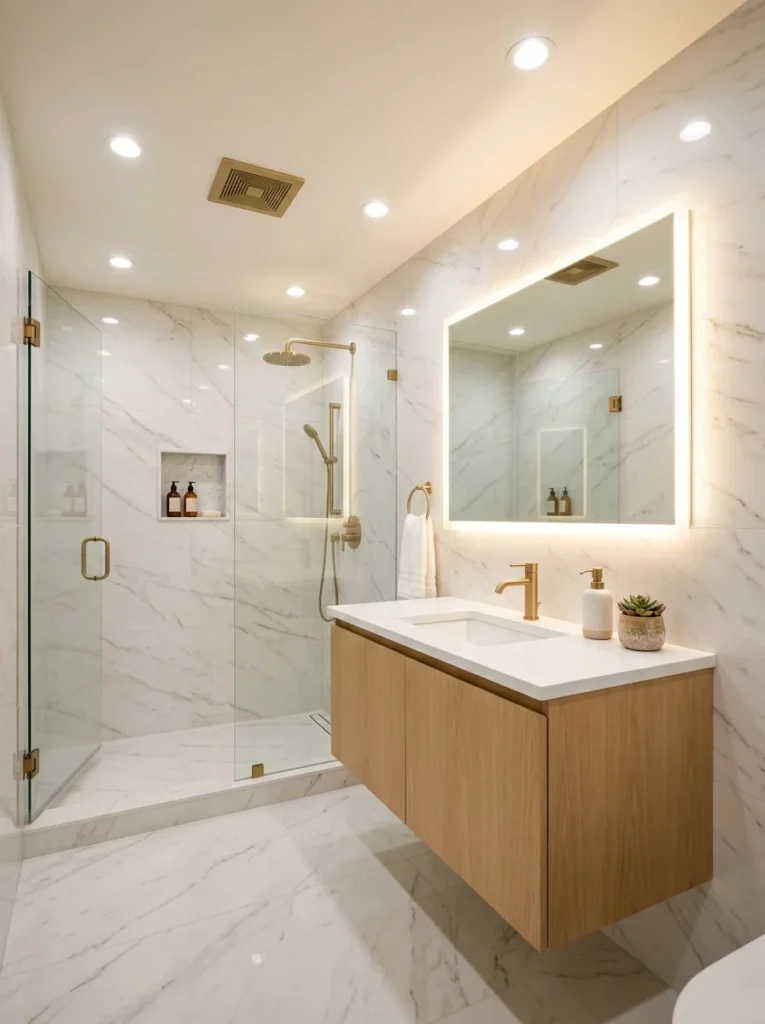
A bathroom with no window is solvable — but it has specific challenges that go beyond aesthetics. Here’s how to handle ventilation, lighting, mold prevention, and making the room feel livable.In most apartment buildings, at least one bathroom — sometimes the only one — was built without a window. The architect made a calculation: the room needed to fit within the floor plan, and the exterior walls were allocated to living spaces with furniture requirements and a genuine claim to daylight. The bathroom got the interior wall, a ventilation fan, and an overhead light. Millions of people live with this bathroom every day, and most of them have learned to live around its limitations rather than addressing them directly.
The windowless bathroom is a more specific problem than the windowless kitchen. A kitchen without a window is primarily a lighting problem. A bathroom without a window is a lighting problem plus a humidity problem plus an air quality problem, all compressed into a small enclosed room that generates significant moisture multiple times per day. Getting it right requires working through these problems in a specific order before addressing anything aesthetic.
Ventilation: The Problem That Comes Before Everything Else
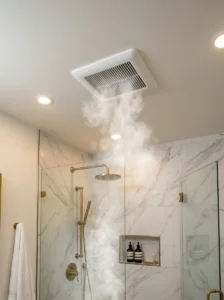
A windowless bathroom that isn’t properly ventilated is a bathroom that will eventually develop mold, regardless of how carefully it’s designed or cleaned. This is the structural reality that makes ventilation the non-negotiable first priority in any windowless bathroom, and the reason to address it before making any aesthetic or design decision.
A window provides passive ventilation — a route for moisture-laden air to escape and replace itself with drier air from outside. Without a window, the only moisture exit is the mechanical ventilation fan. This means the fan must be adequate for the room’s moisture load, must be used correctly, and must be in good working condition. A windowless bathroom with an undersized or malfunctioning fan is a bathroom that will be continuously managing a moisture problem regardless of what else is done to improve it.
Assessing the Fan
Most ventilation fans in apartments and homes are rated by the volume of air they move, measured in cubic feet per minute (CFM) or cubic meters per hour. The standard recommendation for a bathroom is a fan capable of moving the room’s air volume at least eight times per hour. For a small bathroom of 40-50 square feet with a standard ceiling height, this typically means a minimum of 50 CFM; larger bathrooms or rooms with a shower that runs hot need more.
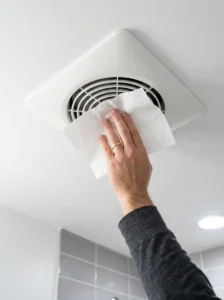
The easiest test for whether an existing fan is adequate: hold a sheet of toilet paper near the fan grille while the fan is running. If the paper is held firmly against the grille by the suction, the fan is working. If the paper hangs or barely responds, the fan is either undersized or obstructed.
Replacing an undersized or failing fan is a practical priority that any electrician can address. The model available at the same fixture location can be upgraded to a higher CFM rating with relatively modest cost. Some replacement fans include humidity sensors that automatically activate when moisture levels rise, which is particularly useful in windowless bathrooms where user discipline about running the fan may vary.
Fan Use: Timing Matters as Much as Capacity
Even an adequate fan cannot remove moisture it isn’t running during. The most common ventilation mistake in windowless bathrooms is turning the fan off when leaving the bathroom, before the moisture has been adequately cleared.
A shower generates humidity that persists in a small enclosed room for fifteen to twenty minutes after the shower ends. Running the fan only during the shower removes some moisture; running it for fifteen to twenty minutes afterward removes considerably more. The investment in a simple timer switch — a mechanical or electronic timer mounted in place of the standard fan switch — automates this without requiring behavioral change. The timer runs the fan for a set duration after the shower and then switches off.
In a bathroom used heavily and frequently, a humidity-sensing fan that runs until the moisture level drops to a target threshold is the most reliable solution. These cost somewhat more than standard fans but require no judgment about timing and adapt automatically to how long and how hot the shower was.
Mold: Specific Prevention in an Enclosed Space
Mold in a windowless bathroom isn’t a sign of neglect — it’s a predictable outcome of moisture without adequate airflow, and it happens to bathrooms that are otherwise carefully maintained. The prevention requires addressing the moisture directly rather than cleaning mold after it appears.
Beyond adequate ventilation, the specific practices that prevent mold accumulation in windowless bathrooms:
Leave the bathroom door open when the room isn’t in use. An open door allows the broader air circulation of the adjacent space to assist with moisture removal after a shower. A closed door traps residual humidity and creates the conditions mold requires.
Squeegee shower walls and the shower floor after every shower. The surface moisture left on tile and glass after a shower is the substrate mold initially grows on. Removing it physically — which takes less than sixty seconds — eliminates the immediate food source before ventilation finishes the rest.
Check grout lines and caulk seams regularly. These are the locations where mold establishes most readily in a bathroom, because the textured surface holds moisture and the porosity of older grout provides organic material for mold to grow on. Re-caulking any joint that shows discoloration, and treating grout with a penetrating sealer annually, significantly reduces the surface area available for mold establishment.
Avoid fabric elements that retain moisture. Fabric shower curtains, thick floor mats left flat against the tile, and textiles hung in enclosed spaces stay damp longer than hard surfaces and can become mold sources themselves. In a windowless bathroom, fabric elements should be hung openly to dry and ideally removed to a drier space if they aren’t drying within a few hours of use.
Lighting: The More Complex Problem in a Windowless Bathroom
The kitchen no-window article addresses lighting in detail, and most of those principles apply directly here. But the bathroom has some specific lighting considerations the kitchen doesn’t.
The primary difference in a bathroom is that the mirror is a lighting relationship, not just a reflective surface. How the mirror is lit in a windowless bathroom — whether overhead from a single source, from the sides, or from a bar above — determines both the functional quality of the grooming light and the overall light quality of the room.
A bathroom with a single overhead fixture in a room with no windows receives all of its light from above. Everything in the room is lit from one direction, and the mirror shows the user in that same unflattering overhead light — shadows under the eyes, nose, and chin that make any morning routine feel worse than it needs to. In a room with a window, daylight corrects this. In a room without one, the artificial lighting is the only available option.
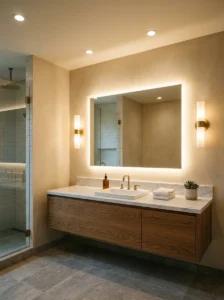
The specific fix: add mirror-level lighting — sconces flanking the mirror, or a horizontal bar above it at face height — to provide light from the side rather than only from above. This single change transforms the grooming quality of the bathroom and simultaneously improves the room’s overall light distribution by adding a source at eye level rather than only at ceiling height.
Color rendering matters more in a windowless bathroom. As covered in the kitchen no-light article, high CRI bulbs (90+) render colors accurately without the daylight correction that a window provides. In a bathroom where skin tone, makeup, and clothing color are being evaluated, a low-CRI bulb that distorts color creates daily frustration without a visible cause. High-CRI bulbs in the correct color temperature are the right specification for any windowless bathroom.
Dimming capability is also more useful in a windowless bathroom than in one with natural light. The single setting of the overhead fixture can feel harsh at different times of day and for different uses. A dimmer allows the bathroom to feel less like an inspection under artificial light and more like a considered space.
Color and Surface Strategy for a Room With No Natural Light Correction
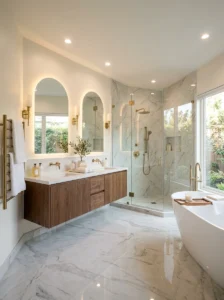
A window doesn’t just provide light — it provides daylight, which is color-balanced light that renders every surface accurately and compensates for whatever undertone is present in the artificial light source. A windowless bathroom has no such correction available.
This means undertone decisions in a windowless bathroom are more consequential than in a naturally-lit one. A wall color with a slightly wrong undertone will read that way in the windowless bathroom every time the artificial light interacts with it, with no daylight to correct the reading at any point in the day.
The safest color strategy for a windowless bathroom: warm whites and warm neutrals that agree with warm-toned artificial light rather than fighting it. A slightly warm white reads as clean and calm under warm-to-neutral LED light. A cool white or slightly green-gray reads as murky or cold. The test that matters — holding a paint sample against the actual bathroom’s artificial light — is even more important here than in any naturally-lit room.
Light-toned surfaces amplify the available light. In a windowless bathroom, every surface choice is also a light management choice. Light tile, light walls, and light-toned flooring collectively reflect the available artificial light around the room. Dark surfaces absorb it. A windowless bathroom can be designed with dark elements, but doing so requires enough artificial light to compensate for what the surfaces absorb.
Glossy surfaces help in a windowless bathroom. In naturally-lit rooms, highly reflective surfaces can read as harsh because they’re reflecting abundant daylight. In a room where every photon of light comes from artificial sources, glossy tile, polished fixtures, and glass surfaces all contribute to light distribution by bouncing it across the room rather than absorbing it.
Mirrors: Working Harder in a Windowless Room
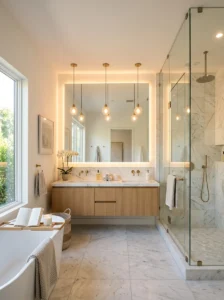
A mirror in a windowless bathroom has a more significant role than in a naturally-lit one, because there’s no window light to bounce. The mirror multiplies whatever artificial light exists.
A large mirror reflects more light than a small one. In a naturally-lit bathroom, mirror size primarily affects spatial perception and grooming utility. In a windowless bathroom, mirror size also directly affects how much light is reflected back into the room from the fixtures opposite it. A larger mirror is meaningfully brighter than a smaller one under the same artificial lighting conditions.
Positioning the mirror opposite the primary light source maximizes light bounce. If the main fixture is above the vanity, the mirror reflects back toward the room. If there are sconces on either side of the mirror, the mirror reflects the room’s own light between the two sources. This geometry of light — fixture to mirror to room — is the mechanism that makes mirrored surfaces valuable in windowless spaces.
Air Quality and Scent Without Natural Ventilation
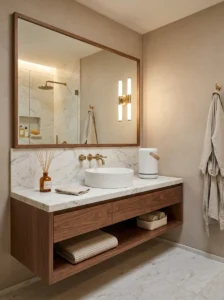
A windowless bathroom that’s properly ventilated is not a bathroom that smells — adequate fan use prevents the humidity and resulting odor that occurs in poorly ventilated enclosed spaces. But the absence of air circulation from an open window means the bathroom’s air quality depends entirely on the mechanical system and on what’s added to the room.
A small air purifier rated for the room size can run continuously in a windowless bathroom and address both air quality and mild odor without requiring the door to be open and the fan to run at all times. This is particularly useful in bathrooms where the ventilation fan runs only during and after use, leaving hours between those cycles where the air isn’t actively moving.
A reed diffuser in a clean, mild scent — specifically not a heavy or sweet fragrance — adds a background note to a windowless bathroom that counteracts the faint closed-room smell that builds up even with adequate ventilation. A diffuser that’s too strong creates a different problem; the goal is something that registers as clean rather than something that announces itself.
A small dehumidifier in a windowless bathroom that’s particularly prone to moisture issues provides continuous moisture management independent of fan use. In bathrooms where mold is an ongoing challenge despite reasonable fan use, a small portable dehumidifier often resolves what fan upgrades alone haven’t.
Plants in a Bathroom With No Natural Light
The typical recommendation to add plants to bathrooms runs into an obvious complication in a windowless room: most plants need some light to survive, and artificial light from standard fixtures isn’t spectrally adequate for most plant species.
The practical options:
Low-light tolerant plants placed under or near the artificial light source. Pothos, snake plants, and ZZ plants tolerate lower light than most species and can sometimes survive in windowless bathrooms with adequate artificial light. “Adequate” here means the fixture is on for several hours per day and is close enough to the plant to provide some light benefit.
A grow bulb in one fixture. A small full-spectrum LED grow bulb in one of the bathroom’s fixtures provides the spectral range plants need, even without natural light. This allows a modest plant to survive and contributes to air quality in the process. The grow light’s output doesn’t read dramatically differently from standard bulbs to the human eye in small wattages.
Rotating plants in from better-lit spaces. A plant brought in from a brighter location, displayed in the bathroom for a week or two, and then rotated back to recover works well for households that want the visual benefit of greenery without committing to the survival challenges of permanent bathroom plants in no natural light.
Key Takeaways
- Ventilation is the non-negotiable first priority in a windowless bathroom — an undersized or poorly used fan creates persistent moisture problems that no aesthetic choice can compensate for
- A timer switch on the fan ensures adequate post-shower ventilation without requiring behavioral discipline; a humidity-sensing fan is the most reliable automatic solution
- Mold prevention requires the combination of adequate ventilation, squeegee use after showering, open-door practice when the room is unused, and regular caulk and grout maintenance
- Mirror-level lighting — sconces or a bar above the mirror — eliminates the overhead-shadow problem and simultaneously improves the room’s overall light distribution
- High-CRI bulbs (90+) are more important in a windowless bathroom than anywhere else, because there’s no daylight to correct color rendering
- Light-toned surfaces and glossy finishes are worth prioritizing in a windowless bathroom because they distribute rather than absorb the available artificial light
- Large mirrors reflect more light than small ones — mirror size is a light management decision, not just an aesthetic one, in a room with no windows
Frequently Asked Questions
Is mold inevitable in a bathroom with no window? No — mold is the outcome of moisture plus time without adequate removal, not the outcome of having no window. A windowless bathroom with a properly sized fan, used for fifteen to twenty minutes after every shower, with squeegee practice on shower surfaces, is not a bathroom that will inevitably develop mold. The problem occurs when one or more of these conditions isn’t met consistently. The most common failure is inadequate fan capacity or insufficient fan run time, both of which are addressable.
Can I grow a living plant in a bathroom with no natural light? With some modification, yes. Low-light tolerant species — pothos, ZZ plant, snake plant — can survive under artificial light if the fixture is on for several hours daily and the plant is reasonably close to it. A full-spectrum grow bulb in one fixture provides the most plant-supportive artificial light without significantly changing how the room looks to humans. Rotating plants between a windowless bathroom and a brighter location is the most reliable strategy for maintaining genuinely healthy plants.
Does dark tile make a windowless bathroom worse? Yes in terms of light management — dark surfaces absorb available artificial light rather than reflecting it, which makes the room dimmer under the same fixture output. Whether this is worth the aesthetic trade-off depends on how much light the fixtures provide and how that level of brightness reads in use. A windowless bathroom with dark tile requires stronger or more numerous light sources than the same room with light tile. The combination of dark tile and insufficient lighting produces the worst possible result in a windowless space.
How important is the ventilation fan if I always leave the bathroom door open? An open door assists air circulation but doesn’t replace mechanical ventilation in a windowless bathroom. Door ventilation depends on the air movement in the adjacent space, which may itself be limited. More critically, shower steam rises and disperses throughout the bathroom before it can exit through the door, which means the surfaces closest to the shower accumulate moisture whether or not the door is open. The fan removes moisture directly from the air before it settles on surfaces; an open door only partially replicates this function.
What’s the most impactful single change for a windowless bathroom that currently feels oppressive? Lighting, specifically at mirror level. Adding a horizontal LED bar above the mirror or two sconces flanking it, in a warm-to-neutral color temperature and on a dimmer circuit, transforms both the functional quality of the grooming light and the overall feel of the room. The single overhead fixture that most windowless bathrooms use creates the specific combination of directional, shadowed, unflattering light that makes an enclosed room feel particularly oppressive. Light at face level from two directions removes this immediately.