


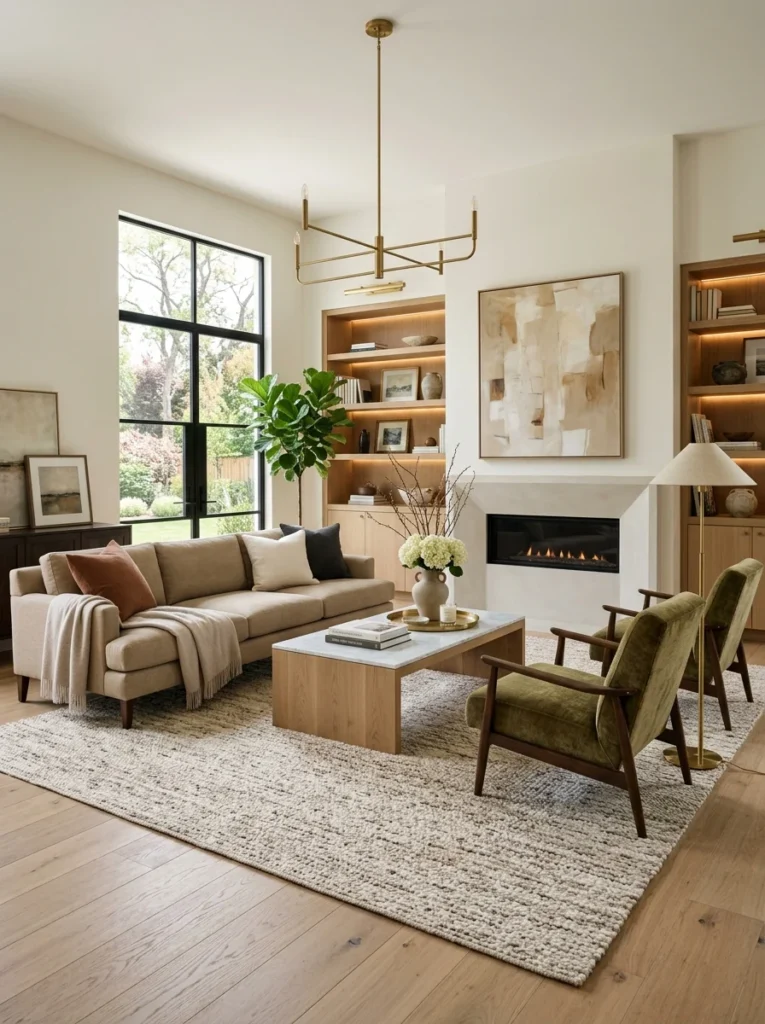
The most common rug mistake in living rooms is size — almost always too small. Here’s exactly how to measure, which standard sizes fit which rooms, and what to do with a rug you’ve already bought that isn’t working.Walk into any furniture showroom and you’ll find rugs displayed beneath sofas that are approximately the size of a large doormat. The sofa sits fully on the showroom floor; the rug exists beneath the front edge only, extending perhaps twelve inches in front of it, floating in the middle of a polished concrete or hardwood floor. This display configuration has sold millions of rugs in the wrong size — because it looks proportionate in the showroom context, where the surrounding space is enormous and the furniture is sparse, and looks catastrophic in an actual room where the rug is surrounded by furniture it was supposed to ground.
The too-small rug is the single most consistent furniture arrangement mistake in living rooms. It’s consistent because size is the hardest thing to evaluate from a photograph or a showroom display, and because rugs in the right size for an actual room look almost oversized in both contexts. The rug that looks correctly proportioned on a product page is almost always the wrong size for any real room.
Getting rug size right requires understanding what a rug is actually doing in a living room — and measuring for what it needs to do rather than buying what looks right in a store or an inspiration image.
What a Rug Is Actually Doing in a Living Room
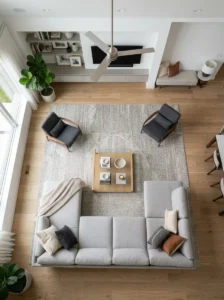
A rug in a living room has one primary job: defining the seating area as a unified zone. It creates a visual boundary that says “the living area is here” on an otherwise undifferentiated floor. This definition is what makes a seating arrangement look anchored rather than floating — furniture sitting within a defined zone versus furniture placed on an unbroken floor.
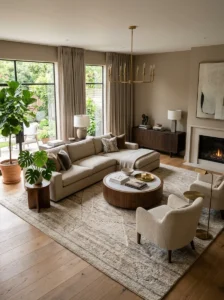
For a rug to do this job, it must be large enough that every major piece of seating in the arrangement sits within or on the edge of the rug. A rug that sits between the furniture — that the furniture is gathered around rather than sitting on — isn’t defining the zone. It’s a small object surrounded by furniture, which produces the opposite of the intended effect.
This is the functional test for any rug in any living room: does the seating arrangement sit within or on the rug, or does the rug sit within the seating arrangement?
The Three Placement Options and When Each Works
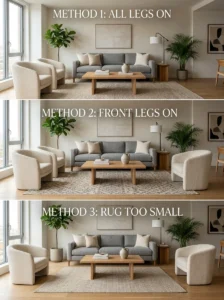
There are three accepted approaches to rug placement in a living room seating arrangement, each with different visual effects and different size requirements.
All legs on. Every leg of every piece of furniture in the seating arrangement sits fully on the rug. This is the approach that most fully defines and unifies the seating zone. It requires the largest rug — in most living rooms, this means a minimum of 9×12 feet and often 10×14 or larger. It works best in larger rooms where the rug can be generous without consuming the entire visual floor area.
Front legs on. The front two legs of the sofa and any chairs sit on the rug; the back legs are on the bare floor. This approach requires a slightly smaller rug than “all legs on” while maintaining the visual connection between the seating pieces — they read as belonging to the same zone through their shared front-edge contact with the rug. For most average-sized living rooms, this approach at a minimum 8×10 foot rug produces a good result.
No legs on. The rug sits in front of the seating as a visual element rather than as an anchor for the furniture. This is the arrangement that looks like the showroom display — and it produces the showroom problem in real rooms. The rug and furniture look unrelated. This approach is not recommended for any seating arrangement and is what creates the “floating furniture” quality that most people are trying to avoid.
Standard Rug Sizes and What Rooms They Actually Fit
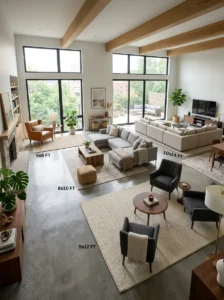
Rugs are sold in standard sizes, and understanding which size fits which room saves the frustration of buying the wrong one.
5×8 feet. This is the most commonly purchased living room rug and the most consistently wrong. A 5×8 rug is appropriate for a small bedroom, a dining table for four people, or a compact apartment entryway. In a living room with a standard sofa and seating arrangement, a 5×8 rug is not large enough to anchor the furniture and will produce the floating, postage-stamp effect in almost every arrangement. The very common recommendation to “go one size up from what you think you need” often applies here — people who think they need a 5×8 usually need an 8×10.
8×10 feet. The minimum functional size for most living rooms with a sofa and two chairs arranged in a standard configuration. At this size, front legs of the sofa and chairs can sit on the rug, creating the visual connection between pieces. It’s appropriate for smaller living rooms — rooms up to approximately 12×14 feet — and works well in apartments.
9×12 feet. The most versatile living room rug size. It accommodates a full sofa and seating arrangement with front legs fully on in most average living rooms, and allows all legs on in somewhat smaller arrangements. For rooms between 12×16 and 15×18 feet, this is typically the right size.
10×14 feet. For larger living rooms or open-plan spaces where the seating area is generous. This size allows all legs on for a full sofa and two or three additional chairs and reads as properly proportionate in rooms with higher ceilings or more expansive floor plans.
Custom sizing. For rooms where standard sizes don’t work — unusual proportions, very large open-plan spaces, round rooms — custom rugs or layered rugs provide sizing flexibility that standard options don’t.
How to Measure Before Buying
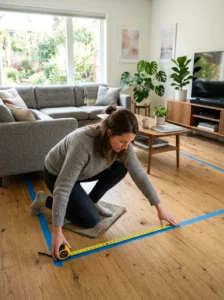
This is the step most people skip and the step that prevents most rug mistakes. The process:
Map the furniture footprint. Using a measuring tape, measure the full area occupied by the seating arrangement — from the outer edge of the sofa to the outer edge of the chairs on the opposite side, and from the outside of one chair to the outside of the other across the arrangement. This is the minimum footprint the rug needs to serve.
Add the right margin. For “all legs on” placement, add eight to twelve inches beyond the furniture footprint on all sides. For “front legs on” placement, the rug needs to extend from under the front legs of the sofa to at least twelve to eighteen inches in front of the coffee table.
Tape the footprint on the floor. Using painter’s tape, mark the proposed rug dimensions on the floor before purchasing. This is the only reliable way to evaluate whether a rug size will work in the actual room with the actual furniture. A 9×12 rug taped on the floor looks very different from a 9×12 rug in a product photograph, and the tape test prevents the most common “it was bigger in my head” purchasing mistake.
Leave adequate border. A rug should leave at least eight inches of bare floor visible between the rug edge and the walls on the sides, and eighteen inches to twenty-four inches at the room’s narrower dimension. A rug that extends wall to wall reads as carpet rather than as a defined zone.
Open-Plan Living Spaces
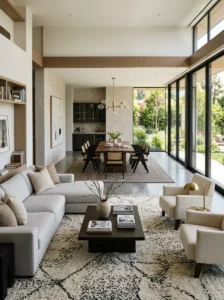
Open-plan spaces — where the living room flows into a dining area and kitchen without physical separation — require rugs to do the zone-definition work that walls would otherwise do. In these spaces, rug sizing becomes even more critical because the rug is the primary visual separator between the living and dining areas.
Each zone needs its own rug. A single rug trying to define both the living and dining areas will be too large for either to read clearly. Two rugs — one appropriately sized for the seating arrangement and one appropriately sized for the dining table — create two defined zones that read as distinct despite sharing the same open floor plan.
The living room rug in an open-plan space should be large enough that the entire seating arrangement sits clearly within it, and positioned far enough from the dining rug that the two areas read as separate. If the rugs overlap visually or are placed too close together, the zone distinction they’re meant to create collapses.
Rug Shape: When Rectangle Isn’t the Answer
Most living rooms use rectangular rugs, which suits most furniture arrangements because most seating arrangements are also rectangular. But shape deserves consideration rather than defaulting to rectangle.
Round rugs work well in smaller seating arrangements — two chairs and an occasional table rather than a full sofa arrangement — and in spaces where the circular shape creates a desirable visual counterpoint to the room’s rectangular architecture. A round rug under a sofa arrangement larger than a loveseat typically doesn’t have adequate surface area to anchor the furniture.
Square rugs can work in rooms with more equidimensional proportions — where the room is closer to square than rectangle — and in seating arrangements that are similarly balanced across their dimensions.
Runner rugs aren’t typically used in main living room seating areas, but work well in hallway approaches to living rooms and in long narrow living room spaces where a runner along the length of the room reads better than a standard rectangle.
What to Do With a Rug You’ve Already Bought That’s Too Small
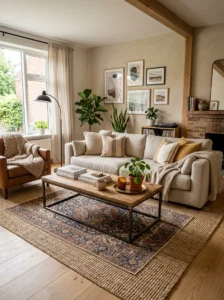
If a rug currently in the room is too small for the seating arrangement, several approaches can rescue it without requiring replacement.
Layering. A smaller rug layered on top of a larger, simpler base rug — typically a natural fiber rug in jute or sisal — gives the original rug a larger visual footprint. The base rug provides the size; the top rug provides the pattern or color. The combination can read as intentional and interesting rather than compensatory, particularly when the base rug is in a natural tone that complements the top rug.
Repurposing the rug to a different room. A rug that’s too small for the living room may be the right size for a bedroom, a reading corner, or a smaller seating area. Moving it rather than replacing it immediately is worth considering before purchasing a new piece.
Working with the existing size by adjusting the seating arrangement. If the rug can’t be replaced or layered, the seating arrangement can sometimes be adjusted so the rug works — a smaller arrangement of furniture rather than the full sofa-plus-two-chairs configuration, for example.
Pattern, Color, and How They Affect the Perceived Size of a Rug
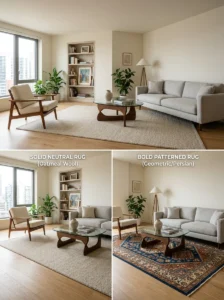
Pattern and color choices affect how a rug reads in terms of size, which matters when a rug is close to the right size but needs to read as slightly larger or smaller.
A rug in a single color or tone reads as larger than a rug with a busy pattern at the same dimensions. The unbroken color field extends visually to the edge without interruption, which makes the edge feel farther away.
A patterned rug reads as slightly smaller because the pattern creates internal visual boundaries that the eye processes as divisions within the rug’s surface.
A rug that matches the floor color in tone reads as disappearing into the floor — the rug’s edge becomes less defined, which can make the rug read as larger or as absent depending on the contrast. The most effective rugs are those that contrast clearly enough with the floor to have a visible edge — defining the zone requires that the zone’s boundary be seen.
Light-colored rugs make rooms read as larger; dark-colored rugs make rooms read as more intimate. This is worth considering when the rug size is constrained by available options and the room needs to read as either more open or more cozy.
Key Takeaways
- The too-small rug is the most consistent furniture arrangement mistake in living rooms — furniture stores display rugs in configurations that look fine in showrooms and wrong in real rooms
- A rug’s job is to define the seating zone; it must be large enough that furniture sits within or on the edge of the rug rather than surrounding it
- The three placement options — all legs on, front legs on, no legs on — require progressively smaller rugs, with “all legs on” requiring the largest and “no legs on” producing the worst visual result
- 5×8 feet is the most commonly bought living room rug size and the most consistently wrong; 8×10 is the minimum functional size for most living rooms
- Tape the rug dimensions on the floor before buying — this is the only reliable evaluation method
- In open-plan spaces, two separate rugs define two separate zones; one rug trying to cover both reads as inadequate for each
- Layering a smaller rug on a larger natural-fiber base rug rescues an under-sized rug without requiring replacement
- A solid-color rug reads as larger than a patterned rug at the same dimensions; light colors expand a room, dark colors create intimacy
Frequently Asked Questions
What’s the bare minimum rug size for a living room with a standard sofa? 8×10 feet for a sofa-and-two-chairs arrangement using the “front legs on” approach. Anything smaller — a 6×9 or 5×8 — will almost certainly read as too small for a full sofa arrangement and is unlikely to produce the grounded, zone-defined look a living room rug is meant to create.
I have a sectional sofa — what size rug do I need? Sectionals typically require at least a 9×12 rug for the front-legs-on configuration, and often a 10×14 to allow the full sectional footprint to feel anchored. The critical measurement is the length of the longest run of the sectional — the rug should be at least as long as this dimension. A sectional on a rug that’s shorter than the sofa’s longest side reads as particularly unanchored because the disproportion between the large piece and the small rug is obvious.
Should the rug match the sofa or the floor? Neither specifically — the rug should work with both. The useful guideline is that the rug should contrast clearly enough with the floor to read as a defined zone (a rug that disappears into the floor color fails at its zone-definition job) and should agree in color temperature with the sofa (warm-toned rug under a cool-toned sofa produces a visual clash that makes the arrangement feel unsettled). The rug is the bridge between the floor and the furniture, and its color should function as a bridge rather than as a match to either.
Can I use two different rugs in one living room? Yes, intentionally. In a room large enough to have two seating areas, or in an open-plan space with living and dining zones, two separate rugs are appropriate and correct — one for each defined zone. Two rugs in the same room should either clearly coordinate (similar color family, different pattern) or clearly contrast (different enough that the choice reads as deliberate). Two rugs that are nearly similar but not quite matching read as inconsistent rather than intentional.
How much should I spend on a living room rug versus other furniture? Rugs wear slowly and last for years to decades if properly maintained — a rug is one of the longer-lived investments in a room. A guideline some designers use: spend on the rug proportionate to how central it is to the room’s feel. In a room where the rug is the primary element that makes or breaks the space, investing in a quality piece makes sense. In a room where the rug is one of many elements and the primary investment is in seating, a mid-range rug that’s correctly sized and proportioned will outperform an expensive rug that’s the wrong size every time.