


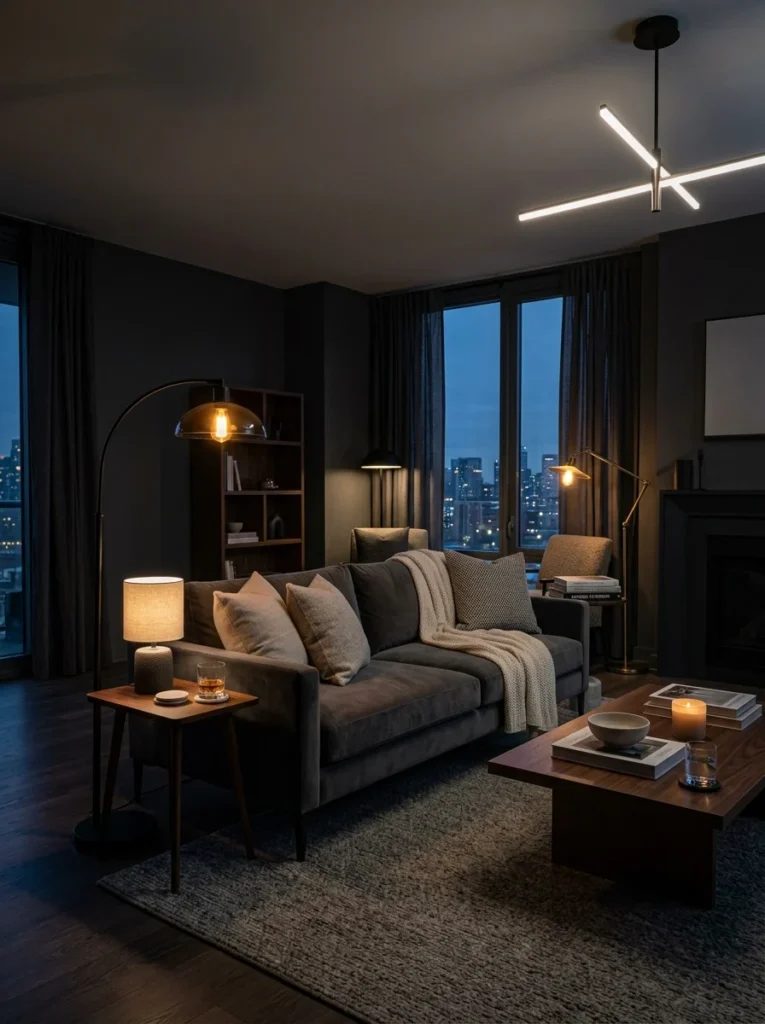
A living room can have every lamp on and still feel dim. The problem is almost never bulb wattage — it’s usually one of a handful of specific, fixable issues. Here’s how to diagnose and solve them.A living room with three lamps switched on, a working overhead fixture, and no obvious burned-out bulb can still feel dim in a way that’s hard to explain and easy to blame on the wrong thing. The instinct is usually to buy a brighter bulb, and sometimes that helps a little — but a living room that feels dark with the lights on is very rarely a wattage problem. It’s almost always a distribution problem, a color problem, or a surface problem, and each of these has a specific, identifiable cause that a brighter bulb doesn’t actually fix.
Total Light Matters Less Than Where It’s Coming From
A room lit entirely by a single source — one overhead fixture, or one tall lamp in a corner — can have plenty of total light output and still feel dim, because human perception of a room’s brightness depends heavily on how evenly light is distributed, not just on how much of it exists.
A single source creates a bright zone immediately around it and a rapid falloff everywhere else. The area directly under an overhead fixture might be adequately lit while the perimeter of the room — the seating furthest from it, the corners, the reading chair by the window that gets no evening light — sits in comparative dimness. The eye and brain register the room by its darkest occupied areas as much as its brightest point, which is why a room can have a bright center and still feel dark overall.
The fix is distributing light across multiple sources at different heights and locations rather than concentrating it in one place. A living room lit well typically has light at three different levels: overhead or ambient lighting for general illumination, mid-level lighting from table lamps and floor lamps for the seating areas people actually occupy, and, where relevant, low-level accent lighting. A room relying on only the first of these three — usually the overhead fixture alone — is the most common version of the “lights are on but it’s still dark” complaint.
This is also why adding a second or third lamp often does more than replacing a bulb with a higher-wattage one. A brighter single source still has the same falloff problem, just with a slightly larger bright zone. A second lamp in a previously dark corner directly addresses the actual issue: an area of the room with no light source at all.
Color Temperature Affects Perceived Brightness, Not Just Warmth
As covered in more detail elsewhere in this series in the context of bathroom lighting, the same underlying principle applies just as directly to living rooms: color temperature — measured in Kelvin — changes how bright a space feels, independent of the actual light output.
Very warm bulbs, in the 2200K-2500K range often marketed as “soft white” or “candle-like,” can make a room feel cozy at low light levels but genuinely dim at any light level, because the amber cast reads to the eye as evening or low-light conditions regardless of the actual lumen output. A living room furnished entirely with very warm bulbs can have adequate total light and still feel like it’s perpetually dusk.
A slightly higher color temperature — 2700K to 3000K — reads as warm and comfortable while feeling meaningfully brighter than 2200K-2500K bulbs at the same output. This range is generally the sweet spot for living rooms: warm enough to feel comfortable rather than clinical, but not so warm that it reads as dim regardless of actual brightness.
Mismatched color temperatures across different fixtures in the same room compound the problem. A ceiling fixture at one temperature and lamps at another creates a visually uneven room where the brain has to reconcile two different color casts, which reads as a less coherent, less bright space than the same total light output delivered at a consistent temperature throughout.
Dark and Glossy Surfaces Absorb Light That Pale, Matte Surfaces Would Reflect
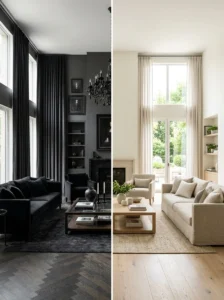
A room’s surfaces — walls, floors, furniture, even large pieces of art or upholstery — either bounce light around the room or absorb it, and this has a substantial cumulative effect on how bright the room feels for the same amount of light output.
Dark walls, dark flooring, and dark furniture absorb far more light than pale versions of the same elements. A living room with charcoal walls, dark hardwood, and a dark sofa can be lit with the same total light output as a room with pale walls and light furniture and feel noticeably dimmer, because a large percentage of the light hitting those dark surfaces simply doesn’t bounce back into the room.
This doesn’t mean dark living rooms are a design mistake — a deliberately dark, moody living room is a legitimate and popular design choice — but it does mean a dark-surfaced room needs meaningfully more light output than a pale-surfaced room to achieve the same perceived brightness, and lighting plans for dark rooms are frequently underestimated because they’re planned using the same light levels that would work in a paler room.
Heavy, dark window treatments compound this specifically at the times of day when natural light matters most. Thick curtains or blinds that stay partially closed, even during the day, cut off a light source that no amount of lamp wattage fully replaces. A living room that feels dark specifically during the day, when the lights aren’t even a factor yet, often has a window treatment problem rather than an artificial lighting problem.
Shades, Diffusion, and Fixture Direction Change How Much Usable Light Actually Escapes
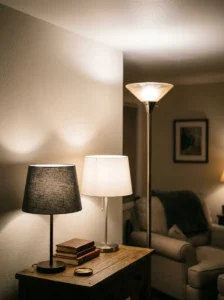
Not all of a bulb’s output reaches the room. A significant amount can be absorbed, blocked, or redirected by the fixture itself, and this varies enormously between fixture designs.
A dark or heavily lined lampshade blocks a substantial portion of the bulb’s output before it ever reaches the room, which is why two lamps with identical bulbs can produce very different amounts of usable light depending on the shade’s color and opacity. A pale or lightly lined shade allows far more light to pass through and disperse into the room, in addition to the light that escapes from the top and bottom openings.
Fixtures that direct light straight down — recessed cans, certain pendant designs — light the floor and furniture surfaces directly beneath them well and contribute comparatively little to the room’s overall ambient brightness, since none of that light bounces upward or outward into the space. A room lit primarily by downward-directed fixtures can have strong pools of light on specific surfaces and still feel dim as a whole, because the light isn’t filling the room’s volume the way an uplight or a diffused source does.
Uplighting — a floor lamp or fixture that sends light toward the ceiling, allowing it to bounce back down diffused — is one of the more effective and often overlooked tools for making a room feel bright without adding visual clutter of additional fixtures. Bouncing light off a pale ceiling distributes it across the entire room far more evenly than any single downward-facing source can.
Diagnosing Which Problem a Specific Room Has
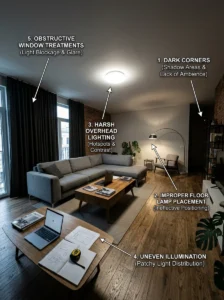
If the room has bright pools of light with dark gaps between them, the problem is distribution — add a light source in the dark zones rather than increasing brightness at the existing ones.
If the room feels dim even in the areas directly under a light source, color temperature is a likely factor — check whether the bulbs are in the very warm 2200K-2500K range and consider shifting to 2700K-3000K.
If the room has adequate, well-distributed, appropriately warm light and still feels dark, surfaces are the likely factor — dark walls, floors, furniture, or heavy window treatments are absorbing a meaningful share of the available light, and the fix is either lighter surfaces where that’s feasible or a genuinely higher total light output calibrated for a dark-surfaced room.
If lamps are present but the room still feels dim, check the shades and fixture direction before assuming the bulbs are inadequate. A dark shade or a straight-down-facing fixture can be quietly discarding a large share of a perfectly adequate bulb’s output before it ever reaches the room.

Key Takeaways
- A living room that feels dark with the lights on is rarely a wattage problem — it’s almost always a distribution, color temperature, or surface issue
- Light spread across multiple sources at different heights reaches a room’s perimeter and seating areas far better than one bright source at the center
- Very warm bulbs (2200K-2500K) can make a room feel dim regardless of actual output; 2700K-3000K generally reads as both warm and adequately bright
- Dark walls, flooring, and furniture absorb significantly more light than pale surfaces, meaning dark rooms need more light output to feel equally bright
- Lampshade color and fixture direction affect how much of a bulb’s output actually reaches the room — a dark shade or a straight-down fixture can waste a meaningful share of otherwise adequate light
- Uplighting, which bounces light off the ceiling, distributes brightness across a room’s volume more evenly than downward-facing fixtures alone

Frequently Asked Questions
Should I just buy the highest-wattage bulb available if my living room feels dark? Usually not the most effective fix. A brighter single source still has the same distribution falloff as a dimmer one — the area near it gets brighter, but the rest of the room doesn’t improve proportionally. Adding a light source to a dark corner, or addressing color temperature and surface absorption, typically does more for how the room actually feels than increasing the output of an existing single source.
Is it better to have overhead lighting or lamps in a living room? Neither alone is usually sufficient — the most effective living rooms combine both, using overhead or ambient lighting for general room-filling light and lamps at multiple locations for the areas people actually sit and read. A room relying entirely on one type, especially overhead-only, tends to have the uneven distribution that makes rooms feel dark despite having light.
Can curtains really make that much difference to how bright a room feels? Yes, particularly during daytime hours. Heavy or partially closed window treatments cut off natural light, which is typically the single largest light source available to a room during the day, and no amount of artificial lighting fully substitutes for it. A living room that feels dark specifically during daylight hours often has more to do with window treatments than with any of the room’s lamps or fixtures.
Does the color of my walls actually affect how bright the room feels, or is that just about aesthetics? It’s a real functional effect, not only an aesthetic one. Pale, matte walls reflect a meaningful percentage of the light that hits them back into the room, while dark walls absorb much of it. Two identically lit rooms with different wall colors can have noticeably different perceived brightness, which is why lighting plans for dark-painted rooms generally need more total light output than the same room painted pale would.
What’s the single most overlooked cause of a dim-feeling living room? Lampshade color and opacity is probably the most commonly overlooked factor, since people tend to evaluate a lamp by its bulb rather than by how much of that bulb’s light the shade is actually letting through. A dark or heavily lined shade can significantly reduce a lamp’s real contribution to the room’s brightness, even with a perfectly adequate bulb installed.