

Mixing old and new furniture looks curated in some rooms and random in others. The difference is specific — here’s exactly what connects pieces across different eras and how to apply it.Most homes accumulate furniture across multiple acquisitions: the piece inherited from a grandparent, the sofa bought on a budget five years ago, the dining table that was a significant purchase, the accent chair discovered at a vintage market. Each piece was chosen at different times, for different reasons, against a different mental picture of what the room should eventually become. The room that results from this accumulation isn’t always bad. It isn’t always good. It’s usually just accumulated — furniture that arrived from different directions and hasn’t been given a reason to belong together.
The curated eclectic room — the one where the antique sideboard and the contemporary sofa and the mid-century chair read as intentional and coherent — looks completely different from the accumulated room. The objects in both may be similar in quality and age. What’s different isn’t the furniture; it’s the presence or absence of connective logic. The curated room has a thread running through all of it. The accumulated room doesn’t, and the eye can tell.
Finding and applying that thread — or creating one retroactively across pieces that arrived without one — is the actual skill involved in mixing old and new furniture.
What “Curated” Actually Means
Curated doesn’t mean expensive, coordinated, or from the same era. It means chosen according to a shared principle — some criterion that all the pieces satisfy simultaneously, even when they don’t match in period, material, or style.
That shared principle can be almost anything as long as it’s consistent:
- All pieces share a warm-toned material palette (warm wood, warm brass, warm upholstery) regardless of their era
- All pieces have a certain quality of restraint in their silhouette — no ornamentation beyond what the form requires
- All pieces are in the same scale register — substantial, heavy, ground-level — regardless of the specific design era
- All pieces share a color range from near-white to warm beige, regardless of material or period
The curated eclectic room is the room where the viewer can sense the principle, even if they couldn’t name it. There’s something all the pieces share that makes them feel like they were chosen by the same eye. The accumulated room has no such principle, or has several incompatible ones, and the eye registers the absence.
Color and Tone: The Strongest Connector Across Eras
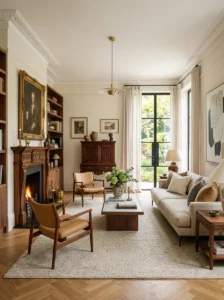
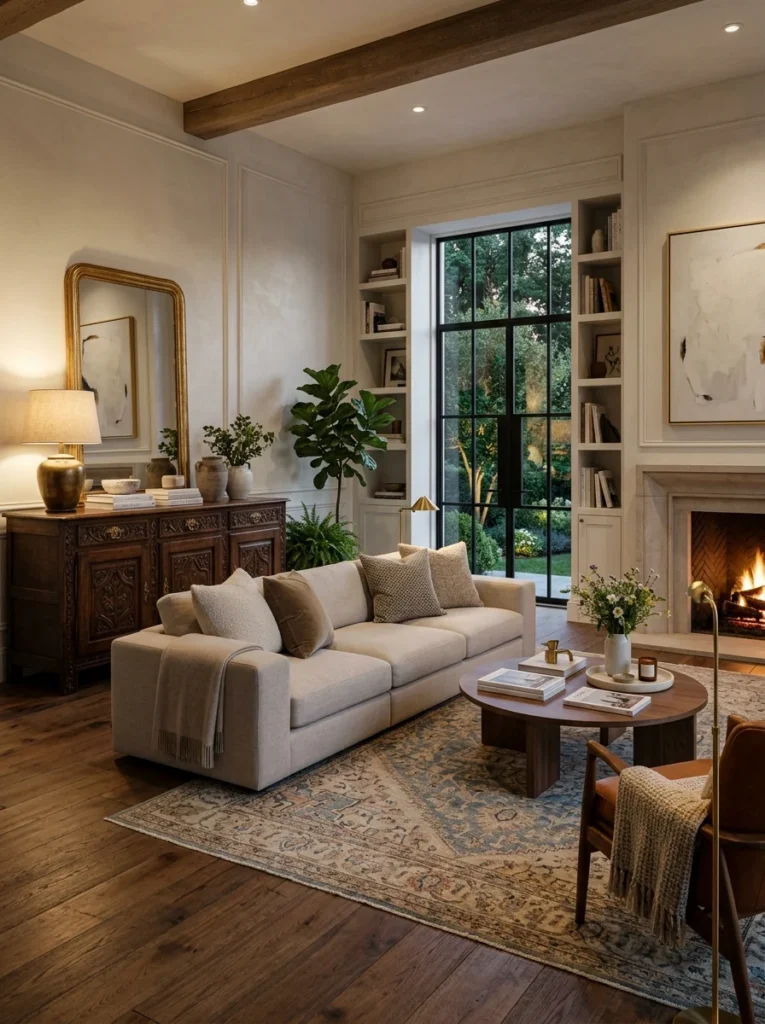
A room where all the furniture — old and new — is within a consistent color and tone range reads as coherent even when the pieces are from wildly different periods. Color ignores era in a way that style doesn’t: a Victorian-era wooden side table in a warm honey tone reads with a mid-century modern console in a similar warm oak reads with a contemporary upholstered bench in camel leather, because the color family is the same.
This is the most reliable connector available when mixing furniture from different periods, and it’s the one most frequently underused because people focus on matching styles rather than matching tones.
The practical application: before placing any mixed-era furniture together, assess the dominant tone of each piece. Warm tones — honey, amber, caramel, warm brown, brass — group naturally. Cool tones — gray, ebony, chrome, cooler whites — group naturally. Pieces from opposite tone families placed together in the same room create a visual tension that reads as conflict unless there’s a specific design reason for the contrast.
Warm and cool mixing can be done intentionally — a single cool-toned contemporary piece against a room of warm-toned traditional pieces, for example, reads as a deliberate contrast. But several pieces from each temperature range mixed without hierarchy reads as unsettled.
Material Logic: What Bridges Eras Naturally
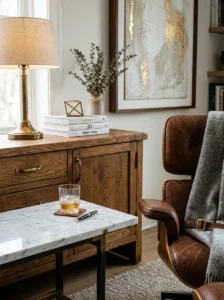
Some materials read as belonging to a specific historical moment. Highly lacquered furniture reads as a specific Art Deco or 1980s era. Certain plastics and synthetic veneers read as 1960s or 1970s. These material signatures can make a piece read as dated in a contemporary room even when its form is otherwise adaptable.
Other materials have continuous history across multiple eras and bridge time naturally:
Solid wood — particularly in natural tones that are close to the tree’s actual color — has been present in furniture from every era. A solid oak table from 1920 and a solid oak stool from 2020 share a material that ignores the century between them.
Brass and bronze — whether polished, brushed, or aged — have appeared in furniture hardware and frames across centuries. A Victorian brass handle and a contemporary brass lamp are in the same material family, which creates a visual connection between objects a hundred years apart.
Natural stone — marble, travertine, slate — is a material without historical period association. A stone table top reads as appropriate in a traditional setting and in a contemporary one because stone predates any furniture style.
Leather — unprocessed or minimally processed hide — has a similar era-transcendence. A Victorian leather club chair and a contemporary leather bench share a material that both read correctly.
When mixing furniture from different periods, prioritizing pieces in these bridge materials — rather than period-specific materials — makes the combination easier to manage and more naturally coherent.
Scale and Proportion: The Variable Nobody Mentions
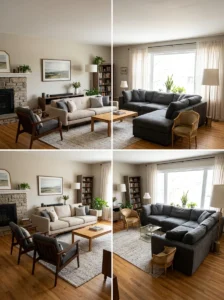
Two pieces can share a color family, share a material family, and still look wrong together if their scale registers are different — if one is light and spindly and the other is heavy and substantial.
Scale register is the quality that makes furniture read as from the same visual weight class. Heavy, substantial pieces with thick legs and solid forms share a scale register. Light, minimal pieces with thin profiles and elevated bases share a different scale register. Mixed within one register reads as coherent. Mixed across registers produces the visual instability that people describe as “something’s off” without being able to name what.
The specific dimensions that determine scale register:
- Leg thickness and visibility
- Overall visual mass (how much space the piece seems to claim)
- Height relative to its footprint (tall and narrow vs low and wide)
- Detail density (highly ornamented vs spare and undecorated)
When evaluating whether a new piece will work with existing furniture, the scale register compatibility question is worth asking explicitly: does this piece feel like it belongs in the same visual weight class as what’s already in the room?
The Connector Layer: What Ties the Room Together When the Furniture Doesn’t
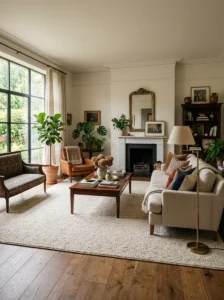
Even with good color, material, and scale alignment across furniture pieces, rooms that mix old and new benefit from connector elements — specific additions that explicitly bridge the different eras by being themselves era-neutral.
Rugs are the most powerful connector available. A rug large enough to encompass the seating arrangement serves as a common ground under furniture from different periods, making them read as belonging to the same place rather than to the same time. The rug’s design can be vintage or contemporary; what matters is that it’s large enough and neutral enough to serve as the common base.
Lighting — particularly a distinctive pendant or floor lamp — operates as a punctuation mark that has its own period sensibility, which can be chosen to bridge the other elements. A warm brass lamp complements both antique wood pieces and contemporary upholstery. A sculptural ceramic table lamp sits in the era of no specific moment.
Textiles — curtains, cushions, throws — in neutral or consistent tones work similarly: they’re period-neutral in a way that furniture typically isn’t, which makes them useful for visually connecting pieces that don’t obviously belong together.
Plants are entirely era-neutral. A fiddle-leaf fig doesn’t belong to the Victorian era or the 2020s. Organic material in a mixed-furniture room consistently reduces the period tension between pieces by providing something none of them share a reference with.
The 60/30/10 Proportion for Mixed-Era Rooms
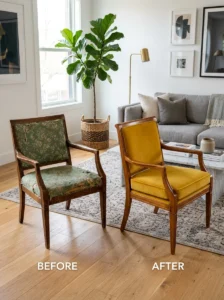
Some designers use a rough proportion guide for eclectic rooms: 60% of the furniture from a dominant period or style, 30% from a complementary or contrasting period, and 10% from something else entirely — an unusual piece that wouldn’t fit either category but provides the specificity that makes the room feel like it was assembled by a particular person.
The exact proportions are less important than the underlying principle: one era or style should dominate, with the other elements serving as contrast or accent rather than competing for equal prominence. A room equally divided between contemporary and antique reads as confused. A predominantly contemporary room with one or two significant antique pieces reads as considered.
The dominant style sets the room’s character. The minority style provides the historical resonance and personality. The outlier provides the specific, personal touch that distinguishes the room from a designed showroom.
What to Do With Inherited Pieces You Don’t Love
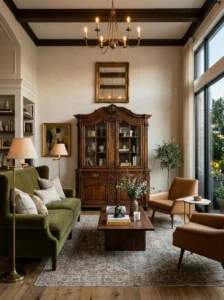
This is the furniture situation most people find genuinely difficult: a piece with family significance, in a style that doesn’t suit the room, that the owner feels obligated to keep visible and incorporated.
Some honest options:
Restore rather than replace. An inherited piece that looks dated may look quite different with reupholstery (for upholstered pieces), refinishing (for wood surfaces), or new hardware. The underlying form of much older furniture is actually well-proportioned and well-made — it’s the surface finish and upholstery that dates it. A Victorian chair reupholstered in contemporary fabric in a neutral tone often looks more contemporary than a mid-range modern chair.
Repurpose rather than use as-is. An inherited sideboard that doesn’t suit the living room might work in a different room where its style is less at odds with the surroundings. An inherited dining table that’s too formal for the primary dining room might work as a desk.
Display with intention. If keeping the piece visible is important and it genuinely won’t work as furniture, it can be treated as an object rather than as furniture — displayed as art, used as a plant stand, positioned as a sculptural element rather than as a functional piece the room depends on.
Accept that “keeping” and “displaying” are separate decisions. A piece can be kept — stored, photographed, passed on within the family — without being displayed in the main living area. The obligation to keep is different from the obligation to use.
The Anchor Piece: Starting From What You Have
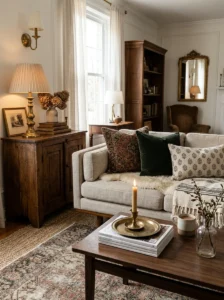
The most practical approach to mixing old and new furniture in a room that’s being assembled or refreshed: identify the piece that will anchor the room’s direction — typically the largest or most significant piece already in the room — and use it as the standard against which all other decisions are made.
If the anchor piece is a significant antique, the room’s character leans traditional, and new additions should complement rather than compete with it: more neutral contemporary pieces that let the antique read as the focal element, connector materials that bridge the two eras, consistent toning across the new pieces.
If the anchor piece is a quality contemporary sofa, the room’s character leans contemporary, and vintage or antique additions should be selected for their compatibility with the sofa’s scale, tone, and material — not for their own period characteristics, but for how they read beside the established anchor.
The anchor approach prevents the most common mixing mistake: adding pieces without a reference point, producing a room that reflects multiple unrelated aesthetic directions rather than one direction with variations.
A Practical Assessment Framework
When evaluating whether a new piece will work with existing furniture in a mixed-era room:
- Tone check. Is this piece in the same warmth or coolness direction as the dominant existing furniture? (Warm wood with warm wood. Cool gray with cool gray. Warm antique with new warm-toned piece — yes. Warm antique with cool-gray contemporary — requires specific management.)
- Material check. Does this piece use a material from the bridge category (solid wood, natural stone, leather, brass, bronze) or a period-specific material that locates it unmistakably in a specific decade?
- Scale check. Is this piece in the same visual weight class as the furniture it will be placed with?
- Role check. Will this piece be a dominant element, a complementary element, or an accent? Is the room currently over-supplied with dominant elements or does it have room for another?
- Connector check. Does the room have adequate connector elements — a large rug, consistent lighting, neutral textiles — to bridge this piece with the others?
Key Takeaways
- The curated eclectic room has a shared principle that all pieces satisfy — tone, material, scale, or aesthetic restraint — that the accumulated room doesn’t
- Consistent color and tone across eras is the most reliable connector between mixed-period pieces; warm-toned pieces read together regardless of their era
- Bridge materials — solid wood, natural stone, brass, leather — have continuous history across eras and connect mixed-period furniture naturally
- Scale register compatibility — similar visual weight class — matters as much as stylistic compatibility when mixing old and new
- Connector elements — a large rug, warm-toned lighting, neutral textiles, plants — bridge era differences by being period-neutral
- One dominant era should set the room’s character, with pieces from other eras as complementary or accent elements; equal division between eras reads as confused
- Inherited pieces that don’t suit the room can often be made to work through refinishing, reupholstery, repurposing, or intentional display as objects rather than furniture
Frequently Asked Questions
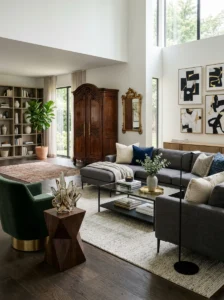
Is there a period or style combination that’s particularly hard to mix? Highly decorated periods — Victorian, Baroque, elaborate Art Nouveau — are the most difficult to mix with contemporary minimalism because the contrast in detail density is so high that the pieces look like they’re fighting rather than coexisting. The most successful mixes typically pair periods with similar levels of ornamental restraint: clean-lined mid-century modern with contemporary minimalism, for example, or casual Arts and Crafts with relaxed Scandinavian design. When a highly ornamented piece must be included, it typically needs to be the clear singular focal point of the room rather than one of several furniture pieces.
How do I know if my furniture mix is reading as eclectic versus messy? Stand in the room’s entrance and assess your immediate response in the first three seconds. An eclectic room produces the sense that there’s a logic to it — something about all the pieces suggests a consistent point of view, even if you can’t immediately name it. A messy room produces a searching quality — the eye moves around looking for the organizing principle and doesn’t find it. If the first response is “interesting” rather than “chaotic,” the mix is working. If the first response is “a lot to look at,” the connecting thread probably needs strengthening.
Can I mix very cheap contemporary pieces with quality antiques? Sometimes, with specific care. Cheap contemporary pieces read as cheap — the materials and construction communicate quality level clearly. In a room where the antiques are the clear dominant element and the contemporary pieces are minor additions, lower-cost contemporary pieces can read as deliberate in their simplicity. Where a cheap contemporary piece is asked to stand alongside a quality antique as an equal, the quality gap reads as a mismatch. The issue isn’t price; it’s the visual quality signal that different construction levels communicate.
What’s the most effective way to introduce one antique piece into a predominantly contemporary room? Choose an antique piece with form that’s compatible with the contemporary room’s aesthetic direction — something with clean lines and minimal ornamentation reads better alongside contemporary pieces than something highly carved or ornate. Position it as the room’s focal point or anchor piece rather than as one of several equivalent items. Surround it with connector elements — a large neutral rug, warm-toned lighting, textiles in tones that bridge the piece’s wood tone with the contemporary pieces’ palette. The antique should look like it was specifically chosen for this context, not like it survived from a previous version of the room.
When mixing furniture, does everything in the room need to follow the same principle, or can accessories and textiles operate by different rules? Accessories and textiles have more latitude than furniture. Furniture pieces occupy physical space and define the room’s proportions — they need the most careful management. Accessories — objects, books, plants, art — can provide contrast, personality, and variety that the furniture doesn’t, because their smaller scale means they’re processed as detail rather than structure. Textiles similarly have flexibility: a cushion in an unexpected color or a throw in an unusual texture can be a successful accent in a room where the same color or texture in a furniture piece would be disruptive.