


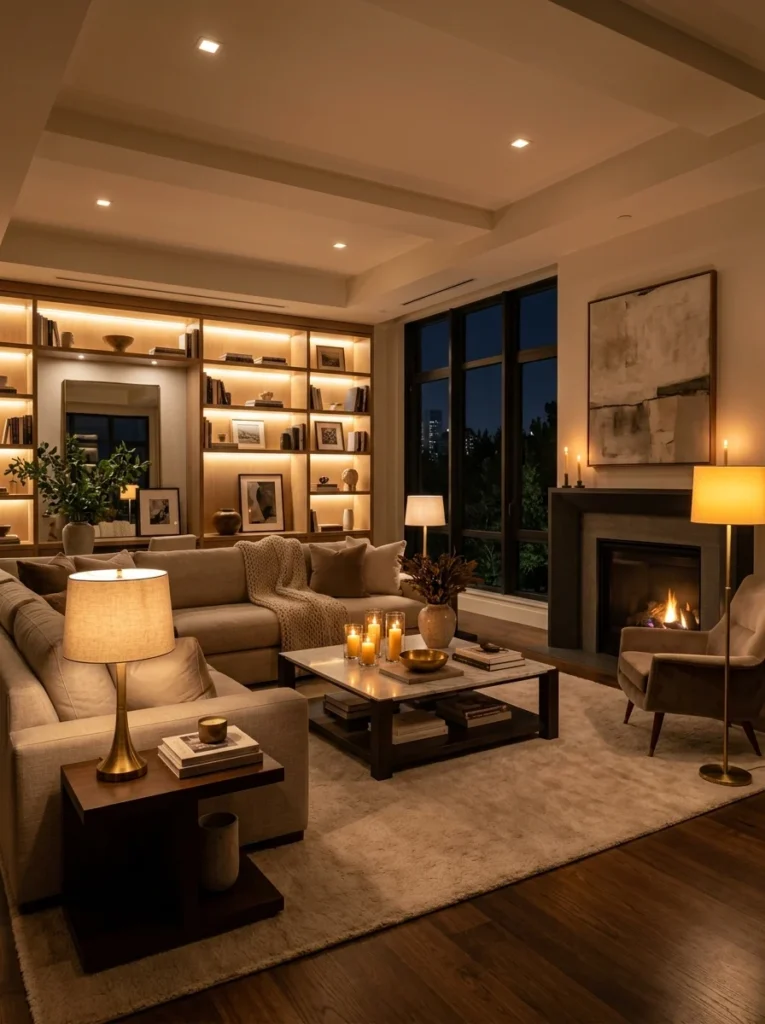
A living room that feels bright and functional during the day can feel harsh and uninviting at night if the lighting doesn’t change with it. Here’s what actually makes a room feel warm after dark.A living room that works well during the day and feels cold or uninviting at night usually has a specific, singular cause: it’s using the same lighting setup for both. Daytime living rooms benefit from bright, even, functional light — the kind that’s good for reading, working, and general activity. Evening living rooms benefit from something almost entirely different: lower, warmer, more layered light that signals rest rather than task. A room lit for daytime function and left that way after dark isn’t malfunctioning — it’s doing exactly what it was set up to do, just at the wrong time.
Making a living room feel warm at night is less about buying different lamps and more about using the lighting already available differently once the sun goes down, and adding a small number of specific tools that daytime lighting doesn’t need.
Overhead Light Reads as Functional, Not Restful, After Dark
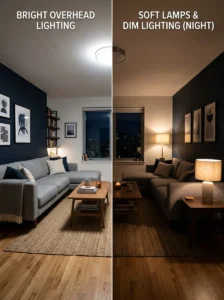
A single bright overhead fixture, left on at full brightness in the evening, is one of the most common reasons a living room feels cold and un-cozy at night, even when nothing else about the room has changed. Overhead lighting is strongly associated with task and utility — it’s the lighting of kitchens, offices, and retail spaces — and using it as the primary evening light source in a room meant for relaxing works against the mood the room is otherwise trying to create.
Turning overhead lighting off or down significantly in the evening, and relying instead on lower, more localized sources, is the single highest-impact change available. This doesn’t mean overhead lighting has no place at night — for cleaning, for finding something dropped on the floor, for a burst of full brightness when needed — but as the default evening state, it works against warmth rather than for it.
A dimmer on the overhead fixture, where the wiring allows it, is a low-cost way to keep the option available without it dominating the room’s evening feel by default. A dimmed overhead fixture, at a low setting, can contribute a soft general fill without reading as the harsh, task-oriented light it is at full brightness.
Layered, Low Sources Do the Real Work

The evening equivalent of daytime’s single bright overhead is several lower, warmer sources placed around the room at different heights — the same layering principle covered elsewhere in this series in the context of daytime brightness, applied here specifically to evening mood rather than functional illumination.
Table lamps and floor lamps, placed at seating height rather than overhead, create the pools of warm light that read as restful rather than functional. A room with two or three lamps lit in the evening, and the overhead fixture off or dimmed, immediately reads as more intentional and more relaxed than the same room lit by its daytime overhead setup, independent of any other change.
The number of sources matters less than their placement relative to where people actually sit. A lamp near the primary seating area does more for the room’s evening warmth than a lamp in an unused corner, since the light closest to where people are actually gathered has the most direct effect on how the space feels to be in.
Warm Color Temperature Matters More at Night Than During the Day
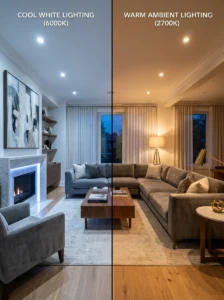
As covered in more detail elsewhere in this series, color temperature affects both brightness and mood, and the case for warm light is considerably stronger in the evening than during the day. During the day, a slightly cooler, brighter light can feel energizing and functional without working against the room’s purpose. At night, that same cooler light reads as clinical and alert in a way that actively works against winding down.
2700K or lower is generally the right range for evening-specific lighting, even in a room that uses a slightly higher color temperature for daytime functional light. Some households use warm-dimming bulbs, which shift toward an even warmer, more amber tone as they’re dimmed, mimicking the way incandescent bulbs and candlelight naturally warm in color as their brightness decreases — a specific effect that reads as cozy in a way that a fixed color temperature simply dimmed doesn’t fully replicate.
Smart bulbs with adjustable color temperature, set to automatically shift warmer in the evening hours, remove the need to manually manage this transition and are a reasonably accessible way to get daytime-appropriate and evening-appropriate lighting from the same fixtures without swapping bulbs.
Candles and Firelight Add a Quality of Light Nothing Electric Fully Replicates

Actual flame — candles, a working fireplace — produces a warm, flickering, low-level light that electric lighting can approximate but not fully replicate, both in its warm color and in its movement, which the eye reads as inherently different from the static light of a bulb, however warm that bulb is set.
A small number of candles, placed at a few points around the room rather than concentrated in one spot, contribute meaningfully to an evening living room’s warmth, even at a very modest scale. This is a genuinely low-cost addition relative to lighting fixtures, and it’s one of the more reliable single changes for making an evening living room feel notably cozier without any electrical or structural change.
A working fireplace, where one exists, is one of the strongest tools available for evening warmth, and even an unused fireplace with a few candles or a simple styled arrangement inside it can borrow some of the same visual association, though it’s a considerably more modest effect than an actual fire.
Dimmers Are the Single Most Useful Piece of Equipment for This Specific Problem

A dimmer on as many of a living room’s light sources as possible is the practical foundation that makes everything else in this list easier to execute consistently. Without dimmers, achieving a lower evening light level means physically turning fixtures off rather than adjusting them down, which tends to produce an uneven, patchy result rather than a smoothly reduced overall level.
Dimmers also make it possible to have one lighting setup that serves both day and evening use from the same fixtures, rather than requiring an entirely separate set of evening-specific lamps. A living room with dimmable overhead lighting and dimmable lamps can go from bright, functional daytime lighting to low, warm evening lighting using the exact same fixtures, simply adjusted differently by time of day.
What to Avoid

Leaving daytime brightness levels unchanged into the evening is the single most common reason a living room feels cold at night despite having plenty of light — the light itself isn’t the problem, its unchanged level and source is.
Relying entirely on overhead lighting, even dimmed, without any lower sources misses the layering effect that lamps and candles specifically provide. A dimmed overhead fixture alone still lights the room from a single, elevated, evenly-distributed angle, which reads differently — and less warmly — than several lower, localized sources even at a comparable total brightness.
Cool-toned bulbs anywhere in the room’s evening lighting plan undercut the warmth the rest of the setup is trying to create, even if only one fixture is mismatched. A single cool-white lamp in an otherwise warm, low-lit room is enough to disrupt the overall effect, in the same way one mismatched color temperature disrupts a bathroom mirror’s lighting.
Key Takeaways

- The single highest-impact change for evening warmth is turning off or significantly dimming overhead lighting and relying instead on lower, localized sources
- Table lamps and floor lamps placed near actual seating areas do more for a room’s evening feel than the same total light output from an overhead fixture
- 2700K or lower is generally the right color temperature for evening-specific lighting, even in rooms that use a slightly higher temperature during the day
- Candles and firelight add a warm, flickering quality that electric lighting can approximate but not fully replicate, and even a modest number of candles meaningfully affects a room’s evening feel
- Dimmers on as many fixtures as possible make it practical to use the same lighting setup for both bright daytime function and low, warm evening mood
- A single mismatched cool-toned bulb, or leaving daytime brightness unchanged into the evening, is enough to undercut an otherwise well-planned warm evening lighting setup

Frequently Asked Questions
Do I need completely separate lamps for daytime and evening lighting? Not if the fixtures are dimmable — the same lamps and overhead lighting can serve both purposes, adjusted to a lower level and, ideally, a warmer color temperature in the evening. Smart bulbs that shift color temperature automatically by time of day make this transition require no manual adjustment at all.
Is overhead lighting always wrong for a living room at night? Not always wrong, but it works best as an occasional full-brightness option — for cleaning, for finding something on the floor — rather than as the default evening light source. Dimmed low, overhead lighting can contribute a soft general fill, but relying on it as the primary evening light, even dimmed, misses the layered, localized quality that lamps and candles provide.
Do candles actually make a measurable difference, or is that mostly psychological? Both, and they’re related. Candles add genuine warm, flickering light that contributes to the room’s actual illumination, and the psychological association with relaxation and evening ritual is real and additive to the physical light itself. Even a modest number of candles, placed near where people are sitting, produces a noticeably cozier effect than the same room without them.
What color temperature should evening lamps be if I can only choose one? 2700K is a reliable single choice for evening-specific lighting — warm enough to read as cozy and restful without being so amber that it looks dim or orange. Households that want to fine-tune further sometimes go slightly warmer, into the 2200K-2400K range, specifically for evening lamps, while keeping other fixtures in the more moderate 2700K-3000K range for daytime use.
Is it worth installing dimmers if my lamps and fixtures don’t currently have them? Generally yes, given how much practical flexibility they add for relatively modest cost — a dimmer switch for hardwired fixtures, or dimmable smart plugs and bulbs for lamps, are both accessible upgrades. Given how central adjustable brightness is to achieving a warm evening feel without buying entirely separate evening-specific lighting, dimmers are one of the higher-value additions available for this specific goal.