


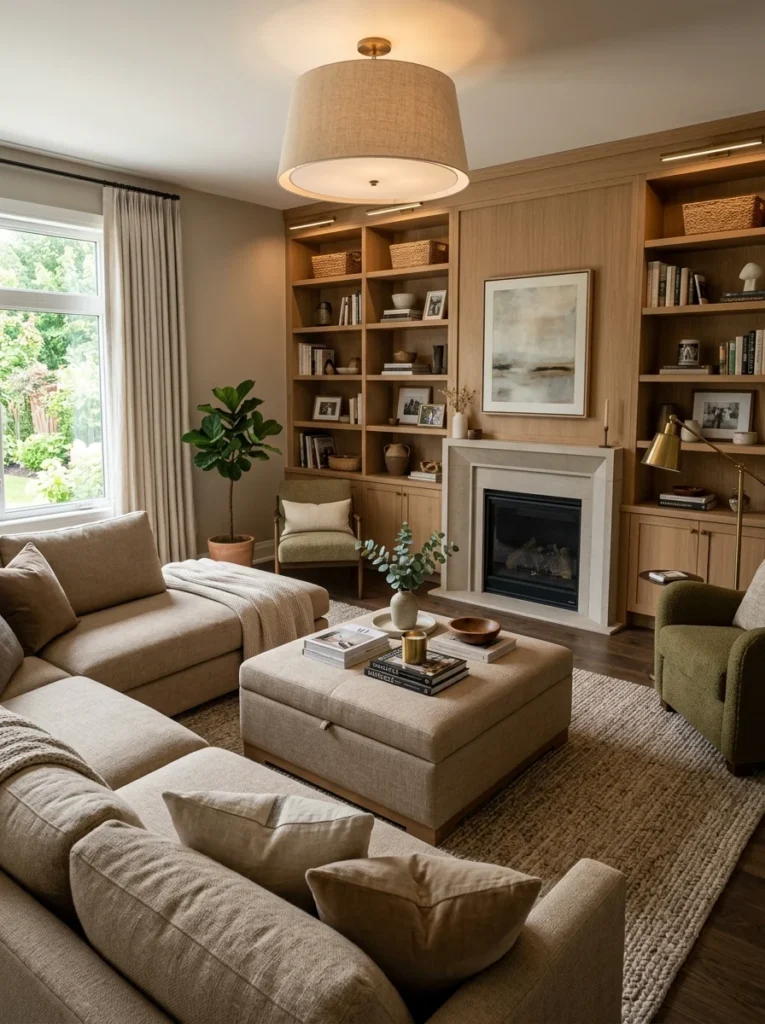
A small living room and a large family create two competing pressures at once — enough seating and storage for everyone, without the room feeling overstuffed. Here’s how to actually solve for both.A small living room shared by a large family has a specific, compounding constraint that neither a small living room with fewer people nor a large living room with a large family has on its own: there’s real pressure to fit meaningful seating capacity, storage for a household’s worth of daily items, and durability for heavy daily use, all into a footprint that doesn’t have much give in any direction. Design advice aimed at small spaces often assumes a household of one or two, and design advice aimed at large families often assumes a reasonably generous room to work with. The overlap of both constraints at once needs its own approach.
The good news is that most of the tension between “enough capacity” and “doesn’t feel overstuffed” is solvable through specific furniture and storage choices, rather than requiring either a compromise on seating or a compromise on how the room actually looks and feels.
Seating Capacity Without a Room Full of Individual Chairs
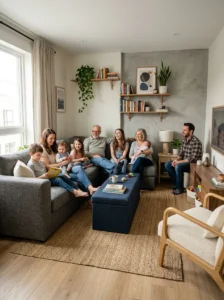
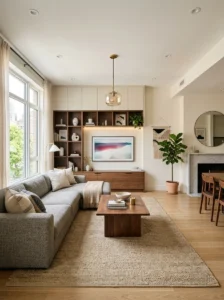
The most space-efficient way to seat a large number of people is a sectional or a large sofa plus a smaller secondary piece, rather than multiple individual armchairs, since a continuous seating run uses floor space more efficiently than the same seat count spread across several separate pieces, each of which needs its own clearance and creates its own visual bulk.
A sectional with a chaise end provides both seating capacity and a lounging spot without adding a separate ottoman or additional chair to the room, which is a meaningful space savings in a small footprint where every additional piece of furniture also means an additional gap of clearance space around it.
Modular seating — individual pieces that can be rearranged or reconfigured — offers flexibility that a fixed sectional doesn’t, which matters more for a large family than it might for a smaller household, since the room’s actual use case shifts constantly: movie night needs maximum seated capacity facing one direction, a smaller weekday evening might not. Modular pieces cost more upfront than a fixed sofa of similar quality, but the flexibility is a genuine functional advantage for a household whose size and configuration needs change throughout a typical week.
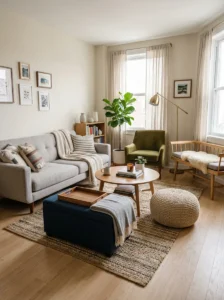
Ottomans that double as extra seating, rather than purely as a coffee table, add capacity that can be pulled out when needed and pushed back against a wall or under a console when it isn’t, which is a more space-efficient solution than a floor plan that permanently allocates space for peak-occupancy seating that isn’t needed most of the time.
Storage Has to Be Built Into the Furniture, Not Added as an Afterthought
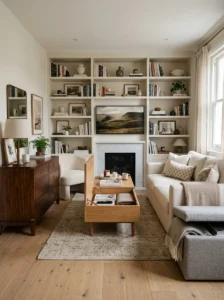
A large family generates more daily-use objects moving through a living room than a smaller household does — toys, school bags, blankets, remotes, games — and a small living room doesn’t have spare floor area for standalone storage furniture the way a larger room might. The practical solution is choosing seating and surface furniture that has storage built in, rather than treating storage as a separate category of furniture competing for the same limited floor space.
Storage ottomans, console tables with drawers or closed cabinet space, and coffee tables with a shelf or drawer underneath all convert furniture the room needs anyway into storage the household also needs, without requiring any additional floor footprint beyond what the piece would have taken up regardless.
Vertical storage — tall, narrow bookshelves or wall-mounted cabinets — uses wall space that a small room isn’t otherwise using, rather than competing with floor space the way a wide, low storage piece would. A small room with several family members generating daily clutter benefits disproportionately from storage that goes up rather than out.
A dedicated, visible system for the specific clutter categories a large family actually generates — a basket for shoes near the entry, a bin for toys, a shallow tray for mail and school papers — prevents these items from accumulating loose across the room’s surfaces, applying the same containment principle covered elsewhere in this series for shelves and coffee tables, scaled up to the volume a larger household actually produces.
Durability Matters More Here Than in Almost Any Other Living Room Context
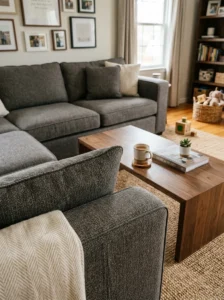
A small living room with a large family sees more concentrated daily use per square foot than almost any other room configuration — more people, more activity, in less space — which makes durability a higher priority here than the aesthetic-first considerations that might dominate in a lower-traffic room.
Performance fabrics — stain-resistant, cleanable weaves designed to withstand heavy use — are worth prioritizing over fabrics chosen purely for hand-feel or appearance, since a small room’s furniture is both more visible (there’s less room for the eye to look elsewhere) and more heavily used than the same furniture would be in a larger, lower-traffic space.
Medium tones and patterns hide everyday wear better than either very pale or very dark solids, which is a specific extension of the same visual-cleanliness principle covered elsewhere in this series regarding bathroom surfaces — the same logic that makes light grout show every stain and dark grout hide it applies to upholstery choices in a heavily used family living room.
Durable, easy-to-clean surfaces on coffee tables and consoles — rather than surfaces that need careful maintenance — reduce the ongoing tension between wanting a room to look nice and knowing it will be used hard, daily, by several people at once.
Sightlines Matter for Supervision as Much as for Aesthetics
In a family with young children, an open sightline across the living room — the ability to see the whole space from the kitchen, from a home office corner, or from wherever a parent spends time while children play — is a genuine functional requirement, not just a design preference, and it should factor into furniture placement decisions alongside the space-efficiency and storage considerations already covered.
Furniture placed to preserve this sightline, even if it means a slightly less space-maximizing layout, is often worth the trade-off in a household actively supervising young children. A tall bookshelf or a floating sofa back that blocks the exact sightline a parent relies on undermines its own zoning benefit if it comes at the cost of losing visual contact with where children are playing.
Making Peak Occupancy and Everyday Occupancy Both Work
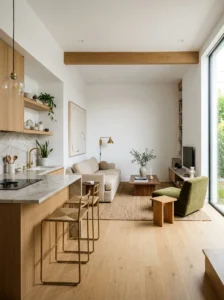
A small living room with a large family has to work both for everyday use — a smaller subset of the family, on a normal evening — and for peak occupancy — the whole family together, or gatherings that bring in guests. Designing purely around everyday use risks a room that can’t actually seat everyone when it matters; designing purely around peak occupancy risks a room that feels oversized and empty during the much more common everyday use.
Flexible, movable seating — ottomans, poufs, a bench that can be pulled from another room — is the practical bridge between these two states, providing genuine extra capacity when needed without permanently allocating floor space to it. This is a more space-efficient solution than either a room sized for maximum family gatherings or a room that simply can’t accommodate the whole family at once.
Key Takeaways
- A sectional or a large sofa plus one secondary piece seats more people per square foot than multiple individual chairs, which each require their own clearance space
- Storage should be built into furniture the room needs anyway — ottomans, console drawers, under-table shelves — rather than competing with limited floor space as separate standalone pieces
- Vertical storage uses wall space a small room isn’t otherwise using, which matters more in a small footprint than in a larger room with floor space to spare
- Performance fabrics and medium tones hold up to heavy daily family use better than fabrics or colors chosen primarily for appearance, and are worth prioritizing accordingly
- Preserving sightlines across the room for supervising young children is a genuine functional requirement worth factoring into furniture placement, even at some cost to space efficiency
- Flexible, movable seating — ottomans, poufs, benches — bridges the gap between everyday occupancy and peak family gatherings without permanently allocating space to capacity that’s rarely needed
Frequently Asked Questions
Is a sectional always the right choice for a small living room with a large family? Generally a strong option, since it seats efficiently and provides a lounging spot without needing a separate chaise or ottoman, but the room’s proportions matter — a sectional sized for maximum seating in a genuinely small room can dominate the space and block sightlines or circulation paths. Measuring the actual room and testing the sectional’s footprint against it, rather than choosing based on seat count alone, avoids overcommitting the room’s limited floor space.
How do I add enough storage without the room looking cluttered with bins and baskets? Building storage into furniture that already needs to be in the room — ottomans, console drawers, under-table shelving — is generally more effective than adding standalone storage pieces, since it doesn’t add visible clutter or extra floor footprint. Where visible storage like baskets is necessary, using a small number of matching, contained baskets for specific categories tends to look considerably more intentional than a larger number of mismatched bins.
Should I prioritize durability or style when choosing furniture for a small, heavily used living room? Both matter, but in a small room used heavily by a large family, durability has a bigger practical impact than it would in a lower-traffic space, since the furniture is both more visible and more used than it would be in a larger or less occupied room. Performance fabrics and medium tones that hide wear are worth prioritizing without needing to sacrifice style entirely — many durable options are available in the same range of colors and textures as less durable alternatives.
Is it worth buying furniture specifically for occasional peak occupancy, like family gatherings? Generally better to solve this with flexible, movable pieces — ottomans, poufs, a bench — rather than permanently sized furniture for peak capacity, since a small room designed around its rarest, highest-occupancy moment tends to feel oversized and underused during much more common everyday use. Flexible seating provides the extra capacity when it’s actually needed without that cost during normal daily use.
How important is it to keep sightlines open in a small living room with young kids? Quite important for households actively supervising young children, since the ability to see the whole room from wherever a parent typically is — cooking, working, sitting — is a genuine functional need. It’s worth factoring into furniture placement even when it means a slightly less space-efficient layout than would otherwise be possible, since the supervision benefit generally outweighs a modest loss in space efficiency.