


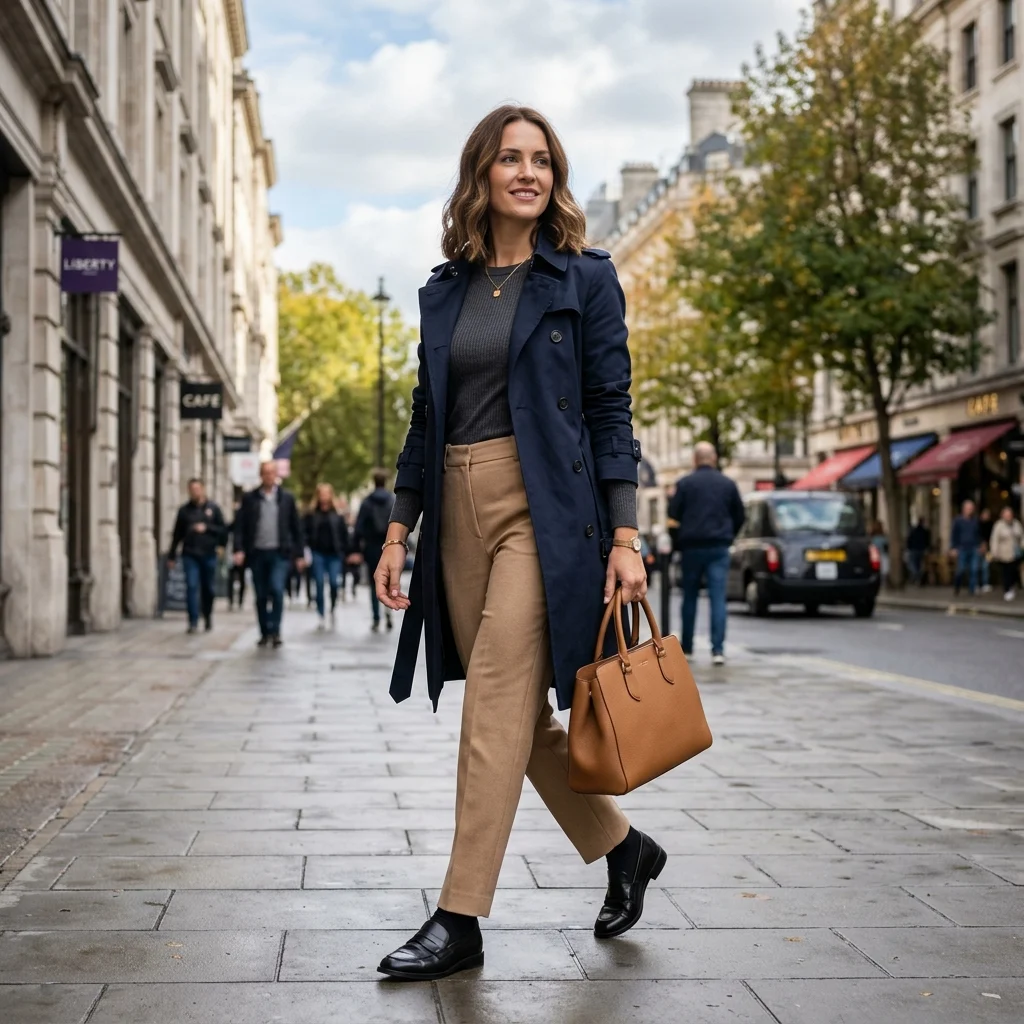
Forty degrees at 7am, seventy by noon, rain out of nowhere at four. Here’s how to actually dress for weather that refuses to commit to anything.
Dressing for the In-Between Days

There’s a specific kind of morning that ruins more outfits than any actual bad weather does — the kind where it’s cold enough for a coat at 7am, warm enough to regret that coat by noon, and somehow raining by the time you’re heading home. Actual storms and heat waves are easy to dress for because they’re decisive. It’s the in-between days, the ones that can’t commit to a season, that leave most people either sweating through an overdressed outfit or shivering through an underdressed one.
I’ve made every version of this mistake — carried a coat all day that never got worn, gotten caught without one during an unexpected temperature drop, worn the wrong shoes for a sky that looked clear and wasn’t. The fix isn’t checking the weather more obsessively. It’s building outfits differently from the ground up, in a way that assumes the temperature won’t stay put.
Why Single-Temperature Dressing Fails on These Days
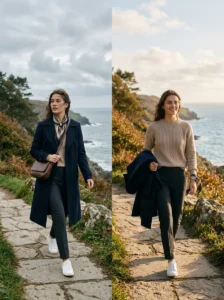
Most people get dressed by checking one number — the current temperature, or the forecasted high — and building an outfit around that single data point. This works fine on stable weather days and fails predictably on unstable ones.
A single temperature reading ignores the range, and the range is the actual problem. A 15-degree swing between morning and afternoon means an outfit built for either end of that range will be wrong for a meaningful chunk of the day — dressing for the high leaves you cold at 7am, dressing for the low leaves you overheated by 2pm.
Humidity and wind change how a temperature actually feels, independent of the number itself. A 55-degree day with wind and dampness feels colder than a still, dry 50-degree day, which is why checking the number alone consistently underprepares people for how a day will actually feel, particularly in transitional seasons.
The forecast’s stated high often arrives hours after you’ve already left the house dressed for the morning. Unless the plan accounts for that gap, the outfit chosen at 7am is stuck being wrong by early afternoon regardless of how accurate the forecast was.
The Layering Principle That Actually Solves This

The standard advice — “dress in layers” — is technically correct and almost useless without specifics, because not all layers function the same way, and stacking three random warm items doesn’t solve a temperature swing the way a properly built layering system does.
Each layer should serve one specific job, not overlap in function. A base layer manages temperature regulation against the skin, a mid layer provides the bulk of the insulation, and an outer layer handles wind and moisture — when all three layers are doing the same job (three different sweaters, for instance), removing one still leaves you either too warm or too exposed rather than genuinely adjustable.
The removable layer needs to be genuinely removable without ruining the outfit underneath. This sounds obvious, but it’s the detail most layered outfits get wrong — a cardigan or jacket that’s clearly “the outer layer” on top of a complete, intentional outfit works; a single warm sweater that’s the entire visual point of the outfit doesn’t survive being taken off without looking unfinished.
Layer thickness should decrease, not just quantity increase, as you move outward. A thick base layer under a thick mid layer creates bulk without proportional warmth benefit and limits mobility; the more effective structure is a thin, close base layer, a moderate mid layer, and depending on conditions, a weather-resistant but not necessarily thick outer layer.
Building From the Middle Out, Not the Outside In

Most people build a transitional outfit by starting with the coat or jacket and working inward. Building from the middle layer outward produces a more genuinely adaptable result.
Start with the piece that would be comfortable alone at the day’s warmest point. This is usually a mid-weight top — a long-sleeve knit, a lightweight sweater — something that wouldn’t feel excessive if the outer layer came off entirely during the warmest hour.
Add the outer layer as insurance, not as the main event. A jacket, blazer, or coat chosen specifically because it can be removed and carried without disrupting the outfit’s completeness is doing its actual job here — this is different from choosing a coat as the outfit’s centerpiece, which then feels incomplete once it’s off.
Choose bottoms and shoes based on the day’s most demanding condition, not its average. Temperature is adjustable through removable layers; wet or unstable ground from a possible afternoon shower isn’t something you can layer around after the fact, which is why footwear and bottom fabric should account for the worst-case condition in the forecast, not the most likely one.
Fabric Choices That Handle Range Better Than Others
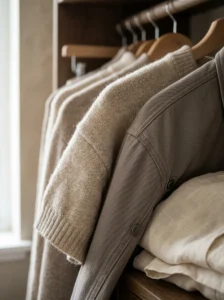
Certain fabrics genuinely perform better across a temperature range than others, independent of how they’re layered — this is a material science point as much as a style one.
Merino wool regulates temperature in both directions, which is why it shows up so often in performance and travel clothing — it insulates in cooler conditions while wicking moisture and remaining breathable as temperatures rise, doing double duty that cotton and many synthetics don’t.
Cotton holds moisture rather than moving it away from the body, which means a cotton base layer that gets damp from either rain or sweat stays damp and cold rather than drying quickly — for a day with real temperature or precipitation uncertainty, this makes cotton a weaker choice for the layer closest to skin, even though it’s often the default fabric people reach for.
A mid-weight, tightly woven cotton or cotton-blend outer layer handles light unexpected rain far better than knit or looser-weave fabrics, which absorb water rather than shedding it — this is worth considering specifically for the outer layer on days where rain is a possibility but not a certainty.
The Footwear Decision Nobody Plans For
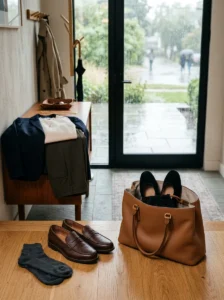
Shoes are usually the last thing adjusted for unpredictable weather, and they’re often the piece that causes the most actual discomfort when the day goes differently than expected.
- A shoe with at least some weather resistance handles more scenarios than a fully open or fully fabric shoe. A leather or leather-look shoe survives an unexpected light rain in a way that canvas or mesh sneakers don’t, without requiring a full waterproof boot that would be overkill on a mostly dry day.
- Socks matter more on transitional days than people expect. A moisture-wicking sock reduces the discomfort of both a warm afternoon and a damp morning in a way that a purely decorative or purely thick sock doesn’t manage as well.
- Carrying rather than wearing a backup is sometimes the better call. On days with real uncertainty, a compact pair of foldable flats or a second pair of socks carried in a bag solves the problem of a shoe choice that turns out wrong for half the day, without requiring the entire outfit to be built around worst-case footwear from the start.
A Practical Way to Actually Plan the Outfit

Rather than checking a single forecast number, a short mental checklist produces a more genuinely adaptable outfit.
- Check the full range, not just the high or the current temperature — specifically the low, the high, and whether precipitation is possible at any point in the day.
- Choose a mid-weight base that would work alone at the warmest expected point.
- Add one genuinely removable outer layer chosen for ease of carrying, not as the outfit’s main visual element.
- Choose bottoms and shoes for the least convenient likely condition, whether that’s rain, wind, or a sharp temperature drop.
- Pack a small backup only if the forecast shows real uncertainty, rather than by default every single day.
Key Takeaways
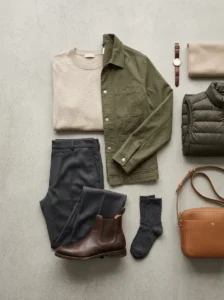
- Building an outfit around a single temperature number is the core mistake on unstable weather days; the actual range across the day matters more than any single figure
- Effective layers each do a distinct job — regulation, insulation, protection — rather than stacking multiple items that all perform the same function
- Building outward from a mid-weight base that works alone, rather than starting from the coat, produces a more genuinely adaptable outfit
- Merino wool and tightly woven fabrics handle a temperature and moisture range better than cotton, particularly in the layer closest to skin
- Footwear and bottoms should be chosen for the day’s most demanding likely condition, since temperature can be layered around but wet ground generally can’t

Frequently Asked Questions
Is it really necessary to plan this much, or can I just carry a jacket everywhere? Carrying a jacket solves the temperature-swing problem reasonably well on its own, but it doesn’t address moisture, wind, or footwear, which are the other common failure points on unstable weather days. The full approach described here takes more upfront thought but solves for more scenarios at once; carrying a jacket alone is a reasonable minimum version of this strategy for someone who doesn’t want to plan the entire outfit around it.
What’s the single most useful piece to own for this kind of weather? A mid-weight, tightly woven jacket or overshirt that can function as either a light outer layer or a mid layer under something heavier is probably the single most flexible piece for transitional weather, since it adapts to more of the temperature range than a single-purpose heavy coat or single-purpose light layer would on its own.
How do I handle this when I need to dress more formally and can’t just throw on a casual layering system? The same principles apply, just executed in more polished pieces — a blazer works as the removable outer layer in place of a casual jacket, a lightweight knit or fitted long-sleeve top serves as the mid layer instead of a hoodie, and the same logic of building from a base that works alone at the day’s warmest point still holds. Formality changes the specific pieces, not the underlying structure.
Does this approach change much between spring and fall, since both are transitional seasons? The core structure stays the same, but the direction of the swing differs — spring days typically start cold and warm up, meaning the removable layer comes off as the day progresses, while fall days can do the opposite, starting mild and dropping sharply by evening, meaning the removable layer might need to go on rather than come off. Planning which direction the day is likely to move in helps decide whether the outer layer should be quick to remove or easy to add back on later.
Is there a simple way to tell in the morning whether today needs this level of planning, or if a normal outfit will be fine? A quick check of the difference between the day’s forecasted low and high is usually enough — a swing of under 10 degrees with no precipitation risk rarely needs this level of layering strategy, while anything approaching or exceeding a 15-degree swing, or any chance of rain during an otherwise mild day, is a strong signal that a single-temperature outfit will likely be wrong for part of the day.