


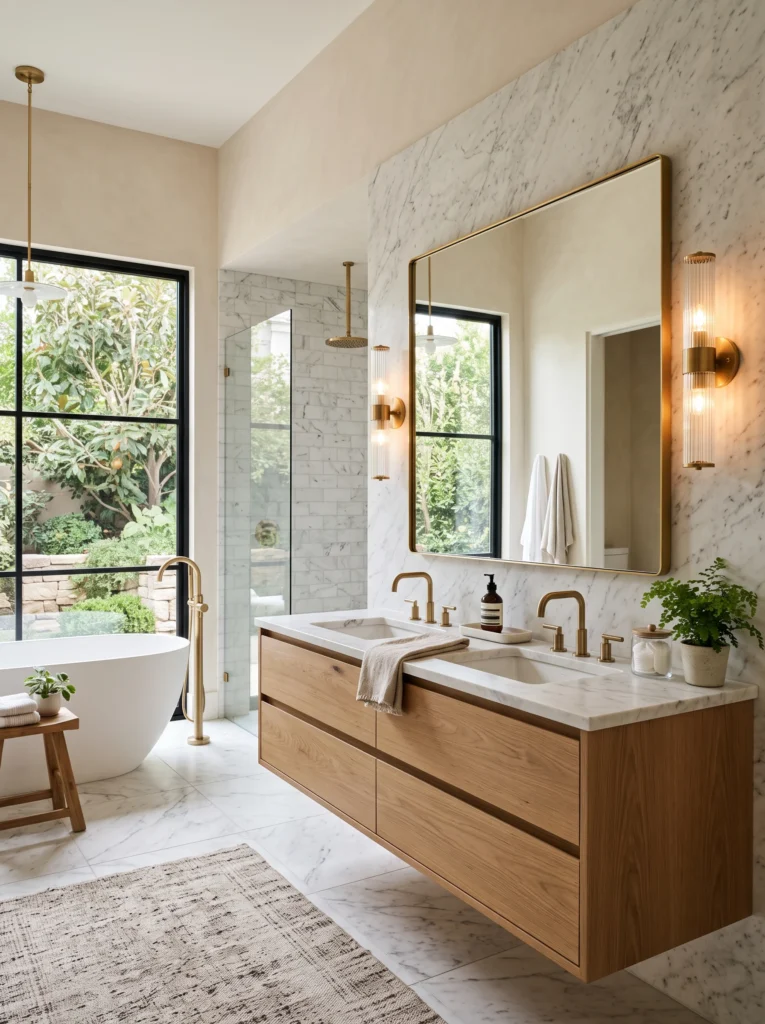
The bathroom mirror is the most-looked-at object in most homes — and the one most people replace last, if ever. Here’s why it matters far more than it gets credit for.Most people spend more time looking at their bathroom mirror than at any other single object in their home. Not the view from a window, not a television, not artwork on a wall — the mirror. It’s there every morning and every evening, often multiple times in between, and almost nobody has thought carefully about whether the one they currently have is the right size, in the right position, in the right frame, or doing the right job for the room it lives in.
The builder mirror that comes with most bathrooms — the frameless rectangle mounted above the vanity, usually a few inches narrower than the vanity itself, positioned at a height that works for one height of person and not others — gets inherited and rarely questioned. It functions well enough that replacing it doesn’t feel urgent, and it’s invisible enough in daily use that most people genuinely don’t notice what it’s failing to do.
What it’s failing to do turns out to be quite a bit.
The Multiple Jobs a Bathroom Mirror Is Actually Doing

A mirror above a vanity isn’t performing a single function. It’s performing several simultaneously, and the right mirror choice depends on understanding all of them rather than just the obvious one.
Reflection for function — the primary use, seeing clearly enough to complete a grooming routine. This requires the mirror to be positioned at the right height, lit from the right angle, and large enough that the relevant parts of the person using it are fully in frame.
Light multiplication — a mirror reflects whatever light source is opposite or adjacent to it back into the room. A well-positioned mirror can make a small, dim bathroom feel significantly brighter by bouncing available light into dark corners. A poorly positioned mirror reflects a blank wall or the back of a door and contributes nothing to the room’s light quality.
Spatial expansion — a large mirror in a small bathroom visually expands the room. The reflection gives the eye more to process before reaching a wall, which the brain interprets as additional space. This effect is real, consistent, and significant — a large mirror is one of the most reliable tools for making a small bathroom feel larger.
Aesthetic contribution — the frame, shape, and scale of a mirror are design elements in their own right. A frameless builder mirror is a neutral choice that neither adds to nor subtracts from the room’s visual character. A mirror with a well-chosen frame — wood, aged brass, a beveled edge, a distinctive shape — is an active design element that contributes to the room the way furniture contributes to a living room.
A bathroom mirror chosen with only the first function in mind will serve adequately. One chosen with all four in mind will change the room.
Why Most Bathroom Mirrors Are Too Small
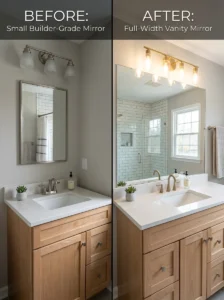
The single most common mistake in bathroom mirror selection is size: the mirror installed is smaller than what the room and the function actually need.
The reasoning behind a smaller mirror is often aesthetic — a smaller mirror feels less dominant, less like it’s taking over the wall. What this reasoning misses is that a mirror’s visual contribution to a room scales directly with its size. A small mirror reflects a small area of light back into the room. A large mirror reflects a large area. In a small bathroom, the difference between a 24-inch mirror and a 36-inch mirror isn’t a matter of proportion — it’s a measurable difference in how light and spacious the room reads.
The practical sizing principle that most designers and experienced renovators use: the mirror should be the same width as the vanity it sits above, or close to it. A vanity that’s 36 inches wide looks best with a mirror in the 32-to-36-inch range. Wider than the vanity is also fine in most rooms — it reads as generous and visually expands the wall. Significantly narrower than the vanity looks like a mismatch and leaves the outer areas of the vanity looking unanchored.
For double vanities, either one large mirror spanning the full width of both sinks, or two individual mirrors of matching size centered over each sink, both work. Two mirrors of mismatched size or a single small mirror centered between two sinks doesn’t serve either function or aesthetic.
Height Dimension: The More Complicated Variable
Width is relatively simple. Height is more nuanced because it involves who is using the mirror and at what height.
A mirror positioned too low forces taller users to stoop. One positioned too high leaves shorter users — and children — with a mirror that cuts off their face below the forehead. In a household where the bathroom is shared across different heights, the positioning decision requires actual consideration of the range of heights in the household, not just what looks centered on the wall.
A useful guideline: the center of the mirror should be at approximately eye level for the average-height user of that bathroom. In a main bathroom used by multiple people of different heights, a taller mirror gives more flexibility than a shorter one positioned precisely for one height.
Framed vs Frameless: What Each Choice Communicates

A frameless mirror reads as neutral and clean — it calls no attention to itself and neither adds nor subtracts character from the room. This makes it a safe choice that suits any aesthetic, and it’s why builders default to it.
It’s also a missed opportunity in rooms where a framed mirror would do more work.
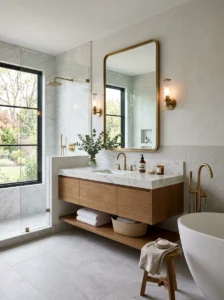
A mirror frame is a design element. It can add warmth (a wood frame), weight and substance (a wide plaster or stone-look surround), drama (an arched or irregular shape), or a character anchor (aged brass, unlacquered metal, a distinctive profile) that changes how the whole room reads.
The frame is also what makes a mirror look like a chosen object rather than an installed one. A frameless mirror reads as a fixture. A framed mirror reads as a decision — someone chose this specifically, which signals the same kind of intentionality that well-chosen hardware or quality textiles do.
The Shape Variable

Rectangular mirrors are the default. They’re also not always the right answer.
A round or oval mirror above a rectangular vanity creates a visual counterpoint that breaks the dominant horizontal lines of a bathroom — the vanity top, the tile lines, the towel rail — and adds variety to what is otherwise a room of right angles. In bathrooms where the horizontal line dominates, a round mirror reads as a deliberate design choice rather than an installation.
Arch-top mirrors — rectangular with an arched top — add height and visual interest while maintaining the clean edge of a rectangular mirror on three sides.
Irregular-edge or organic-shaped mirrors are a bolder statement that suits specific design aesthetics — more natural, more expressive — and looks jarring in a bathroom with strong clean lines. The shape should match the room’s design language.
The Lighting and Mirror Relationship
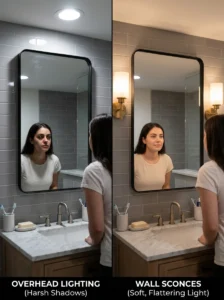
A mirror and its light source are not independent decisions. How the mirror is lit determines how useful it is for its primary function, and getting this wrong is one of the most common bathroom design mistakes.
The worst possible light arrangement is an overhead fixture centered on the ceiling with nothing at the mirror level. This configuration casts shadows downward from the brow and nose — exactly the opposite of useful grooming light, and the light that produces the unflattering quality that makes people look tired in bathroom mirrors.
The best arrangement is light at the level of the face, coming from the side — which means fixtures mounted on either side of the mirror, or a horizontal bar across the top of the mirror, at a height that places the light source at approximately face level for the person using it.
This is why good hotel bathrooms often have sconces flanking the mirror rather than overhead lighting alone. The side-lit mirror provides genuinely useful, flattering light that removes the overhead shadow problem entirely.
The mirror and the light source should be decided together. A mirror choice that doesn’t include the lighting context is an incomplete decision. In any bathroom where overhead-only lighting is currently the arrangement, the mirror upgrade and a flanking sconce or mirror-top light bar belong in the same project.
What the Mirror Reflects: A Variable Most People Never Consider
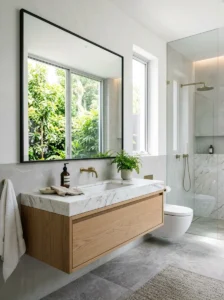
A mirror doesn’t exist in isolation. It reflects whatever is directly opposite it, and in most bathrooms, that’s either a blank wall, a door, a window, or another bathroom fixture. What the mirror reflects contributes to the room’s light and feeling in ways that the mirror alone can’t account for.
A mirror positioned opposite a window reflects natural light back into the room — this is the most favorable arrangement and one worth engineering if there’s flexibility in mirror placement. Even a partial reflection of natural light noticeably brightens a bathroom.
A mirror positioned to reflect a dark or visually cluttered area reflects that darkness and clutter back into the room. In a bathroom where the mirror is opposite the toilet or a chaotic storage area, the mirror is multiplying the room’s least attractive view.
Before mounting a mirror, stand at the vanity and look at what the mirror will reflect from its proposed position. If the reflection is unfavorable, an adjustment in position — even a few inches — can change what the mirror doubles.
Full-Length Mirrors in Bathrooms
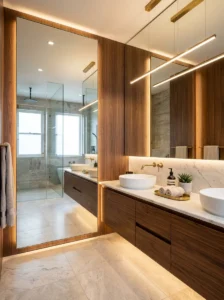
Most bathroom mirrors serve the vanity height only — the head, face, and upper torso. A full-length mirror is a separate consideration that many bathrooms benefit from and rarely have.
A full-length mirror in a bathroom serves a specific function that a vanity mirror can’t: checking the full appearance before leaving the house. In bathrooms large enough to accommodate one on a wall without creating a cramped feeling, a floor-to-ceiling or full-length mounted mirror adds this function and simultaneously makes the bathroom read as larger.
In small bathrooms where floor space is limited, a full-length mirror doesn’t need to be freestanding. A door-mounted full-length mirror on the back of the bathroom door, or on an adjacent bedroom door, provides the function without claiming floor space and without reducing the apparent size of a small room by dividing it.
The Practical Detail Nobody Leads With: Anti-Fog

A mirror that fogs completely within thirty seconds of a shower starting and stays that way for ten minutes every morning is a mirror that fails its primary function at exactly the moment it’s most needed.
Anti-fog mirrors, which have a heating element behind the glass that keeps the surface above the dew point, solve this problem permanently. They’re available in both framed and frameless configurations and across a range of sizes. The cost premium over standard mirrors varies, but for a bathroom mirror used daily, the daily frustration of a fogged mirror is a reasonable thing to pay to eliminate.
For bathrooms where an anti-fog mirror isn’t in the budget, a ventilation fan that runs during and after the shower significantly reduces fogging time by keeping moisture levels in the room lower. The combination of good ventilation and a larger mirror (which has more thermal mass and fogs more slowly than a small one) is the low-cost alternative.
Replacing a Builder Mirror: Easier Than Most People Assume
The persistence of inadequate builder mirrors in most bathrooms is partly inertia — they work, they don’t obviously fail, and replacing a mirror feels like a project that requires a contractor.
In most cases, it doesn’t. A framed mirror hung with appropriate wall anchors for the weight, or a smaller mirror replaced with a larger frameless one, is a straightforward DIY task. The electrical connection for mirror lighting is the part that requires a licensed electrician if new wiring is involved — but replacing the mirror itself is not.
The most complicated scenario is removing a mirror that was glued directly to the wall during installation, which requires care to avoid damaging the wall surface behind it. In this case, cutting the mirror into sections for safe removal is one approach; having a glazier or experienced handyperson handle it is another.
Key Takeaways
- A bathroom mirror performs four simultaneous jobs — functional reflection, light multiplication, spatial expansion, and aesthetic contribution — and most mirrors are chosen with only the first in mind
- Most bathroom mirrors are too small; matching the vanity width or going wider produces better visual results than going narrower
- A framed mirror reads as a chosen design element; a frameless mirror reads as an installed fixture — both are valid choices with different contributions to the room
- Mirror shape (round, arched, irregular) can break the dominant horizontal lines of a bathroom and add design character
- The mirror and its light source are a single decision, not two separate ones — overhead-only lighting with no mirror-level fixture is the most common bathroom lighting mistake
- What the mirror reflects is a variable worth considering before installation — a mirror opposite a window bounces natural light back; a mirror opposite clutter doubles it
- Anti-fog mirrors solve a daily functional problem permanently and are worth including in any mirror replacement decision
Frequently Asked Questions
How high should a bathroom mirror be mounted on the wall? The center of the mirror should sit at approximately eye level for the primary user, or at a height that accommodates the range of heights in the household. Practically, this means the center of the mirror lands at roughly 57 to 65 inches from the floor for most adults, with the lower end of that range better for mixed-height households. Children’s bathrooms benefit from mirrors positioned lower, or from the addition of a step stool rather than a compromised mirror height for adults.
Can a mirror be too large for a bathroom wall? Practically, yes — a mirror that extends edge to edge on a wall removes all opportunity for other wall elements and can make a room feel like a changing room rather than a considered space. Aesthetically, a mirror up to and including the full width of the vanity reads as intentional; wider than that still works in many bathrooms. The ceiling height also affects how much vertical mirror dimension works well — very tall mirrors in low-ceilinged bathrooms can feel slightly off in proportion.
Does a round mirror work above a rectangular vanity? Very commonly, yes — the contrast between the round mirror and the rectangular vanity reads as intentional design rather than mismatched accident. The practical consideration is scale: a round mirror above a wide double vanity should have a diameter substantial enough to anchor the space. A small round mirror above a wide vanity looks like it belongs in a different bathroom. Size appropriately to the vanity width even when the shape contrasts it.
Is it worth paying for an anti-fog mirror, or are there effective alternatives? Anti-fog mirrors are worth the premium for bathrooms with heavy daily shower use where mirror fogging is a consistent functional frustration. For bathrooms used more lightly or with good ventilation that clears fogging quickly, the premium may not be necessary. The alternatives — better ventilation, a larger mirror that clears faster, and anti-fog sprays applied to standard glass — are imperfect but functional substitutes for moderate fogging situations.
Should the mirror match the hardware finish in the bathroom? Not necessarily exactly, but they should share a material logic. A warm wood mirror frame in a bathroom with matte black hardware reads as a deliberate contrast if it’s handled with intention throughout the room. The same frame in a bathroom with brushed gold fixtures reads as complementary. The failure case is a mirror that accidentally contradicts the room’s material direction — a very cool chrome frame in a bathroom with warm aged brass throughout — rather than one that intentionally plays against it.