


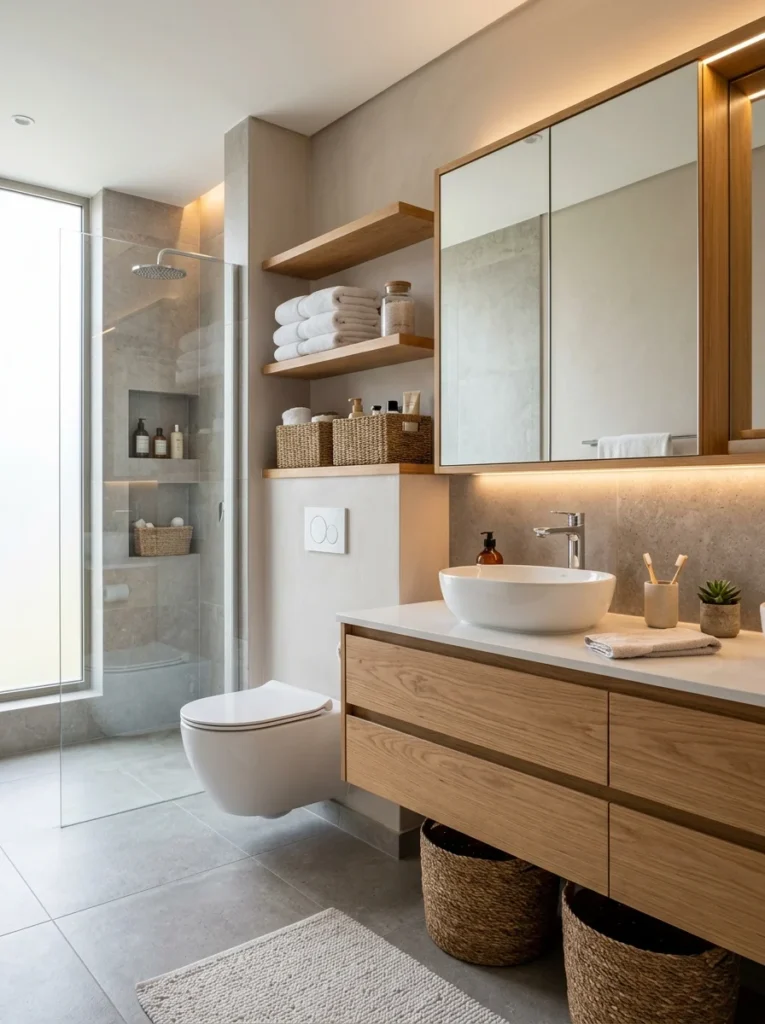
A bathroom with no storage is solvable even without renovation. These specific, layered solutions work with the space as it exists — wall space, door backs, under the sink, and beyond.The morning rush in a bathroom with no storage has a recognizable quality. The counter holds several people’s worth of products because there’s nowhere else for them to go. The cabinet under the sink is a dark pile where things get pushed to the back and forgotten. The towel rail is doing the work of three rails because it’s the only one. Someone’s electric toothbrush charger is plugged into the only outlet and there’s a minor negotiation every morning about who needs which product and when.
None of this is a character flaw. It’s a space problem — specifically, a problem of too many objects and not enough designated places for them to live. And unlike many home improvement challenges, bathroom storage is one where meaningful, lasting solutions are available at a range of budgets, most of which require no structural change at all.
The starting point, though, is the same as any storage problem: understanding what’s actually being stored before deciding where to put it.
The Edit That Makes Everything Easier
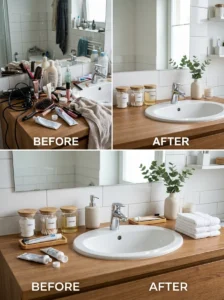
Bathroom product accumulation happens quietly. A new shampoo purchased before the old one was finished. A skincare product tried once and abandoned. Hotel toiletries collected on the basis that they might be useful someday. Expired medication kept in the cabinet because discarding it was never the most pressing task.
Before a single shelf or hook is added, an honest audit of what the bathroom is being asked to store changes the scope of the problem. In most bathrooms, a thorough clear-out reveals that between a quarter and a third of what’s occupying storage space is either expired, unused in the last six months, or a duplicate of something else being used.
Products that fall into this category should leave the bathroom before anything new is added. More storage built around unused products is just organized accumulation — the storage problem hasn’t been solved, the clutter has simply been arranged more neatly.
After the edit, measure again what’s left. The gap between what the bathroom needs to store and what the bathroom currently provides is now a specific, sized problem rather than a vague overwhelming one.
The Wall Above the Toilet: The Most Consistently Wasted Space in Any Bathroom
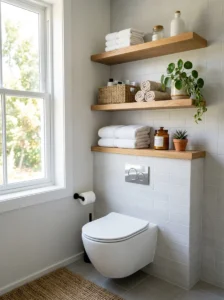
In most bathrooms, there is two to three feet of wall space above the toilet tank that goes completely unused. It is the single most available and consistently ignored storage zone in the room.
This wall space can accommodate:
A freestanding over-toilet unit — a frame with shelves or a combination of shelves and a small cabinet that sits on the floor and reaches over the tank. These require no installation, no drilling, and work in rented bathrooms as easily as owned ones. They provide two to three additional shelves of storage using floor space that the toilet already occupies.
Floating wall shelves — two or three shelves mounted directly to the wall above the toilet at varying heights. These require drilling and wall anchors, but are a straightforward DIY project for most people. The storage capacity depends on shelf depth and number, but even two shelves in this zone effectively creates a storage wall where there was none.
A wall-mounted cabinet — a closed unit with a door, which hides the contents rather than displaying them. Useful for items that don’t need to be seen or that look messy when visible. Wall-mounted cabinets above the toilet require more secure mounting than floating shelves but carry heavier loads and provide concealed storage in a bathroom where visible clutter is a concern.
The height of the lowest shelf matters: it needs to clear the toilet tank lid, which typically sits at around 30-32 inches from the floor, and ideally remains reachable from a standing or sitting position without requiring a step stool for regular-use items.
Under the Sink: Recovering the Space That’s Already There
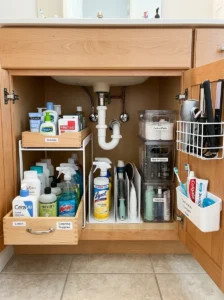
Most bathroom under-sink cabinets are organized with the optimism of the first day and the chaos of every day after. The pipes that run through the center of the cabinet create an awkward obstacle, and without a specific organization system built around them, items pile up against each other and the back wall fills with things that haven’t been seen in months.
This is fixable without spending much or changing anything structural.
An under-sink organizer designed around the pipe — available in many configurations specifically engineered for the standard U-bend and P-trap positions — typically doubles the usable storage by creating tiers and compartments around the obstruction rather than fighting it. The pipe stops being an obstacle and becomes the center of a storage layout.
Small pull-out drawers that sit beside or around the pipe give access to items without requiring full arm-in-cabinet retrieval. Items at the back of a cabinet that can be pulled forward on a small drawer are items that will actually be used rather than forgotten.
Vertical dividers for tall products — cleaning sprays, dry shampoo cans, hairspray — keep them upright and accessible rather than lying on their sides or falling into each other when the door opens.
Door-mounted storage on the interior of the under-sink cabinet door — a small wire rack, a narrow pocket organizer — adds storage on a surface that is otherwise completely unused. This is particularly useful for small items: cotton pads, spare toothbrushes, small cleaning tools, medication packets.
Medicine Cabinet vs Mirror: The Decision Worth Reconsidering
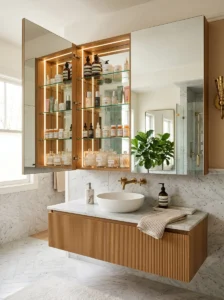
Many bathrooms have a simple framed or frameless mirror mounted above the vanity. This mirror is performing one function — reflection — when it could be performing two.
A medicine cabinet is a recessed or surface-mounted cabinet with a mirror on the front. The same mirror the bathroom already needs becomes the door of a storage unit, typically providing four to six inches of depth and several adjustable shelves — enough for most daily-use toiletries, medications, and small items.
Replacing a flat mirror with a surface-mounted medicine cabinet requires no structural change — it mounts to the wall on the same hardware footprint with a similar level of effort. The gain is several shelves of closed storage at eye height, where daily-use items are most accessible, in a zone that was previously serving only as reflection.
Recessed medicine cabinets — mounted into the wall rather than on it — require cutting into the drywall and working around whatever is inside the wall cavity, which makes them a renovation-level project. Surface-mounted units provide most of the benefit without this complexity and are the right solution for bathrooms where the goal is to add storage without structural work.
The Back of the Door: Reliable, Unused Real Estate
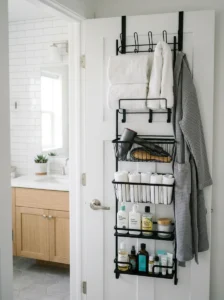
The back of a bathroom door is a vertical surface that’s hidden when the door is open and invisible when the door is closed — which means whatever is stored there doesn’t contribute to visual clutter in the room.
An over-door organizer — a unit that hangs from the top of the door with hooks — can hold towels, robes, hair tools, or bags. A door-mounted rack with multiple pockets or small shelves holds smaller items: hair accessories, daily skincare, small bottles, a backup supply of toiletries.
The consideration with door-back storage is clearance: the door must close fully with the organizer attached. Measure the gap between the door face and the nearest wall, cabinet, or obstacle when the door is in the closed position before committing to any door-mounted unit.
The weight capacity of over-door units also deserves attention. Most are designed for light items. Heavy objects — full-size bottles, appliances — should not be door-mounted without hardware rated for the weight.
Floating Shelves: The Most Versatile Addition Available
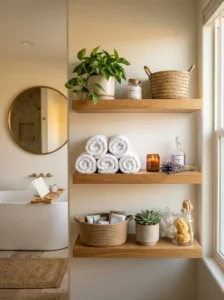
A floating shelf on any wall that currently has nothing on it adds storage in direct proportion to its dimensions and requires nothing beyond mounting hardware and a level. In a bathroom, the question is not whether floating shelves would help — they almost always would — but where the available wall space is.
Wall space candidates in most bathrooms:
- The wall opposite the vanity, which often has nothing on it
- The wall beside the toilet, below a window or between two fixtures
- The space on either side of the mirror above the vanity
- The wall section above the door, which is often two feet of unused height
- Inside the shower or wet room, as a tiled niche or water-resistant shelf
For bathroom floating shelves in wet-adjacent areas — not inside the shower, but near the sink or tub — material choice matters for longevity. Sealed wood works but requires maintenance. Powder-coated metal, tempered glass, or water-resistant composites hold up better against the regular humidity a bathroom generates.
The Shower Niche: Adding Storage Where It’s Most Needed
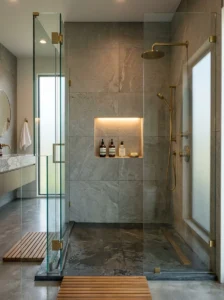
The inside of a shower is one of the most storage-demanding locations in the bathroom — shampoo, conditioner, body wash, razors, and an accumulation of products that expand to fill the ledge they’re given. A hanging caddy does the job functionally but never quite fits the aesthetic of a well-finished bathroom and eventually shows rust or discoloration.
A recessed shower niche — a box cut into the wall between studs and tiled to match the shower — is the clean, permanent solution and one of the most worthwhile investments in a shower renovation. It’s a built-in shelf that takes no floor or ledge space, doesn’t accumulate rust, and integrates visually with the shower rather than being an afterthought hanging from the shower head.
Adding a shower niche requires accessing the wall cavity and is most practically done during a shower renovation rather than as a standalone project. It is, however, worth specifically including in the scope of any shower work being planned — the additional cost relative to the functional improvement is among the most favorable in any bathroom renovation.
For bathrooms where a shower renovation isn’t planned, a water-resistant corner shelf in a material appropriate to the shower environment — stainless steel, teak, or a surface-mounted ceramic shelf — provides some of the same benefit with installation rather than reconstruction.
Hooks: The Most Underused Tool in Bathroom Storage
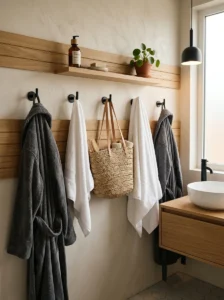
Hooks are not decorative accessories — they are primary storage infrastructure in any bathroom with limited fixed storage, and most bathrooms have far fewer than the space and the household actually need.
A single towel rail does one or two people’s towels adequately. Add a hook for a robe. Add hooks for multiple family members’ daily towels. Add a hook for the bag that gets brought into the bathroom. Add a hook for the wet swimsuit that needs to dry.
The math of hooks is simple: every hook corresponds to one object that isn’t on the floor or the counter. In a bathroom where surfaces are already crowded, that’s a meaningful exchange.
Hooks in bathrooms can be:
- Wall-mounted on any available wall surface, including the backs of doors as described above
- Over-door hooks for robes, towels, and bags
- Adhesive-mounted for renters or situations where drilling isn’t possible — modern adhesive hooks rated for bathroom environments hold several pounds reliably and remove without wall damage when properly used
The placement of hooks matters as much as their presence. Hooks at a useful height for the person who will use them, positioned where they’ll naturally be reached for rather than an awkward detour from the exit path, actually get used. Hooks placed in awkward positions don’t.
What to Store Outside the Bathroom
The bathroom is a small room asked to store everything related to grooming, hygiene, and daily personal care. In most bathrooms, the available space cannot comfortably accommodate all of it — and the solution isn’t always more storage inside the bathroom.
Items that work well stored elsewhere:
Backup supplies — the extra shampoo, the spare body wash, the replacement razors — don’t need to be in the bathroom until they’re needed. A hall closet, linen cupboard, or under-sink area in another room handles backup stock without contributing to bathroom crowding.
Medications — commonly stored in the bathroom by habit, but the humidity and temperature fluctuation of a bathroom is actually among the worst environments for medication storage. A cool, dry bedroom or hall closet is better for medication efficacy, and moving them there frees bathroom cabinet space for items that genuinely need to be there.
Cleaning supplies — the toilet brush and cleaning products belong in the bathroom for use, but the backup stock of cleaning products belongs with the broader household cleaning supplies rather than crowding the under-sink cabinet.
Infrequently used items — the facial steamer used monthly, the hair color kit used seasonally, the large travel bag of toiletries assembled for trips — these earn bathroom storage only during active use. Between uses, any available storage elsewhere in the home serves them better.
Key Takeaways
- An honest product edit before adding any storage recovers significant existing capacity and right-sizes the actual problem
- The wall above the toilet is the most available and most ignored storage zone in most bathrooms — over-toilet units and wall shelves use it without structural change
- Under-sink storage is almost always improvable with organizers designed around the pipe, pull-out drawers, and door-mounted pockets
- A medicine cabinet does two jobs where a mirror does one — the same wall footprint, meaningfully more function
- Door backs provide concealed storage for items that don’t need to be visible
- Floating shelves on any available wall add storage in direct proportion to the time it takes to mount them
- A recessed shower niche is the most functional and visually clean shower storage solution — worth including in any planned shower work
- Hooks are primary storage infrastructure, not decoration — most bathrooms need more of them
- Moving backup supplies, medications, and infrequently used items out of the bathroom reduces what the bathroom needs to store
Frequently Asked Questions
How do I add storage to a rented bathroom without drilling into walls? Several options work without permanent installation. Over-toilet freestanding units, over-door organizers, adhesive hooks rated for bathroom use, freestanding shelving units that stand on the floor, and surface-mounted medicine cabinets that use removable adhesive mounting are all viable. Adhesive-mounted products specifically marketed for bathroom environments — resistant to humidity and designed to remove cleanly — have improved significantly and hold more weight reliably than they once did.
What’s the most useful single piece of storage furniture for a small bathroom? For most bathrooms with no vanity storage, a surface-mounted medicine cabinet — mirror on the front, shelving inside — gives the most return per installation effort. It adds several shelves of accessible daily-use storage at eye height, where the most-reached-for items belong, in the exact wall space already used by the mirror it replaces.
Can floating shelves hold heavy bathroom items like full-size product bottles? Yes, with appropriate mounting for the wall type. Shelves mounted with proper wall anchors into drywall, or into the wall studs, hold considerably more weight than the shelf itself is likely to require for bathroom products. The critical step is matching the mounting hardware to the wall material — drywall anchors for hollow walls, masonry anchors for concrete or brick, stud mounting for the heaviest loads. Using the wrong anchor type is what causes shelf failures, not the shelves themselves.
Should bathroom storage be open shelves or closed cabinets? It depends entirely on what’s being stored and how much visual tidiness matters. Open shelves are more accessible and visually lighter in a small bathroom, but they display their contents and require that the contents look reasonably organized. Closed cabinets conceal everything and allow more casual organization inside, but they add visual weight and can make a small bathroom feel more enclosed. A combination — closed storage for daily items and small products, open storage for display items like plants, candles, and neatly folded towels — gives the benefit of both.
Is it worth renovating a bathroom specifically to add built-in storage? If the bathroom is otherwise in reasonable condition and the only significant issue is storage, a targeted renovation limited to specific storage additions — a medicine cabinet replacement, a shower niche, a new vanity with storage — is generally worth the investment. A full bathroom renovation to solve a storage problem alone is rarely the most cost-efficient path. The freestanding and wall-mounted solutions described in this article typically solve most bathroom storage problems for a fraction of what even a limited renovation costs.