


Some bathrooms photograph beautifully and are exhausting to maintain. Others look modest and stay clean with almost no effort. Here’s what actually separates the two — and how to choose materials that work with daily life instead of against it.A showroom bathroom and a lived-in bathroom are not the same test. The showroom version is evaluated once, under staged lighting, with no toothpaste on the counter and no one’s hair on the floor. The lived-in version is evaluated every single day, usually in passing, usually with less-than-ideal lighting, and usually after it’s already been used that morning. A bathroom can pass the first test brilliantly and fail the second one constantly — and the gap between the two isn’t about how often someone cleans. It’s about which materials were chosen before cleaning ever became a daily habit.
This is worth separating clearly, because most bathroom renovation decisions are made while looking at a single beautiful photo, not while imagining a Tuesday morning six months later. The materials that photograph best are frequently the materials that show the most evidence of daily life — and the ones that photograph modestly are frequently the ones that quietly stay looking fine with almost no effort.
Visual Cleanliness and Actual Cleanliness Are Different Properties
A surface can look dirty without being unsanitary, and it can look clean while harboring more grime than a surface that shows every mark. These are two separate properties — visibility of mess, and actual presence of mess — and bathroom materials vary enormously on both.
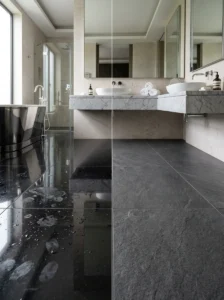
Textured tile and matte grout are honest about mess but slow to show it. A slightly textured floor tile scatters light in a way that hides hair, dust, and water spots far better than a smooth glossy tile does, even when the actual amount of debris on both floors is identical. This is a genuine advantage for daily appearance, with a real trade-off: texture also traps more debris in its surface, which means it needs actual cleaning more often even while looking like it doesn’t.
Glossy surfaces are the opposite: they show everything immediately, whether or not it matters. A glossy black tile or a polished chrome fixture reveals every water spot, every fingerprint, and every smear of toothpaste within minutes of use, regardless of whether the surface is actually unsanitary. This is why glossy black surfaces have a specific reputation for looking perpetually smudged in daily use, despite being, in strict hygienic terms, no dirtier than a matte surface would be after the same use.
Neither property is objectively better. The choice is about what a household actually wants to manage: a surface that hides mess and needs periodic deeper cleaning, or a surface that shows mess immediately and needs frequent light wiping to look presentable.
Grout: The Detail That Decides More Than It Should
Grout color is one of the highest-leverage, lowest-cost decisions in a bathroom, and it’s frequently made based on which sample looked most premium in the showroom rather than on how it performs afterward.
Light and white grout looks clean and expensive on installation day and shows every subsequent stain. Its porous surface absorbs soap residue, hair product, and everyday grime, and because the color starts so light, any darkening reads immediately and looks like neglect even when the grout is being cleaned regularly. White grout in a shower, specifically, is one of the most common sources of a bathroom looking dated and dirty within a year or two of a renovation that was otherwise well-executed.
Mid-tone or dark grout hides the same amount of staining almost entirely. A charcoal or medium-gray grout absorbs the same soap residue and grime that white grout does, but the color shift is invisible against a background that’s already dark. This is a purely practical trade rather than an aesthetic downgrade — dark grout has become a standard choice in higher-end bathroom design specifically because designers have learned this maintenance lesson, not despite it.
Epoxy grout, regardless of color, resists staining significantly better than standard cement grout, because it’s far less porous. It costs more and is somewhat harder to install, but for a shower specifically — the wettest, highest-staining-risk grout in the house — it’s a durable upgrade that reduces the maintenance gap between light and dark grout considerably.
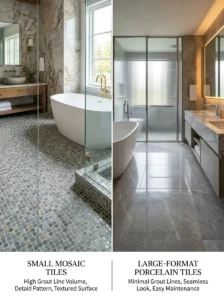
Tile Size: Fewer Grout Lines Is a Maintenance Strategy, Not Just a Look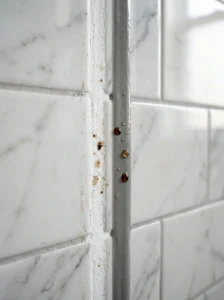
Grout lines are the least sanitary and highest-maintenance part of almost any tiled surface, which makes tile size a direct maintenance variable and not only a stylistic one.
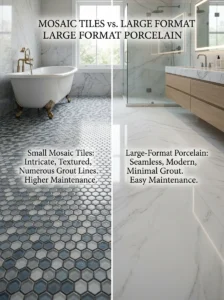
A small mosaic tile has vastly more grout line per square foot than a large-format tile does. A shower floor tiled in one-inch mosaic pieces might have ten times the linear grout length of the same floor in twelve-inch tiles. Every inch of that grout is a place that stains, needs sealing, and requires scrubbing that flat tile surfaces don’t. The visual appeal of small mosaic — often chosen for shower floors because it accommodates the slope needed for drainage — comes with a maintenance cost that’s rarely mentioned at the point of selection.
Large-format tile, used wherever the surface is flat enough to accommodate it, reduces the grout-line problem dramatically. Walls, floors outside the shower, and even shower floors with slight format adjustments can often use larger tile than the default mosaic, cutting the amount of grout — and therefore the amount of staining-prone surface — substantially.
This is worth weighing deliberately rather than defaulting to whatever the tile showroom displays most prominently, since mosaic and small-format tile are often presented as the standard shower floor option without the maintenance trade-off being mentioned.
Glass Shower Doors vs. Curtains: The Trade Nobody States Plainly

A glass shower enclosure reads as more expensive and more modern than a shower curtain, and it also requires meaningfully more maintenance to maintain that appearance. This is a direct trade, not a strict upgrade, and it’s worth being honest about before installing one.
Glass shows water spots and soap scum within days without a squeegee habit. Hard water minerals etch and cloud glass permanently if left unaddressed, and soap scum builds a visible film that requires more than a quick wipe to remove once established. A glass enclosure that isn’t squeegeed after most uses will look noticeably worse within a few weeks than the same shower would with a curtain, which simply gets washed or replaced periodically instead of needing continuous surface maintenance.
A shower curtain has a lower maintenance ceiling but a lower maintenance floor. It never achieves the clean, expensive look of glass, but it also never develops the specific etched, spotted, cloudy look of neglected glass — because a curtain that’s dirty gets washed or replaced rather than slowly and permanently degrading. For a household that knows it won’t maintain a daily squeegee habit, a curtain is arguably the lower-maintenance choice despite reading as the less premium one.
Frameless glass is worse for maintenance than framed glass, ironically. Frameless enclosures are cleaner-looking and more expensive, but the exposed edges and larger hardware-free glass panels show water spots and streaking more visibly than framed glass, where sightlines are broken up by metal framing that partially hides the same amount of buildup.
Fixture Finish: Which Metals Show Water Spots

Fixture finish affects daily appearance nearly as much as tile choice, and the differences are specific enough to be worth knowing before selecting a finish based on trend alone.
Matte black is the most dramatic version of the glossy-surface problem. It shows water spots, fingerprints, and dried toothpaste with high contrast against the dark, non-reflective surface — a faucet that looks sleek in a photo can look visibly spotted within a day of normal household use. This doesn’t make matte black a poor choice, but it does mean it requires more frequent wiping than other finishes to maintain the look it’s chosen for.
Brushed and satin finishes — brushed nickel, brushed brass, satin brass — hide water spots and fingerprints substantially better than polished or matte finishes. The texture of the brushing scatters light in a way that disguises mineral deposits and smudges, which is the same underlying principle as textured tile hiding debris. This is a significant part of why brushed finishes have remained a steady, practical choice across design trend cycles even as high-shine and matte-black finishes have moved in and out of fashion.
Polished chrome sits in between. It shows water spots more than brushed finishes but is easier to wipe clean and restore to a spotless look than matte black, since the reflective surface makes streaks from wiping less visible than they’d be on a matte one.
Sinks and Counters: The Edge Is Where Grime Collects

An undermount sink, where the counter surface runs continuously to the sink’s edge with no raised lip, can be wiped directly into the sink in one motion. This is a small daily convenience that compounds significantly over time — no ridge for toothpaste, soap residue, or water to collect against, and no seam that requires separate attention from the counter cleaning.
An overmount or drop-in sink has a raised edge where it sits on top of the counter, and that edge is exactly where grime, water, and residue collect and require separate scrubbing. It’s a small detail, but it’s the kind of small detail that determines whether wiping down a bathroom counter takes ten seconds or genuinely requires effort every time.
Counter material affects this too. A quartz or solid-surface counter with an integrated sink — no seam anywhere between counter and basin — removes the edge problem entirely and is close to the practical maximum for easy daily maintenance, at a cost premium over a standard undermount installation.
Choosing Deliberately Instead of Defaulting to What Photographs Well
None of this means glossy tile, glass enclosures, matte black fixtures, or white grout are wrong choices. It means they come with a specific, predictable maintenance cost that’s worth knowing in advance rather than discovering after the renovation is finished. A household that genuinely enjoys the daily ritual of squeegeeing glass and wiping down matte black fixtures will be perfectly happy with a high-maintenance-but-striking bathroom. A household that wants a bathroom to look consistently presentable with minimal daily effort is generally better served by textured tile, dark or epoxy grout, brushed fixtures, large-format tile, and either a well-maintained curtain or a genuinely committed glass-cleaning habit.
The honest version of this decision happens before the materials are ordered, by asking what the household will actually do on a normal Tuesday — not what looked best in the showroom on the day of selection.
Key Takeaways
- Visual cleanliness and actual cleanliness are different properties — glossy surfaces show mess immediately regardless of hygiene, while textured surfaces hide mess while still needing regular cleaning
- Grout color is one of the highest-leverage low-cost decisions in a bathroom — dark or epoxy grout hides the same staining that white grout reveals within months
- Larger tile format directly reduces maintenance by reducing the total amount of grout line, which is the hardest-to-clean part of most tiled surfaces
- Glass shower enclosures look more premium than curtains but require a genuine squeegee habit to avoid looking worse than a curtain within weeks
- Matte black fixtures show water spots dramatically; brushed and satin finishes hide the same spots substantially better
- Undermount sinks and seamless counter-to-sink transitions remove the edge where grime collects, making daily wiping meaningfully faster
Frequently Asked Questions
Is dark grout actually dirtier than white grout, or does it just look cleaner? It’s not dirtier — it absorbs and accumulates the same soap residue and grime that white grout does, but the color shift from staining is far less visible against a darker base color. White grout looks cleaner only on day one; dark grout looks cleaner for years, for the same underlying level of actual cleanliness.
Are glass shower doors a mistake if I know I won’t squeegee every time? Not necessarily a mistake, but worth going in with clear expectations. Glass that isn’t squeegeed regularly will develop visible water spots and soap scum within weeks, and hard water etching can become permanent if left unaddressed for long stretches. A household that knows it won’t maintain that habit is often better served by a curtain or by budgeting for a professional glass cleaning a few times a year.
Why does matte black look so much dirtier than other finishes so quickly? Matte black has essentially no reflective quality to disguise surface marks, so water spots, fingerprints, and residue show in high contrast against the dark, non-reflective surface. Brushed and satin finishes scatter light across their textured surface in a way that hides the same amount of residue far more effectively.
Is it worth paying more for epoxy grout instead of standard cement grout? For a shower specifically, generally yes. Epoxy grout resists staining and moisture penetration significantly better than standard cement grout because it’s far less porous, which reduces the gap between how light and dark grout perform over time. For lower-moisture areas like a bathroom floor outside the shower, the upgrade matters less.
Does tile size actually make a meaningful cleaning difference, or is it a minor detail? It’s a meaningful difference, not a minor one. A small mosaic tile can have many times the linear grout length of the same area in large-format tile, and grout is consistently the hardest-to-clean, most stain-prone part of a tiled surface. Choosing larger tile wherever the surface allows it is one of the more effective structural decisions available for reducing ongoing bathroom maintenance.