

Open shelving looks effortless in photos and chaotic in daily use for most households. Here’s what actually separates a styled shelf from a cluttered one — and how to keep it that way after the first week.Open shelving is one of the most common gaps between a bathroom photo and a bathroom in use. In the photo, three or four objects sit on a shelf with generous space around each one, arranged with obvious intention. In use, a household’s actual bathroom inventory — shampoo, conditioner, a razor, a half-used bar of soap, sunscreen, a toothbrush cup, cotton swabs, whatever skincare routine is currently in rotation — arrives at that same shelf within a week and looks nothing like the photo. This isn’t a failure of styling instinct. It’s a mismatch between how open shelves are staged for photography and how many objects a bathroom actually needs to store.
Getting open shelving to look intentional in daily use is less about arranging objects artfully and more about controlling which objects are allowed on the shelf in the first place, and how the ones that are allowed there are contained.
The Real Problem Isn’t Arrangement — It’s Volume
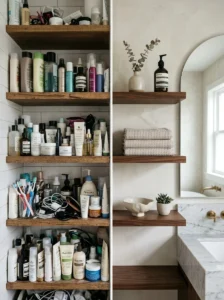
Most styling advice for open shelves focuses on arrangement: group in threes, vary height, add a plant. This advice isn’t wrong, but it solves a problem most bathrooms don’t actually have. The problem most bathrooms have is that open shelving is being asked to store the full working inventory of a bathroom — a job closed storage does much better — and no arrangement technique makes twelve daily-use bottles look like a curated vignette.
The first decision, before any styling begins, is what doesn’t go on the open shelf at all. Daily-use functional items — the shampoo actually being used in the shower, the razor, the exfoliating scrub, anything in active rotation — belong in closed storage: a cabinet, a drawer, an in-shower caddy, or a closed basket. What goes on an open shelf is a smaller, curated subset: items used occasionally, items that look good enough to display, and a small number of purely decorative objects that anchor the arrangement.
This single reallocation — moving daily clutter to closed storage and reserving open shelves for a smaller, chosen set of objects — solves most of the “why doesn’t my shelf look like the photo” problem before any arrangement technique is applied.
What Actually Belongs on an Open Shelf
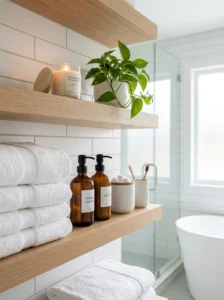
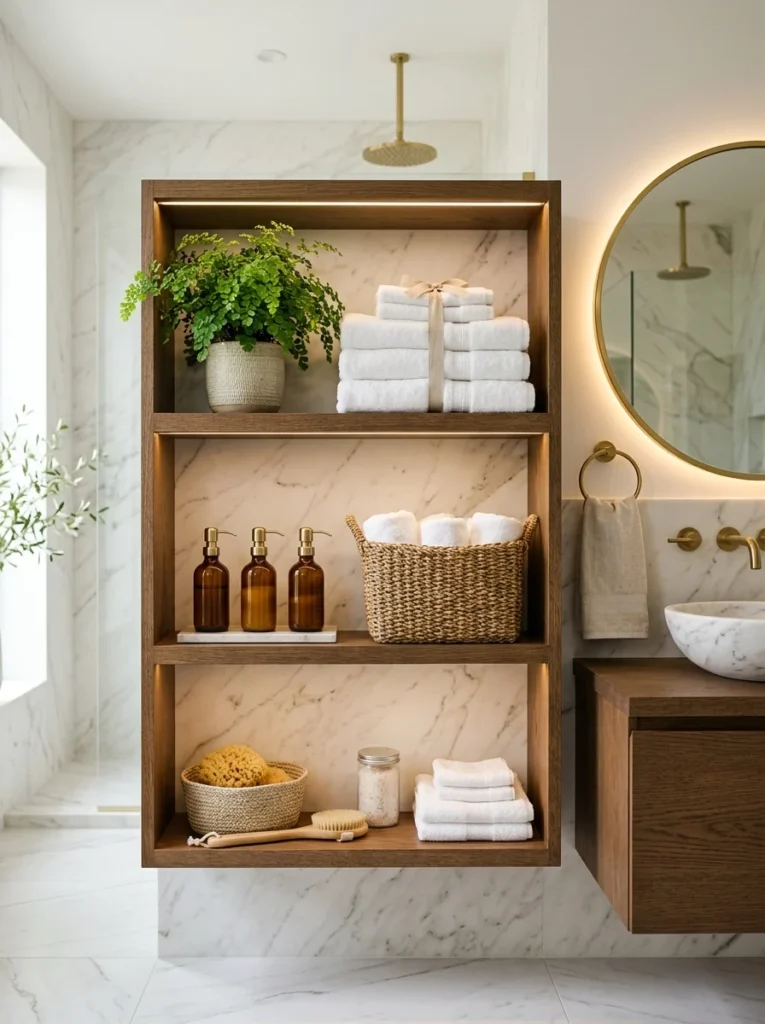
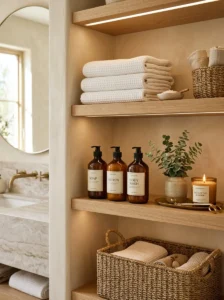
Folded towels are the most reliable open-shelf object, because they’re large, textural, and visually calming in a way that small bottles aren’t. A stack of two or three towels, folded consistently and in a limited color palette, does more to make a shelf look intentional than any arrangement of small objects can. Towels also solve their own maintenance problem: they’re used and replaced in a natural cycle, so they don’t accumulate the way half-used product bottles do.
Decanted products in matching containers handle the items that do need to be visible — hand soap, lotion, a small number of frequently reached-for items — without the visual noise of mismatched branded packaging. A set of two or three matching pump bottles or glass containers reads as intentional in a way that the same products in their original retail bottles don’t, largely because branded packaging is designed to compete for attention on a store shelf, which is the opposite of what a calm bathroom shelf needs.
A small number of purely decorative objects — a plant, a candle, a small dish or tray — anchor the shelf and give the eye somewhere to rest between functional items. These objects earn their space by adding visual interest without adding clutter, which is different from functional items that are on the shelf simply because they didn’t have anywhere else to go.
What doesn’t belong, even if there’s room: anything in active daily use with more than a week or two of remaining product, anything in its original retail packaging with visible branding, and more than a small number of similar-category objects. A shelf with six different skincare bottles, regardless of how neatly they’re lined up, reads as inventory rather than as a styled shelf.
Containment: The Technique That Does the Most Work
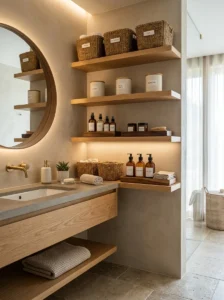
The single most effective tool for keeping a smaller number of necessary functional items from looking cluttered is grouping them inside a container rather than placing them individually on the open shelf.
A tray or shallow basket holding several small items reads as one object, not several. Cotton swabs, a small dish of hair ties, and a few skincare items grouped on a single tray occupy the same shelf space they would individually, but the eye processes them as one unit instead of several competing objects. This is the same principle that makes a junk drawer feel chaotic when opened but invisible when closed — containment converts multiple small objects into a single visual unit.
Baskets with lids or closed sides go further, hiding the contents entirely while keeping them within reach on the shelf. This is the right choice for items that need to be accessible but don’t need to be seen — extra toilet paper, cleaning supplies, backup products not yet in rotation.
Uniform containers across a shelf create a sense of intentional system even when the contents vary. Three matching woven baskets, each holding a different category of item, look considerably more organized than the same three categories of items placed loose on the shelf, even though the actual level of organization inside each basket might be identical.
Repetition and Restraint in the Arrangement Itself
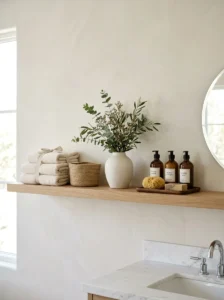
Once the volume problem and containment are addressed, arrangement principles do meaningful additional work, though they matter less than the previous two steps.
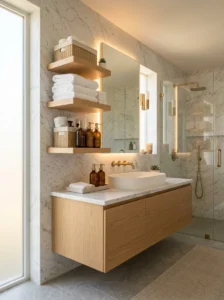
Grouping in odd numbers — three objects rather than two or four — reads as more intentional to most people, a principle borrowed directly from visual merchandising. A single shelf styled with three grouped elements (a stack of towels, a tray, a plant) looks more resolved than the same shelf with five or six individually placed items.
Height variation prevents a flat, lined-up look. A tall item — a plant, a taller vessel — next to a shorter stack of towels or a low tray creates visual interest that a shelf of uniformly sized objects doesn’t. This doesn’t require dramatic height differences; even a modest variation is enough to avoid the flat effect of everything sitting at the same level.
Negative space is doing real work, not wasted space. A shelf filled edge to edge, even with well-chosen objects, reads as cluttered regardless of what those objects are. Leaving visible empty space around and between groupings — often described as breathing room — is part of what makes a styled shelf look calm rather than full. This is frequently the first thing sacrificed when a household starts adding “just one more thing” to a shelf that was originally styled with restraint.
Maintaining It Past the First Week
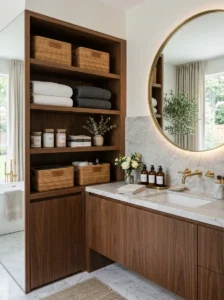
The reason open shelves in real bathrooms drift back toward clutter isn’t a failure of the original styling — it’s that the shelf becomes the default landing spot for whatever doesn’t have another home. A new product arrives, there’s no obvious place for it, and the open shelf is right there.
The sustainable fix is having a designated closed-storage spot for every category of item before it’s needed, so a new bottle of sunscreen or a backup pack of razors has somewhere to go that isn’t the open shelf. A bathroom where every functional item has an assigned closed-storage location rarely drifts, because there’s no ambiguity about where new items belong.
A periodic reset — five minutes, roughly monthly — catches drift before it compounds. Products that have migrated from a drawer to the shelf, containers that have quietly filled past their intended capacity, items that were meant to be temporary and have become permanent: a short regular check catches these before the shelf gradually reverts to its pre-styling state.
The household member using the shelf daily needs to buy into the system for it to hold. A beautifully styled shelf that doesn’t account for how the primary daily user actually behaves — where they reach for things, what they use every day, how much they’re willing to put away after each use — will drift back to clutter regardless of how well it was initially designed. The most durable version of a styled open shelf is one built around actual daily habits, not around an idealized version of how the household would like to behave.
Key Takeaways
- The core problem with cluttered open shelves is usually volume, not arrangement — daily-use items belong in closed storage, leaving only a smaller curated set for open display
- Folded towels are the single most reliable open-shelf object because they’re visually calming and naturally cycle through use and replacement
- Grouping small items in a tray or basket converts several competing objects into a single visual unit, which does more for a tidy appearance than individual arrangement
- Decanting frequently-used products into matching containers removes the visual noise of competing retail branding
- Odd-numbered groupings, modest height variation, and visible negative space are real techniques, but they matter far less than solving the underlying volume and containment problem first
- A styled shelf stays styled only if every category of bathroom item has a designated closed-storage home, so new products don’t default to landing on the open shelf
Frequently Asked Questions
How many items should actually be on an open bathroom shelf? There’s no fixed number, but a shelf styled around three to five groupings — where each grouping might be a single object or a small contained cluster — generally reads as intentional. Once the count of individually visible objects climbs much past that, even careful arrangement struggles to keep the shelf from reading as cluttered.
Should shampoo and conditioner ever go on an open shelf? Generally not the bottles in active daily use, since they arrive with retail branding, get used down unevenly, and rarely look intentional regardless of arrangement. Decanting a small amount into a matching container for guest-facing display, while keeping the working bottle in shower storage, is a common workaround for households that want the product visible without the retail packaging.
Do open shelves work in a small bathroom, or do they just show clutter faster? They can work, but small bathrooms have less margin for error, since there’s less shelf space to absorb overflow and less distance for a viewer’s eye to be forgiving. In a small bathroom, the volume-reduction and containment principles matter even more than in a larger one — a smaller number of well-contained groupings, rather than an attempt to display more.
Is it worth buying matching containers, or is this an unnecessary expense? For anyone planning to keep an open shelf styled long-term, matching containers are one of the higher-impact, lower-cost purchases available, because they solve the branding-noise problem that arrangement alone can’t fix. It’s not necessary to buy an entire matching set at once — even replacing the two or three most visually dominant items with simple, uniform containers makes a noticeable difference.
What’s the fastest way to fix a bathroom shelf that’s already cluttered? Remove everything from the shelf, then add back only what genuinely belongs there — a smaller set of occasional-use and decorative items — while relocating daily-use items to closed storage first. Attempting to rearrange an already-overloaded shelf without first reducing what’s on it rarely produces a lasting result, since the volume problem is still present underneath any new arrangement.