


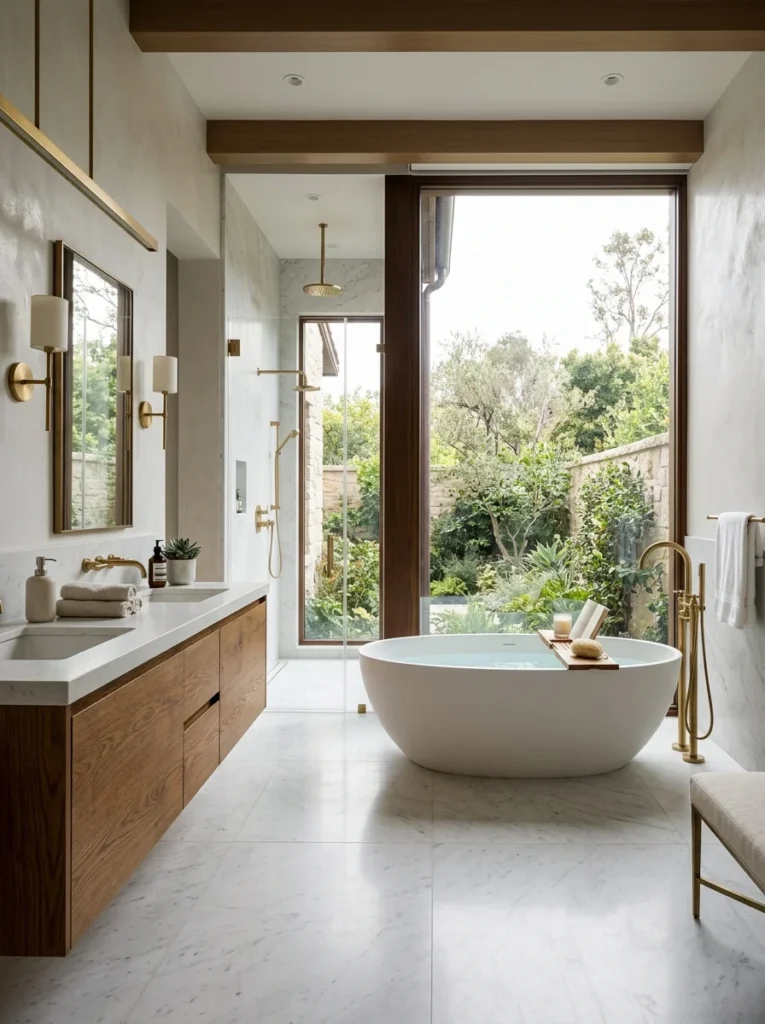
Freestanding tubs are the single most requested bathroom upgrade in renovation photos, and one of the most frequently regretted. Here’s what the photos don’t show, and who a freestanding tub actually works for.A freestanding tub is the fastest way to make a bathroom photo look expensive. It’s become the default visual shorthand for a luxury renovation — sitting alone in the frame, often in front of a window, with none of the surrounding cabinetry or fixtures competing for attention. This is exactly why it’s requested so often, and exactly why it’s worth separating what the tub does for a photograph from what it does for a household actually living with it every day.
None of this means freestanding tubs are a bad choice. For the right bathroom and the right household, they’re genuinely wonderful. But they come with a specific set of trade-offs that rarely make it into the photo, and a renovation decision made primarily on how a tub will look tends to skip past questions that matter more for how it will function.
The Space Cost Is Larger Than It Looks in Photos
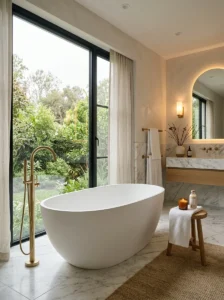
A freestanding tub needs clearance on all sides to look and function as intended — it’s designed to be walked around, not tucked against a wall like a built-in alcove tub. Photos rarely show this clearance because the photo is framed to make the tub the entire subject, cropping out the empty floor space required around it.
This clearance requirement means a freestanding tub often uses considerably more total floor area than a built-in tub of similar bathing capacity. A built-in tub against a wall, by contrast, only needs clearance on the open side, since the other three sides are already enclosed by the wall or a surround. In a bathroom where floor space is already tight, a freestanding tub can end up consuming space that would otherwise go toward a larger shower, more counter area, or simply a room that doesn’t feel cramped to move through.
The tub also needs to be reachable from all sides for cleaning and use, which means it typically can’t be pushed close to a wall the way a built-in can, even in a space-constrained bathroom. A freestanding tub positioned too close to a wall to save space undermines the reason for choosing a freestanding style in the first place, while still incurring its space cost.
Cleaning Underneath and Around Is a Real, Ongoing Task
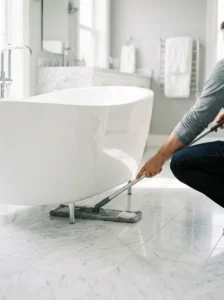
A built-in tub has no underside to clean — it’s sealed against the floor and wall, with no gap for dust, hair, or moisture to collect. A freestanding tub, by design, has visible legs or a base with a gap beneath it, and that gap collects dust and debris the same way the space under any furniture does, except in a room where moisture and hair are constantly present.
The area underneath a freestanding tub is awkward to reach and easy to neglect. It’s low, often tight, and not part of the routine wipe-down that covers the rest of the bathroom. Over time, this space accumulates dust, hair, and in humid bathrooms, occasionally mold or mildew if moisture collects and isn’t addressed. This isn’t a flaw in every freestanding tub, but it’s a maintenance task that a built-in tub simply doesn’t have, and it’s rarely mentioned when a freestanding tub is being chosen primarily for its look.
The exterior surface of the tub itself, particularly if it’s a matte or textured material, also needs its own regular cleaning on all sides, rather than the single accessible front panel a built-in tub with a surround presents. A freestanding tub is, in a real sense, one more full piece of furniture to maintain in a room that already has several.
Splashing and Water Containment Work Differently
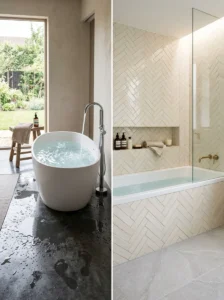
A built-in tub is typically enclosed on three sides, which naturally contains splashing within a smaller, wall-protected area. A freestanding tub, positioned away from walls, has no such containment on most sides, which means water splashed during bathing — especially with children, who are the primary users of tub-specific bathing in most households — has more places to go.
This matters most for households with young children who bathe rather than shower. The active splashing that’s routine during a child’s bath sends water toward the floor, and a freestanding tub with open sides has considerably more exposed floor perimeter to manage than a built-in tub tucked against two or three walls. For this specific use case, a built-in tub with a shower curtain or door is often the more practical choice regardless of how the freestanding option looks.
Freestanding tubs also frequently don’t include an integrated shower, since the open design doesn’t accommodate a curtain or door in most configurations. A household that wants to actually shower in the same fixture — a common daily need in most bathrooms — either needs a separate shower entirely or needs to accept that the freestanding tub is purely for bathing, not for daily use.
The Faucet Question Is More Complicated Than It Looks
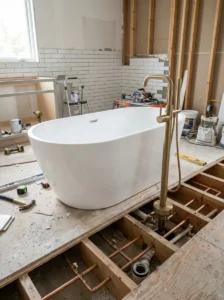
A freestanding tub needs its own dedicated faucet, either floor-mounted and rising up beside the tub, or wall-mounted at the correct height and position to reach into the tub’s basin. This is different from a built-in tub, which typically uses a deck-mounted or wall-mounted faucet integrated into the surrounding structure.
Floor-mounted tub fillers require plumbing to be run through the floor to the exact location the faucet will sit, which is straightforward in new construction but can be a significant additional cost in a renovation of an existing bathroom, where floor plumbing wasn’t originally planned for that location. This is one of the most commonly underestimated costs in a freestanding tub renovation — the tub itself may be comparably priced to a quality built-in tub, but the plumbing work to support a floor-mounted or precisely positioned wall-mounted faucet adds a real and sometimes substantial cost that doesn’t show up when comparing tub prices alone.
Who a Freestanding Tub Actually Works Well For
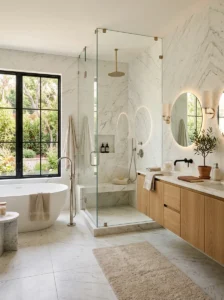
None of this is an argument against freestanding tubs — it’s an argument for choosing one based on how a household actually uses a bathroom, not based on how the tub looks alone.
A freestanding tub works well in a primary bathroom used mainly by adults, where bathing is occasional rather than a daily children’s routine, and where a separate shower already exists elsewhere in the bathroom or the house. In this scenario, the tub’s function is closer to a spa-like occasional indulgence than a daily-use fixture, and the space, cleaning, and splash considerations matter less because the tub simply isn’t being used as often or as actively.
It works well in a bathroom with enough square footage that the clearance requirement doesn’t compromise anything else — where adding a freestanding tub doesn’t mean subtracting from shower size, counter space, or general room to move.
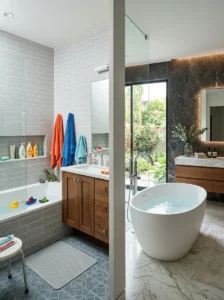
It works less well in a family bathroom used for daily children’s baths, in a bathroom where floor space is already limited, or in a household that wants a single fixture to handle both bathing and daily showering. In these cases, a built-in tub — which can still look considered and well-designed without the freestanding format — is often the more functional choice, even though it won’t produce quite the same photograph.
Key Takeaways
- Freestanding tubs require clearance on all sides, which uses meaningfully more floor space than a built-in tub of similar capacity — a cost that’s rarely visible in photos
- The gap beneath a freestanding tub is an added, easy-to-neglect cleaning task that built-in tubs don’t have
- Open-sided freestanding tubs contain splashing less effectively than built-in tubs, which matters most for households bathing young children
- Freestanding tubs rarely integrate a shower, meaning many households need a separate shower fixture entirely
- Floor-mounted or precisely positioned faucets often require plumbing work beyond what a comparable built-in tub needs, adding cost that isn’t reflected in the tub’s price alone
- Freestanding tubs suit adult-primary, occasional-use bathrooms with generous floor space more than daily-use family bathrooms with space constraints
Frequently Asked Questions
Is a freestanding tub a bad idea in a small bathroom? Not automatically a bad idea, but it requires careful planning, since the clearance a freestanding tub needs for both function and visual effect competes directly with limited floor space. In a small bathroom, that clearance often has to come from somewhere else — a smaller shower, less counter space, or a tighter walking path — which is worth deciding deliberately rather than discovering after installation.
Do freestanding tubs actually mold underneath them? Not inevitably, but the space beneath a freestanding tub is more prone to accumulating dust and moisture than a sealed built-in tub, simply because it’s an enclosed, low, hard-to-reach gap in a room that regularly has water and humidity present. Regular cleaning underneath, and ensuring the bathroom has adequate ventilation generally, keeps this from becoming a problem in most cases.
Can a freestanding tub have a shower too? It’s uncommon but not impossible — some freestanding tub configurations use a ceiling-mounted shower rod and curtain that encircles the tub, though this changes the open, sculptural look that’s usually the reason for choosing a freestanding tub in the first place. Most households that want both bathing and daily showering in the same bathroom end up with a separate shower enclosure alongside the freestanding tub rather than trying to combine both functions in one fixture.
Why does a freestanding tub cost more than expected once plumbing is factored in? The tub itself is often comparably priced to a good built-in tub, but freestanding tubs typically need a floor-mounted or precisely positioned wall-mounted faucet, which frequently requires new plumbing routed to a specific floor or wall location that wasn’t part of the original bathroom’s layout. This plumbing work, particularly in a renovation of an existing bathroom rather than new construction, is the cost that most commonly exceeds initial budget estimates.
Is a built-in tub actually less attractive, or just less photographed? Less photographed is closer to accurate. A well-designed built-in tub, especially one integrated into a considered tile surround or paired with a well-chosen faucet, can look just as intentional as a freestanding tub — it simply doesn’t have the same single-object visual drama that makes freestanding tubs a popular choice for a hero renovation photo. The functional advantages of a built-in tub are independent of how photogenic the freestanding alternative is.