


Bathroom fixtures that look dated within three years almost always share specific characteristics. Here’s exactly what to look for — and what to avoid — before making decisions you’ll live with for a decade.Bathroom fixture showrooms are among the most carefully merchandised retail environments in the home improvement industry. Every finish is displayed at its most flattering angle under lights designed to make it look definitive. Every tap is positioned against a backdrop that communicates: this is the obvious choice right now. What no showroom has any incentive to show you is what any of these fixtures will look like in three years, surrounded by fittings whose finishes have shifted, in a bathroom where the specific design language that made this tap look fresh has already moved into its decline phase.
The bathroom fixture industry runs on a renewal cycle. New finishes are introduced, celebrated in design media, adopted at scale, and eventually positioned as the “before” in renovation content that’s selling the next cycle. The homeowner who buys a faucet at peak adoption — the moment when it appears in every showroom, every renovation blog, every “best of” product roundup — is buying at the precise point where the fixture’s relationship to current taste is about to shift.
None of this means contemporary fixtures are wrong choices. It means the criteria for choosing fixtures that will still look right in three to five years is different from the criteria the showroom environment encourages you to use.
What Actually Makes a Fixture Look Dated
The fixtures that age visibly share specific characteristics. Not inferior quality — many dated-looking fixtures were expensive and well-made. They share specific design characteristics that located them unmistakably within a trend moment.
Finish that spiked to peak adoption within a narrow window. A finish that went from “emerging” to “everywhere” within eighteen to twenty-four months is a finish that will read as era-specific when the cycle completes. Its ubiquity — the quality that made it feel safe at the time — is exactly what will mark it as “that period” to anyone looking at it five years later.
Silhouettes with high stylistic specificity. A faucet with a very particular curve, a towel rail with a distinctive geometric detail, a shower head with a highly recognizable profile — these belong to a design moment in a way that simpler forms don’t. When the moment passes, the specificity is what dates them. A plain cylindrical spout has no specific stylistic moment to belong to. A faucet with the particular angular geometry of a specific design trend is a product of that trend in a way that will be visible once the trend ends.
Finishes that don’t develop gracefully. Lacquered finishes, PVD coatings that show wear at contact points, chrome that pits or tarnishes — all of these age in ways that make the fixture look tired before it looks dated. A fixture that becomes slightly worn-looking before it becomes classically aged reads as neglected rather than character-rich, and the dated quality is compounded by the tired quality.
The Finish Question: The Decision With the Longest Consequences
Of all the choices made in selecting bathroom fixtures, finish has the most significant impact on how long the fixtures will remain visually appropriate. And it’s the choice most influenced by current trend.
Finishes With Continuous History
Some finishes have been present in bathrooms continuously across multiple decades without belonging specifically to any one of them. These finishes have earned something trend-specific finishes can’t claim: they’ve survived multiple trend cycles and remained appropriate throughout.
Chrome — specifically polished chrome — has been present in bathrooms since plumbing moved indoors as a standard fixture. It reads as clean, classic, and neutral in a way that no finish that emerged within the last fifteen years can fully replicate. Chrome doesn’t signal a moment because it has been present across all moments.
Brushed or satin nickel entered the mainstream in the 1990s and has remained continuously present, available, and appropriate since. It reads as contemporary without being trend-specific — a rare quality in any bathroom product.
Polished nickel is slightly warmer than chrome and has a similarly long history. More expensive than either of the above, it has the warmth of brass without brass’s trend cycle risk.
These finishes are the baseline against which trend-specific finishes should be measured when making a decision intended to last a decade or more.
The Brass Question
Brushed brass and unlacquered brass have returned to prominent bathroom use after a period of absence. This return raises a specific question: is brass currently in trend adoption (and therefore at risk of reading as dated when the trend completes), or has it returned to continuous presence (and therefore safe to choose)?
The honest answer is: unlacquered brass specifically has characteristics that trend-specific finishes don’t. It ages by developing a patina — it doesn’t fail, it evolves. A fixture in unlacquered brass looks different in five years than it did at installation, but it looks intentionally aged rather than faded. This aging trajectory is more similar to chrome’s neutral permanence than to a lacquered brass or brushed gold that chips at contact points and eventually looks worn.
Lacquered brass and brushed gold are a different category. They maintain consistency while the lacquer holds and then chip and discolor at contact points as it fails. This failure mode — a gold finish with visible wear at the most-touched surfaces — is one of the more visually clear “aged fixture” signals available in any bathroom.
The Matte Black Question
Matte black fixtures have been at or near peak adoption for several years. Whether they’ll read as dated within three years from now depends on where in the trend cycle they sit at the moment of purchase — and this is precisely the type of judgment the showroom environment makes difficult.
What can be said with confidence: matte black currently reads as “contemporary” rather than “timeless.” A fixture finish that reads as timeless belongs to no specific moment. Matte black currently belongs to a moment — a recognizable one — in a way that chrome and brushed nickel don’t. Whether that moment has ended or is ending is a judgment call the buyer must make with incomplete information.
The safest position on matte black: appropriate as an accent in a bathroom whose primary fixtures are in a more neutral finish, rather than as the dominant finish across all fixtures. If the trend completes its cycle, the accent remains interesting; if it becomes dominant before completing the cycle, the bathroom becomes defined by it.
Form and Silhouette: The Less-Discussed Variable
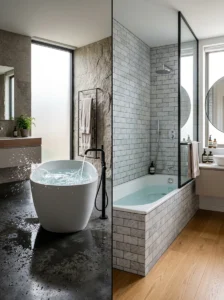
Finish is the most obvious choice variable, but form is equally important for longevity. A faucet’s silhouette — the outline it makes against the vanity and wall — is what the eye reads at a glance. Form carries stylistic era-information the same way finish does.
Simpler forms outlast complex ones. A cylindrical spout with a clean arc, a lever handle with minimal ornamentation, a straight bar for a towel rail — these forms have been present across multiple design eras because they carry no stylistic specificity. They read as “faucet” rather than “faucet in the particular style of 2023.”
Highly specific silhouettes belong to moments. The squared-off waterfall spout at a precise angle, the particularly flat disc handle at a very specific proportion, the statement shower head in a format introduced by a specific brand in a recognizable campaign — these are silhouettes that will be immediately recognizable as products of their era in ways simpler forms won’t be.
The test for form: If you showed a photograph of the fixture with no brand label, no context, and no finish — just the silhouette — could someone reasonably guess when it was made? The more precisely datable the silhouette, the higher the risk.
Fixture by Fixture: What to Consider for Each

Faucets and Taps
The most-used fixture in the bathroom and the one most evaluated at close range during daily use. The combination of finish and spout form determines whether it reads as timeless or era-specific.
What ages well: a clean arc spout in a cylindrical or simply shaped body, with a lever handle (rather than a highly styled or geometric handle) in chrome, brushed nickel, or unlacquered brass.
What ages less well: waterfall spouts in very specific proportions, handles with geometric details particular to a design moment, and any form that could be described as “statement” rather than “classic.”
Shower Heads
Shower heads are evaluated less frequently at close range than faucets, but they’re often the highest-profile visible fixture in a bathroom and contribute significantly to the room’s overall aesthetic reading.
Standard round ceiling-mounted shower heads in clean, unornamented profiles age well because they suggest the universal form of “shower” rather than a specific product design. Large-format rain heads in simple round or square profiles have become prevalent enough that they now read as broadly contemporary rather than trend-specific.
Highly styled shower arms, unusual mounting configurations, and shower heads with distinctive design elements that reference a specific product family are more era-specific.
Towel Rails and Heated Rails
Towel rails are some of the most reliably form-neutral bathroom fixtures available. A straight horizontal bar, a simple ladder configuration, or a heated rail in a clean vertical format have been present for decades without trend association.
The variants that carry more era-specificity: very unusual forms, rails with distinctive geometric details that emerge from a specific design trend, and extremely oversized formats introduced at the same time as a specific renovation aesthetic.
For a decision intended to last ten or more years, a clean, proportionally appropriate rail in a neutral or historically-present finish is the specification most likely to remain appropriate throughout.
Toilets
Toilets are simultaneously the most functional and the most trend-resistant fixture in a bathroom. Basic toilet form has changed very little over decades, and the primary visible variation — the profile of the pan and cistern — tends to change slowly enough that even “contemporary” profiles from five or ten years ago don’t read as dramatically dated the way other fixtures can.
The exception: very highly styled toilets with specific design details from a trend moment — the particularly aggressive wall-hung profile with an unusually shaped pan that was featured heavily in design publications during a specific window — can read as era-specific when those design details are distinctive enough.
For most purposes, a clean, simple close-coupled or wall-hung toilet in a standard white glaze reads as permanent rather than trend-specific and represents the most durable aesthetic choice.
Consistency Across Fixtures: The Requirement Nobody Should Skip
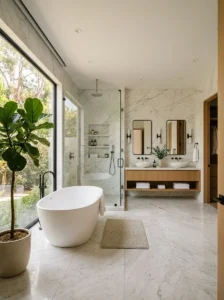
A bathroom where the faucet is in brushed gold, the towel rail is in chrome, the toilet hardware is in brushed nickel, and the shower fitting is in matte black reads as accumulated rather than designed — regardless of how good each individual fixture is. The inconsistency is what reads as dated, even when individual pieces remain within their own trend cycle.
Choosing a consistent finish direction across all visible fixtures — faucet, shower, towel rail, toilet flush plate — and maintaining that direction through all subsequent replacements and additions is the specification decision that most reliably keeps a bathroom from reading as dated. Not because any single finish has infinite longevity, but because consistency reads as intentional design, and intentional design ages better than accumulation.
This also means when one fixture needs replacement, matching the existing finish rather than substituting the newest available finish. A bathroom where one fixture has been replaced in a different finish reads as a bathroom that has started to drift from its original design direction.
The Quality Dimension: What It Changes and What It Doesn’t
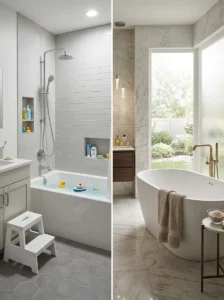
Fixture quality affects durability, maintenance, and the quality of the experience of using the bathroom. It doesn’t change the trend cycle. A premium faucet in a finish that peaks and declines will date at the same rate as a budget faucet in the same finish. Quality extends the fixture’s physical life; choosing a finish with genuine staying power extends its aesthetic relevance.
The cases where quality investment changes the longevity equation:
Finishes that age gracefully — unlacquered brass, solid brass that develops a patina, quality chrome that maintains its clarity — benefit from quality construction because the material that’s aging is the actual substrate material, not a coating over it. Cheap chrome can pit and discolor; quality chrome maintains its finish.
Operational quality — a tap that continues to feel precise and well-weighted after years of daily use reads as quality regardless of its design era. A tap that becomes stiff, drips, or wobbles reads as aging regardless of its finish.
The contact point experience — handles, spouts, and surfaces touched daily should feel substantial and consistent. This is the dimension of fixture quality that translates directly into daily satisfaction and that mediocre products most consistently fail at over time.
Key Takeaways
- Fixtures bought at peak trend adoption are buying at the rear of the trend cycle — the ubiquity that makes the choice feel safe is also what will mark it as era-specific when the cycle completes
- Form matters as much as finish: simpler, less stylistically specific silhouettes age better than statement forms that belong to a particular design moment
- Chrome and brushed/satin nickel have continuous bathroom history and read as timeless rather than trend-specific; unlacquered brass ages through patina rather than failing; lacquered finishes and coatings that chip at contact points age poorly
- Matte black currently reads as contemporary rather than timeless — appropriate as an accent but risky as the dominant finish across all fixtures
- Consistency across all visible fixtures matters as much as the finish choice itself — inconsistency across fixtures reads as accumulated rather than designed
- Quality affects operational longevity and how gracefully some finishes age, but doesn’t change trend cycles — a premium product in a trend-specific finish dates at the same rate as a budget one
Frequently Asked Questions
Is it worth paying significantly more for premium fixtures to avoid looking dated? Premium fixtures justify their cost through operational quality, durability, and in some cases finishes that age more gracefully — but not through any inherent protection against trend dating. A well-priced fixture in chrome or brushed nickel will age more appropriately than an expensive fixture in a peak-trend finish. The investment decision should be: quality material in a finish with genuine longevity, rather than premium cost as a substitute for considered finish choice.
Can I mix two different finishes intentionally without the bathroom reading as accumulated? Yes, when the mixing is clearly deliberate rather than incidental. Two finishes that are close enough in tone to read as a considered pairing — brushed nickel and polished nickel, chrome and polished nickel, unlacquered brass with a warm matte black — can work as an intentional contrast. Two finishes that were clearly chosen at different times, with no design logic connecting them, read as accumulated. The test: if a visitor noticed both finishes, would they think “that’s intentional” or “that doesn’t match”?
Are matte fixtures (as opposed to polished) generally more durable and appropriate? Matte finishes hide water marks and minor scratches better than polished ones in daily use, which extends their maintained appearance. Whether matte reads as contemporary or dated depends entirely on which matte finish and when — matte chrome has long continuous history, matte black has trend-specific history currently. Matte as a surface quality isn’t inherently more durable than polished; the underlying substrate material and coating quality determine actual durability regardless of surface finish type.
What’s the single most important fixture decision to get right for long-term appropriateness? The faucet finish, applied consistently to all plumbing fixtures in the bathroom. The faucet is the most-used, most closely evaluated fixture in the room, and its finish sets the expectation for all other metal finishes in the space. A faucet in chrome or brushed nickel with everything else matching reads as permanently appropriate. A faucet in a trend-specific finish, with matching fixtures throughout, creates a bathroom whose entire metal palette belongs to a specific moment.
When does it make sense to choose a trend-specific fixture finish deliberately? When the fixture is in a position that’s relatively easy to change — a towel ring, a toilet roll holder, a soap dish — rather than a plumbing fixture that requires professional replacement. Using a trend-specific finish for accessories and a classic finish for plumbing fixtures gives contemporary feeling to the room while keeping the most permanent and expensive-to-change elements appropriately timeless.