

“Spa-like” is one of the most used phrases in bathroom design and one of the least examined. Here’s what actually creates the feeling — and why it’s not primarily about towels and candles.”Spa-like” is one of the most used phrases in bathroom design and one of the least examined. People know a spa bathroom when they’re in one — there’s an immediate, physical shift in how the body responds to the space before anything has been consciously evaluated — but most descriptions of what produces that response land on the same short list: thick towels, candles, a plant or two, perhaps some rolled towels in a basket.
These things contribute. They are not the reason the feeling exists.
The reason is something more fundamental, and it operates at a level the body registers before the eye has processed the room’s aesthetic details. A genuine spa experience is the product of several specific conditions that most domestic bathrooms don’t replicate — not because the fixtures are wrong or the budget was insufficient, but because home bathrooms are typically designed around different priorities than the conditions a spa creates deliberately.
Understanding what those conditions are, and how to create them in an ordinary bathroom, is the more useful question than “what products should I buy to make my bathroom feel luxurious.”
The First Condition: The Bathroom Has Only One Purpose
This is the quality most overlooked in spa bathroom advice and the most responsible for the gap between a spa experience and a home bathroom experience.
A spa bathroom is a room with exactly one purpose: bathing and restoration. Nothing in the room refers to any other aspect of the user’s life. There’s no laundry accumulating in a corner. There’s no visible medication that reminds the user they have a health condition to manage. There’s no cleaning product under the sink that needs attention. There’s no scale. There’s no phone. The room contains only what serves the specific experience of being in it.
A home bathroom is typically a multifunctional room. It stores medication, cleaning supplies, toiletries in various states of use, and products belonging to multiple members of the household. It often receives laundry, holds the scale where physical self-assessment happens, and sits adjacent to the bedroom where a phone is always within reach.
The spa feeling depends significantly on the absence of other life concerns. The room signals, through what it contains and what it excludes, that the person in it has temporarily left the other categories of their existence outside. This signal is what creates the physiological decompression — the drop in the shoulders, the slower breathing rate, the genuine sense of having arrived somewhere separate from ordinary demand.
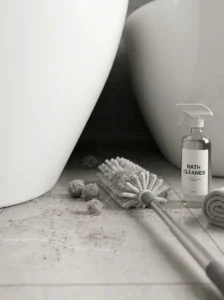
The practical implication: before adding anything to create a spa feeling, audit what the bathroom currently contains that refers to any concern other than the bathing experience itself. Scale: remove it, or position it where it’s not visible from the shower or bath. Medication: store it in a closed cabinet where it’s not visible. Cleaning supplies: under the sink behind a closed door. Laundry: a basket with a lid, or removed from the bathroom entirely. Phone: left outside.
This subtraction produces more of the spa feeling than almost any addition.
The Second Condition: Sound
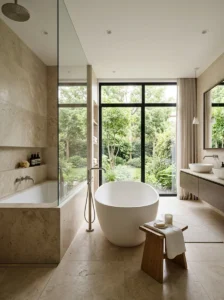
Spas are quiet in a specific way. Not silent — silence in isolation can feel eerie rather than relaxing — but quiet in the sense that the sounds present are either neutral (water, very quiet ambient music at a low volume, the subtle hum of systems) or absent. The sounds of other people’s conversations, the television from another room, the notifications, the street noise — these are excluded.
A home bathroom can replicate this in specific ways:
A Bluetooth speaker playing ambient sound at low volume — specifically not music with lyrics, which engages the language-processing part of the brain and prevents the cognitive disengagement that the spa feeling depends on. Nature sounds, instrumental music, binaural recordings, or even the recording of a specific type of rainfall play at low volume in a closed bathroom create a sound environment that masks external noise and gives the brain something neutral to rest against.
The specific acoustic quality of a tiled room with water running is itself relaxing for most people — it’s not an accident that spas often feature the sound of water prominently. A shower or bath running before entry, or a small tabletop water feature in a bathroom large enough to include one, provides this quality without electronics.
The closed door is more important than it sounds. A bathroom door that remains open while the occupant is bathing allows the sounds of the household — the television, other voices, the sound of tasks needing attention — to enter a space that needs acoustic separation from those things to function as a restorative environment.
The Third Condition: Temperature That Supports the Experience
A spa is warm. Not hot to the point of discomfort, but genuinely warm — the ambient temperature of the room supports being undressed without the anxious awareness of cold that a typical bathroom produces.
As discussed in the bathroom cold article, the domestic bathroom’s coldness is partly about actual air temperature and partly about conductive surfaces — tile floors that draw heat away from bare feet immediately, towels that haven’t been warmed, the drop in ambient temperature that ventilation creates.
The spa-feeling bathroom addresses this not as an afterthought but as a primary design condition. The floor is warm enough to stand on barefoot without the reflexive wincing that cold tile produces. The towels are warm, either from a heated rail or from the ambient heat of a well-heated room. The transition from shower or bath to drying doesn’t involve the small physical stress of cold contact.
Underfloor heating is the complete solution for cold floors and the most transformative single installation for the spa feeling in a home bathroom. A heated towel rail is the most immediately useful addition for the post-shower experience. Together they address the two most acute temperature failures in a typical domestic bathroom.
The Fourth Condition: Light That Doesn’t Perform an Assessment
This requires a slightly unusual way of thinking about bathroom light, but it’s accurate: most home bathroom lighting is assessment lighting. It’s bright, directional, designed to let you see clearly whether your hair is right, whether your skin looks correct, whether you’re presenting appropriately. It’s functional light optimized for inspection.
Spa light is different. It’s enough to see clearly, but it doesn’t perform an assessment. It’s warm enough that skin looks healthy rather than analyzed. It comes from low or indirect sources rather than from directly above. It doesn’t highlight every imperfection or make the face look tired. It creates an environment where the user is encouraged to be in the experience rather than to evaluate their appearance.
The specific changes that move bathroom lighting from assessment to restorative:
Dimmer switches are the most important single electrical addition in a bathroom intended to feel like a spa. The ability to reduce the overhead light — not eliminate it, but soften it significantly — changes the quality of a long bath or an evening shower from functional to genuinely restorative. No other single switch flips the room’s character so completely.
Warm-toned bulbs at 2700K or lower change how skin looks in the mirror from examined to seen. The difference between being in a room lit at 5000K and 2700K, standing in front of a mirror, is palpable within seconds. The warmer light doesn’t flatter dishonestly — it simply removes the harshness of cool overhead light that makes any bathroom feel more clinical than it needs to.
Candles — in the right placement and the right moment — provide light at the lowest possible level, from below eye height, in the warmest possible tone. Their flickering is processed by the brain differently from steady electric light, and the response is consistently calmer. They’re not a replacement for functional bathroom lighting. They’re a specific tool for a specific kind of bathroom use — the long bath, the intentional decompression moment — and their contribution to the spa feeling in that specific context is outsized relative to their cost.
The Fifth Condition: Scent That Doesn’t Announce Itself
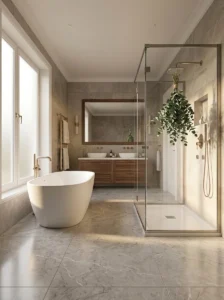
The approach to scent in a spa is calibrated differently from most home attempts at scented bathrooms. A spa doesn’t smell like scented products — it smells like an absence of other smells combined with something clean, faintly present, and deliberately chosen.
The home version of this: a background note that registers as “clean and considered” before any specific fragrance is identified. Not the strong top note of a scented candle at full throw. Not the layered conflict of multiple scent sources in a small room. A single clean note at low intensity that creates a subtle boundary between the bathroom and the rest of the home.
Eucalyptus in a shower — a small bundle of fresh eucalyptus hung from the shower head — is one of the most effective scent additions available in a home bathroom because the steam activates the essential oils and fills the shower enclosure with a spa-quality scent that’s clean, medicinal in the best sense, and genuinely different from the smell of any scented candle or diffuser. It costs very little and it disappears into the steam, which makes it feel atmospheric rather than added.
A single reed diffuser with a clean fragrance — one that doesn’t announce itself from outside the bathroom but is noticeable inside it — provides the background quality that makes a room smell like someone considered it. This is different from a room that smells like fragrance products.
The Sixth Condition: Water That Feels Good
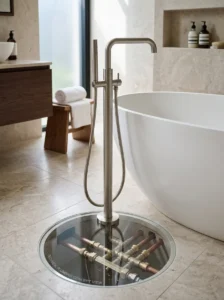
This is the condition least within aesthetic control but most within practical reach: the quality and pressure of the water itself.
A spa shower doesn’t feel like a practical necessity being efficiently completed. It feels like an experience that’s worth lingering in. The difference is often water pressure — specifically the pressure and spray quality of the shower head, which in many domestic bathrooms is either too low to feel satisfying or uses a shower head that breaks the water into too-fine a spray to have the physical weight of a genuinely good shower.
A quality shower head — not necessarily expensive, but specifically chosen for spray quality and pressure output — changes the physical experience of the shower. This is the part of the spa experience that’s most directly about the bathing function itself rather than its surroundings, and it’s consistently underinvested in relative to everything else.
Water softeners in areas with hard water change the skin and hair experience of showering in ways that genuinely justify the installation cost for households that cook or bathe in hard water regularly. Hard water leaves a film; softened water doesn’t. The difference on the skin after a shower, and in how soap and shampoo lather and rinse, is one of the most consistently reported quality-of-life improvements by households that make this change.
The Ritual Dimension: What Spas Understand That Home Bathrooms Forget
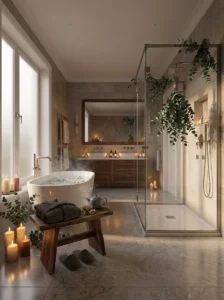
Spas don’t just provide a nice room. They provide a structured experience with arrival, transition, and completion. The robe when you arrive. The warm space before the treatment. The water feature to sit beside. The tea afterward. The experience is designed with a beginning and an end, and the design of the physical environment supports this structure.
A home bathroom can replicate this not through physical design but through deliberate practice. The bathing experience that reads as spa-like in a home is almost always a specifically bounded one: the phone outside, the bathroom door closed, the duration set by intention rather than by finishing as quickly as possible. The room doesn’t create the ritual — but the room’s design can support or undermine the ritual the user brings to it.
A bathroom that’s warm, quiet, scented appropriately, lit gently, and cleared of non-bathroom concerns supports a restorative bathing ritual. The same room used hastily under assessment lighting with a phone on the vanity does not. The room’s potential and the use made of it are both necessary parts of the spa equation.
What to Actually Do, In Order
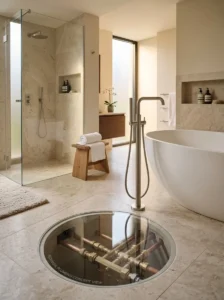
For a bathroom intended to feel genuinely spa-like in daily use:
- Remove everything that references concerns outside the bathing experience — scale, visible medication, cleaning products, laundry, phone
- Address the temperature — underfloor heating or a good bath mat for the floor; a heated towel rail for post-shower warmth
- Install dimmer switches on whatever circuits are practical — this is the single highest-impact electrical change available
- Replace bulbs with warm-toned, high-CRI versions at 2700-3000K throughout
- Establish one clean background scent at low intensity — a diffuser, a eucalyptus bundle in the shower, or a well-chosen candle used only for this purpose
- Evaluate the shower head and replace if the pressure or spray quality is inadequate
- Invest in genuinely good towels in a consistent neutral color, maintained properly — this is the physical quality the body encounters most directly
- Create the conditions for the ritual — door closed, phone outside, enough time allocated to actually use the space as intended
Key Takeaways
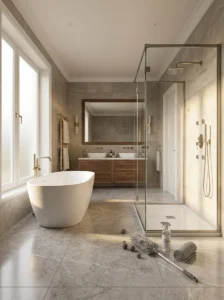
- The spa feeling begins with the exclusion of things that refer to other areas of life — the scale, the visible medication, the laundry, the phone — not with the addition of products
- Sound management — ambient neutral sound at low volume, a closed door, the sound of water — contributes to the decompression that defines the spa experience
- Temperature is foundational: a cold-floored, cold-towel bathroom cannot feel like a spa regardless of its aesthetic qualities
- Dimmer switches and warm-toned bulbs shift lighting from assessment mode to restorative mode — the single most impactful electrical change available
- Scent should register as “clean and considered” rather than announce itself — one source, low intensity, specifically chosen
- The physical quality of the shower itself — pressure, spray, water softness — is the most-used element and the most underinvested
- The ritual dimension matters as much as the room: a bathroom that supports a deliberate bathing practice delivers the spa experience; the same room used hastily does not
Frequently Asked Questions
Does a spa-like bathroom require renovation, or can it be created within an existing space? Almost entirely created within an existing space. The conditions that produce the spa feeling — temperature, scent, lighting, sound, the exclusion of other concerns — are achievable through habit, product choices, and low-cost additions rather than structural renovation. The exception is underfloor heating, which requires installation, and a shower head upgrade. Both are practical changes well short of renovation.
How important is the visual design compared to the sensory conditions? The sensory conditions — temperature, sound, scent, light quality, water quality — are more responsible for the spa feeling than the visual design. A visually modest bathroom that’s warm, quiet, softly lit, and properly scented produces more of the spa experience than a beautifully designed bathroom that’s cold, brightly lit from overhead, and filled with the visual noise of daily life’s concerns. Design supports the conditions; the conditions create the experience.
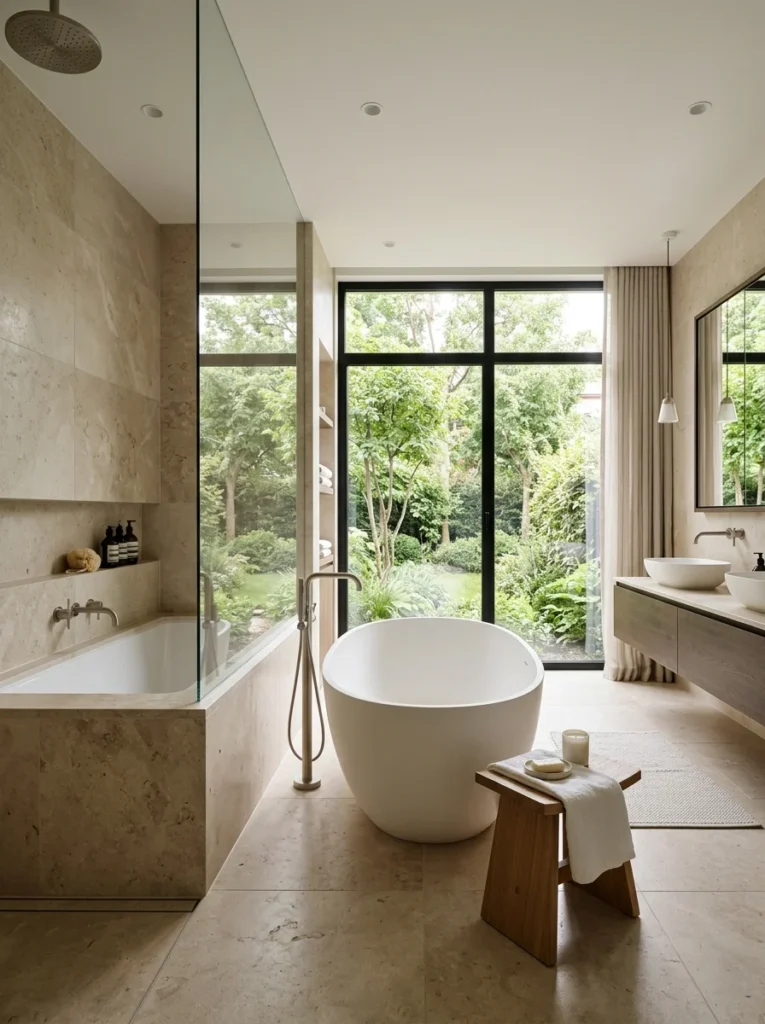
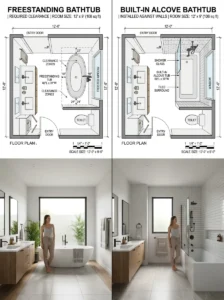
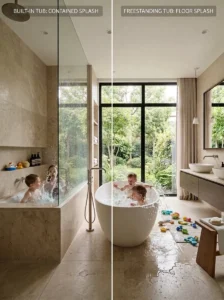
Is a freestanding bathtub necessary for the spa feeling? No — though it contributes to the aesthetic of a spa bathroom in some contexts. The bathing experience itself is created by temperature, time, water quality, and the absence of competing concerns, not by the specific vessel. A built-in bath used in the right conditions produces the same restorative experience as a freestanding one used the same way. The freestanding bath reads differently aesthetically but doesn’t create the spa feeling independently of the other conditions.
Why does a hotel bathroom sometimes feel like a spa when the fittings aren’t particularly special? Because a hotel bathroom is, by definition, a room with one purpose — bathing — in a location you’ve specifically traveled to, away from the concerns of home. The spatial and psychological separation from ordinary life is built into the hotel context. This is the “exclusion of other concerns” condition provided automatically by the hotel environment. It’s why people sometimes feel more relaxed in a modest hotel bathroom than in their own beautifully designed one — the hotel bathroom doesn’t contain their ordinary life, and their own bathroom does.
What’s the single fastest change that moves a bathroom toward a spa feeling? Remove whatever in the bathroom refers to concerns beyond the bathing experience — particularly the scale, visible medications, and cleaning products — and install a dimmer on the main lighting circuit. These two changes cost almost nothing and together shift what the room contains and how it can be lit in ways that immediately change the experience of being in it.