


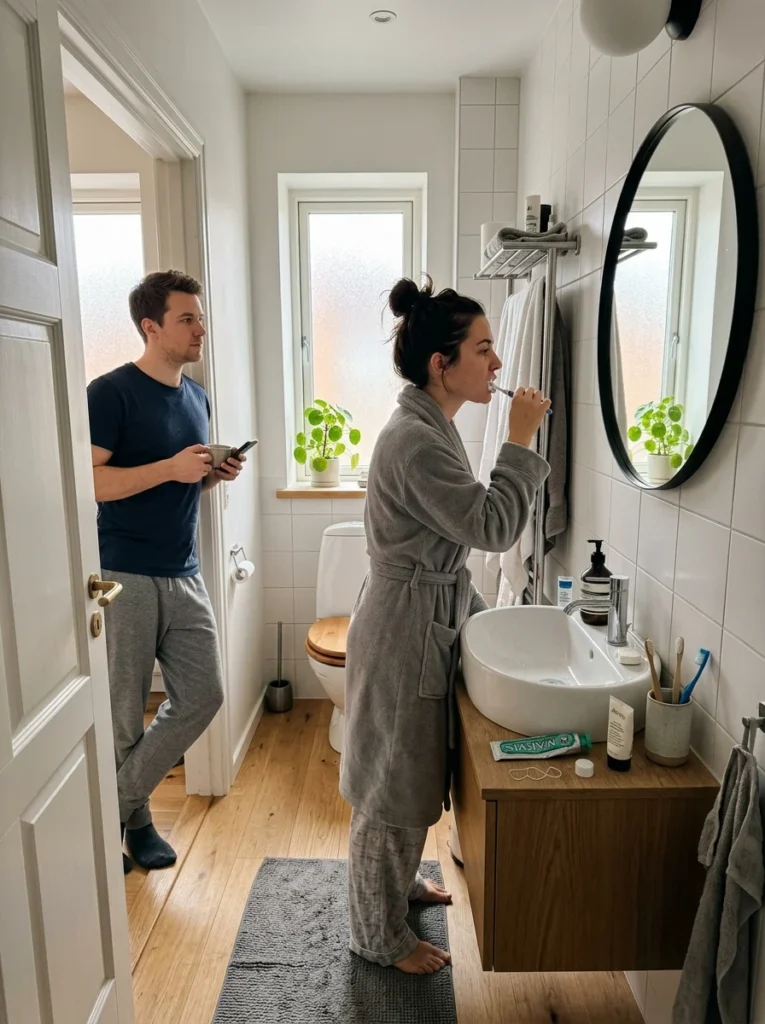
Shared bathrooms fail not because of bad design but because two routines were never given two systems. Here’s how to solve both the design and coordination problems at once.The bathroom at 7:15 a.m. in a shared household has a specific energy. One person needs the mirror. The other needs the sink. The same outlet is shared between a hair dryer and an electric shaver and there’s one stretch of counter being silently contested by two different people’s morning routines. Someone gets their turn and someone waits, and this dynamic — repeated every weekday morning — gradually becomes a source of friction that has nothing to do with how either person feels about the other.
This is the shared bathroom problem in its most honest form. It’s not primarily a storage problem. It’s not primarily a design problem. It’s a coordination problem that happens to take place in a small room with limited physical resources that two people need simultaneously.
The bathrooms that work for two people solve both dimensions. The design creates dedicated space and clear visual boundaries for each person’s belongings and activities. The coordination system means both people know whose zone is whose, when the bathroom is available, and what happens when the morning routine needs to happen at the same time. Neither the design nor the system works without the other.
The Two Categories of Shared Bathroom Problems
Before any solution is considered, it’s useful to categorize the specific friction in the bathroom, because the design and coordination solutions are different for different problems.
Resource contention is about two people needing the same physical resource simultaneously: the mirror at the same time, the only outlet, the same section of counter. This is solved primarily by creating two of the resource (a second mirror, a second outlet) or by scheduling — agreeing on a sequence rather than competing for simultaneous access.
Territory ambiguity is about unclear ownership of physical space: neither person knows whose products belong where, things drift into each other’s area, the bathroom reads as disorganized because nobody’s system dominates and the two systems conflict. This is solved primarily by creating clear, designated zones for each person’s belongings and maintaining them with enough discipline that the zones don’t collapse.
Most shared bathrooms have both problems, and most attempts to fix shared bathrooms address one and ignore the other. A design that creates beautiful individual storage zones but doesn’t solve the mirror contention at 7:30 a.m. still produces daily friction. A morning schedule that staggers arrival times but leaves storage completely unorganized still produces daily frustration.
Designated Zones: The Foundation Everything Else Builds On
The single most important principle in making a shared bathroom work is: each person has a defined physical zone, and their belongings live in that zone and only that zone.
This sounds obvious and it is obvious. What makes it difficult is that most bathrooms aren’t set up to support it. A single under-sink cabinet, a shared medicine cabinet, a single set of hooks, and one undivided counter space don’t have any natural mechanism for “yours” and “mine” — everything is shared space and things migrate constantly.
The zone system works when it’s physically supported:
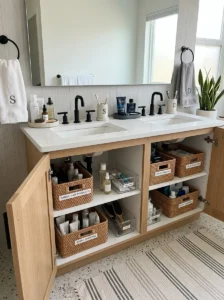
Two separate under-sink drawers or bins inside the under-sink cabinet, one per person, each responsible for their own contents. These don’t need to be fancy — two identical pull-out bins or baskets, labeled if the household benefits from that, create the physical separation that keeps products from mixing.
A medicine cabinet per person, or clearly divided shelves within a single medicine cabinet. An easy implementation for a single cabinet: tape or a small divider to mark where one person’s shelves end and the other’s begin. A better implementation: a second surface-mounted medicine cabinet if wall space allows, giving each person independent storage at eye height above the vanity.
Counter zones are harder to enforce in a small bathroom but important to attempt. If the vanity has two sinks, the division is natural. With a single sink, the counter to the left and the counter to the right can be designated — each person keeps their daily-use items in their half and returns them there after use.
Separate towel hooks or towel rails at minimum, so towels don’t become a shared category. Two hooks side by side, or two rails rather than one, means each person has their towel in a specific location and can identify it without lifting.
The zone system requires initial setup and ongoing maintenance — things drift, habits form slowly, and the first few weeks need occasional resets. But once the system is established and respected, the visual result is a bathroom that reads as organized even with two complete sets of personal belongings in it.
The Mirror Problem and Its Solutions

The mirror is the most contended resource in most shared bathrooms because both people’s morning routines typically require it at approximately the same time, and most bathrooms have exactly one mirror in one position above one sink.
A second mirror is the cleanest solution and requires less space than people expect. A second mirror doesn’t need to be the same size as the first — a smaller mirror mounted on an available wall, on the back of the bathroom door, or in a dressing table configuration in the adjacent bedroom gives one person mirror access while the other uses the main vanity mirror. This completely resolves morning mirror contention without requiring any scheduling agreement.
A makeup mirror — a small magnifying mirror on a stand or arm-mounted to the wall — functions as a task mirror for detailed work (makeup application, shaving) without requiring the main mirror to be available. One person uses the main mirror; the other uses the task mirror for the work requiring magnification and uses the main mirror only briefly for a final check.
Staggered mirror use through scheduling — if two mirrors aren’t possible — requires agreeing explicitly on who uses the mirror from what time to what time, rather than an implicit competition that’s silently frustrating to both parties. The conversation is briefly uncomfortable and saves thousands of morning moments of friction.
Outlet Management: The Overlooked Source of Daily Frustration
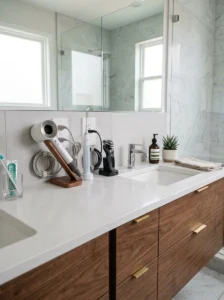
Most bathrooms have one ground-fault outlet near the vanity. Most households with two people using a bathroom have at least two regularly used electrical grooming tools: hair dryer, hair straightener, electric shaver, electric toothbrush charger, hair curler. One outlet serving all of these is a serialized system where each tool waits for the one before it to finish.
A second outlet installed by an electrician near the existing one — or a shaver outlet added if not present — doubles the capacity and allows simultaneous use of two tools. This is among the lowest-cost electrical additions available and has a daily impact disproportionate to its cost.
An outlet extender or bathroom-rated power strip provides multiple sockets from the existing outlet without new wiring. These need to be bathroom-rated (protected against moisture) and positioned where they won’t be hazardous near water. An extender tucked behind the vanity or wall-mounted above the counter at a safe distance from the sink provides additional capacity without professional installation.
Cordless alternatives for tools where battery versions are viable — electric toothbrushes with charging docks rather than continuous plug-in, cordless shavers — reduce outlet demand and are worth considering when outlet scarcity is the daily frustration.
Morning Scheduling: The System That Costs Nothing

Some shared bathroom problems don’t have design solutions — they have coordination solutions. The question isn’t what to install but what to agree on.
A morning schedule for a shared bathroom isn’t a rigid appointment system — it’s a shared understanding of the usual sequence that avoids simultaneous contention for the same resource. The most functional version typically looks like:
- One person starts the shower first and exits by a shared understood time
- The other person enters and showers while the first is getting dressed elsewhere
- Mirror and counter time is naturally staggered by the shower offset
This requires a fifteen-minute conversation and some adjustment of morning timing in the first week. It requires no installation, no purchase, and no renovation. In most households, it resolves a majority of the morning bathroom friction completely.
The stagger principle — one person’s bathroom time ends before the other’s begins, by design — is more achievable than it sounds because it only requires a shift of ten to twenty minutes in one person’s timing, not a fundamental restructuring of the morning.
Storage That Actually Works for Two Complete Sets of Belongings

A shared bathroom needs to store two complete sets of personal care products: two people’s shampoos, conditioners, body washes, skincare products, hair tools, and daily medications. This volume is simply larger than a bathroom designed for one person and it needs to be acknowledged as a design constraint rather than managed as a failure.
The vertical dimension matters here. Storage that goes upward — medicine cabinets, shelving above the toilet, shelving on available walls — adds capacity without claiming floor space. Two medicine cabinets rather than one is often achievable with wall space that’s currently unused, and provides independent eye-height storage for each person.
Under-sink optimization with pull-out drawers or organizers around the drain pipe was covered in the bathroom storage article, but for two people it’s worth specifically noting: two designated bins side by side under the sink, one per person, provide individual storage in a shared cabinet without requiring a second cabinet.
Rotation principle for bathroom counter: if two people’s daily items both need to be accessible, a tray per person on the counter — with the agreement that only the person who currently needs a product takes it out, and returns it to the tray afterward — creates a visual boundary within a shared space.
Towels and Linens: A Category That Needs Simple Rules

Shared bathroom towel management fails almost universally through one of two patterns: identical towels where neither person can identify their own (leading to shared towels, which not everyone is comfortable with), or mismatched towels that make the bathroom read as disorganized.
Different colors for each person’s towels within a coordinated palette — cream and warm gray, for example, or two shades of the same tone — solves the identification problem while maintaining the visual coherence of the room. Each person always knows which towels are theirs. The bathroom reads as a consistent palette rather than a collision of personal choices.
Named or initialed hooks for each person eliminates the identification problem structurally rather than through color memory.
A specific hook or rail per person — not one shared towel rail where towels end up overlapping and neither dries properly — gives each person a dedicated drying location and prevents the damp-towel pile that results from inadequate hook allocation.
When Two People Have Different Design Preferences

A shared bathroom occupied by two people with different aesthetic preferences is a negotiation problem more than a design problem. Both people live in the space daily. Both people’s experience of the space matters.
The practical approach that works for most households: agree on the fixed elements — tile, vanity, paint color, fixtures — which are expensive and permanent, using the principle that the choice should be something both people can accept and neither actively dislikes. The moveable elements — towels, accessories, personal items — can reflect individual preferences since they’re easily changed.
The “neither of us will regret this” test applied to fixed elements is more reliable than trying to find what both people love. A choice that generates genuine enthusiasm from one person and reluctant acceptance from the other is more likely to become a source of ongoing friction than a choice both consider adequately good.
Personal items in designated personal zones don’t need to be aesthetically agreed-upon — they’re that person’s space and visible primarily to that person. The shared zones (towel rails, vanity surface, accessible shelving) benefit from agreed-upon choices that both people can live with.
What Renovation Additions Help Most in a Shared Bathroom

If a renovation is being considered, the additions with the highest return specifically for shared use:
A double vanity — two sinks in one vanity unit — is the most functionally significant change possible for a two-person bathroom. It doubles the most-used functional resource (the sink) and creates a natural left/right division of the entire vanity space. Not possible in all bathrooms due to space constraints, but worth prioritizing in any renovation that allows it.
A second mirror, ideally a medicine cabinet with storage, alongside or opposite the primary mirror.
Additional outlets near the vanity.
Extra towel hook positions rather than a single towel rail.
Separate storage zones built into the renovation — two sets of drawers rather than one, dedicated shelving units rather than a single cabinet — that the zone system can operate within structurally rather than being imposed on a space designed for one person.
Key Takeaways
- Shared bathroom problems fall into two categories: resource contention (two people needing the same thing at once) and territory ambiguity (unclear ownership of space) — both need addressing
- Dedicated physical zones for each person’s belongings — separate storage within the cabinet, counter zones, individual hooks — are the foundation everything else depends on
- A second mirror or task mirror resolves the most common daily contention point without requiring any scheduling conversation
- A second outlet (or outlet extender) doubles electrical capacity for the cost of a simple installation
- Morning staggering — one person’s bathroom time ending before the other’s begins — resolves most scheduling friction through a single conversation rather than ongoing daily negotiation
- Different towel colors within a coordinated palette solves identification without compromising the bathroom’s visual coherence
- The “neither will regret this” test for fixed renovation decisions serves shared bathrooms better than finding what both love
Frequently Asked Questions
What’s the most common reason shared bathrooms stay frustrating even after organizing them? The organization addressed one type of problem (usually storage/territory) without addressing the other (usually scheduling/resource contention). A beautifully organized bathroom with two separate storage zones still produces morning frustration if both people need the mirror and the outlet at the same time. Lasting improvement requires both dimensions — physical organization and coordination agreement — to be addressed together.
Is a double vanity actually necessary for two people, or is it just a luxury? Not necessary, but it’s the most functionally significant renovation addition for a two-person bathroom, more than any other single change. Two sinks don’t just double the sink capacity — they create a natural physical division of the entire vanity area, including counter, mirror, and cabinet space, that makes the zone system work structurally rather than requiring ongoing enforcement. If the renovation budget and the space allow for it, a double vanity consistently produces the most significant improvement in shared bathroom function.
How do we handle a shared bathroom when we have very different morning routines in terms of timing? A significant timing difference is actually easier to manage than similar timing, because natural staggering already exists. The person who uses the bathroom first simply has unrestricted access, and the second person has unrestricted access after. The problems arise when timing is similar — both people want the bathroom within the same fifteen-to-twenty-minute window. In that case, the stagger conversation matters more.
What’s the best way to handle a shared bathroom when one person is much tidier than the other? Design to the less tidy person’s natural habits where possible — make “putting things away” the path of least resistance rather than requiring deliberate effort. Dedicated bins that things drop into rather than neat rows that require placement. Hooks rather than towel rails that require folding. Closed storage rather than open shelving that requires items to be neatly arranged. Meeting the less tidy person’s habits with design that supports them produces better outcomes than relying on behavioral change.
Should children share a bathroom with adults, or is a separate bathroom better if possible? A separate bathroom for children, if available, is significantly better for both the adults’ experience of their bathroom and the bathroom’s maintainability. Children’s bathroom use — the products, the mess pattern, the storage requirements — is genuinely different from adults’, and combining them usually means the adult bathroom never quite functions as adult bathrooms can. If a separate bathroom for children isn’t possible, dedicated children’s storage zones and a strong cleanup routine produce the best available outcome in a shared space.