


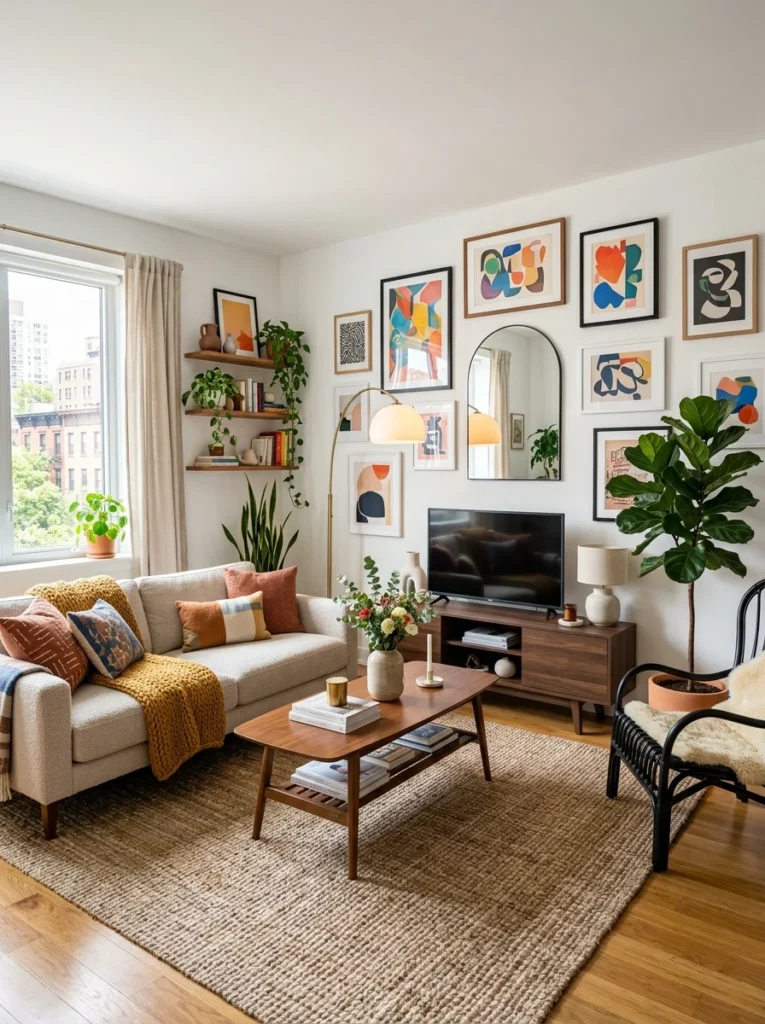
White rental walls aren’t the enemy of personality — they’re the backdrop every well-styled rental uses. Here’s how to make a rented living room genuinely feel like yours without a paintbrush.White walls have a reputation as the enemy of personality in a rental. They read as the visual equivalent of a blank lease — deliberately neutral, waiting for the landlord to restore when you leave. Most tenants treat them as a constraint to work around. The tenants whose rental spaces consistently look the most personal treat them as the starting point.
There’s a reason that the most carefully decorated rental apartments in every design publication feature white or off-white walls. It isn’t because the tenants couldn’t be bothered to push for painting rights. It’s because white walls are the single most versatile backdrop available for every other decision — art, textiles, furniture, objects — and the personality of a rental comes not from the walls but from everything placed against them.
The real limitation in most under-personalized rentals isn’t the white walls. It’s the failure to invest energy and intention in the elements that are fully within the renter’s control. This article is about those elements specifically.
What Personality in a Room Actually Is
Before adding anything, it helps to be precise about what “personality” means when applied to a room, because it’s one of those words that sounds clear but isn’t.
A room with personality reads as belonging to someone specific. It has elements that suggest a particular point of view, a set of interests, or an aesthetic direction that couldn’t have been chosen by just anyone. It’s distinct from a generic furnished space the way a handwritten letter is distinct from a form letter — same basic format, completely different identity.
Personality in a room comes primarily from three sources: things that are personally meaningful (photographs, collected objects, things from specific places), things that reflect a specific aesthetic direction (not just “nice” but a particular kind of nice), and things that show investment of attention — that someone looked at this room and made choices rather than just filled it.
None of these sources require paint. All of them are within a renter’s control.
Large-Scale Art and Prints: The Fastest Personality Addition Available
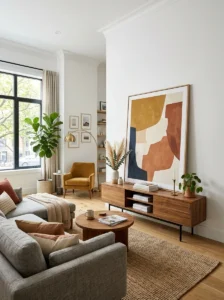
In a room with white walls and no art, the walls are not neutral — they’re empty, which reads differently. Empty walls signal incompletion. Art-covered walls signal that someone lives here, has a point of view, and brought their view with them.
Large-scale art works better than small art in a rental context specifically because large pieces make a commitment that small pieces suggest were unable to be made. A single print at 24×36 inches on a white wall reads as decisive. Six small prints arranged carefully on the same wall read as tentative — as if the tenant was afraid to commit to something big.
Renter-friendly hanging options have improved dramatically and made the nail-holes concern largely obsolete:
Command strips for frames — 3M Command picture-hanging strips hold most frames up to eight pounds per pair, remove cleanly, and have supported the majority of the gallery walls in rental apartments for the past decade. For heavier frames, multiple pairs distribute the load.
Gallery rails or picture rails — a horizontal rail mounted with two small screw holes that then accommodates an unlimited number of hung pieces via hooks and cables without additional wall damage. One installation serves the entire wall.
Leaning large pieces — oversized art and mirrors leaned against a wall rather than hung requires no installation at all, reads as intentional in the right context, and moves with the tenant. This works particularly well for pieces that are too heavy to hang with command strips but that define the room’s visual center.
Poster frames allow large, low-cost prints to read as considered rather than temporary. A high-quality poster in a quality frame on a large wall is often more visually impactful than expensive small originals scattered across multiple positions.
Gallery Walls Done Right in a Rental
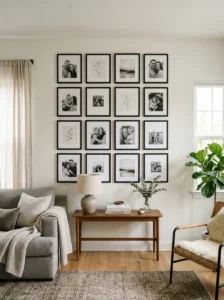
A gallery wall — a grouped collection of frames and objects on one wall — is one of the most effective personality-adding moves available in any rental, but its success depends on approach.
The two gallery wall configurations that work in rentals:
The tight grid. Frames in the same or coordinating sizes, hung in a precise grid with consistent spacing between them (typically two to three inches). This configuration reads as intentional and controlled rather than eclectic. It works best with a consistent frame finish (all black, all gold, all natural wood) that unifies the grid visually. The precision of the arrangement is what reads as personality — someone took the time to make this right.
The organic salon hang. A mix of frame sizes and shapes arranged on the wall without a fixed grid, following the contour of a general shape (rectangular, arched, centered on a specific anchor piece). This reads as more personal and lived-in than the grid configuration but requires more planning — the arrangement should be worked out on the floor before any hanging begins, adjusted until it feels right, and then transferred to the wall.
Both configurations benefit from the same rule: the overall grouping should be treated as one large element rather than many small ones. The outer edge of the grouping should be large enough to serve as a focal point — typically at least five feet wide for a primary wall — and positioned relative to the furniture below it as one large piece of art would be.
Textiles: The Category That Changes a Room Most Completely
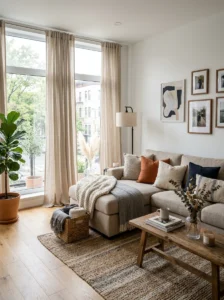
No category of rental personalization has more impact per dollar spent than textiles. The specific textile changes that produce the largest shift:
Curtains and window treatments change the proportion, the warmth, and the read of any room more than almost any other single addition. The builder-grade blinds or bare windows most rentals offer are one of the clearest signals that a space hasn’t been decorated. Full-length curtains — hung high (close to the ceiling rather than at the window frame) and wide (extending beyond the window on each side) — make windows look larger, ceilings look higher, and rooms look intentionally designed.
The curtain rod is the adjustment most renters underestimate: a curtain rod at window-frame height makes the window look small; a curtain rod four to six inches below the ceiling makes the same window look like an architectural feature. Command products include curtain rod brackets that hold up to several pounds; dedicated renter-friendly curtain rod systems are also available. For heavier curtains, two small holes for brackets that are filled with spackle at move-out is generally accepted by most landlords and produces minimal visible damage.
Throw pillows and cushions change the sofa’s personality more efficiently than any other element. Three to four cushions in a coordinated palette — not matching exactly, but sharing a color temperature direction — express a specific aesthetic in the room’s most prominent piece of furniture. The cushion palette becomes the room’s signature: earthy natural tones, rich jewel accents, crisp graphic prints. Whatever direction is chosen, the cushions carry it consistently.
Throws and blankets draped over the sofa or chair add both texture and warmth — and in a rental’s typically neutral space, warm texture is one of the primary personality signals available.
Rugs: The Foundation Everything Else Builds On
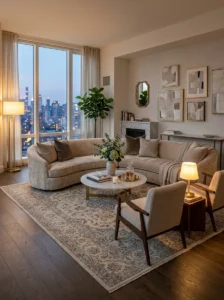
This has been established across multiple articles, but its rental-specific importance deserves emphasis: in a rental with bare floors or builder-grade carpet, a well-chosen rug is the single investment that most transforms how the room reads.
A rug in a specific pattern, material, or texture is also one of the clearest expressions of personal taste available in a rental. A kilim rug says something specific about the tenant’s aesthetic direction. A hand-tufted wool rug in a geometric pattern says something different. A vintage or vintage-style rug layered on a neutral ground says something else again.
The rug should be chosen at the scale described in the rug sizing article — large enough that the seating arrangement sits within or on it — and in a direction that expresses the room’s aesthetic point of view rather than a safe inoffensive option that could belong to any room.
Lighting: The Most Transformative Rental Change Nobody Makes
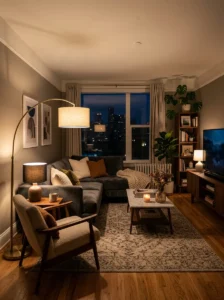
Most rentals have the same overhead fixtures — a simple ceiling light that provides flat downlight and defines the room as generic. Most tenants leave these in place for the duration of their lease.
Swapping a rental’s light fixture is technically possible (keep the original, reinstall at move-out) but involves more complexity than most renters want to navigate. The more accessible route: supplement the existing fixture with multiple floor and table lamps that change the room’s light quality completely.
A floor lamp in a corner — particularly one that washes light upward or provides an ambient glow at seated height rather than pointed downward — changes a rental living room as dramatically as any aesthetic change. The combination of overhead light dimmed (if the switch allows) and floor lamp light active produces a completely different room from the overhead-only default.
Table lamps on side tables bring light to eye level when seated — the specific quality of light that makes a room feel warm and inhabited rather than illuminated for function.
Lamp shade choice matters as much as the lamp: a warm-toned fabric shade produces warm-colored light; a cooler or translucent shade produces more neutral light. In a rental where warmth and personality are the goals, warm-toned shades on every lamp consistently produce better results than cool or white shades.
Swapping light bulbs in existing fixtures from cool white to warm white is available to any renter who wants it and costs the price of a pack of bulbs. It’s the rental’s most underused option.
Bookshelves and Object Displays Without Wall Damage
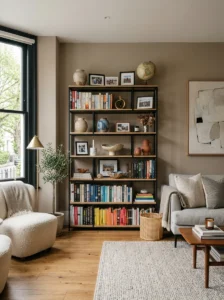
Permanent shelving typically requires hardware that most leases prohibit. The alternatives that provide equivalent function:
Freestanding bookshelves — floor-to-ceiling units that stand without wall attachment, which in many rooms can be stabilized with small wedges at the floor rather than bolts at the wall. A full-height bookcase in a rental is not a budget item but it’s one of the most personality-rich additions available: its contents, arrangement, and proportions say more about the tenant than almost any other single piece.
Ladder shelves — freestanding frames that lean against the wall at an angle, with horizontal rungs serving as shelves. These require no installation, move cleanly, and provide several display surfaces in a footprint smaller than a bookcase.
Stackable storage units — modular cube shelving, crates, or stacked boxes that function as shelving systems without requiring installation. The stacking arrangement itself can be designed to suit the room.
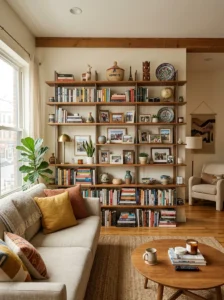
The objects displayed on these surfaces are what express personality most specifically. A collection of objects from travel, a specific type of ceramic, a set of books that are actually read, objects with particular associations — these communicate who lives in the space in ways that generic décor doesn’t.
Plants: The Rental Personalization That Requires Nothing From the Walls
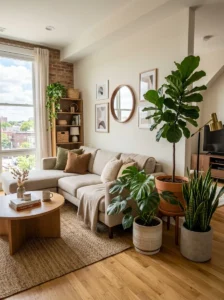
A home’s plants are among the most personal elements in any space. They communicate that someone tends to this environment, that they pay attention to what’s alive in it, that the room is maintained rather than just occupied.
In a rental’s typically neutral space, plants add what no manufactured object can fully replicate: living material that grows, changes, and occupies space with a different quality of presence than furniture.
A few thoughtfully placed, well-maintained plants — sized appropriately for the space, in vessels that agree with the room’s aesthetic — contribute more personality than many decorative object collections. A neglected plant communicates the opposite, so the selection should be matched to what the household will genuinely care for.
What to Invest In and What to Keep Portable
Rental personalization is most effective when the investment logic mirrors the eventual move: buy things that are either worth taking to the next home or worth giving away, not things that are lost when the lease ends.
Worth investing in: rugs, curtains, art, quality lamps, a bookcase, meaningful objects. These all move to the next home and continue delivering return on investment.
Worth keeping modest: items that are truly location-specific or that won’t suit the next space’s proportions. It’s rare that furniture exactly fits a future rental’s dimensions.
The rental advantage most people miss: a rental’s impermanence is a reason to make bolder aesthetic choices than you might in a purchased home. The commitment is shorter, the cost of changing is lower, and the accumulated decorating experience of each rental informs better decisions for the next. Renters who treat their spaces as worth investing in live better in each home and learn more about their own taste through the process.
Key Takeaways
- White walls aren’t the limitation — they’re the most versatile backdrop available; personality comes from everything placed against them
- Large-scale art makes bolder impact than many small pieces; renter-friendly hanging systems have eliminated most of the damage concern
- Curtains hung high and wide (near ceiling, extending beyond window) are one of the fastest personality transformations in any rental
- Cushions and throws carry the room’s aesthetic direction in its most prominent piece of furniture — they’re the most efficient personality expression per dollar
- Floor and table lamps change a rental’s character more completely than most people attempt; warm-toned bulbs throughout is the single easiest rental upgrade
- Objects displayed on freestanding shelving communicate who lives in the space more specifically than any wall color
- Plants add a quality of presence that manufactured objects don’t replicate — and they move to the next home
- Invest in rugs, art, curtains, and lighting that move with you; these are the elements that will serve the next rental too
Frequently Asked Questions
What’s the single highest-impact change in a rental living room with no budget to spare? Rearranging the furniture around a specific focal point — particularly if the current arrangement is room-around-walls rather than seating-facing-inward. This costs nothing and changes how the room reads more than almost any purchase. The second zero-cost change: replacing the lightbulbs with warm-white bulbs if the existing ones are cool or neutral. Together, these two changes produce the largest shift for the smallest spend.
Can I hang art in a rental without any wall damage at all? Almost entirely yes. Leaning large art and mirrors against walls requires no installation. Command strip products hold frames up to eight or more pounds cleanly. Picture rails installed with two small holes accommodate many pieces thereafter. The combination of these three approaches covers most art-hanging needs without meaningful wall damage. For the one or two pieces that need a nail, a small nail hole filled with white toothpaste or spackle and touched up with matching paint is typically invisible to landlords and often specifically permitted under “normal wear and tear.”
Should I invest in furniture for a rental or keep things minimal? The right balance depends on how long you’ll be there and how much the quality of the space matters to daily life. For a six-month stay, minimal investment in furniture makes sense. For a two-year or longer tenancy, the quality of your furniture significantly affects how much you enjoy the space every day — and quality furniture moves to the next home. A good sofa, a quality rug, and a meaningful lamp are investments that compound across multiple rentals rather than being lost at one move-out.
What if my rental has dark or ugly flooring that I can’t change? A large rug in an appropriate size for the seating arrangement covers most flooring concerns effectively. The rug’s size determines how much of the floor is visible: a correctly-sized rug (as described in the rug sizing article) leaves only the perimeter of the room visible, which typically doesn’t read as prominent when furniture is in place. A rug in a pattern or texture that the eye goes to actively reduces the attention that goes to the floor beneath.
Is it worth involving a landlord in negotiations about painting or modifications? In many cases yes — landlords are sometimes more flexible than the lease suggests, particularly for longer-term tenants who are clearly invested in maintaining the property. The request most likely to succeed: asking to paint in a neutral tone with the agreement to return the walls to the original color at move-out, or offering to have the work done professionally. Even if the answer is no, the conversation clarifies exactly what’s permitted and may open options you didn’t know were available.