


Comfort and coziness are not the same thing, and understanding the difference explains why some living rooms feel good to be in and others feel good to leave. Here’s what actually creates coziness.There’s a hotel lobby you’ve probably been in: good chairs at a comfortable temperature, adequately lit, pleasant enough. You’re comfortable in it. You don’t linger. There’s also a specific kind of bar, café, or friend’s living room where you arrive intending to stay thirty minutes and leave ninety minutes later without particularly having noticed the time pass. The difference between those two experiences isn’t the quality of the furniture. The chairs in the hotel lobby might be objectively better. The difference is something the hotel lobby consistently fails to produce and the other space consistently does.
Comfort is a physical state. The chair supports you correctly. The temperature isn’t making demands on you. Your body has no complaints. Comfort is the absence of physical discomfort, which is achievable through good furniture and climate control.
Coziness is something else — a specific quality of environment that produces what researchers studying the Danish concept of hygge describe as a sense of psychological enclosure. The room isn’t just not uncomfortable. It’s actively pulling you in. It communicates shelter in a way that larger, more open, more formally arranged spaces don’t. And while comfort can be engineered fairly straightforwardly, coziness requires understanding what produces that specific quality of psychological enclosure — and what consistently destroys it.
The Scale Problem: Why Big Rooms Struggle With Coziness

The most reliable predictor of whether a living room will feel cozy or merely comfortable is scale — not just the room’s size but the relationship between the room’s dimensions and what’s in it.
A large, open living room with furniture arranged at its perimeter and a rug in the center produces a large room that feels large. The furniture doesn’t define a human-scale zone within the space. The ceiling height amplifies the open quality. The clear sightlines across the room leave nothing to discover and no sense of containment.
A smaller room, or the same large room with furniture arranged to create a defined, contained seating zone, produces a space that the occupant feels within rather than merely inside. This sense of being within something — of the space having a human-scale boundary — is the foundation of the cozy quality.
What this means practically: coziness in a large room requires deliberately creating smallness within it. A seating arrangement pulled into the center of the room rather than spread across its perimeter. A low ceiling element — a large pendant light over the seating, a canopy or fabric element — that visually lowers the ceiling height over the main sitting area. Heavy curtains that draw inward and reduce the sense of expansiveness. Bookshelves or large plants at the boundaries of the sitting zone that create a sense of enclosure without physical walls.
The small room is structurally advantaged for coziness: it doesn’t need to create the enclosure, the architecture provides it. The large room must create it deliberately.
Light: The Variable Most Responsible for Coziness

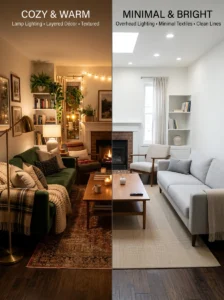
Of all the design variables, lighting has the most consistent and direct relationship with the cozy quality. And the specific lighting condition associated with coziness is low, warm, directional light at seated height — which is almost the exact opposite of what most living rooms have.
Most living rooms are lit from the ceiling at a height that illuminates the room from above and produces even, flat light across all surfaces. This light is functional. It’s not cozy. It produces the quality of a well-lit workspace rather than a refuge.
The neurological basis for this isn’t mysterious: human beings for most of their evolutionary history experienced warm, directional light from fire sources at seated height — the campfire, the hearth, the candle. These light sources illuminated immediate surroundings warmly and left the periphery in relative shadow. The brain interprets this light pattern as safety and shelter. The flat overhead lighting of modern rooms doesn’t produce this pattern, and the sense of shelter it fails to provide is part of why so many comfortable rooms don’t feel cozy.
The specific light conditions that produce coziness:
Multiple low sources. A floor lamp beside the sofa that illuminates the seating area rather than the whole room. Table lamps on side tables at arm height. A candle or two on the coffee table on specific occasions. The combination of these sources means the room has warm pools of light at occupied heights, with relative shadow at the ceiling and periphery.
Warm color temperature. 2700K or lower — the light temperature that reads as golden rather than white. This is the temperature of candlelight and incandescent light, and the brain’s association with shelter and warmth is real.
Dimmable circuits. The ability to lower the overhead light significantly — to use it as ambient fill at low intensity rather than as primary room lighting — is the shift that converts a comfortable living room into a cozy one after dark.
The overhead turned down or off. The single change that most immediately produces coziness in any living room: turn off the overhead light and use lamps only. This change, requiring zero investment and taking one action, is the lighting difference between comfortable and cozy.
The Warmth Dimension: Physical and Visual

Coziness and warmth are so closely associated that they’re nearly synonymous in many languages, and for good reason: the environments the brain reads as sheltering are typically both physically warm and visually warm.
Physical warmth — adequate room temperature, warm surfaces underfoot, accessible textiles — creates the bodily comfort that is a prerequisite for the psychological state of coziness. A room where you’re cold, or where the floor is cold under bare feet, or where you’re reaching for a blanket, can’t feel cozy regardless of what else is right about it.
Visual warmth is different. It’s the quality of surfaces and materials that the eye reads as warm-toned — wood, warm-colored textiles, amber light, earthy tones, terracotta, warm cream — rather than cool-toned. A room in blue-gray with cool white light can be physically warm and still read visually as cold, because the color temperature of the environment signals cold to the brain even when the body’s sensors report otherwise.
The cozy room is physically and visually warm simultaneously. Cold physical environment or cool visual environment breaks the cozy quality, and the fix depends on which type of coldness is present.
Softness and Layering: The Tactile Foundation

Cozy rooms are soft rooms. Not soft in the sense of lacking structure — a room can have significant formal architecture and still be cozy — but soft in the sense that surfaces you encounter, touch, and look at are texturally soft: cushions, throws, rugs, curtains, upholstery.
The softness matters because coziness is experienced through the body, not just through the eyes. A room that looks soft in photographs but has hard, smooth surfaces in person — glass tables, leather sofa without cushions, bare floors — reads as less cozy in life than in pictures because the body’s experience contradicts the visual impression.
Layering amplifies the softness effect. A single flat element — one smooth rug, one uncushioned sofa — reads as adequate. Multiple layered elements — a rug with a soft texture, a sofa with cushions in different materials, a throw draped available for use, a second rug layered beneath a jute base — read as abundant, which is part of what the brain reads as shelter. Abundance of soft material is an environmental signal that the inhabitants have prepared for comfort.
Enclosure: Creating Psychological Shelter Within a Room

This is the quality hardest to achieve through product purchases alone, because it’s primarily about the relationship between elements and the space rather than about specific objects.
A cozy seating arrangement has a quality of wrapping around the person in it. The sofa is against or near something at the back — a wall, a window, a bookcase. Chairs are positioned facing inward toward the group. The coffee table is within reach from all seated positions. The arrangement doesn’t just face a focal point; it encloses the space around the people sitting in it.
Contrast this with the seating arrangement that prioritizes sightlines and traffic flow over enclosure — furniture pulled away from walls with clear pathways on all sides, an arrangement that’s efficient but generates no sense of being within something.
The specific elements that contribute to enclosure in a living room:
High-backed furniture. A sofa with a higher back creates a wall effect behind the seated person that lower-profile contemporary sofas don’t. A wingback chair was literally designed to create a sense of enclosure around the seated occupant — the wings protect the face from drafts and limit the peripheral visual field, producing a pocket of contained space.
Bookshelves at the boundaries. A tall bookcase at one edge of the seating arrangement creates a visual wall where no physical wall exists, producing enclosure in open-plan rooms or large spaces.
A rug that defines the zone. As established in multiple articles, a correctly-sized rug that encompasses the seating arrangement defines the zone as separate from the rest of the room — which contributes to the sense of a contained, human-scale space within a larger room.
Pendant lighting that descends into the space. A pendant hung over the seating area at a height that’s lower than the ceiling — typically seven to eight feet above the floor — visually closes the zone from above and produces a ceiling-like effect that lower light sources can’t.
Sound Absorption: The Overlooked Cozy Variable

A room where sound reverberates — where conversation or music bounces off hard surfaces and the acoustic quality is bright and echoey — cannot feel cozy regardless of how warm the lighting is or how soft the furnishings are.
Sound reverberation is the acoustic equivalent of visual openness: it signals space and exposure rather than shelter and enclosure. A room where sound is absorbed, where the acoustic quality is muffled and contained rather than reflective and resonant, registers as shelter in the same way that soft surfaces and low light do.
The soft elements that absorb sound and contribute to coziness are the same elements that contribute to softness visually: rugs, curtains, cushions, upholstered furniture, throws, bookshelves full of books. A bare-floored, bare-walled room with leather furniture reverberates. The same room with a large rug, heavy curtains, cushioned sofa, and a bookcase is acoustically different in a way the occupant feels before they consciously notice.
This is one of the reasons that rooms with bookshelves consistently feel cozy: not just because books are associated with warmth and intellect, but because a wall of books absorbs sound in a way that changes the acoustic quality of the room in the direction of shelter.
What Breaks Coziness Even in Otherwise Warm Rooms
Understanding what disrupts coziness is as useful as understanding what creates it.
Overhead-only lighting. Even in a warm, soft room, if the only light source is overhead, the room reads as a lit space rather than a cozy one. As described above, overhead light establishes the quality that coziness needs to counteract.
Visual clutter. A cozy room isn’t a minimal room, but it’s not a cluttered one either. Coziness depends on a quality of deliberate abundance — the right things present in comfortable quantities. A room where objects are scattered without organization reads as chaotic rather than abundantly sheltering.
Cold, hard floors where bare feet land. If the first physical sensation of being in the room is cold tile or hardwood under bare feet, the body reads the space as exposed regardless of what the eyes see. A rug at the immediate entry point into the seating zone — including the landing point from the sofa or chair — addresses this specific cozy-breaking sensation.
Screens and devices in default positions. A television that dominates the room’s primary focal point and is on as background changes the room’s acoustic and visual quality in a direction that’s more stimulating than sheltering. The cozy room may have a television; it doesn’t lead with it.
Bright overhead lighting at full intensity. The ceiling light at full brightness is the single fastest way to remove the cozy quality from any room. This is the reason the advice “just turn off the overhead light and use lamps” works so reliably — it removes the primary disruptor in a single action.
Key Takeaways
- Comfort is the absence of physical discomfort; coziness is a quality of psychological enclosure that the environment produces — they are different states achieved through different means
- Large rooms struggle with coziness because the architecture doesn’t produce enclosure; deliberate zone-creation within large rooms is necessary to achieve it
- Warm, low, directional light at seated height is the single most powerful coziness variable — the human brain associates this light pattern with shelter and safety
- Turning off the overhead light and using lamps only is the fastest available coziness transformation, requiring no cost or installation
- Physical and visual warmth are both required — a visually cold room can read as cold even when physically warm
- Soft, layered materials create both the visual and tactile qualities associated with coziness — the body’s experience of the room must confirm what the eyes see
- Enclosure — the seating arrangement wrapping around the occupant rather than simply facing a focal point — is the spatial quality that distinguishes cozy from comfortable
- Sound absorption from soft elements changes the acoustic quality of a room toward shelter; reverberant rooms can’t feel cozy regardless of other variables

Frequently Asked Questions
Can a very modern, minimal living room be cozy? Yes, but it requires more deliberate attention to warmth, texture, and light than a traditionally furnished room. The minimal room’s structural absence of soft layering means each soft element that is present must work harder. A single high-quality large rug, a sofa with genuinely good cushions, warm-toned lighting from multiple sources, and a warm color palette can produce coziness in a minimal room — it just requires that each element be specifically chosen for its cozy contribution rather than for appearance alone.
Is coziness the same as hygge? Hygge is the Danish concept closest to the specific quality described in this article, but it’s broader — hygge encompasses the social, atmospheric, and seasonal dimensions of cozy togetherness that pure interior design can support but can’t fully create. The design elements described here produce the environmental conditions that hygge requires; the hygge itself involves the people, the occasion, and the specific quality of unhurried togetherness. The room can be designed to support hygge; it can’t manufacture it independently of the people in it.
Why does my living room feel cozy with guests but not when I’m alone? Because some coziness is social. The presence of other people at close proximity, engaged in low-key shared activity, is itself a coziness variable that room design supports but can’t replace. A room designed for coziness reduces the gap between “alone in the room” and “with others in the room,” but some of what feels like room quality may be the social quality of the specific occasions when the room is fully occupied.
Does color temperature of the room (beyond lighting) affect coziness? Yes — significantly. A room in warm earthy tones reads as cozy at the same objective temperature and with the same furniture as a room in cool grays and blues. The color temperature of the palette contributes to the visual warmth that the brain reads as shelter. This doesn’t mean all cozy rooms must be warm-toned — cool-toned rooms can be cozy with sufficient attention to the other variables — but warm palettes start with an advantage that cool palettes must compensate for.
What’s the fastest single change for a room that’s comfortable but not cozy? Switch off the overhead light and use only lamps. This requires no purchase, no installation, and no rearrangement. The change in light quality — from flat overhead illumination to warm pools of light at seated height — is the most immediate and most dramatic shift available in any living room. If the room has no floor or table lamps, buying one quality floor lamp is the highest-return single purchase available for the cozy conversion.