


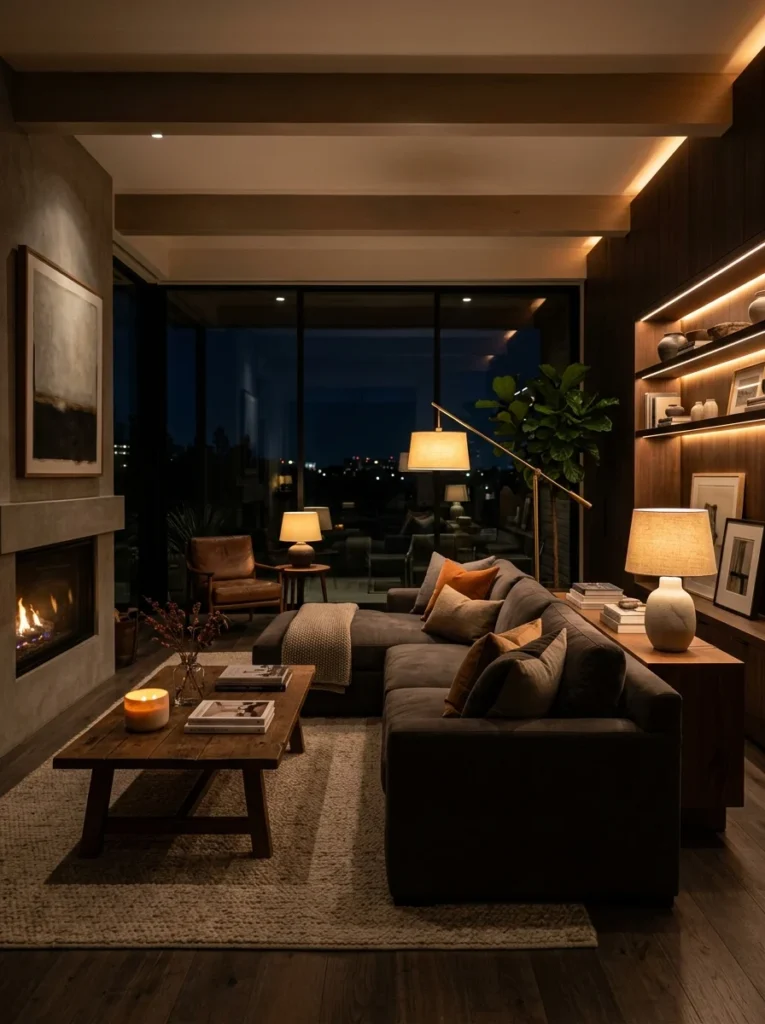
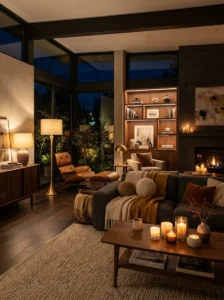
The difference between a living room that’s lit and one that’s warm at night comes down to specific lighting choices. Here’s exactly what creates warmth after dark and what consistently destroys it.There’s a difference between a living room that’s lit and a living room that’s warm. The lit living room has the overhead on, the room is visible from end to end, and it reads more or less like it does during the day — just without the natural light. The warm living room has something else happening: pools of warm light at different heights, some relative shadow in the corners and ceiling, a quality that makes the room seem to generate its own light rather than receive it from above.
These are the same room. Same furniture, same walls, same proportions. What changes between them is the lighting source, the lighting position, and the color temperature of the bulbs — and the difference between the two conditions is the difference between a room you want to leave when you’re tired and a room you want to stay in.
Most people live in the lit version. Not because it’s preferable but because it’s the default: the overhead fixture that came with the apartment or house, the single switch at the door, the room brought to visibility by one flat light source from above. The warm version requires a few specific changes, and understanding which changes produce which results is what turns a functional evening room into a genuinely inviting one.
Why Overhead Light Is the Enemy of Evening Warmth
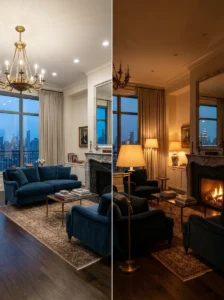
Overhead light does what it was designed to do: illuminate a room from above so that all surfaces can be seen. During the day, this overhead light is supplemented and corrected by natural light coming from multiple directions — windows, skylights, the ambient daylight that enters even from indirect angles. The two types of light together produce a room that reads as naturally lit.
At night, the natural light is gone. What’s left is the overhead fixture alone, doing all the room’s lighting work from one direction, one height, and typically one color temperature. The effect is the functional version of a room — you can see everything clearly — without the warmth or depth that natural light provided.
The brain’s relationship to overhead-only artificial light is different from its relationship to natural light or low directional light. As discussed in the cozy vs comfortable article, the light conditions associated with safety and shelter in evolutionary terms are warm, directional light at seated height or below — firelight, candlelight, the low lamp beside the chair. Overhead light at full intensity reads more like the light of a functional space — a workspace, a utility room — than a resting space.
This isn’t about dimness. A warm living room doesn’t have to be dim. It has to have the right sources, at the right heights, in the right color temperatures. Brightness is a separate variable from warmth, and warmth is what matters in the evening.
Color Temperature: The Specification That Changes Everything
This was covered in the kitchen and bathroom articles, but its importance in living rooms at night makes it worth a dedicated revisit with specific evening-use guidance.
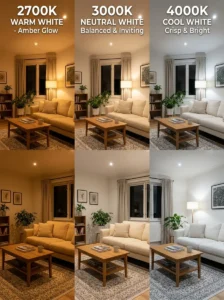
Bulbs are rated in Kelvin — a number that describes the color of the light they produce. Higher Kelvin reads as white to blue-white (daylight, office light). Lower Kelvin reads as amber to warm white (candlelight, firelight, incandescent).
For living room evening lighting specifically:
2700K — the temperature that most closely matches incandescent light. This is the baseline warm bulb, producing light that reads as amber-white and renders skin tones and wood tones with the warmth that cooler temperatures strip away. For any lamp in a living room used primarily in the evening, 2700K is the starting specification.
2400K or lower — approaching candlelight temperature. More amber, more dramatic, more intimate. This temperature in a lamp at seated height produces the quality of light that reads as genuinely cozy rather than just warm. Available in some specialty bulbs and filament-style LED bulbs. Particularly effective in floor lamps and table lamps where the bulb is somewhat visible.
3000K — a compromise temperature used in many “warm white” LED products. Warmer than office lighting but cooler than 2700K. In a room with other warm sources, 3000K is acceptable. As the sole light source at night, it often reads as slightly clinical rather than genuinely warm.
4000K and above — kitchen and task lighting temperatures. In a living room at night, these temperatures make the room read as if the wrong lights are on. Cool-white light at evening feels like an environment someone forgot to warm up rather than one that was prepared for use.
The bulb swap — replacing all living room bulbs with 2700K equivalents — is the fastest, cheapest lighting change available for improving a living room’s evening quality. It costs the price of bulbs and takes ten minutes.
The Layer System: How Warm Rooms Are Actually Lit
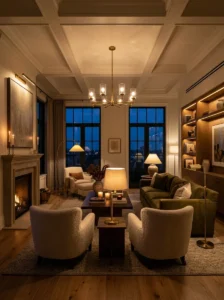
The warm evening living room isn’t lit by one source at the right temperature. It’s lit by multiple sources at different heights, each contributing to a room that has variation in light intensity — some areas warmer, some areas softer, with relative shadow at the ceiling and in corners rather than uniform illumination across all surfaces.
Layer one: Ambient background. This is typically the overhead fixture dimmed — not off, but reduced to a low level that provides baseline visibility without dominating the room. When dimmed to 20-30% of its full output, most overhead fixtures provide adequate ambient light without producing the flat, functional quality of full-intensity overhead lighting.
Layer two: Task and seating-area light. Floor lamps and table lamps at seated height or slightly above, positioned where the primary activities of the evening occur — beside the sofa for reading, beside a chair for conversation, near the television for viewing. These are the sources that produce the pools of warm light that define the evening quality of the room.
Layer three: Accent and mood light. Smaller, lower-intensity sources — a candle, a small decorative lamp, string lights around a feature element, a lamp inside or above a bookcase — that provide additional warm points of light without primary illumination function. These sources are optional but contribute significantly to the layered quality that distinguishes designed evening lighting from functional lighting.
The combination of these three layers, all at 2700K or warmer, produces the evening room that reads as inviting rather than merely visible.
Floor Lamps: The Highest Single-Purchase Impact
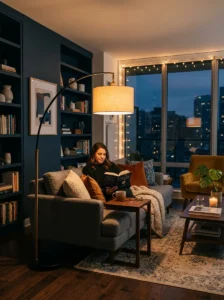
Of all the lamps available for a living room, a quality floor lamp positioned in the right location produces more transformation per purchase than any other lighting addition.
Position: beside the sofa or primary seating, not in an empty corner. The floor lamp should light the space where the person sits, not the space where nobody is. A floor lamp in the corner of the room provides ambient fill but doesn’t produce the pool of warm light that makes seated time genuinely pleasant.
Height: a floor lamp whose shade sits at approximately shoulder height when seated — 50-55 inches from the floor at the center of the shade — produces the quality of light at the right level. Very tall floor lamps whose shades are above standing eye level read as room-illuminating rather than seating-area warming.
Shade material: opaque shades direct light downward and create a defined pool. Semi-translucent fabric shades allow some light through the shade as well as below it, creating a wider, softer distribution. White or light-toned inner shade surfaces reflect more light than dark inner surfaces. For warm evening light, a drum shade in a warm-toned fabric — warm linen, amber-tinted, warm cream — produces light that’s warm-toned even before the bulb temperature is considered.
Bulb type in floor lamps: a visible bulb (Edison-style, globe, or filament bulb) in a floor lamp with an open or partially open shade produces the quality of light that reads as decorative and warm because the light source itself is visible and has visual character. An entirely hidden bulb produces good light but less visual warmth.
Table Lamps: Multiple Small Sources Over One Large One

The table lamp principle that consistently applies: multiple smaller lamps placed appropriately around the seating area produce more warmth than one large lamp placed centrally.
Two table lamps on a console or sideboard behind or beside the main seating create warm light at a height above the seated viewer that fills the room without the overhead-fixture quality. This configuration is one of the most effective warm-light setups in a living room because the light comes from behind and to the sides of the viewer rather than from above.
Table lamps on end tables beside the sofa produce light at seated eye level — warm, direct, and perfectly positioned for the activities (reading, conversation, relaxing) that the sofa is used for.
Pairs rather than singles — two matching or coordinating lamps rather than one — create visual balance that reads as intentional and produces twice the warm light coverage.
The shade’s effect on table lamp light: a drum shade with a light interior gives bright, even distribution below and through the sides. A coolie or tapered shade directs more light downward and produces a more focused pool. An opaque shade on a table lamp produces dramatic directed light with defined shadow above, which reads as more intimate.
Dimmers: The Electrical Change That Changes the Room
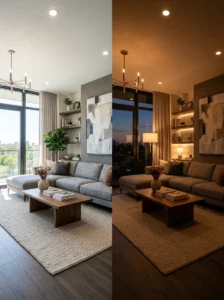
Every living room benefits from a dimmer on the overhead circuit. Not to turn the overhead off — it has a role even at low intensity — but to move it from full bright to fill-only ambient.
The transition from “overhead at full, room lit for function” to “overhead at 20%, lamps on, room lit for evening” is the single biggest available improvement in most living rooms. The dimmer switch makes this transition a one-action change rather than a lamp-by-lamp adjustment.
Smart bulbs and smart plugs offer the same capability without requiring switch replacement: a set of lamps on smart plugs, controlled by phone or voice, that come on to a warm, dimmed setting while the overhead adjusts separately. This level of automation makes the transition to evening lighting frictionless, which means it actually happens rather than being skipped because it’s inconvenient.
Candles: What They Do That Electric Light Cannot
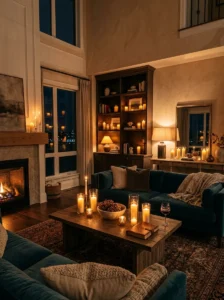
A candle in a living room at night doesn’t provide meaningful illumination. What it provides is something electric light physically cannot replicate: the quality of flickering, moving light that the brain has associated with warmth and shelter for the entirety of human existence.
The neurological response to candlelight — the specific quality of light that moves and changes rather than holding perfectly steady — is different from the response to any electric light source, including Edison filament bulbs that approximate the visual appearance. The movement of candlelight registers as alive in a way static light sources don’t.
A single candle on the coffee table doesn’t warm the room. Several candles at different heights — coffee table, console behind the sofa, a windowsill — contribute to a layered warmth that adds to the room’s evening quality in a way that’s felt before it’s consciously noticed.
Unscented candles in warm-toned glass or ceramic vessels are the most versatile — they provide the light quality without adding to any existing scent in the room or creating competing fragrance.
Flameless candles with realistic flicker produce a reasonable approximation for situations where open flame isn’t appropriate. The quality isn’t identical to real candlelight but produces enough of the movement and warmth to contribute to the room’s evening character.
The Sources That Consistently Fail to Create Warmth
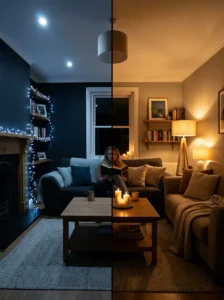
String lights as the only evening light source. String lights produce a charming, twinkling effect and almost no usable warm illumination. They read as decorative rather than functional and don’t produce enough light to make a room feel warmly inhabited at evening. As an addition to a properly layered lighting scheme, they’re delightful. As the primary evening light, they leave the room feeling dim and unfinished rather than warm.
Overhead at full brightness alone. Covered above, but worth restating: overhead at full intensity at night reads as functional rather than inviting regardless of the bulb temperature.
Cool-toned bulbs in warm-colored shades. A lamp with a warm amber shade and a 4000K or 5000K bulb produces a room that the eyes register as warm (amber shade) but that the skin and furniture register as cool (cool-toned light). The shade color and the bulb temperature need to agree, not work against each other.
Accent lighting as the only source. LED strips behind the television or under furniture are accent sources — they contribute depth and visual interest to a layered scheme but don’t produce sufficient illumination to be the room’s primary evening light source.
A Simple Audit for Your Current Living Room Lighting
Stand in the room at evening with the current lighting as you normally have it. Ask:
- How many distinct light sources are on? (If only one, the room is underlit for evening warmth regardless of the source quality.)
- Where is the light coming from relative to seated height? (If all sources are above shoulder height, the light isn’t positioned for the sitting quality evening rooms need.)
- What does the color temperature look like? (Stand beside something white — a white cushion, a white book cover — and assess whether the light reading on it is warm-amber or cool-white.)
- Is there any light at coffee table level or below? (The lowest-level light sources contribute most to the warmth feeling; their absence means all light is coming from above.)
- Would the room feel different if the overhead was dimmed to 20% and the lamps supplemented it? (If yes, a dimmer and some additional lamps are the specific interventions needed.)
Key Takeaways
- The warm evening living room isn’t defined by dimness — it’s defined by multiple sources at the right positions, heights, and temperatures rather than one source from above
- 2700K is the baseline specification for any lamp used in evening living room lighting; 2400K for warmer, more intimate effects; 3000K and above works as supplementary only
- The three layers — dimmed ambient overhead, task/seating-area lamps at seated height, accent and mood sources — work together to produce the quality that single sources can’t
- A floor lamp beside the primary seating (not in a corner) is the highest-return single lamp purchase for evening warmth
- Multiple smaller table lamps distributed around the seating area produce more warmth than one large lamp placed centrally
- A dimmer switch on the overhead circuit is the single most impactful electrical change for the transition from day to evening lighting
- Candles produce flickering movement that no electric source fully replicates — even a few candles add a warmth quality that registers before it’s consciously noticed
- String lights, cool-toned bulbs, and overhead-only lighting consistently fail to produce evening warmth regardless of their visual appearance during the day
Frequently Asked Questions
How many lamps does a living room actually need for good evening lighting? A minimum of three — one floor lamp in the primary seating area, one or two table lamps on a console or end tables, and the overhead dimmed to ambient fill. This produces the two-layer minimum (ambient plus seating-height task) that distinguishes warm from merely lit. Each additional source deepens the layering: a lamp on a bookcase, a candle on the coffee table, accent lighting in the corners. For most living rooms, four to six sources on simultaneously in the evening is the range that reads as warmly lit rather than dramatically dim or functionally bright.
Can I make my overhead fixture less flat without replacing it? Yes — dimming it is the most effective change, even without a formal dimmer switch. Some overhead fixtures accept smart bulbs that can be dimmed via an app; others can be partially reduced by removing one bulb in a multi-bulb fixture. Another approach: switching the overhead bulb to a lower-lumen output bulb so that even at full switch-on, the overhead contributes less than it currently does, requiring the lamps to fill in.
What’s the best kind of floor lamp for a living room that reads and watches television in the evening? A torchiere (floor lamp that directs light upward) provides broad ambient fill without glare on a television screen. An arc lamp with a shade directed over the sofa works for reading. For rooms that do both, a combination floor lamp — torchiere with an adjustable arm that can provide directed reading light — serves both purposes without requiring two separate lamps.
Do LED bulbs produce the same warmth as incandescent? At 2700K with high CRI (90+), modern LED bulbs produce light visually close to incandescent. The primary remaining difference is in very low-lumen applications — a 5-watt LED at 2700K doesn’t quite produce the amber-gold quality of a 25-watt incandescent, because the LED’s color point is consistent across all output levels while incandescent light gets more orange as it dims. Filament-style LED bulbs specifically designed to approximate incandescent visual quality produce the closest result.
How do I prevent my living room from looking dark and moody rather than warm? Ensure adequate total lumen output across all sources combined, and ensure some light is reaching all major surfaces — not just the seating area but the walls, the ceiling (even indirectly), and any areas someone might move through. A warm room isn’t a dark room. It’s a room where the light is distributed from multiple positions at appropriate heights rather than from one position overhead. If the room feels dark despite multiple lamps, the combined lumen output may be inadequate — consider higher-output bulbs in one or two sources while keeping the color temperature warm.