


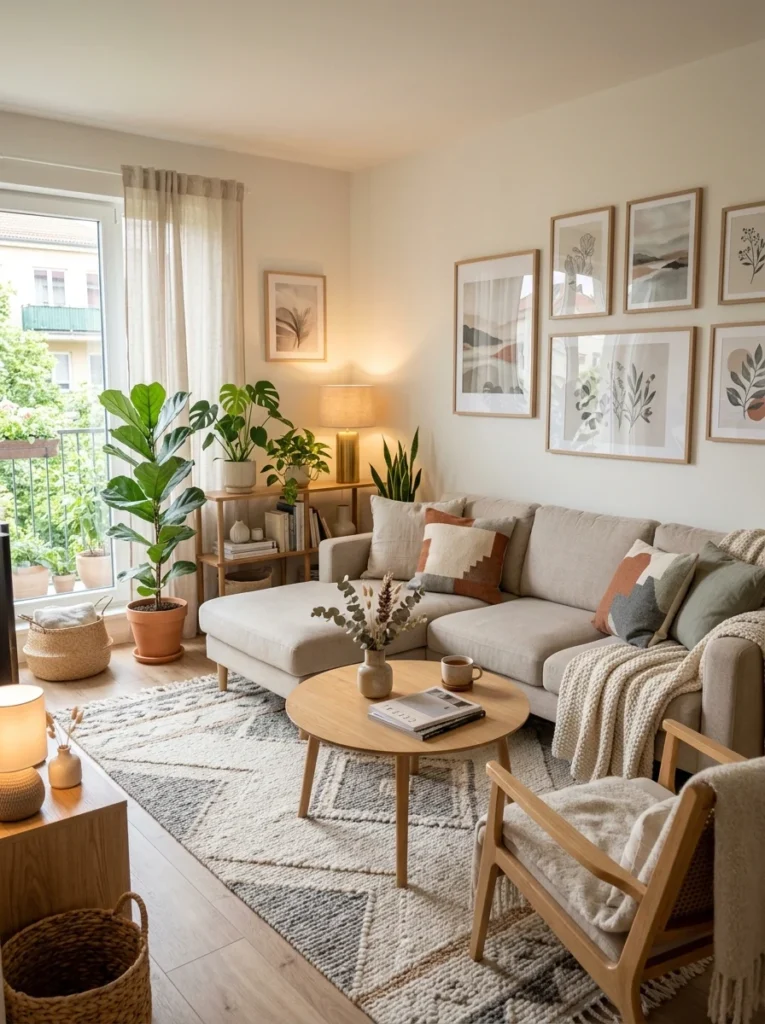
A rental restricts what can be permanently changed, but permanence isn’t actually what makes a living room feel like home. Here’s what does.A rental living room comes with real, specific constraints — walls that can’t be painted, fixtures that can’t be replaced, sometimes flooring or window treatments that are fixed regardless of taste. It’s easy to treat these constraints as the whole problem, and to assume that a rental will always feel provisional until a household owns the walls it’s living inside of. But most of what actually makes a living room feel like it belongs to someone has very little to do with permanent structural elements, and a great deal to do with layered, removable choices that a renter has full control over regardless of lease terms.
The households who feel most at home in a rental aren’t the ones who’ve found workarounds for every restriction — they’re the ones who’ve stopped waiting for ownership to invest in the layered, personal details that were never actually restricted in the first place.
The Restrictions That Matter Least Are the Ones Most People Fixate On
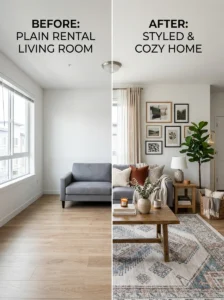
Wall color is usually the single most fixated-on rental restriction, and it’s also one of the least consequential to a room’s overall feeling of belonging, compared to the layered furnishing choices that are entirely within a renter’s control. A white or beige rental wall, left as-is, disappears almost entirely behind a well-furnished room — rugs, art, furniture, and textiles do the majority of the visual work in defining a room’s character, and wall color, while not irrelevant, plays a smaller role in that overall impression than it’s often given credit for.
Where wall color genuinely can’t change, removable wallpaper — a peel-and-stop product designed to come off cleanly at move-out — is a widely available workaround that many rental agreements explicitly permit even when paint isn’t allowed, and it can address the specific rooms or accent walls where color genuinely matters most to a household, without requiring a fight over the lease’s paint restrictions for the entire space.
Flooring, similarly, is often treated as a fixed constraint that can’t be addressed, when a large area rug covering most of the visible floor accomplishes much of what a flooring change would — particularly in a room with flooring the household finds genuinely unappealing rather than merely neutral.
Layering Is What Actually Signals a Space Is Lived-In and Chosen

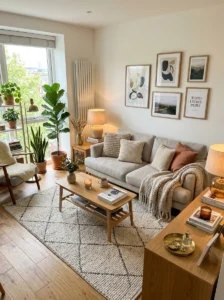
A room with a landlord-provided beige wall and nothing else on it reads as unfinished regardless of how nice the wall itself is. The same wall, behind a rug, a sofa with pillows and a throw, art on the walls, and a few personal objects on display, essentially disappears from the room’s overall impression — the layering is doing the work of making the room feel considered and lived-in, not the wall underneath it.
This is genuinely good news for a renter, since layering is entirely reversible and entirely within a renter’s control, unlike structural or surface-level permanent changes. A household investing in rugs, textiles, art, and furniture is investing in the exact elements that both make the current rental feel like home and travel intact to the next home, whereas investment in a permanent change — even where permitted — doesn’t transfer at all when the lease ends.
Removable Solutions Now Cover Far More Ground Than They Used To
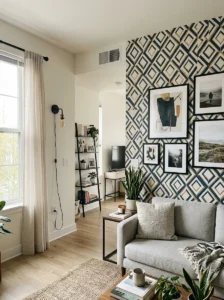
Command hooks and strips, rated for real weight, allow art and even some lighter shelving to be hung without drilling, which removes one of the most common rental barriers to displaying art at the scale covered elsewhere in this series regarding large walls. Modern removable hanging hardware is considerably more capable than the light-picture-frame-only products of a decade or two ago, and it’s worth checking current weight ratings rather than assuming removable hanging solutions can’t support a genuinely substantial piece.
Peel-and-stick tile, for surfaces like a dated fireplace surround or a section of accent wall, provides a way to change a fixed surface’s appearance without a landlord-prohibited permanent renovation, and can be removed at move-out to restore the original surface underneath.
Tension rod curtain setups, requiring no drilling into the wall or window frame, allow window treatments to be fully customized — including the blackout or light-filtering options relevant to some of the lighting considerations covered elsewhere in this series — without needing landlord permission for permanent hardware installation.
Plug-in fixtures and lamps, rather than hardwired lighting, allow a renter to fully customize a room’s lighting scheme — the layered, warm evening lighting covered elsewhere in this series is entirely achievable through lamps and plug-in sconces, none of which require any electrical work or landlord approval.
Furniture Investment Should Be Chosen for the Next Space, Not Just the Current One
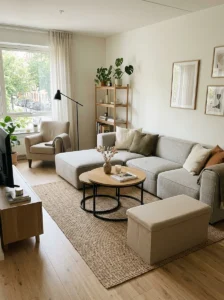
A common rental mistake is either under-investing in furniture on the assumption that “it’s just a rental,” which produces a space that never quite feels finished, or over-investing in pieces sized or styled specifically for the current rental’s exact dimensions, which then don’t transfer well to the next move. The more sustainable approach treats furniture investment the same way it would be treated in an owned home — buying quality pieces the household genuinely wants to keep — while being thoughtful about scale flexibility, since the next living room may have different proportions than the current one.
Modular and multi-functional furniture, covered in more detail elsewhere in this series in the context of small living rooms, has a particular advantage for renters specifically: pieces that can be reconfigured are more likely to adapt successfully to a new floor plan at the next move than furniture designed for one specific, fixed arrangement.
Personal Objects Do More Than Any Structural Change Could
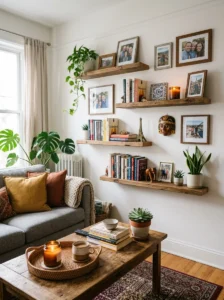
Photographs, meaningful objects collected over time, and items with a genuine personal history contribute more to a room feeling like it belongs to someone than any amount of paint color or fixture upgrade could, and these are entirely unrestricted by any lease. A rental fully furnished with beautiful but entirely generic, purely functional pieces can feel less personal than a more modest rental where a few genuinely meaningful objects are visibly present and thoughtfully placed.
Displaying these objects using the same principles covered elsewhere in this series for shelving and coffee tables — contained groupings, height variation, restraint rather than clutter — helps personal objects read as intentionally curated rather than simply accumulated, which matters as much in a rental as it does in an owned home.
What to Prioritize First With a Limited Budget
Given a limited budget and the reality that some rental investments transfer to the next home and some don’t, prioritizing the transferable investments first — a good rug, quality lamps, art, textiles — generally produces more lasting value than prioritizing rental-specific workarounds like peel-and-stick surfaces, which are valuable but tied to the current space’s specific fixed elements.
A large rug is often the single highest-impact purchase for a rental living room specifically, since it addresses flooring the household can’t change, anchors furniture the way covered elsewhere in this series regarding open-plan zoning, and transfers directly and usefully to whatever living room comes next.
Key Takeaways
- Wall color, the restriction most renters fixate on most, actually plays a smaller role in a room’s overall feeling of belonging than layered furnishing choices that are fully within a renter’s control
- A rug, art, furniture with pillows and throws, and personal objects do the majority of the work in making a beige rental wall disappear from a room’s overall impression
- Removable hanging hardware, peel-and-stick surfaces, tension rod curtains, and plug-in lighting now cover far more of what used to require landlord permission or permanent installation than they did even a decade ago
- Furniture investment is best treated the same way it would be in an owned home — genuinely good pieces the household wants to keep — with some attention to scale flexibility for the next move
- Personal, meaningful objects, displayed with the same restraint and containment principles used elsewhere in this series, do more to make a space feel like home than any structural or fixture change could
- With a limited budget, prioritizing transferable investments — rugs, lamps, art, quality furniture — generally produces more lasting value than prioritizing rental-specific fixed-surface workarounds alone
Frequently Asked Questions
Is it worth investing in nice furniture for a rental I might move out of in a year or two? Generally yes, as long as the furniture is chosen with some flexibility for a future space in mind rather than built or sized for the current rental’s exact dimensions alone. Quality furniture is one of the more transferable investments a renter can make, since it moves with the household to the next home, unlike any structural or fixed-surface change made specifically for the current rental.
What’s the single best thing to buy first for a rental living room on a limited budget? A large area rug is frequently the highest-impact single purchase, since it addresses flooring the household usually can’t change, anchors the furniture arrangement, and transfers directly and usefully to the next living room regardless of that space’s specific layout or flooring.
Can I actually hang real art in a rental without drilling into the walls? In many cases yes — modern removable hanging hardware, including weight-rated command strips and hooks, is considerably more capable than older removable products and can support genuinely substantial art in many cases. Checking the specific weight rating of the product against the piece being hung is worth doing before assuming a heavier piece can’t be displayed without drilling.
Does removable wallpaper actually work, or does it damage the walls when removed? Quality removable wallpaper products, applied and removed correctly, are generally designed to come off cleanly without damaging the underlying paint or wall surface, though results can vary by product quality and by how long the wallpaper has been in place. Testing a small section in an inconspicuous area, and following the specific product’s removal instructions carefully, reduces the risk of an issue at move-out.
How do I make a rental feel personal without it looking cluttered? Apply the same containment and restraint principles covered elsewhere in this series for shelving and coffee tables — a smaller number of genuinely meaningful objects, grouped thoughtfully with some height variation and negative space, rather than every personal item on display at once. A curated, contained display of a few meaningful pieces reads as more intentional and more personal than a larger, more scattered collection.