


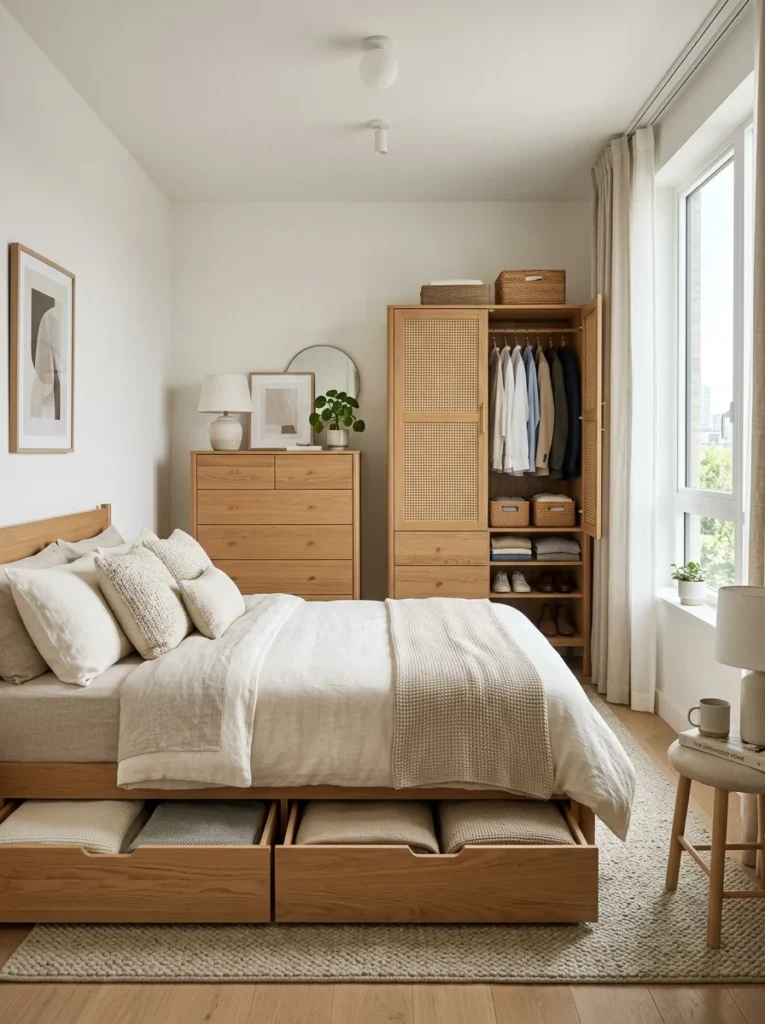
A bedroom with no closet, or an inadequate one, is a common problem in older homes and small apartments. Here’s how to solve for real storage capacity without a built-in closet to rely on.Older homes, converted spaces, and small apartments frequently have a bedroom with no closet at all, or one so shallow and narrow it barely holds a week’s worth of clothing. This is a specific, solvable storage problem, but it’s one that most bedroom storage advice doesn’t actually address, since most of it assumes a working closet exists and simply needs better organization inside it. A bedroom with no closet needs a different kind of plan — one that recreates a closet’s actual functions using freestanding furniture and wall space, rather than optimizing a built-in that isn’t there.
The goal isn’t to find one clever piece of furniture that replaces a closet entirely. It’s to recreate the several distinct functions a closet actually performs — hanging storage, folded storage, shoe storage, and a spot for out-of-season or occasional items — using a combination of furniture suited to a room that wasn’t built with a closet’s storage capacity in mind.
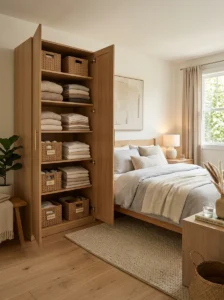
A Wardrobe or Armoire Is the Most Direct Substitute for Hanging Storage
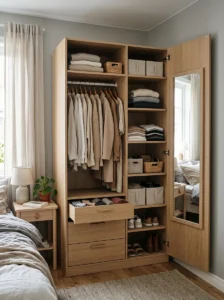
A freestanding wardrobe is the closest functional equivalent to a closet’s core purpose — hanging storage for clothing that needs to stay uncreased — and it’s worth treating as the anchor of the room’s storage plan rather than an afterthought. Wardrobes range considerably in size, and choosing one that genuinely fits the household’s hanging storage needs, rather than the smallest one that fits the available floor space, avoids solving the closet problem only partially.
A wardrobe with a mix of hanging space and shelving or drawers inside consolidates more of a closet’s function into a single piece, which is a meaningful space efficiency in a room that’s already dealing with a floor plan not designed around bedroom storage needs. Some wardrobes include a mirrored door, which adds a functional benefit — both for dressing and, as covered elsewhere in this series regarding light-starved rooms, for reflecting available light — without requiring a separate piece of furniture.
Placement against a wall that isn’t otherwise doing much work — behind a door’s swing path, in a corner that doesn’t accommodate a bed or nightstand well — makes efficient use of a small bedroom’s limited wall space, and this is worth planning deliberately rather than placing the wardrobe wherever it happens to fit last, after the bed and other furniture are already arranged.
Dressers and Drawer Storage Handle What Doesn’t Need to Hang
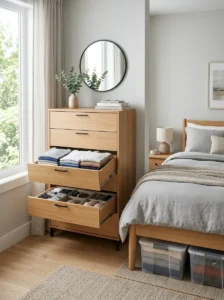
A significant portion of most people’s clothing — folded items, undergarments, workout clothes, sleepwear — doesn’t need hanging storage at all, and a dresser handles this category more space-efficiently than a wardrobe with only hanging rods would. A household relying entirely on a wardrobe for all clothing storage is often using hanging space inefficiently for items that would store more compactly folded in drawers.
A tall, narrow dresser makes better use of a small bedroom’s limited floor footprint than a wide, low one, using vertical space the way vertical storage solutions do throughout this series’ small-space discussions. This is a particularly relevant consideration in a bedroom already dealing with a wardrobe taking up floor space that would otherwise go to a closet.
Under-bed storage — drawers built into a bed frame, or storage containers slid beneath a standard bed frame with adequate clearance — captures a genuinely large amount of storage volume that a room with no closet can’t afford to leave unused. Out-of-season clothing, bedding, and items used infrequently are well suited to under-bed storage specifically, since they don’t need to be as immediately accessible as daily-use clothing in a dresser or wardrobe.
Vertical Wall Storage Recreates a Closet’s Shelf Function
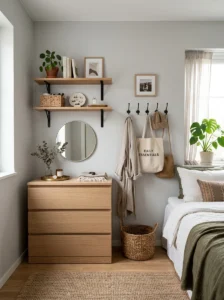
A closet typically includes shelving above the hanging rod for folded items, out-of-season storage, and accessories, and a bedroom without a closet needs to recreate this function somewhere, since floor-based furniture alone rarely accounts for it. Wall-mounted shelving, positioned above a dresser or wardrobe, or in an otherwise unused section of wall, captures this vertical storage capacity without adding to the room’s floor footprint.
Hooks — for bags, robes, frequently worn outerwear, or accessories — mounted on the wall or the back of the bedroom door, address the category of items that a closet typically handles casually via a rod or hook inside it, and that otherwise end up draped over a chair or the end of the bed in a room without a dedicated spot for them.
A valet stand or a single dedicated hook near the wardrobe or dresser, for the next day’s outfit or an item currently in rotation, solves a specific small problem that closets handle without anyone noticing — a spot for the one item that’s neither properly stored nor actively worn.
Room Dividers and Curtained Storage Add Concealed Capacity
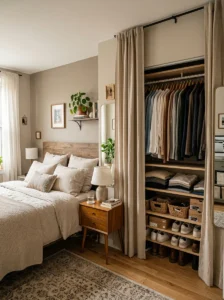
A curtained-off section of the room — a rod mounted across a corner or along part of a wall, with a curtain concealing hanging storage or shelving behind it — recreates a closet’s concealment function, hiding stored items from the room’s main visual field the way a closet door does. This is a particularly useful solution in a room too small for a full freestanding wardrobe, since a curtained rod takes up meaningfully less visual and physical space than an enclosed piece of furniture while still providing genuine hanging capacity.
This approach also addresses a specific psychological aspect of the no-closet problem that furniture alone doesn’t fully solve: a room where all clothing storage is visibly on display, even if well organized, tends to feel more cluttered and less restful than a room where storage is concealed, the same way a closet’s closed door contributes to a bedroom’s sense of order regardless of what’s actually inside it.
Solving for Off-Season and Occasional-Use Items Specifically
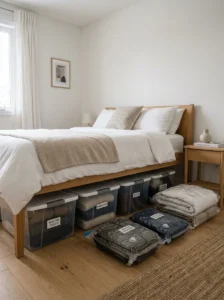
A closet typically absorbs the bulkiest, least-frequently-accessed category of storage — off-season clothing, luggage, out-of-season bedding — and a bedroom without a closet needs a specific plan for this category, since it’s the storage need most likely to be overlooked when focusing primarily on daily-use clothing storage.
Under-bed storage, covered above, is often the best-suited location for this specific category, precisely because off-season and occasional items don’t need frequent access the way daily clothing does. Vacuum storage bags, which compress bulky items like out-of-season bedding and winter coats significantly, make under-bed and other tight storage spaces considerably more effective for this category than storing these items at their full, uncompressed volume would allow.
Where a bedroom’s storage need genuinely exceeds what the room itself can accommodate, storage outside the bedroom entirely — a hall closet, a storage unit, under-stair storage elsewhere in the home — for specifically the off-season and occasional-use category is a reasonable and common solution, reserving the bedroom’s limited storage capacity for daily-use items that genuinely need to be close at hand.
Choosing Furniture That Serves the Room’s Storage Needs First
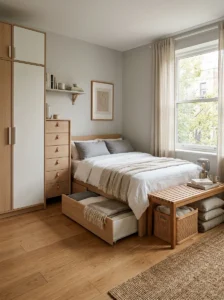
In a bedroom without a closet, storage furniture needs to be selected and prioritized before more purely aesthetic furniture decisions, since the room’s basic functional need — somewhere for clothing to actually go — is more urgent than it would be in a bedroom with a working closet already handling that need. This sometimes means a smaller bed frame, a more modest nightstand, or fewer purely decorative pieces than a household might otherwise choose, in order to allocate the room’s limited floor space to the wardrobe and dresser doing the actual storage work.
Multi-functional furniture — a bench at the foot of the bed with storage inside, a nightstand with drawers rather than an open shelf — captures additional storage capacity from furniture the room needs regardless, applying the same principle covered elsewhere in this series for small living rooms to a bedroom facing an even more acute storage constraint.
Key Takeaways
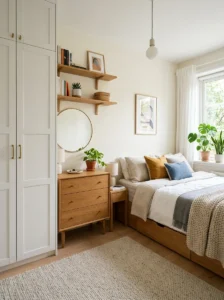
- A wardrobe or armoire is the most direct substitute for a closet’s hanging storage function and is worth treating as the anchor of the room’s storage plan, sized generously enough to genuinely meet the household’s needs
- Dressers handle folded clothing more space-efficiently than hanging storage would, and a tall, narrow dresser makes better use of limited floor space than a wide, low one
- Under-bed storage captures significant volume well suited to off-season and occasional-use items that don’t need frequent access
- Wall-mounted shelving and hooks recreate a closet’s shelf and hook functions without adding to the room’s floor footprint
- A curtained rod section can provide genuine hanging capacity with a smaller footprint than a full wardrobe, while also concealing storage the way a closet door does
- Storage furniture needs to be prioritized ahead of purely aesthetic furniture choices in a closet-less bedroom, since the room’s basic storage function is more urgent than it would be with a working closet already in place
Frequently Asked Questions
Is a wardrobe or a dresser more important to prioritize first in a bedroom with no closet? Generally the wardrobe, since it addresses the storage category — hanging clothing — that has no other reasonable substitute in the room, while folded storage can be supplemented to some degree by other options like bins or under-bed storage if a full dresser isn’t immediately feasible. That said, most households ultimately need both, and a wardrobe with some internal shelving or drawers can partially cover both needs if only one piece of furniture fits initially.
Does under-bed storage actually hold a meaningful amount, or is it mostly marginal? It holds a genuinely significant amount, particularly for bulkier, less-frequently-accessed items like off-season bedding and clothing, and especially when combined with vacuum storage bags that compress these items considerably. For a bedroom without a closet, under-bed storage is one of the higher-capacity options available relative to the floor space it requires, since it uses space beneath existing furniture rather than adding new floor footprint.
Is a curtained storage area actually a good substitute for a real closet, or does it look obviously improvised? Done with some intention — a well-chosen curtain fabric, a clean rod installation, contents organized behind it reasonably neatly — it can look considered rather than improvised, and it offers a genuine space and cost advantage over a full wardrobe in a small room. The concealment itself, regardless of how the area looks when the curtain is open, contributes meaningfully to the room feeling ordered, since it removes clothing storage from the room’s visible surfaces.
Should out-of-season clothing be stored in the bedroom at all if there’s no closet? Not necessarily — if the bedroom’s storage capacity is limited, it’s often more efficient to reserve that space for daily-use clothing and store off-season or occasional items elsewhere in the home, such as a hall closet or another storage area, rather than trying to fit everything into a bedroom that wasn’t built with adequate storage capacity in the first place.
What’s the single most space-efficient piece of furniture for a bedroom with no closet? A wardrobe or armoire that combines hanging space with internal shelving or drawers generally provides the most storage function per square foot of floor space, since it consolidates several of a closet’s separate functions into one piece rather than requiring multiple separate furniture items to cover the same range of storage needs.