


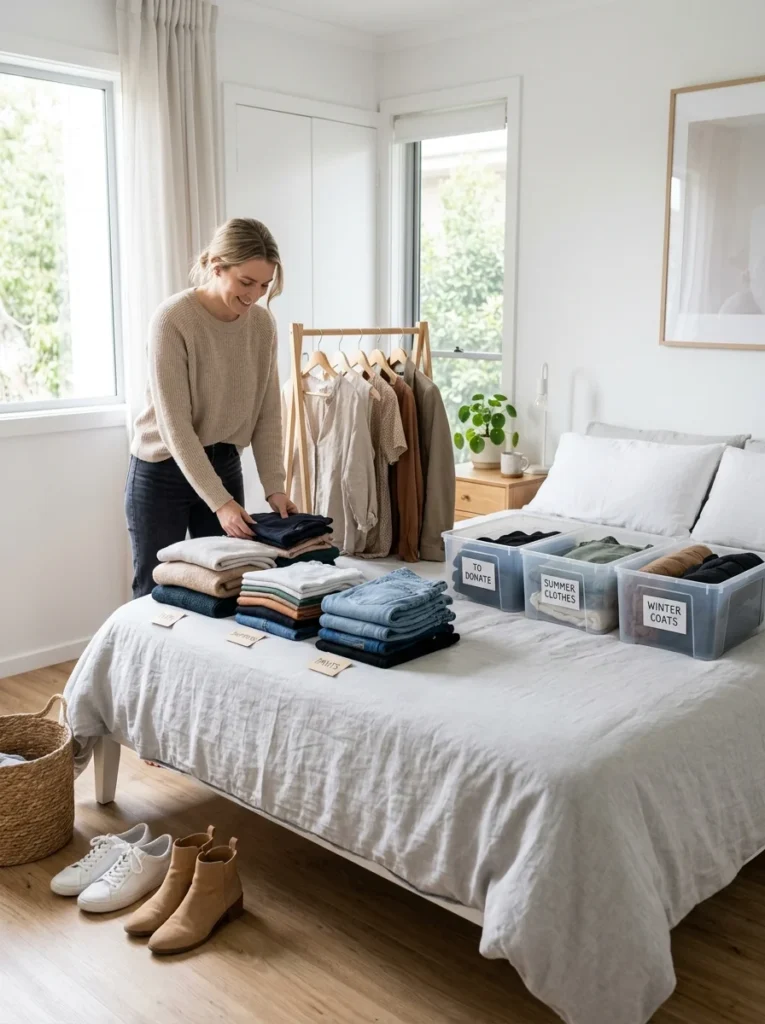
A bedroom without a built-in closet isn’t a broken design — it’s the original design. Here’s how to solve clothing storage in a room that was never built to include it
Built-in bedroom closets are a twentieth-century American invention. Before roughly the 1930s, when residential building codes began requiring minimum closet space in new construction, clothes were stored in wardrobes, armoires, trunks, chests, hooks on walls, and dedicated dressing rooms in larger homes. The bedroom without a closet isn’t an architectural failure — it’s the original design, still present in the older houses, European apartments, and converted spaces that make up a significant portion of the world’s housing stock.
This context matters because it shifts how the problem gets approached. A room without a built-in closet isn’t incomplete — it’s a room that requires a different approach to clothing storage than the twentieth-century solution of a built-in alcove behind a bi-fold door. The solutions available are numerous, most of them pre-date the American closet by centuries, and several of them are more visually interesting than the standard built-in.
The challenge in a room without a closet is not really finding somewhere to put clothes. It’s finding somewhere to put them that doesn’t make the bedroom feel like a laundry room, a dressing room that got out of hand, or a storage unit with a bed in it.
Start With the Inventory: What Actually Needs to Live in This Room
Before adding any storage, the most useful exercise is an honest accounting of what the bedroom needs to contain. Closet space problems are frequently not storage problems — they’re inventory problems, where the volume of belongings exceeds what any reasonable bedroom storage solution could accommodate without overflowing into the visible space.
The specific categories of clothing and personal items that typically need bedroom storage:
- Clothing worn regularly (weekly or more often)
- Shoes for current-season daily use
- Accessories used regularly (belts, jewelry, watches)
- Pajamas and loungewear
- Undergarments and socks
Everything outside this list is either occasionally-used clothing (which can live elsewhere), seasonal items (which belong in off-season storage), or items that should honestly be considered for donation or disposal.
An edited inventory — one that contains only what’s currently worn and needed in this room — requires significantly less storage than the unedited accumulation that most people are trying to accommodate. Before purchasing any storage solution, the edit is worth doing first. In most bedrooms without closets, the edit alone reduces the perceived storage gap considerably.
The Wardrobe: The Original Closet That Works Better Than People Expect
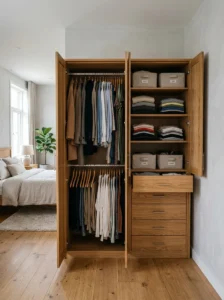
The wardrobe is the oldest and most complete solution for bedroom clothing storage, and it’s been refined across centuries of use in exactly the context where people face the no-closet situation. A well-chosen wardrobe does everything a built-in closet does — hanging space, drawer storage, shelf space, door storage — in a freestanding unit that moves with the owner and doesn’t require any construction.
The size that actually works: a wardrobe for daily use should be at least 24 inches deep (to accommodate hanging clothes that span 20-22 inches) and at least 48 inches wide for one person, 72-80 inches for two. Anything narrower than 48 inches is a supplementary piece rather than a primary clothing storage solution — the hanging space is too limited for a full wardrobe.
The interior configuration matters as much as the exterior dimensions. A wardrobe with only a hanging rod and one shelf at the top provides hanging capacity but no organized drawer or shelf storage for folded items, undergarments, and accessories. Look for wardrobes with at least one drawer bank (three to four drawers) and some adjustable shelf capacity in addition to the hanging rod.
Wardrobe placement affects both function and room feel. Against a wall with some clearance to adjacent furniture for door swing, positioned so it doesn’t create an awkward traffic path through the room. A wardrobe placed against a wall that creates a natural alcove — beside a chimney breast, flanking a window — reads as more intentional than one placed arbitrarily in the room’s center.
The visual weight of a wardrobe is significant — it’s typically the room’s largest piece of furniture. A wardrobe in a darker finish or heavily figured wood can dominate a small room. A wardrobe in a lighter color — white, pale wood, a soft painted tone — reads with less visual weight and suits smaller rooms better.
Freestanding Clothing Racks: The Visible Approach
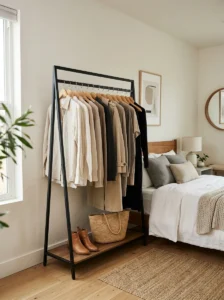
A clothing rack in a bedroom is the opposite of the hidden-behind-closed-doors closet approach. It makes clothes visible, which is a trade-off: it requires that the clothes visible on the rack are curated enough to look intentional rather than haphazardly hung.
When this is managed well — a rack with only the current season’s most worn items, hung consistently in one color direction or by category, clear of hangers that aren’t currently in use — a clothing rack reads as an intentional design feature rather than a storage workaround. Many specifically designed home-use clothing racks have become genuinely attractive pieces of furniture, and the visible wardrobe approach is common in fashion-forward interiors.
When this is managed poorly — a rack overloaded with clothes in every direction, hangers mixed, items drooping off the edges — a clothing rack reads as the visual chaos that makes a no-closet bedroom feel like it can’t be organized.
The rack that works for the visible approach: a simple pipe or solid metal rack in black or brass, at adequate width for the clothes being displayed (minimum 36 inches for a curated selection), with matching velvet or wooden hangers throughout. No plastic, no mixed hangers, no unused hangers taking up space.
Under the rack: a rack with adequate floor clearance can have shoes organized below it — again, in a curated selection, in a consistent line rather than piled. This makes the rack-plus-shoes arrangement read as a dressing area rather than a clothes pile.
Under-Bed Storage: The Overlooked Square Footage
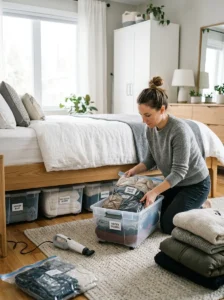
The space under a standard bed at sixteen to eighteen inches of clearance represents significant storage volume that most bedrooms with no closet don’t fully exploit.
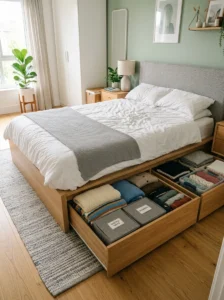
Purpose-built under-bed storage — flat plastic bins with lids and wheels, soft fabric storage bags with handles, or purpose-designed furniture with built-in drawers — stores folded items, off-season clothing, extra bedding, and shoes without consuming visible room space.
Bed frame choice affects storage availability. A bed on legs with clearance provides under-bed storage. A platform bed with solid base panels doesn’t. A divan bed may have built-in drawers. In a no-closet bedroom, the bed frame choice is simultaneously a furniture and storage decision, and a bed with under-storage is worth specifically seeking.
Under-bed storage works best for: seasonal items (winter sweaters in summer, summer clothes in winter), extra bedding (spare duvet, extra pillows), shoes that aren’t in current rotation, and any item that’s needed occasionally rather than accessed multiple times per week. Items needed daily are better stored in more accessible locations; the effort of pulling a bin from under the bed is appropriate for monthly access, not daily access.
Hooks, Rails, and Wall-Mounted Systems

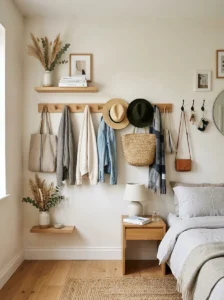
A wall section without furniture can become structured clothing storage through mounted hardware that costs considerably less than any freestanding piece and uses the wall surface rather than the floor footprint.
A wall-mounted rail at the appropriate height for hanging clothes — approximately 70-72 inches from the floor — creates hanging space without a wardrobe. Shelves above the rail accommodate folded items. Drawers or a small chest below the rail complete the wardrobe function in a system that’s built into the wall rather than freestanding in the room.
Hooks at a consistent height create the hanging storage that closet doors and wardrobe interiors usually provide. A row of hooks — at 60-65 inches from the floor, consistent spacing — provides day-to-day access to the most-used items (the coat, the robe, the next-day outfit) without requiring any wardrobe or rack.
The Shaker peg rail — a continuous horizontal board with regularly spaced pegs, originally from Shaker religious communities who used them for both furniture and clothing storage — is the most visually intentional version of wall-hook storage. Installed at a consistent height around the room’s perimeter or on one primary wall, a peg rail provides the functional equivalent of closet rod storage in a design that reads as architectural feature rather than improvised solution.
Supplementary Storage Furniture: What Belongs in the Bedroom Beyond the Wardrobe
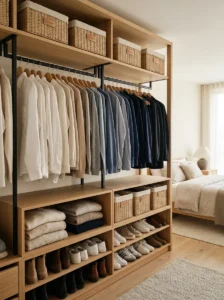
A wardrobe handles hanging and folded clothes. Additional furniture pieces handle the categories the wardrobe doesn’t:
A chest of drawers (or dresser) — three to six drawers of folded storage for undergarments, socks, t-shirts, and anything that folds rather than hangs. The chest of drawers is the wardrobe’s complement and is typically a dedicated piece rather than an integrated component.
An ottoman or storage bench at the foot of the bed — the day’s nearly-clean or next-to-be-worn items, the items that don’t quite make it to the wardrobe because they’ll be worn again before washing, the extra blanket, the shoes worn most recently. The storage bench contains the “landing zone” category of clothing that otherwise ends up on the floor or on a chair.
The chair problem: almost every bedroom has a chair — the bedroom chair, the exercise bike chair, the chair nobody sits in — that has become a clothing depository. If the chair is being used this way consistently, it’s because there’s no other convenient intermediate storage for partly-used clothing. A storage bench or ottoman with a lid provides the same “put it here temporarily” function with containment, which prevents the visual chaos of the chair pile.
A jewelry and accessories organizer — wall-mounted, drawer inserts, or a dedicated tray system — keeps the categories the wardrobe doesn’t hold organized and accessible rather than scattered across the dresser top.
Making Visible Storage Look Intentional
When storage is visible in a bedroom without a closet — a clothing rack, mounted shelves, hooks — the specific visual management decisions determine whether it reads as a considered feature or an improvised workaround.
Consistent hangers throughout any hanging system. Mixed plastic and wire hangers on a clothing rack immediately read as improvised. A set of matching velvet hangers in black or natural wood, same style throughout, reads as intentional. This is a ten to fifteen dollar difference that changes the visual result completely.
Consistent color direction in visible clothing. A rack or wall rail where clothes are grouped by color or type reads as organized; one where items are in random order reads as a messy closet that happened to not have doors.
Clear, consistent containment for smaller items. Open baskets, matching bins, a consistent container type for shoes — these read as a storage system that someone designed. Mismatched containers in different materials and colors read as accumulated.
Adequate space between displayed items. A cramped, overloaded rack or shelf reads as insufficient storage. A rack or shelf with breathing room between items — clothes not pressing against each other, shoes with visible space between pairs — reads as curated and sufficient.
Seasonal Rotation as a Management Tool

A bedroom without a closet typically can’t hold a full year’s wardrobe for one person, let alone two. Seasonal rotation — moving off-season clothing to alternative storage and keeping only current-season clothing in the bedroom — is the management approach that makes limited bedroom storage work across all four seasons.
Off-season storage can be: a hallway linen closet, under the bed in flat bins, a utility room, a second bedroom, or purpose-built storage boxes in a garage or basement. The location doesn’t need to be convenient for daily access — it just needs to exist and be accessible for the seasonal swap.
The swap timing — moving winter to off-season storage when spring reliably arrives, moving summer clothing out in autumn — keeps the bedroom’s in-room storage containing only the category of clothing currently in use, which is the only category that needs to be accessible.
Key Takeaways
- Built-in closets are a modern, geographically specific invention; the bedroom without one isn’t deficient, it requires a different approach
- An honest edit of what actually needs bedroom storage is the most important first step — inventory problems are more common than storage problems
- A properly sized wardrobe (minimum 24″ deep, 48″ wide for one person) with interior configuration for both hanging and folded storage handles the full closet function freestandingly
- Clothing racks work as intentional design elements when managed with consistent hangers, curated color-grouped clothing, and adequate space between items; they fail when overloaded and unsystematic
- Under-bed storage at appropriate clearance handles seasonal items and infrequent-access categories without consuming visible room space
- Wall-mounted rails with shelves, Shaker peg rails, and hook rows use wall surface rather than floor footprint for hanging storage
- A storage bench at the foot of the bed contains the “partially used” clothing category that otherwise creates the chair pile
- Seasonal rotation — off-season clothes stored elsewhere — keeps in-room storage manageable across a full year
Frequently Asked Questions
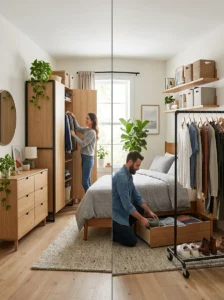
How do two people share a bedroom with no closet without constant chaos? Designated individual zones — one wardrobe per person, or a wardrobe divided down the center with clear ownership of each half — prevent the mixing of two people’s clothing that creates the most difficult-to-manage storage situations. A clearly personal clothing rack, a personal chest of drawers, and a personal ottoman or storage box give each person’s items a specific home that’s visibly separate from the other’s, even when all the storage is in the same room.
What’s the most cost-effective storage solution for a room without a closet? Wall-mounted hooks and a chest of drawers together provide the most storage per dollar in a bedroom without a closet. A chest of drawers handles folded items; hooks handle frequently-worn hanging items and accessories. This combination misses the hanging capacity for items that need to hang (formal clothes, structured jackets) but covers the daily-use categories at lower cost than a full wardrobe. A clothing rack added for hanging completes the basic system for significantly less than a comparable wardrobe.
Can I add a built-in closet to a bedroom that doesn’t have one? In most cases yes, with varying degrees of construction. A true built-in requires framing, drywall, shelving, and a door — several thousand dollars in materials and labor. A more accessible option is an alcove closet: a section of wall where shelving, a hanging rod, and a curtain or sliding panel create a closet-like area that looks integrated without full construction. In rental situations, a freestanding wardrobe is the appropriate equivalent.
Are there specific wardrobe brands worth recommending for no-closet bedrooms? The most widely available and price-accessible options with adequate interior configuration tend to come from IKEA’s wardrobe category (PAX system specifically), which allows fully customized interior layouts at reasonable cost. The PAX system’s combination of hanging, drawer, and shelf configuration options makes it more functional than most pre-configured wardrobes at similar price points. At higher price points, midcentury-inspired wardrobes from furniture brands provide better visual character in rooms where the wardrobe will be a prominent design element.
Should I try to hide the clothing storage or embrace it as a visible design element? This depends on the room’s size and the quality of storage available. In a small bedroom, hiding storage (wardrobe with doors, closed chests) keeps the room visually calm and reads as more spacious. In a larger bedroom where a styled clothing rack or open shelving system can be positioned deliberately, visible storage can be a genuine design feature rather than a workaround. The test: does the visible storage look like it was specifically designed for this room, or does it look like a closet that lost its door? The former is a design feature; the latter should probably be hidden.