

The nightstand is used at the most specific moments of the day — falling asleep and waking up. What’s on it matters more than any other bedroom surface. Here’s exactly what belongs and what doesn’t.
The nightstand is used twice a day at the most specific moments in the daily rhythm: when you’re getting into bed, and when you wake up. Everything on it is encountered in those particular states — tired, or just awoken, or somewhere in between. This makes the nightstand the bedroom surface with the highest functional specificity and the most direct relationship between its contents and how you feel in those moments.
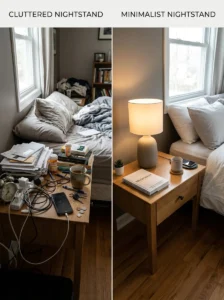
It also makes it the bedroom surface most likely to be loaded with everything that didn’t have a more obvious home — the reading glasses that migrated from the living room, the water bottle from the gym, the book that hasn’t been opened in two weeks, the charging cable that’s technically necessary but creates a visual nest of wire, the medication taken at night, the lip balm, the phone and the phone charger, the hand lotion, the notebook with a few pages used, the second notebook started when the first couldn’t be found.
The nightstand that contains all of this is the nightstand of most real bedrooms. It functions, in the sense that everything on it has been there for a reason at some point. It doesn’t serve either of its actual moments particularly well — the moment of slowing toward sleep or the moment of returning to the day — because it asks for cognitive processing at exactly the times when cognitive processing is least available.
What the Nightstand Is Actually For

Before deciding what to put on or in the nightstand, it’s useful to be precise about the specific functions it needs to serve in the twenty-four-hour cycle.
In the thirty minutes before sleep: the nightstand provides a surface for whatever is in hand during the winding-down period — typically a book, a glass of water, and the ability to switch off the light without getting out of bed. These three functions cover the genuine pre-sleep nightstand requirements for most people.
During the night: accessible water, an alarm mechanism, and anything required for a nighttime health need (medication, asthma inhaler, whatever is specific to that person).
At waking: the ability to stop the alarm, access water if needed, find glasses if worn, and begin orienting to the day with minimal cognitive load.
These functions are collectively served by fewer items than most nightstands contain. The additional items — the things that have accumulated beyond these functional categories — are there by default rather than by decision.
The Lamp: First Priority, Non-Negotiable

A nightstand without a lamp forces the use of the overhead light for everything that happens in bed — reading, winding down, and the moment of switching off. Overhead light at full brightness in the hour before sleep is one of the most direct disruptions to melatonin production and sleep onset quality.
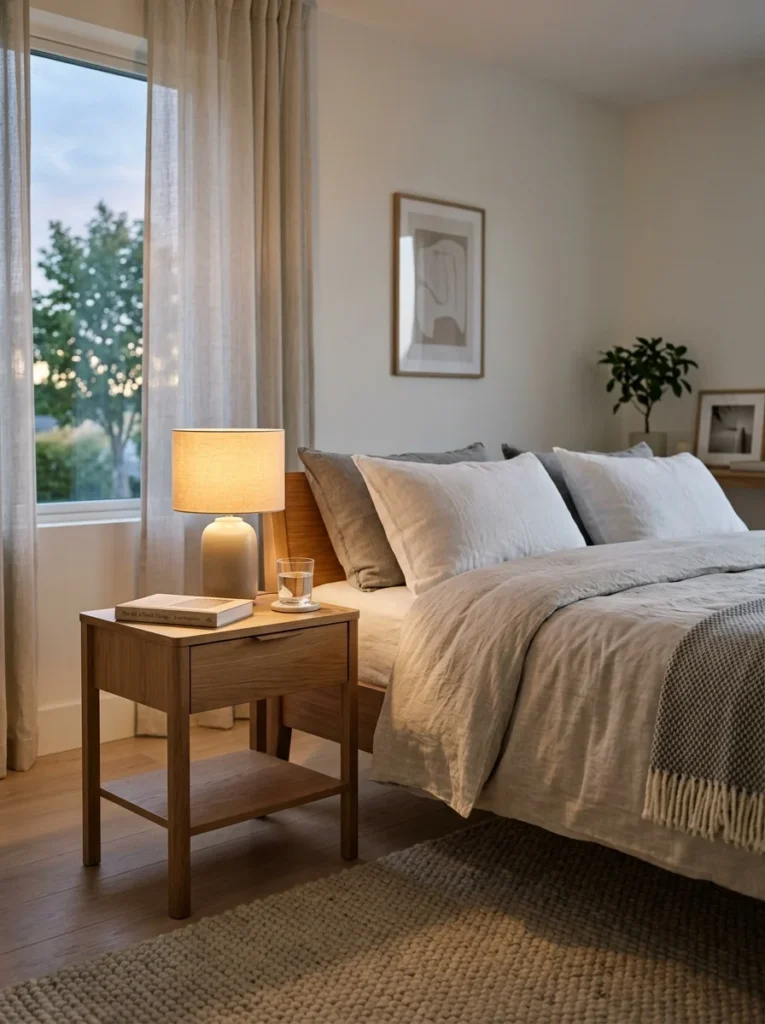
A lamp on the nightstand is not optional equipment. It’s the most important single item the nightstand holds, because it enables warm, directed, low-level light for the entire pre-sleep period — the specific light condition that supports the sleep transition — without requiring the room’s overhead light.
The lamp’s position on the nightstand: close enough to reach easily from the bed without sitting up. The switch or touch-pad should be reachable from a lying position — the lamp that requires physical adjustment to turn off doesn’t serve its final pre-sleep function well.
The lamp’s shade and bulb: a warm-toned shade (warm linen, amber-tinted, cream) and a 2700K or lower bulb produces the light quality appropriate for the pre-sleep period. A white shade with a neutral or cool bulb produces light that’s appropriate for reading but doesn’t contribute to the warm-light environment the bedroom needs after dark.
Water: The Simple Item Most Nightstands Lack
A glass of water on the nightstand solves a specific problem that’s significant enough to be worth naming: the 3am thirst that requires getting up and going to another room, fully waking in the process and losing the light-sleep state that would have returned to deeper sleep.
The container matters slightly: a glass (not a plastic bottle) reads better visually. A carafe-and-glass combination reads as particularly considered and hotel-suite-adjacent. The water is the same; the reading of the surface is different.
The Book: Conditional
A book on the nightstand is appropriate when it’s actively being read. A book that hasn’t been opened in two weeks, or that’s more aspirational than actual, occupies surface space that its non-use doesn’t justify.
One book at a time on the nightstand is the upper limit for most surfaces. More than one reads as a stack — the beginning of the accumulation pattern that eventually makes the nightstand read as a general surface rather than a specific one.
If reading in bed is part of the nightly routine, the book earns its position definitively. If reading in bed is aspirational and rarely happens, the book’s presence contributes to the visual noise of items that reference activities rather than supporting them.
The Phone: The Most Important Nightstand Decision

The phone on the nightstand is the item most directly linked to sleep quality and most resistant to removal despite the evidence.
The specific ways the phone disrupts sleep from the nightstand position:
Light at the worst possible time. The pre-sleep screen use that the bedside phone enables is the most direct common-life disruption of melatonin production. The phone within reach invites use in the period when its light does the most damage to sleep onset.
Notification presence during sleep. Phones set to silent still light up for notifications. The light response — even if the sound is off — can disrupt lighter sleep stages in people who are light-sensitive to changes in room brightness.
First-morning association. A phone within reach on waking is a phone that gets checked before full consciousness has returned. This specific behavior — checking the phone as the first act of the day — has been associated with elevated cortisol responses early in the morning and with the phone establishing the cognitive and emotional tone of the day before any other input.
The alternative: charging the phone in another room and using a dedicated alarm clock (or a smart speaker in alarm-only mode) for the wake function. This removes the phone from the nightstand, removes the pre-sleep temptation, and removes the first-morning association.
This is advice most people have encountered and fewer people follow, because the phone is also genuinely useful — for the alarm, for the urgent message you might miss, for the specific content that feels worth the disruption. The trade-off is real; so is the cost.
Medications and Health Items: Organized Proximity
Medications taken at night or in the morning belong within reach because their function is timing-dependent. A small dish, a drawer, or a dedicated corner of the nightstand for this category keeps it accessible without it taking over the surface.
The distinction between health items that belong on the surface and those that belong in a drawer: items used every night (a nightly medication, reading glasses, lip balm) benefit from surface accessibility. Items used occasionally (a backup migraine medication, a rarely-used supplement) belong in the drawer rather than taking surface space.
A small lidded dish that corrals the nightly-use items into one visual unit reads better than each item scattered separately across the surface.
What Does Not Belong on the Nightstand

Work materials. A notebook used for work, a work device, physical work documents — anything that represents work category belongs outside the bedroom, and specifically off the nightstand. The bedroom and sleep association is undermined by visible work materials at the exact sleeping surface. Work that couldn’t be finished that day, represented on the nightstand, is the specific kind of unresolved loop that maintains brain activation during the pre-sleep period.
More than one night’s worth of items. The nightstand accumulates the items of days past — the receipt that arrived in a pocket, the expired medication never discarded, the object moved from somewhere else and never moved back. These items belong in a monthly clear-out, not on the nightstand surface.
Clutter of any kind. The nightstand is seen first and last every day. Clutter that would be tolerable on a kitchen counter or a coffee table — a mix of objects with no particular organization — reads differently when encountered tired or just awake. The nightstand should require no cognitive processing to use, which means its contents should be obvious, minimal, and specifically placed.
The phone charger cable (specifically). A charging cable that trails across the nightstand surface, over its edge, and down to the outlet reads as infrastructure rather than considered arrangement. If charging at the bedside is necessary (despite the phone-in-another-room recommendation), a cable organizer or a wireless charging pad eliminates the visible wire.
The Aesthetic Layer: What Stays After Function Is Met
After the lamp, water, current book, nighttime health items, and alarm mechanism — what’s left for the nightstand surface in terms of optional aesthetic elements?
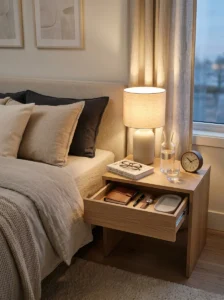
One small object that contributes to the bedroom’s aesthetic without serving a daily function is the ceiling for most nightstands. A small plant (low-maintenance, appropriate for the room’s light level), a small ceramic or stone object, a single framed photograph — any one of these adds a personal or decorative note without overcrowding the surface.
Nothing more than one. Two decorative objects on a nightstand that’s also holding a lamp, water, and a book is at the upper limit of what reads as curated rather than cluttered. Three or more decorative objects — beyond the functional items — reads as a display surface rather than a nightstand.
The Drawer: Where Most Nightstand Items Actually Belong

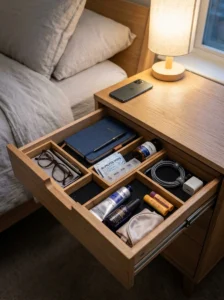
The nightstand with a drawer is significantly more useful than the one without, for exactly the reason described above: the drawer contains the items that need to be accessible but don’t need to be visible.
A useful nightstand drawer organization: one layer of nightly-use items (backup charger cable, medication, an additional item of personal care), one section for reading-adjacent items (bookmarks, reading glasses), one small section for the genuinely miscellaneous.
The drawer that reads as functional and organized is one where each item in it has a specific reason to be in the bedroom and a reason to be accessible from bed rather than from another room. Items that are in the bedroom drawer because they migrated there belong in a periodic reassessment — not because the drawer needs to be minimalist but because the drawer that stores whatever arrived last has less accessible space for the items with genuine nightstand function.
Matching vs Unmatched Nightstands

A final practical note on nightstands that isn’t about contents but about their visible relationship to each other in a shared bedroom.
Matched nightstands — identical on each side, or deliberately related as a pair — read as designed. Unmatched nightstands — one acquired before the other, in different styles, at different heights — read as accumulated. The height mismatch is particularly visible: two nightstands at different heights create an asymmetry that the bed arrangement amplifies rather than hides.
In a bedroom shared by two people, matched nightstands is one of the lowest-cost and highest-visual-return changes available: the same investment in two matching tables instead of two separately purchased mismatched ones. The design coherence produced by matched sides changes how the whole sleeping zone reads.
Key Takeaways

- The nightstand is used at the specific moments of sleeping and waking — its contents should be chosen for those specific states, not for general convenience or default accumulation
- A lamp is the nightstand’s most important item; it enables the warm, directed pre-sleep light that overhead lighting can’t provide from the required position
- Water on the nightstand solves a specific 3am disruption problem more effectively than any sleep supplement
- The phone on the nightstand disrupts sleep through pre-sleep light exposure, notification light response during sleep, and first-morning association — charging in another room removes all three
- Work materials don’t belong on a nightstand, or in the bedroom — they maintain the specific kind of brain activation that resists the sleep state
- One small optional decorative object is the aesthetic ceiling for a nightstand that’s already holding a lamp, water, and functional items
- The nightstand drawer is where most items should live — accessible but not visible, organized by specific nighttime function
- Matched or deliberately related nightstands on each side of a shared bed change the sleeping zone’s visual quality more per dollar than almost any other paired purchase
Frequently Asked Questions
How do I keep my phone accessible for the alarm but still benefit from not having it at the nightstand? A simple alarm clock placed on the nightstand removes the need for the phone in this role entirely. Alarm clocks are available in formats from minimal digital displays to gentle sunrise-simulation versions. The investment is low; the functional replacement is complete. A smart speaker (set to alarm-only, with notification lights disabled or covered) provides a voice-activated alarm if the traditional clock format isn’t preferred.
What should go in a nightstand drawer if there is one? Items that need to be accessible from bed but don’t need to be visible: a backup charger or charging cable if phone charging must happen at the bedside, reading glasses, a pen and notepad for the occasional idea during the night, a backup medication, personal care items used at night but not daily. The test for nightstand drawer inclusion: would I reach for this without leaving the bed, and is there a reason it specifically needs to be in this room rather than elsewhere?
Is it okay to have a small plant on the nightstand? Yes, with the right species selection for the bedroom’s light conditions. A plant on a nightstand at window distance from any natural light source will typically receive some filtered light. Low-light tolerant options — a small pothos in water propagation, a succulent if near a window — survive nightstand placement. High-light-requirement plants don’t belong in most bedroom positions. The benefit: a small plant adds a living quality to the sleeping zone’s most closely observed surface.
Why do nightstands accumulate so quickly? Because they’re at the point of arrival — you pass them when getting into bed, and everything in hand at that moment has a convenient surface to land on. The nightstand is physically at the transition point between the active part of the house and the sleeping space, and it collects items from both directions. A monthly clear is the practical management approach; the alternative is a deliberate decision about what’s allowed to land there, with everything else redirected to its correct home before it reaches the nightstand.
Does the nightstand need to have a drawer to function well? A drawer meaningfully improves a nightstand’s functionality by providing accessible but invisible storage for the nighttime-specific items that earn proximity without needing surface visibility. A nightstand without a drawer works if what’s needed is only surface-accessible items — if the functional list is genuinely short (lamp, water, one item), the drawer isn’t essential. For most people’s actual needs, a drawer reduces surface clutter by containing the category of items that are used regularly but don’t benefit the room by being visible.