


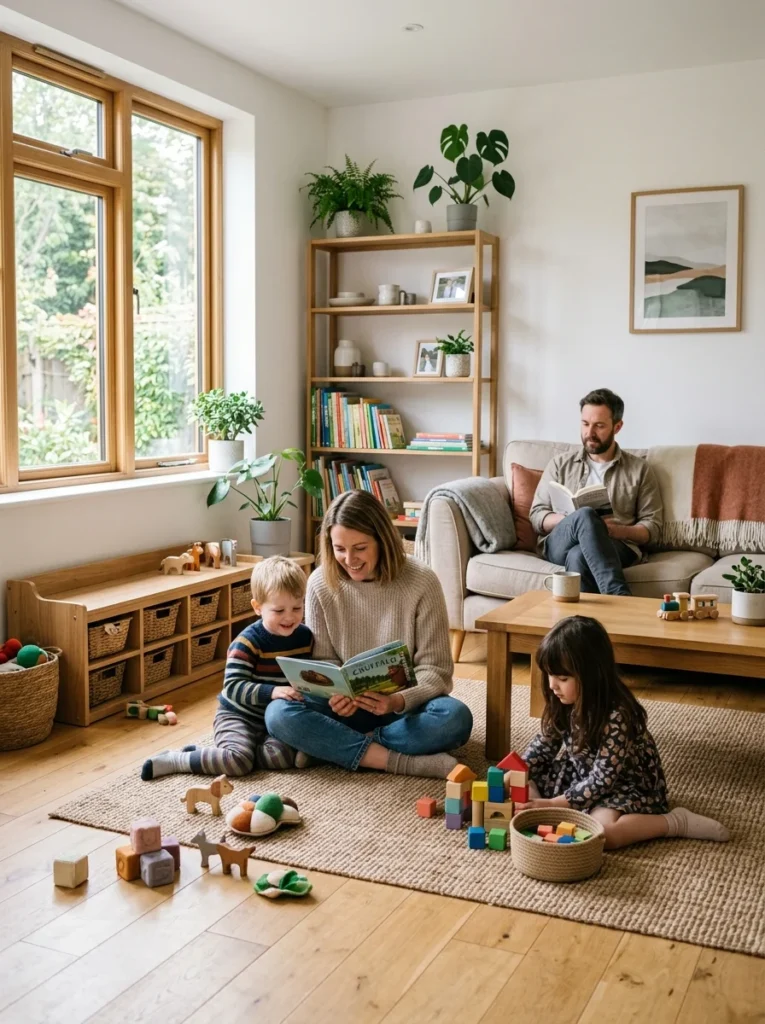
Minimalism and a home full of kids seem like a contradiction, but the version of minimalism that actually works in this context looks different from the showroom version. Here’s what that looks like.
Minimalism, as it’s typically presented in design media, assumes a level of control over what enters and stays in a home that a household with young children simply doesn’t have — toys arrive as gifts, school projects accumulate, growth-stage clothing and gear cycles through constantly, and a rigid, purely aesthetic minimalism collides directly with the reality of raising children in the space. This doesn’t mean minimalism is incompatible with a home full of kids. It means the version that actually works is functionally, not purely aesthetically, oriented — minimalism as a tool for reducing decision fatigue and cleanup time, rather than minimalism as a fixed visual standard the household is constantly failing to maintain.
Functional Minimalism Serves the Household; Aesthetic Minimalism Serves the Photo
The distinction worth making explicitly is between minimalism pursued for its visual effect — a specific, sparse look that has to be actively maintained against the household’s actual daily activity — and minimalism pursued for its functional effect: fewer things to manage, faster cleanup, less decision fatigue about where things go and what needs attention. A household with kids that pursues the first version is setting itself up for constant, demoralizing failure, since the natural state of a home with young children actively living and playing in it will regularly diverge from a rigid aesthetic standard. A household pursuing the second version is solving an actual problem — the genuine chaos and overwhelm that comes with managing a large volume of children’s belongings — and the visual simplicity that results is a byproduct of that functional solution, not the primary goal being chased.
This reframing matters because it changes what “success” looks like day to day — a functionally minimal home with kids will still have visible evidence of active use, art projects in progress, toys currently being played with, applying the same principle covered elsewhere in this series regarding a decorated house versus one that feels like a genuine home. The goal isn’t a home that always looks like nobody lives there; it’s a home where the volume of things being managed is kept intentionally limited, so that returning it to order is fast and realistic rather than an ongoing losing battle.
Toy Rotation Reduces Volume Without Requiring Difficult Discarding Decisions
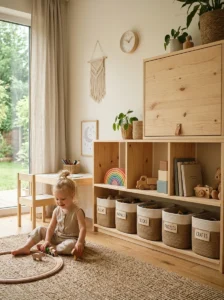
A significant portion of what makes a home with kids feel overwhelming isn’t necessarily the total volume of toys and belongings owned, but the volume actively out and accessible at any given time — and toy rotation, where a portion of toys are stored away and periodically swapped with what’s currently in circulation, addresses this directly without requiring the household to make the harder, more emotionally fraught decisions about permanently discarding items.
This has a secondary benefit beyond simple volume reduction: children often engage more deeply with a smaller, curated selection of currently available toys than with an overwhelming full collection available all at once, and a “new” toy reintroduced from rotation storage frequently gets renewed interest similar to an actually new purchase, at no additional cost.
Storage Systems Designed for a Child’s Actual Height and Ability
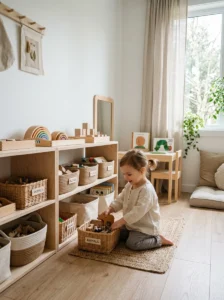
As covered in more detail elsewhere in this series regarding containment and shelving generally, a storage system only functions if it’s actually used, and a storage system positioned or designed beyond a child’s practical ability to use independently — too high, too complex, requiring adult assistance for every interaction — tends to fail regardless of how well-organized it looks when first set up.
Low, open bins or shelving at a child’s actual height and ability level, often associated with Montessori-influenced design approaches, allow a child to genuinely participate in both retrieving and returning their own belongings, which is a meaningfully different and more sustainable system than one that requires an adult to manage every interaction with the storage. This is a functional minimalism principle as much as an educational one: a system a child can actually use independently reduces the ongoing burden on the adults managing the household, which is precisely the kind of practical simplification that makes minimalism sustainable in this context.
Durable, Simple Materials Serve Both Minimalist Aesthetics and Real Family Use
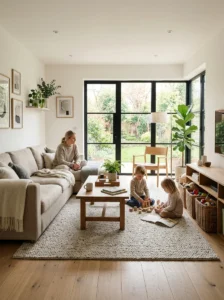
As covered in more detail elsewhere in this series regarding small living rooms with large families, durability is a higher practical priority in a heavily used family home than in a lower-traffic space, and this happens to align naturally with minimalist material preferences — simple, solid, well-made pieces in durable materials tend to both look visually calmer and hold up better to genuine daily use than heavily detailed, delicate, or trend-driven alternatives.
This alignment is genuinely useful: a household doesn’t have to choose between minimalist aesthetics and family-practical durability, since the same simple, solid, quality-over-quantity approach that produces a visually calmer result also tends to produce more durable, longer-lasting furniture and objects — fewer, better things, rather than many disposable ones, serves both goals simultaneously.
Involving Kids in What Stays Builds Buy-In Rather Than Resentment
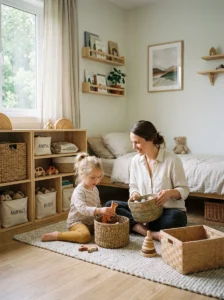
A minimalism approach imposed entirely by parents, without any child input, tends to produce more resistance and less lasting cooperation than an approach that involves children — age-appropriately — in deciding what toys and belongings actually matter enough to keep readily accessible. A child who has some genuine say in curating their own currently-available toy selection is more likely to understand and cooperate with the system than one who experiences minimalism purely as things being taken away without their input.
This doesn’t mean children make every storage and volume decision independently, but involving them in an age-appropriate way — choosing which few toys go into current rotation, helping decide what’s ready to be donated — builds a level of buy-in and understanding that a purely parent-imposed system doesn’t achieve as reliably.
Minimalism as Decision Fatigue Reduction, Not Just Object Reduction
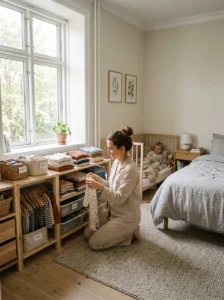
A less commonly discussed benefit of a functionally minimal approach in a family home is the reduction in ongoing decision-making it provides — fewer clothing options mean faster morning routines with less negotiation, a smaller toy rotation means less time spent deciding what to play with or where things belong, and fewer total possessions mean fewer decisions about organization and placement on an ongoing basis. This decision fatigue reduction is arguably a more practically valuable benefit for a busy household with children than the purely visual calm that minimalism is often marketed around, since the actual lived experience of managing a household with children involves a constant stream of small decisions, and reducing that volume has a real, felt effect on daily stress levels independent of how the home looks in any given moment.
What This Doesn’t Require
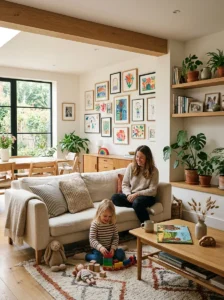
Functional minimalism in a home with kids doesn’t require an empty, sparse-looking house, doesn’t require eliminating sentimental items or genuinely loved toys, and doesn’t require achieving a magazine-ready appearance at all times. It requires being intentional about volume — how much is actively out and being managed at once — and about systems — whether storage actually works for the people, including the children, expected to use it. A home that achieves this can still look genuinely warm, personal, and evidently lived-in by an active family, which is a different and more achievable goal than the purely visual minimalism standard that doesn’t actually account for how children and family life genuinely function.
Key Takeaways
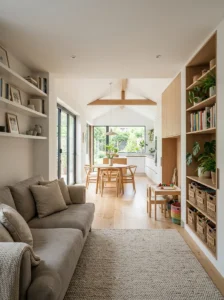
- Functional minimalism — reducing volume and decision fatigue — is a more sustainable and more useful goal in a home with kids than aesthetic minimalism pursued purely for visual effect
- Toy rotation reduces the volume of belongings actively out and accessible without requiring the harder emotional decisions involved in permanently discarding items
- Storage systems designed for a child’s actual height and independent ability to use them are more sustainable than systems that require constant adult management
- Durable, simple materials happen to serve both minimalist aesthetics and the practical durability priority that heavy family use requires, meaning the two goals don’t have to compete
- Involving children in age-appropriate decisions about what toys stay in current rotation builds genuine buy-in, rather than the resistance that a purely parent-imposed system tends to produce
- The most practically valuable benefit of minimalism in a busy family home may be reduced ongoing decision fatigue, not simply a calmer visual appearance
Frequently Asked Questions
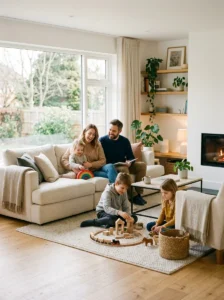
Is it realistic to keep a genuinely minimalist home with young kids? Realistic if the goal is functional minimalism — reduced volume and simplified systems — rather than a rigid, purely aesthetic standard that has to be constantly maintained against a household’s actual daily activity. The functional version is achievable and sustainable; the purely visual version tends to set families up for ongoing, demoralizing failure given how children actually use and fill a home.
How does toy rotation actually work in practice? A portion of a household’s toys are stored away, out of immediate reach, while a smaller, curated selection remains actively accessible, with the stored and active portions periodically swapped. This reduces the volume of toys a child and household are managing at any given time without requiring the harder decision of permanently discarding items, and often renews a child’s interest in toys reintroduced from storage.
At what age can kids start participating in their own household’s minimalism system? Even fairly young children can participate in an age-appropriate way — choosing which few toys are currently in rotation, helping decide what’s ready to be donated, using low, accessible storage independently. The specific level of involvement scales with age and ability, but meaningful participation is possible well before children are old enough to manage a full system entirely on their own.
Does minimalism in a family home mean getting rid of sentimental items? Not at all — functional minimalism is about managing active volume and building sustainable systems, not about eliminating sentimental or genuinely loved belongings. A household can maintain meaningful keepsakes and favorite toys while still reducing the total volume actively out and requiring daily management.
Why does reducing decision fatigue matter as much as reducing clutter? Because the daily lived experience of managing a household with children involves a constant stream of small decisions — what to wear, what to play with, where things go — and a smaller volume of options reduces this ongoing mental load in a way that has a real, felt effect on daily stress, independent of how organized or visually calm the home looks in any single moment.