

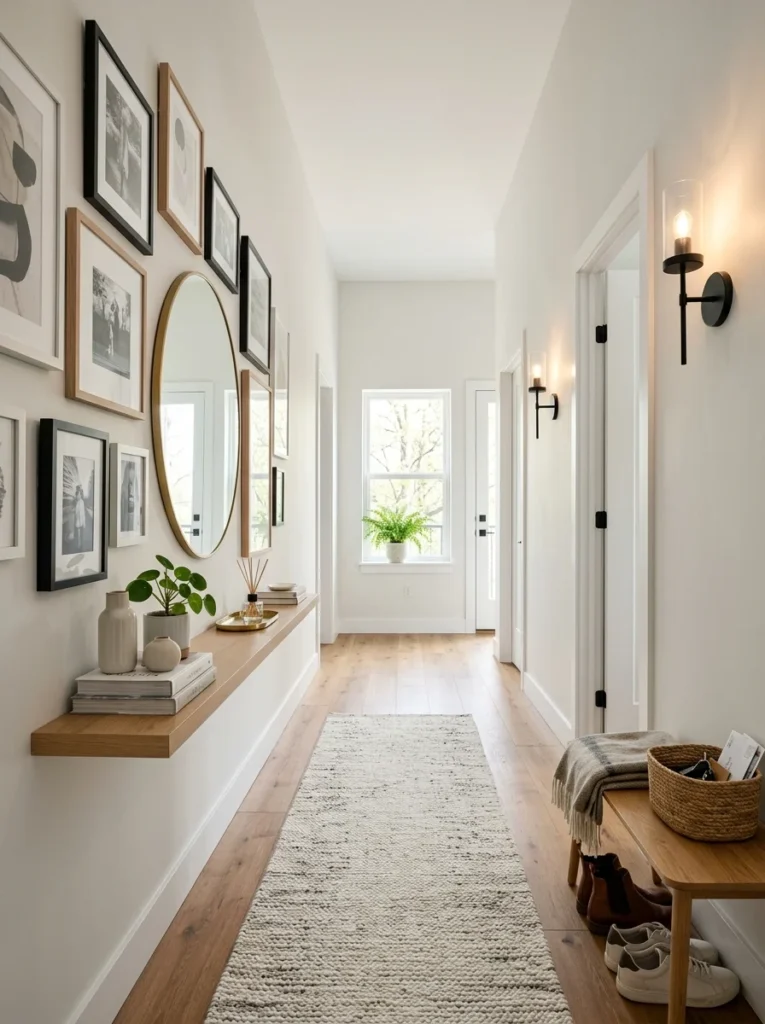
A narrow hallway feels too tight for furniture and too long to leave bare, which is why so many end up decorated with nothing more than a single forgotten picture frame. Here’s what actually works.
A narrow hallway occupies an awkward middle ground in most decorating plans: too tight for the console tables, benches, and furniture-based solutions that work in a more generous entryway or living space, and too long and visually prominent to simply leave bare the way a genuinely minor transitional space might. This is why so many narrow hallways end up decorated with almost nothing — a single picture frame hung without much thought, walls left entirely blank — not because nothing could work there, but because the standard furniture-based decorating approach genuinely doesn’t fit the space’s real constraints.
The Core Constraint Is Depth, Not Length
A narrow hallway’s actual limiting dimension is depth — how far anything can protrude from the wall without obstructing the walking path — rather than length, which is often perfectly generous and simply needs to be treated as an asset (a long wall for a gallery arrangement) rather than a problem. Understanding this distinction early reframes the whole decorating approach: the goal isn’t finding furniture small enough to squeeze into a tight space, but finding wall-based and depth-minimal solutions that work with the hallway’s actual proportions rather than fighting them.
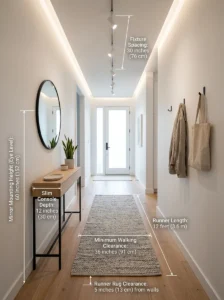
A reasonable clearance guideline is maintaining at least 24 to 30 inches of clear walking width at all times, which in a genuinely narrow hallway may mean that anything protruding more than a few inches from the wall is off the table entirely, regardless of how appealing it might be in a different context.
Gallery Walls Are Especially Well Suited to Narrow Hallways
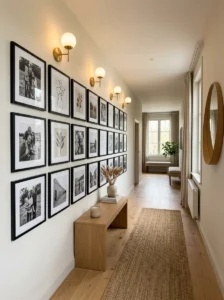
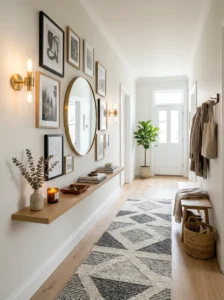
A long, narrow hallway is one of the best possible settings for a gallery wall, covered in more detail elsewhere in this series regarding large living room walls, precisely because a hallway’s length provides ample linear wall space while its depth constraint rules out most furniture-based alternatives — art and photography add zero depth to the space while making full use of its actual available length.
A hallway gallery arrangement benefits from being viewed differently than a living room gallery wall, since it’s typically seen while walking past rather than while seated and viewing from a fixed distance — this means individual pieces can be spaced somewhat more generously along the hallway’s length, creating a sense of a considered sequence or journey along the walk, rather than needing the same dense, single-glance-friendly clustering that works well on a living room wall.
Lighting the gallery arrangement — picture lights, or general hallway lighting positioned to illuminate the wall rather than only the floor path — matters more in a hallway than in many other gallery wall locations, since hallways frequently lack the ambient natural light a living room might have, and art in a dim, poorly lit hallway loses much of its intended effect.
Runners Provide Warmth and Definition Without Consuming Any Depth
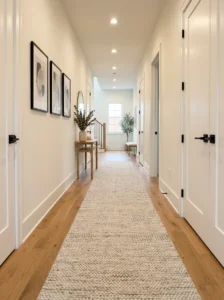
A runner rug, laid along the hallway’s length, adds warmth, sound-dampening, and visual definition without protruding from the walls at all, making it one of the few “furnishing” additions that works in even the most severely depth-constrained hallway. As covered in more detail elsewhere in this series regarding rug sizing generally, a runner should generally leave a consistent border of visible flooring on both sides — commonly a few inches — rather than extending wall to wall, which reads as more intentional than a rug that appears to have simply been the widest option available regardless of fit.
Wall-Mounted and Shallow-Depth Furniture Extends What’s Actually Possible
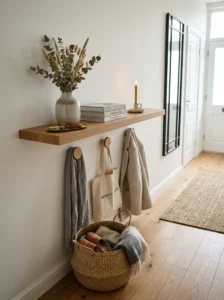
Where a hallway has slightly more width to work with than the most severely constrained cases, wall-mounted, shallow-depth furniture — a slim floating shelf, a narrow console under 10 inches deep — can provide functional surface space and display area without meaningfully impeding the walking path, applying the same shallow-shelf styling principles covered elsewhere in this series regarding awkwardly proportioned shelving to furniture that’s shallow by design rather than by accident.
Wall-mounted hooks or a slim coat rack, in a hallway that serves as a secondary route to an entry or garage, provide storage function using zero floor depth, which is a meaningfully more space-efficient solution than any floor-standing storage option in a genuinely tight hallway.
Mirrors Address Both the Narrow Feeling and the Light Deficit
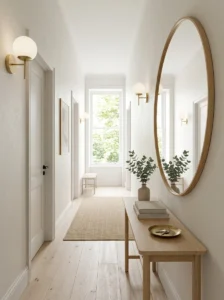
As covered throughout this series regarding mirrors and light, a mirror hung along a narrow hallway’s length does real work beyond simple decoration — it visually doubles the perceived width of the space and, in a hallway without natural light of its own, bounces available light further along the corridor than it would otherwise reach. This is a particularly high-value application of the general mirror-placement principles covered elsewhere in this series, since a narrow hallway is precisely the kind of space where both the width-perception and light-amplification benefits matter most acutely.
A single generously sized mirror, or a sequence of smaller mirrors spaced along the hallway’s length as part of a broader gallery arrangement, both apply this principle effectively — the choice between the two approaches depends more on the household’s aesthetic preference than on any functional difference between them.
Color and Ceiling Treatment Affect How Narrow the Space Feels
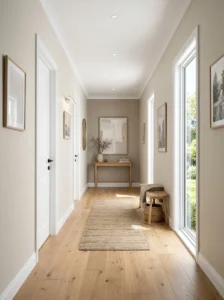
As covered in more detail elsewhere in this series regarding bedroom accent walls and room proportion, lighter wall colors generally make a narrow space feel less confined than darker ones, since dark colors visually advance and reduce perceived space, which works against a narrow hallway’s existing constraint rather than helping it.
A lighter ceiling color specifically helps counteract the tunnel-like feeling a long, narrow, uniformly colored hallway can produce, and this is worth prioritizing in a hallway even more than in a similarly sized bedroom, given how much a hallway’s proportions are already working against a sense of spaciousness before any color decision is made.
Where a bolder or darker color is genuinely desired for a narrow hallway’s character, applying it selectively — as an accent on a single short end wall rather than along the full length of both long walls — captures some of the visual interest a bolder color provides without compounding the hallway’s existing narrowness the way full-length dark walls would.
Lighting Placement Matters More in a Hallway Than in Most Rooms
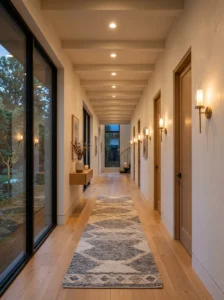
A narrow hallway frequently has no natural light source of its own, relying entirely on artificial lighting, which makes lighting placement and quality more consequential here than in a room that can fall back on daylight during part of the day. A single central overhead fixture, particularly in a longer hallway, tends to leave the far ends dimmer than the middle, applying the same distribution principle covered elsewhere in this series regarding living room lighting — multiple smaller fixtures spaced along the hallway’s length generally produce more even, usable light than a single central source trying to cover the entire corridor.
Wall sconces, positioned along the hallway at intervals, are a particularly space-efficient lighting solution for a narrow hallway specifically, since they add zero floor or walking-path depth while providing the distributed light coverage a long, narrow space actually needs.Key
- Key TakeawKe
- A narrow hallway’s real constraint is depth, not length — reframing the decorating approach around wall-based and depth-minimal solutions works with the space rather than fighting it
- A gallery wall is especially well suited to a narrow hallway, since it adds zero depth while making full use of the hallway’s often-generous length
- A runner rug adds warmth and definition without consuming any depth, and should generally leave a visible flooring border on both sides rather than spanning wall to wall
- Mirrors do double duty in a narrow hallway, visually widening the perceived space while also bouncing available light further along a corridor that often lacks natural light of its own
- Lighter wall and ceiling colors help counteract the tunnel-like feeling of a long, narrow, uniformly colored hallway, more so than in most other rooms
- Multiple smaller lighting sources spaced along the hallway’s length provide more even coverage than a single central fixture, which tends to leave the far ends of a longer hallway dim
Frequently Asked Questions
What’s the minimum hallway width needed to add any furniture at all? A reasonable guideline is maintaining at least 24 to 30 inches of clear walking width after accounting for anything added, which in a genuinely narrow hallway may rule out most floor-standing furniture entirely. Wall-mounted, shallow-depth solutions and wall-based decor like gallery arrangements and mirrors work in even the most constrained hallways, since they add no meaningful depth to the walking path.
Should a hallway runner extend the full width of the hallway? Generally not — leaving a consistent border of visible flooring on both sides, commonly a few inches, reads as more intentional than a runner that spans the full width, which can look like it was simply the widest available option rather than a deliberately chosen size.
Does a dark accent color always make a narrow hallway feel smaller? Applied across the full length of both long walls, yes, generally — dark colors visually advance and reduce perceived space, which compounds a narrow hallway’s existing constraint. Applied selectively, such as on a single short end wall, a bolder or darker color can add visual interest without significantly worsening the sense of narrowness.
Is it worth adding multiple light fixtures to a hallway instead of just one central light? For a longer hallway, yes — a single central fixture tends to leave the far ends noticeably dimmer, while multiple smaller fixtures, including wall sconces, spaced along the length provide more even coverage. This matters more in a hallway than in many other rooms, since hallways frequently lack any natural light of their own to supplement uneven artificial lighting.
Are gallery walls actually a good idea in a hallway, or do they make it feel more cluttered? Gallery walls tend to work particularly well in hallways specifically, since the length provides ample space for a sequence of pieces spaced comfortably apart, rather than requiring the denser clustering that works on a shorter living room wall. Combined with adequate lighting to actually illuminate the art, a hallway gallery arrangement is one of the more consistently successful uses of this kind of space.