

The entryway is the first thing seen and the most walked-through space in most homes, and it’s also one of the most commonly neglected. Here’s why it matters more than its size suggests.
An entryway is often the smallest, least-furnished space in a home, and it’s also the space that determines the very first impression of the entire house, every single time someone walks in — a household member returning from work, a guest arriving for the first time, or the same person crossing the same threshold multiple times a day. This disproportionate importance relative to its physical size is exactly why an unaddressed, cluttered, or purely functional-and-nothing-else entryway undersells a home that might be genuinely well put-together everywhere else — the first several seconds of any visit are calibrated by this one small space, before anyone has seen the rest of the house at all.
First Impressions Are Formed Faster Than People Realize, and the Entry Is Where They Happen
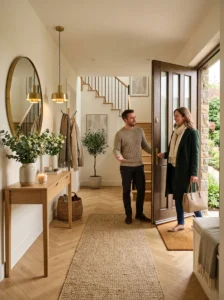
Psychological research on first impressions consistently finds that people form rapid, largely unconscious judgments within the first few seconds of encountering a new environment, and a home’s entryway is the specific physical location where a visitor’s very first impression of the entire house is formed, before they’ve seen any other room. This means the entryway is disproportionately influential relative to the amount of square footage or design attention it typically receives — a beautifully designed living room can’t fully offset an entryway that greets every visitor with a chaotic pile of shoes and unsorted mail, since the negative first impression has already been formed by the time anyone reaches the living room.
This same effect applies to the household members living there, not just visitors — the entryway is also the first thing a resident sees returning home each day, and a calm, considered entry sets a genuinely different tone for arriving home than a cluttered, chaotic one does, even though the person walking through it lives there and has seen it many times before.
The Entryway Has to Solve Real Function Before It Can Look Considered
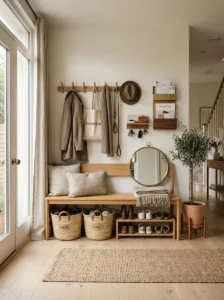
Unlike many other rooms in a home, an entryway has a specific, demanding functional job — absorbing the transition between outside and inside, handling shoes, coats, bags, keys, mail, and whatever else moves through the door multiple times a day — and a beautifully styled entryway that doesn’t actually solve this function well will fail regardless of how it looks, since the practical chaos it wasn’t designed to handle will simply relocate somewhere else in the home instead.
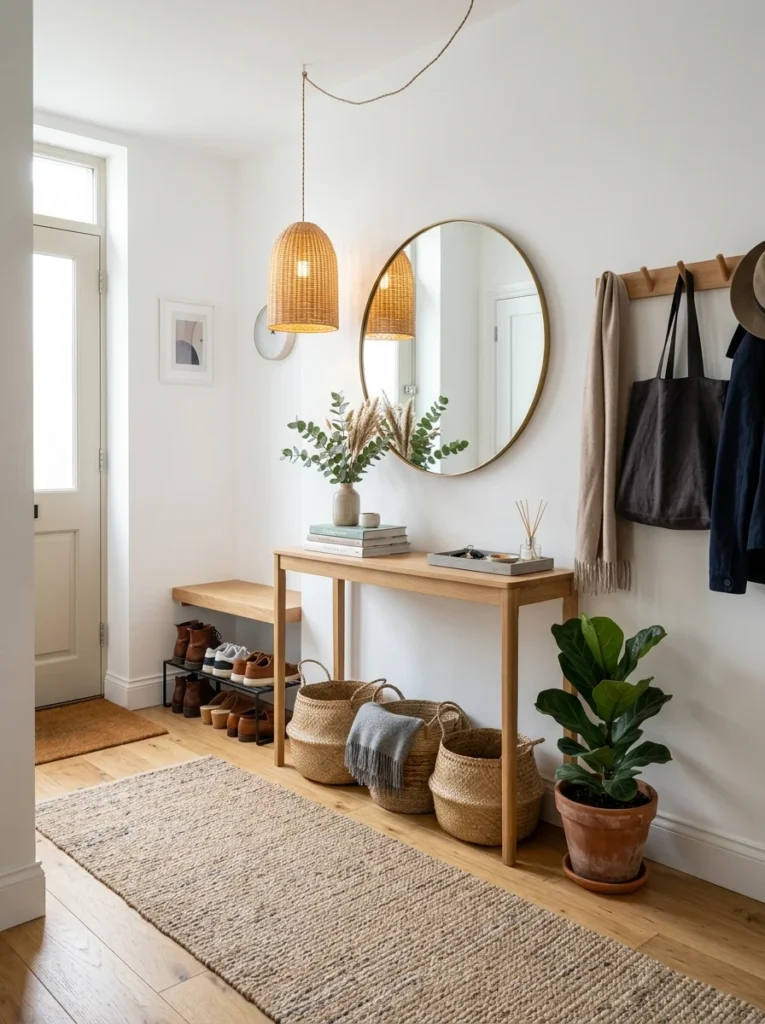
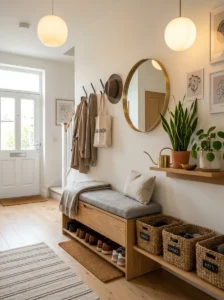
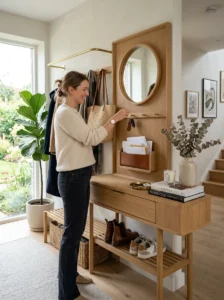
A dedicated spot for each category of item that regularly passes through — hooks or a closet for coats, a bench or shelf for shoes, a tray or small drawer for keys and mail, applying the same containment principle covered throughout this series regarding shelving and surfaces — solves the functional demand directly, which is a prerequisite for the entryway looking calm and considered rather than a battle against daily accumulation.
A bench, even a small one, serves a specific and often underrated function: a place to sit while putting on or removing shoes, which sounds minor but genuinely affects how smoothly the daily transition in and out of the house happens, particularly for households with children, guests, or anyone who finds putting on shoes standing up genuinely inconvenient.
Scale and Proportion Matter Even in a Very Small Space
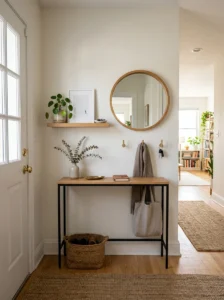
As covered in more detail elsewhere in this series regarding large living room walls, correct scale matters regardless of a room’s size, and an entryway — often one of the smallest spaces in a home — still needs its furniture and decor proportioned appropriately to its actual dimensions rather than either overwhelming a tight space with oversized furniture or leaving a generously sized entry feeling underfurnished with pieces too small for the space.
A narrow entryway benefits from furniture that hugs the wall closely and doesn’t obstruct the walking path — a slim console or a wall-mounted shelf rather than a substantial freestanding piece — while a more generous entry space can accommodate a genuine bench, a larger console, or a small seating arrangement without feeling cramped.
Lighting Sets the Entry’s Mood Before Anyone Reaches the Rest of the House
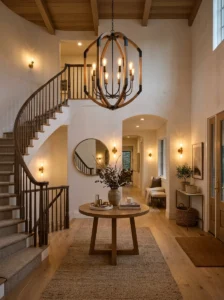
As covered throughout this series in various room-specific contexts, lighting quality significantly affects a space’s felt atmosphere, and this applies directly to an entryway — a dim, harshly lit, or poorly considered entry light sets an unwelcoming tone before a visitor has even fully entered the home, while a warm, well-considered entry light immediately signals that the rest of the house has received similar care and attention.
A statement light fixture in the entryway — a pendant, a distinctive sconce pairing, something with genuine visual presence — is a common design choice precisely because the entryway is a low-risk, high-visibility location to introduce a bolder lighting choice than might feel appropriate throughout the rest of a more restrained home, applying the same logic covered elsewhere in this series regarding introducing bolder choices through smaller, contained elements rather than a room’s largest, most expensive investments.
A Mirror in the Entry Serves Both a Practical and a Spatial Function
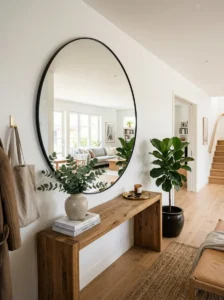
A mirror near the entry serves an obvious practical purpose — a final check before leaving the house — and also, as covered in more detail elsewhere in this series regarding mirrors and light, contributes to how spacious and light-filled the entry itself feels, which matters disproportionately in a space that’s often small and sometimes without much natural light of its own.
Positioning an entry mirror to reflect a pleasant view into the home, rather than directly reflecting the front door or a cluttered coat closet, applies the same reflection-and-framing principle covered elsewhere in this series regarding window treatments and views — the mirror’s reflection becomes part of the entryway’s own composition, and it’s worth being deliberate about what it’s actually reflecting back into the space.
The Entry Sets an Expectation That the Rest of the Home Then Confirms or Contradicts
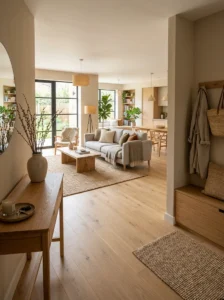
A well-considered entryway creates a specific expectation in a visitor’s mind about the rest of the home, and the remaining rooms then either confirm or contradict that expectation as the visitor moves further inside — which means a genuinely beautiful living room can feel like a pleasant surprise after an underwhelming entry, or, more commonly, an unremarkable room can feel like a letdown after an entryway that promised more than the rest of the house delivers.
This is worth considering directly when prioritizing where limited renovation or decorating budget and effort go: a household with genuinely limited resources to address every room in the home is often better served addressing the entryway well, given its disproportionate influence on overall impression, than by spreading the same limited effort thinly and evenly across every room including the entry.
Key Takeaways
- First impressions form within the first few seconds of encountering a space, which means the entryway disproportionately shapes a visitor’s overall impression of the entire home before they’ve seen any other room
- An entryway needs to solve its demanding daily function — shoes, coats, keys, mail — before it can look genuinely considered, since unresolved daily chaos here tends to simply relocate elsewhere in the home
- Furniture scale still matters in a very small entryway — a narrow space needs wall-hugging, slim furniture, while a more generous entry can support a genuine bench or larger console
- Entry lighting sets the tone for the entire home before a visitor has seen any other room, and it’s a natural, low-risk location to introduce a bolder lighting choice
- An entry mirror serves both a practical checking function and a spatial one, contributing to how light-filled and spacious the entry feels, and it’s worth positioning deliberately to reflect a pleasant view
- Given its disproportionate influence on overall impression, the entryway is often the highest-leverage room to prioritize when resources for improving a home are genuinely limited
Frequently Asked Questions
Is it really worth spending significant effort on such a small space? Yes, given how disproportionately influential the entryway is relative to its size — it shapes a visitor’s first impression of the entire home before they’ve seen any other room, and it’s also the first thing residents see returning home each day. A household with limited overall resources is often better served prioritizing the entry over spreading the same effort thinly across every room.
What’s the single most important function an entryway needs to solve? A dedicated, contained spot for each category of daily-use item that passes through — shoes, coats, keys, mail — since unresolved accumulation of these items is what most commonly makes an entryway feel chaotic rather than considered. This functional foundation needs to be in place before styling and decor can actually succeed.
Should entryway lighting match the rest of the house, or can it be different? It can reasonably be bolder or more distinctive than the rest of the home’s lighting, since the entryway is a naturally low-risk, high-visibility location to introduce a statement fixture without needing that same boldness to carry through every other room. This mirrors the broader principle of introducing bolder choices through smaller, contained elements rather than a home’s largest, most permanent decisions.
Do I need a mirror in my entryway? Not strictly required, but it serves both a genuine practical function — a final check before leaving — and a spatial one, helping the entry feel more light-filled and spacious, which is particularly valuable given how often entryways are small and lack abundant natural light of their own.
What should I prioritize if my entryway is very small and narrow? Wall-hugging, slim furniture — a narrow console or a wall-mounted shelf rather than a substantial freestanding piece — keeps a tight entry from feeling cramped or obstructing the walking path. Functional containment for shoes, keys, and mail remains just as important in a small entry as a larger one, simply achieved through more compact, space-efficient solutions.