

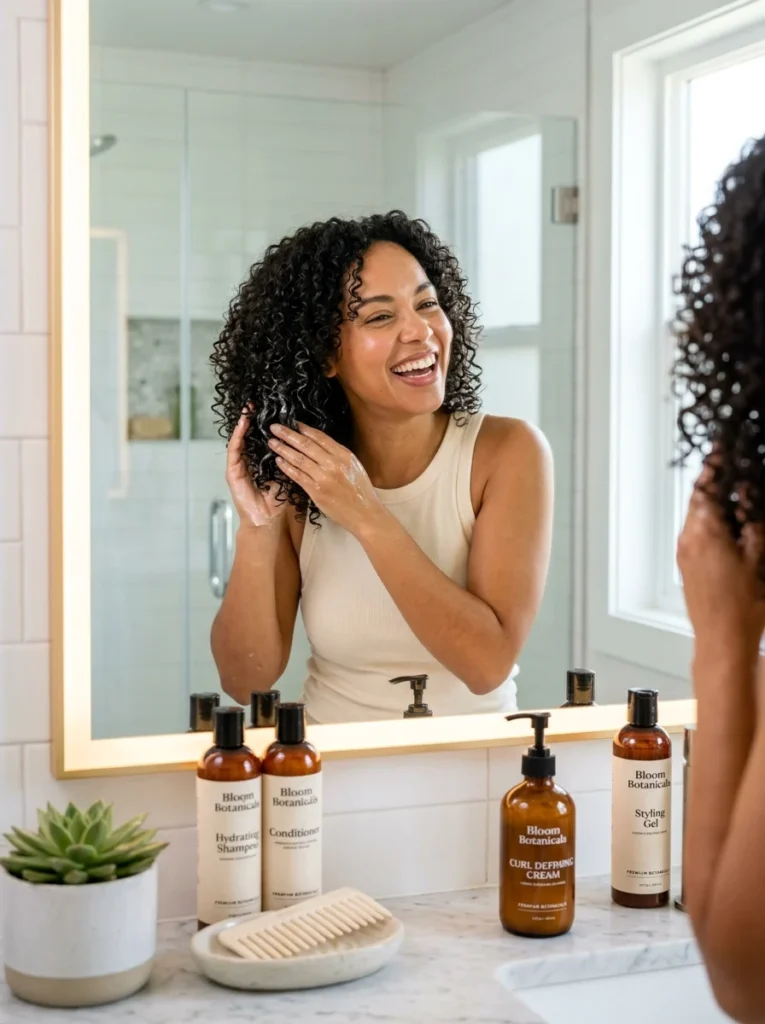
Curly hair care involves genuinely different rules than straight hair care, and most of the confusion comes from applying straight-hair habits to a texture that responds to them completely differently. Here’s where to actually start.
Curly hair care operates on a genuinely different set of principles than straight hair care, and most of the frustration people experience trying to manage curly hair comes from applying straight-hair habits — brushing when dry, using sulfate-heavy shampoo daily, towel-drying vigorously — to a hair type that responds to these habits by frizzing, losing curl definition, or becoming damaged in ways straight hair simply doesn’t experience the same way. Starting from an accurate understanding of what curly hair actually needs, rather than adapting straight-hair habits, produces considerably faster and less frustrating progress.
Understanding Curl Pattern Helps Calibrate Expectations and Product Choice
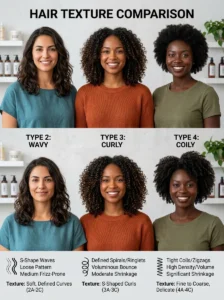
Curl patterns are commonly categorized on a scale from wavy (type 2) through curly (type 3) to coily (type 4), with sub-categories (A, B, C) within each indicating tighter or looser variations — this classification isn’t a rigid rulebook, since most people have some variation across their own head, but it’s a useful reference point for understanding which specific product and technique recommendations are actually relevant to a given hair type, since advice calibrated for loose, wavy hair often doesn’t translate directly to tightly coiled hair, and the reverse is equally true.
Identifying a general pattern category — through comparison to reference images or simply observing how hair behaves when left to air-dry without any product or manipulation — is a reasonable starting point before investing in a full product routine, since it narrows down which recommendations are actually likely to be relevant rather than starting from an undifferentiated pool of general “curly hair” advice.
Sulfates and Harsh Cleansers Strip Curly Hair’s Natural Oil Distribution
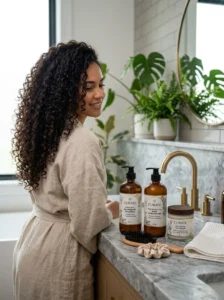
Curly and coily hair’s natural oil, produced at the scalp, has a harder time traveling down the hair shaft compared to straight hair, due to the bends and turns in curly hair’s structure, which means curly hair is often naturally drier at the mid-lengths and ends than straight hair, even with the same scalp oil production. Sulfate-based shampoos, which clean effectively but also strip oil aggressively, compound this natural dryness tendency, which is why sulfate-free or low-sulfate cleansers are widely recommended specifically for curly and coily hair types.
Co-washing — cleansing with a conditioning cleanser rather than traditional shampoo, or on some wash days, skipping shampoo and relying on conditioner alone to clean the scalp gently — is a common curly-hair practice addressing this same dryness tendency, though it’s worth balancing with periodic actual shampoo use (even if sulfate-free) to prevent product buildup, which curly hair is also prone to given how much product it typically requires compared to straight hair.
Detangling Wet, With Fingers or a Wide-Tooth Comb, Prevents Unnecessary Breakage and Frizz
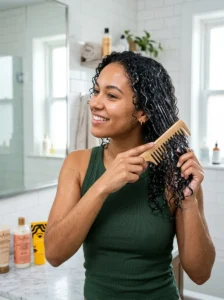
Curly hair is generally more fragile and more prone to breakage when detangled dry, particularly with a standard brush, since brushing dry curls disrupts the curl pattern, creates significant frizz, and can cause breakage at the points where the brush catches on tangles rather than gently working through them.
Detangling while the hair is wet and coated with conditioner — using fingers or a wide-tooth comb, working from the ends upward toward the roots rather than starting at the root and pulling through tangles along the entire length — is the standard, gentler approach for curly hair, since wet hair coated in conditioner has more slip and is less prone to the friction and breakage dry detangling causes.
Product Application While Hair Is Soaking Wet Supports Curl Definition
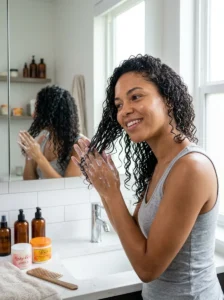
Curly hair generally responds better to styling products applied to soaking wet hair, immediately after washing and while still dripping, rather than towel-dried or partially dried hair, since this allows product to distribute evenly through hair that’s already in its most pliable, curl-clumping-friendly state.
Layering products in a specific order — commonly referred to as the LOC or LCO method (Leave-in conditioner, Oil, Cream — or Leave-in, Cream, Oil, depending on hair’s specific porosity and preference) — is a commonly recommended framework for curly hair, though the specific order and specific products that work best vary by individual hair porosity and pattern, which means some experimentation is generally necessary to find what actually works for a specific head of hair rather than assuming one universal formula applies to everyone.
Plopping and Diffusing Support Curl Clumping During the Drying Process
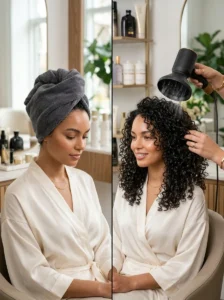
“Plopping” — wrapping soaking wet, product-coated hair in a microfiber towel or soft cotton T-shirt, secured on top of the head, for a period of time before removing — encourages curls to clump together and set into their natural pattern without the friction and frizz-inducing texture that a standard terry cloth towel or vigorous rubbing creates.
Diffusing, using a diffuser attachment on a blow dryer that disperses airflow more gently and broadly than a standard nozzle, dries curly hair while minimizing the frizz and disruption a direct, concentrated airflow would cause to the curl pattern, and it’s generally recommended over air-drying alone for anyone wanting to speed up drying time without sacrificing curl definition, though air-drying remains a completely reasonable, lower-heat-exposure alternative when time allows.
Curl-Specific Cutting Approaches Differ From Standard Straight-Hair Cutting
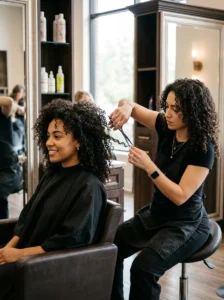
Some stylists specifically trained in curly hair cutting cut hair while it’s dry and in its natural curl pattern, rather than wet, since curly hair’s shrinkage and shape when dry can differ substantially from how it appears wet or stretched, and cutting to the hair’s actual dry, curled shape allows for more precise shaping around how the hair genuinely falls and behaves day to day.
This is a genuinely different approach from standard cutting practice, which typically involves cutting hair wet, and seeking out a stylist specifically experienced with curly or textured hair — rather than assuming any stylist can apply standard technique successfully to curly hair — often produces a considerably better-fitting cut for curl-specific texture and shrinkage patterns.
Sleep and Environmental Habits Affect Curl Preservation Between Washes

A silk or satin pillowcase, rather than cotton, reduces the friction between hair and pillowcase overnight, which helps preserve curl pattern and reduce frizz and breakage compared to a cotton pillowcase’s more textured, friction-generating surface.
A silk or satin bonnet or scarf, wrapped around the hair overnight, serves a similar friction-reducing function and additionally helps preserve the curl pattern’s actual shape between wash days, which is particularly useful for anyone trying to extend the time between full wash-and-style routines.
Humidity affects curly hair more noticeably than straight hair in many cases, since curl pattern is itself partly a function of how hair absorbs moisture from the air, and a humidity-resistant styling product, alongside realistic expectations about how curl pattern may shift somewhat in genuinely humid conditions regardless of product used, helps manage this specific environmental factor.
Building a Routine Takes Genuine Trial and Error, and That’s Normal
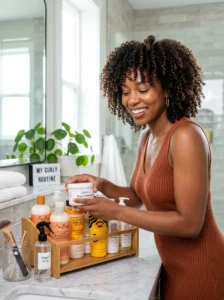
Curly hair care, more than many other hair care approaches, requires individual experimentation to find the specific combination of products, techniques, and routine that works for a given person’s actual curl pattern, porosity, and density, since general guidance provides a starting framework rather than a guaranteed formula that works identically for everyone.
This trial-and-error period — often informally referred to within curly hair communities as a transition or adjustment period when someone is newly adopting a more curl-specific routine — is a normal, expected part of the process rather than a sign that curly hair care fundamentally isn’t working, and patience through this initial period generally produces meaningfully better results than abandoning the approach after a single unsuccessful attempt.
Key Takeaways

- Identifying a general curl pattern category helps calibrate which specific product and technique recommendations are actually relevant, since advice for loose waves often doesn’t translate directly to tightly coiled hair
- Sulfate-free or low-sulfate cleansers, and co-washing on some wash days, address curly hair’s natural tendency toward dryness at the mid-lengths and ends, caused by oil’s difficulty traveling down curly hair’s bent structure
- Detangling wet, with fingers or a wide-tooth comb from ends to roots, prevents the breakage and frizz that dry detangling with a standard brush typically causes
- Applying styling product to soaking wet hair, layered in a specific order like the LOC or LCO method, supports curl clumping and definition better than product applied to partially dried hair
- Plopping and diffusing both support curl pattern during drying by reducing the friction and disruption that standard towel-drying or direct high-heat airflow cause
- Seeking a stylist specifically experienced with curly or textured hair, and accepting that building an effective routine requires genuine individual trial and error, both meaningfully improve results over generic approaches
Frequently Asked Questions
Do I really need special curly hair products, or can I use regular shampoo and conditioner? Sulfate-free, curl-specific formulations are generally recommended because curly hair tends to be naturally drier at the mid-lengths and ends than straight hair, and standard sulfate-based shampoo can compound this dryness by stripping oil aggressively. This doesn’t mean every product needs to be specifically marketed as “curly hair” branded, but checking for sulfate-free formulation is a reasonable starting guideline.
Why does brushing my curly hair when it’s dry create so much frizz? Brushing dry curls disrupts the natural curl clumping pattern and separates strands that were grouped together into a defined curl, which creates the frizzy, undefined appearance many people associate with “bad” curly hair days. Detangling wet, with fingers or a wide-tooth comb, generally preserves curl definition far better than dry brushing.
What’s the difference between plopping and diffusing, and do I need to do both? Plopping is a method of wrapping wet, product-coated hair in a towel or T-shirt to encourage curl clumping before drying, while diffusing is an active drying method using a diffuser attachment on a blow dryer. They can be used together (plopping first, then diffusing) or separately, and the right combination depends on your hair’s specific needs, available time, and how it responds to each method individually.
How long does it take to find a curly hair routine that actually works? There’s no fixed timeline, since it depends on genuine trial and error specific to your hair’s curl pattern, porosity, and density, but most people within curly hair communities describe an initial adjustment period of weeks to a few months before finding a routine that consistently works well. This is a normal part of the process, not a sign that curly hair care isn’t working for you specifically.
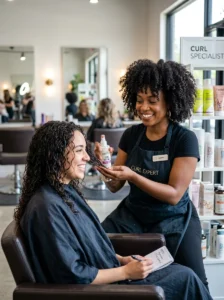
Should I find a stylist who specializes in curly hair, or is any stylist fine? Seeking a stylist specifically experienced with curly or textured hair generally produces better results, particularly for cutting technique, since some curly-hair-specialized stylists cut hair dry and in its natural curl pattern rather than wet, accounting for shrinkage and shape in a way that standard wet-cutting technique doesn’t always address as precisely.