


There’s a specific kind of stress that hits three days before an interview, right after you’ve prepared your answers and researched the company, when you open your closet and realize you have no idea what “the vibe” actually is. The job posting said nothing about dress code. The company’s Instagram shows people in hoodies. The office photos on their careers page show blazers. Nobody told you, and now you’re guessing.
This uncertainty is more common than most career advice admits, and most of the advice that exists doesn’t actually solve the problem — it just tells you to “dress one level above the role,” which sounds useful until you realize you still don’t know what that means for the specific room you’re about to walk into.
Why Nobody Tells You the Dress Code Anymore

A decade ago, dress codes were more predictable. Corporate meant suits. Startups meant jeans. Creative fields meant something in between. That predictability has mostly disappeared, and it’s worth understanding why, because the reason changes what you should do about it.
Hybrid and remote work broke the old signals. Companies that used to have a visible daily dress code now have employees who show up in person only occasionally, which means the office itself no longer enforces a consistent look. A company can have a formal brand identity and a completely casual in-office culture, because the people making hiring decisions rarely see each other in person either.
Industries have blurred together. Finance companies now have product teams that dress like tech companies. Tech companies now have client-facing roles that dress like finance. The old shortcut — “guess based on industry” — fails more often than it used to, because most companies now contain multiple internal cultures under one roof.
Job postings avoid the topic on purpose. Many companies deliberately leave dress code off the posting because they don’t want to filter out candidates who might assume the role is too formal or too casual for them. This is well-intentioned, but it shifts the guessing burden onto you.
The Research That Actually Works

Before defaulting to a safe outfit, there are a few concrete steps that remove most of the guesswork — and they take less time than the anxiety spiral usually does.
Look at the interviewer’s LinkedIn or company bio photo, not the company’s marketing photos. Marketing photos are staged and often outdated. A recent, casual photo of the actual person interviewing you — at a team event, a conference, a headshot — tells you more about daily norms than any polished website ever will.
Check the company’s careers page for team photos, specifically ones that look candid rather than professionally shot. Candid photos from an office party or a team offsite show you what people actually wear when no one is performing for a camera.
Ask the recruiter directly. This is the step people skip out of fear it looks unprepared, when it actually signals the opposite. A short, direct question — “Is there a particular dress code for the interview, or should I dress business casual?” — is a completely normal question recruiters answer constantly. It shows you’re thoughtful, not clueless.
Consider the interview format and location. An in-person interview at a corporate headquarters carries different expectations than a video call, and a video call carries different expectations than a coffee shop meeting with a founder. The setting itself is a data point.
The Safe Middle Ground: Business Casual, Done Correctly

When research doesn’t resolve the uncertainty completely — and sometimes it won’t — business casual is the default that works across the widest range of company cultures, but only if it’s executed with intention rather than as a vague compromise.
For Traditionally Feminine-Coded Presentation

Tailored trousers or a knee-length skirt paired with a blouse or fitted top, plus a blazer that can be removed if the room turns out to be more casual than expected. The blazer is the flexibility piece — wearing it signals effort, and taking it off mid-conversation signals that you can read a room, which is itself a soft skill interviewers notice.
A structured dress in a solid, neutral color works as a one-piece solution that reads as put-together without requiring you to coordinate separate items. Avoid anything with a plunging neckline, a short hemline, or heavy pattern — not because these are inherently unprofessional, but because they introduce risk in a situation where you’re already managing uncertainty on other fronts.
For Traditionally Masculine-Coded Presentation
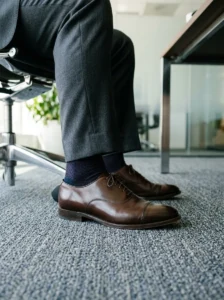
Dress trousers or dark, well-fitted chinos with a button-down shirt is the base layer that works whether or not you add a blazer. The shirt should be ironed — wrinkled fabric undermines an otherwise correct outfit faster than almost any other single detail.
A blazer without a tie is the modern middle ground between full formal and startup-casual. It reads as prepared in a formal setting and doesn’t read as overdressed in a casual one, which makes it the single most flexible piece a man can bring to an uncertain interview.
The Shoes Problem Nobody Mentions

Shoes are the detail most people get wrong even when the rest of the outfit is correct, mostly because they’re an afterthought decided the morning of the interview. Scuffed, overly casual sneakers or worn-down flats undercut a well-chosen outfit more than people expect, because interviewers — consciously or not — read shoe condition as a signal of overall attention to detail.
Clean, closed-toe shoes in good condition, whether formal or a well-maintained minimal sneaker, are safer than a formal shoe that’s visibly worn down.
When “Overdressed” Is Actually the Better Risk

Career advice often treats overdressing and underdressing as equally risky, but in practice they are not symmetrical risks, and understanding the asymmetry helps resolve genuine uncertainty.
Being slightly overdressed reads as respect for the process. An interviewer in jeans meeting a candidate in a blazer rarely interprets this negatively — at worst, it reads as a candidate who didn’t know the internal culture yet, which is completely reasonable for someone who doesn’t work there.
Being underdressed reads differently, and less forgivably, because it can be interpreted — fairly or not — as a lack of effort or a lack of understanding of the seriousness of the interview, even in companies with genuinely casual internal cultures. Most casual companies still expect a degree of visible effort from external candidates, even if they don’t require it from existing employees.
This asymmetry is the practical reason “dress one level above” persists as advice: it’s not that overdressing is ideal, it’s that overdressing is the lower-risk error when the alternative is genuinely unknown.
Adjusting for Company Type
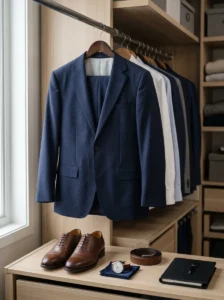
Startups and creative companies generally tolerate business casual without a blazer more comfortably than traditional corporate environments, but a first interview still benefits from slightly more polish than what current employees might wear on an ordinary Tuesday. Save the fully casual look for after you’ve observed the actual internal norm.
Corporate, finance, and law-adjacent companies still lean toward the traditional end of business casual or full formal for interviews, even in offices that have relaxed their daily dress code, because interview settings in these industries tend to preserve older norms longer than daily office wear does.
Client-facing or sales roles, regardless of industry, generally warrant slightly more formal dress than internal-facing roles at the same company, because the interview itself is implicitly evaluating how you’d present to a client.
Key Takeaways

- Dress code ambiguity is a structural result of hybrid work and blurred industry norms, not a failure of research on your part
- Checking candid team photos and asking the recruiter directly resolves most uncertainty faster than guessing
- Business casual, executed with intention rather than vague compromise, works across the widest range of company cultures
- Shoe condition is an underrated detail that undercuts otherwise correct outfits
- Overdressing and underdressing are not equal risks — overdressing reads as respect for the process, while underdressing risks reading as a lack of effort
- Interview dress expectations often remain more formal than daily office norms, even at companies with casual internal cultures

Frequently Asked Questions
Is it ever appropriate to ask the recruiter about dress code directly? Yes, and it’s one of the most efficient ways to resolve the uncertainty. A short, specific question sent after scheduling the interview — not the day before — signals preparedness rather than confusion. Recruiters field this question regularly and rarely read it as a negative signal.
What if the interview is virtual — does dress code still matter? It matters differently but still matters. Virtual interviews are typically judged from the waist up, but interviewers can often tell when someone is dressed inconsistently between what’s visible and what isn’t, through posture and comfort level. Dressing fully, even for a video call, tends to affect confidence and presentation in ways that dressing only partially doesn’t.
Should I dress differently for a first interview versus a second or final round? Often yes. First interviews, especially with recruiters, tend to warrant a safer, more universally professional choice since you have the least information about internal culture. By a second or final round — especially one involving current team members or an office visit — you typically have more data points to calibrate against, and slightly more casual dress can be appropriate if the environment clearly supports it.
What’s a safe outfit if I genuinely cannot find any information about the company’s culture? Business casual with a blazer that can be removed remains the safest universal default. It signals effort and preparation without assuming a formality level the company might not actually have, and the ability to remove the blazer allows you to adjust in real time once you see the room.
Does dress code advice differ for industries like tech versus more traditional fields? Generally yes, though less than people assume for interviews specifically. Daily office wear in tech is often far more casual than in finance or law, but interview settings across most industries still trend more formal than daily wear, because interviews are evaluative moments rather than ordinary workdays, even at companies with famously relaxed cultures.