
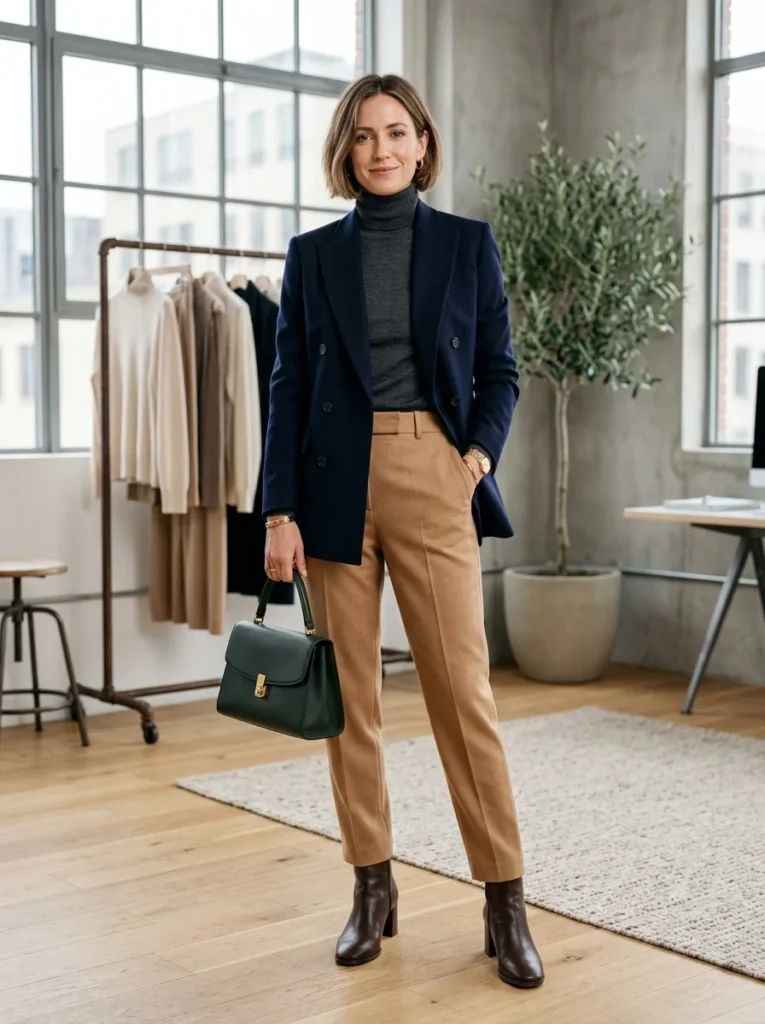
Some outfits look effortlessly styled while others with the same budget look thrown together. The difference isn’t the clothes — it’s a specific set of decisions most people never learn.
Two people can wear almost identical pieces — same jeans, same white shirt, same jacket — and one will look like they stepped out of a magazine while the other looks like they got dressed in the dark. This isn’t about having better clothes. It’s about a handful of decisions that most people never consciously learn, because nobody ever explains them directly.
After years of paying close attention to what actually separates “styled” from “random” — both in my own closet mistakes and in watching what works on other people — I’ve noticed the difference almost never comes down to money. It comes down to proportion, repetition, and restraint. Here’s what’s actually happening when an outfit works.
Why “Matching” Is Different From “Coordinated”
Most people who struggle with outfits are still operating on a rule they learned as kids: match your colors, match your shoes to your belt. That rule isn’t wrong, but it’s incomplete, and it’s why so many “matched” outfits still look flat.
Matching means sameness. Navy shirt, navy pants, navy jacket — technically matched, visually boring, and often looks like a uniform rather than an outfit.
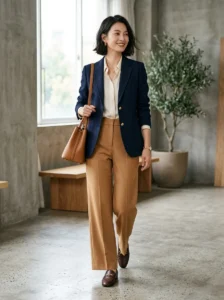
Coordinating means relationship. The colors, textures, and shapes talk to each other without being identical. A navy jacket with warm camel trousers and a cream shirt isn’t “matched” in the traditional sense, but it reads as far more intentional than an all-navy outfit because there’s contrast doing actual work.
The outfits that look thrown together are usually either matched too literally (boring, flat) or not coordinated at all (random, disconnected). The ones that look styled sit in the middle — related but not identical.
Proportion Does More Work Than People Realize
This is the single most underrated factor in whether an outfit reads as put-together, and it has almost nothing to do with the actual clothing items.
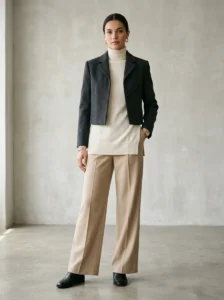
The 1/3-2/3 rule. Outfits generally look more intentional when one section of the body takes up roughly a third of the visual space and the other takes up two-thirds, rather than splitting evenly at the waist. A cropped jacket over a longer shirt, or a fitted top tucked into high-waisted trousers, creates this imbalance on purpose — and it’s what separates a styled silhouette from a boxy one.
Volume needs a counterbalance. If the top half is loose — an oversized sweater, a relaxed blazer — the bottom half needs some shape to anchor it: slim trousers, a fitted skirt, tapered denim. Two loose pieces worn together (baggy top, baggy pants) is one of the most common reasons an outfit reads as unstyled, even when both pieces are genuinely nice on their own.
Cropped vs. long is a deliberate pairing, not an accident. A cropped top with high-rise bottoms works because it shortens the torso and lengthens the leg line. A longer top with the same high-rise bottoms cancels that effect out and often looks accidental rather than chosen.
Color: Fewer Decisions, More Impact
People assume color coordination means matching shades carefully. In practice, the outfits that look most effortless usually limit themselves to two or three colors total, including neutrals.
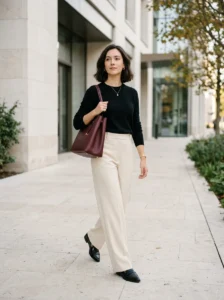
Neutrals aren’t “no color” — they’re the foundation. Black, white, beige, navy, and gray form a base that almost anything else can sit on top of. An outfit built on two neutrals plus one accent color (a burgundy bag, a green scarf) looks considered because the eye isn’t asked to process five competing colors at once.
Warm and cool tones clash more than people expect. A warm-toned camel coat over a cool-toned icy blue sweater can look slightly “off” even though both are technically neutral-adjacent colors. This is a subtle mismatch most people can’t name but can definitely see — it’s part of why some all-neutral outfits still feel slightly wrong.
Repetition of a single color creates intention. Wearing the same shade of green in a scarf and in a shoe, even in different materials, ties an outfit together in a way that’s much more visible than people expect. It reads as a deliberate choice rather than coincidence, even when it’s genuinely just what was clean that day.
Texture Is the Detail Nobody Talks About
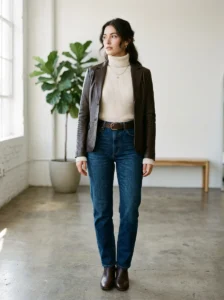
This is probably the most overlooked factor of all, because texture doesn’t show up in a photo the same way color and fit do — but it’s felt immediately in person.
All-smooth or all-textured reads as flat. An outfit made entirely of smooth cotton and jersey — no knit, no leather, no denim — tends to look one-dimensional, even if the fit and color are perfect. Mixing at least two textures (a knit sweater with a leather jacket, a silky blouse with structured denim) adds visual depth that makes an outfit feel richer.
Texture can rescue a boring color palette. An all-black outfit sounds risky for looking flat, but black in three different textures — matte cotton, sheen leather, ribbed knit — looks intentional and layered rather than one dimensional, even without a single additional color.
Heavy and light textures need to balance, similar to proportion. A chunky knit with delicate, thin trousers can look unbalanced in the same way volume does. Pairing weights that feel like they belong in the same season and same “weight class” keeps the eye from snagging on the mismatch.
Accessories: The Difference Between “Finished” and “Almost”
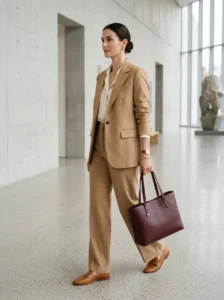
An outfit that’s 90% right without any accessories often reads as unfinished, not minimal. This is the part most people skip entirely, either from unfamiliarity or from running out of energy at the end of getting dressed.
- One statement piece, not several. A bold necklace and bold earrings and a bold bag competing at once usually cancels each other out. Choosing one focal accessory and keeping the rest quiet is what makes the statement piece actually register.
- Metals should generally stay consistent. Gold jewelry with a silver watch and silver belt buckle is a small detail, but it’s one of the fastest ways an otherwise good outfit starts to look slightly careless.
- Bags and shoes don’t need to match, but they do need to relate. A structured black bag with soft ballet flats can look mismatched in formality even if the colors align — matching the general “mood” of the pieces (both polished, both casual) matters more than matching the color.
Fit Beats Everything Else on This List
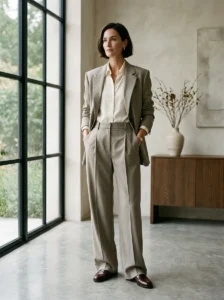
If proportion, color, texture, and accessories are all correct but the clothing doesn’t actually fit the body wearing it, none of the rest fully lands. This is worth saying plainly because it’s the factor most people underinvest in relative to how much it matters.
Shoulders are the non-negotiable fit point on jackets and blazers. A jacket with the shoulder seam sitting even slightly past the actual shoulder reads as ill-fitting no matter how good the rest of the outfit is. This is also the hardest and most expensive part of a jacket to alter, which is why shoulder fit matters most at the point of purchase.
Trouser length changes the entire read of an outfit. Trousers that pool at the ankle or ride noticeably short can undo an otherwise well-put-together outfit in a single glance. A basic hem alteration, something most tailors can do cheaply, solves more styling problems than most people realize.
“Room to move” is not the same as “too big.” Clothing that’s genuinely too large doesn’t look relaxed — it looks like it belongs to someone else. Intentional oversized pieces (an oversized blazer, a relaxed trouser) are cut differently from clothing that’s simply the wrong size, and the difference is visible even if it’s hard to articulate.
Key Takeaways
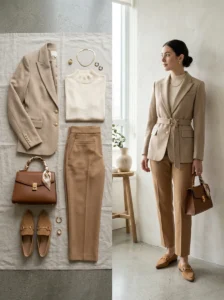
- Coordinating colors and textures that relate to each other looks more intentional than matching everything exactly
- Uneven proportions (fitted with loose, cropped with long) read as styled; two loose or two fitted pieces together often look accidental
- Limiting an outfit to two or three colors, including neutrals, creates a calmer and more considered look than more color combinations
- Mixing at least two textures adds depth that color and fit alone can’t provide
- One focal accessory, with the rest kept quiet, finishes an outfit more effectively than several competing pieces
- Fit — especially at the shoulders and trouser hem — has more impact on how “put together” an outfit looks than the actual clothing choices
Frequently Asked Questions
Can an outfit look put together without spending money on new clothes? Yes, and this is usually the biggest misconception about styling. Most of what separates a good outfit from a random one is proportion, color limiting, and fit — all of which can be adjusted with pieces already owned. Simply tucking in a top that’s usually left untucked, or rolling sleeves to change proportion, can shift how an entire outfit reads without buying anything new. The pieces that make the biggest visible difference for the lowest cost are usually hemming trousers and having a jacket’s sleeves adjusted, both inexpensive tailoring jobs.
Why do some all-black or all-neutral outfits look expensive while others look plain? The difference almost always comes down to texture and fit rather than the color itself. An all-black outfit in three different textures — leather, knit, matte cotton — reads as layered and considered, while the same colors in identical smooth fabrics reads as flat. Fit also plays a heavy role here, since a plain color palette has nothing else to distract from an ill-fitting shoulder or a baggy silhouette, whereas pattern or bold color can sometimes mask fit issues.
Is it possible to overdo texture mixing or color limiting? Yes, though it’s less common than the opposite problem. Mixing more than three or four distinct textures in one outfit can start to look busy rather than layered, especially if the textures are all competing for attention rather than one clearly leading. Similarly, an outfit can feel monotonous if every piece is not just coordinated but genuinely identical in color and finish — some contrast, even subtle, keeps an outfit from reading as a costume or uniform.
Do accessories really matter that much, or is that overstating it? They matter more than most people budget time or money for, mainly because accessories are usually the last decision made and the first one skipped when getting dressed quickly. An outfit that’s well-proportioned and well-fitted but has no accessories at all often reads as unfinished rather than minimal, particularly in more formal or occasion-based dressing. That said, accessories work as a finishing touch, not a rescue tool — they can elevate an already solid outfit, but they generally can’t fix poor fit or proportion on their own.
How much does body shape affect which of these rules apply? Body shape affects where the “third” falls in the proportion rule and which silhouettes create the most flattering balance, but it doesn’t change the underlying principles. Someone with a longer torso might crop higher to shorten it visually, while someone with a shorter torso might choose a slightly longer top to lengthen it — but both are still using the same uneven-proportion principle described earlier. The rules stay consistent; only the specific application shifts based on the individual body they’re being used on.