

A designer piece that doesn’t fit right will always look worse than a basic piece that does. Here’s why fit outperforms brand every time, and how to spot the difference.
The Designer Label Won’t Save an Outfit That Doesn’t Fit

Stand two people next to each other — one in a well-known, expensive label that fits poorly, the other in an unbranded piece that fits precisely — and ask a room to guess which one cost more. More often than not, people guess wrong, or they guess based on fit rather than fabric, cut, or logo. This isn’t a trick. It’s just how clothing actually reads to the eye, and it’s the opposite of what most shopping habits assume.
I used to believe brand was doing more work than it actually was, chasing labels I’d seen praised online, only to notice the pieces sat oddly on me in ways I couldn’t quite name at the time. It took years of paying attention to realize the common denominator in every outfit that actually looked expensive wasn’t the label inside the collar — it was whether the garment was built for a body shaped like mine. Here’s the actual mechanics of why fit outperforms brand, every time, and what to check instead of a tag.
What “Fit” Actually Means, Beyond Just Size

Most people equate fit with size — does it zip, does it button — but genuine fit is a more specific and more demanding standard than simply closing.
Fit means the garment’s structural points align with the body’s structural points. A shoulder seam sits at the actual shoulder edge, a waistband sits at the actual waist rather than riding up or slipping down, and a sleeve ends where the wrist naturally is rather than several inches short or long. A garment that technically closes but misses these alignment points isn’t well-fitted, it’s just wearable.
Fit is dynamic, not static. A piece that looks fine standing still but pulls, gaps, or rides up when sitting, walking, or raising an arm isn’t actually fitted correctly — it’s fitted for a single pose, which is a much lower bar than clothing that moves the way the body moves.
Fit varies by garment type in what it’s actually checking. A fitted blazer is judged primarily at the shoulder and through the body; a trouser is judged at the waist, hip, and break at the shoe; a dress is judged at the bust, waist, and hem relative to leg length. Treating “fit” as one universal checkpoint misses that each category has its own specific pressure points.
Why Expensive Brands Don’t Guarantee Good Fit
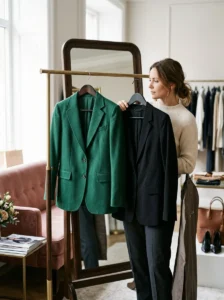
This is the part that surprises people most, because it seems logical that a higher price should correlate with better fit — but the two are actually solving different problems.
Brand pricing largely reflects material cost, design development, and marketing — not fit accuracy for your specific body. A designer label may use better fabric or more considered construction, but its garments are still cut to standard sizing blocks that are statistical averages, not individual measurements — the same limitation that applies to a budget brand’s sizing block.
Standard sizing blocks fit an average, and almost nobody is exactly average. Every clothing brand, regardless of price point, builds around a set of standard measurements for each size label. A person whose actual proportions deviate from that average — a longer torso, narrower shoulders, a different waist-to-hip ratio — will experience fit problems in an expensive brand’s size 8 in largely the same way as in a budget brand’s size 8, because both are built from a similar averaged block.
What expensive brands more reliably offer is better fabric behavior and construction quality, which matters, but differently than fit. A higher-quality fabric drapes and holds its shape better, and better construction (finished seams, proper interfacing, quality closures) affects how long a garment lasts and how it looks up close — these are real, valuable differences, but they’re separate from whether the cut itself matches your specific proportions.
The Specific Fit Points That Change How an Outfit Reads

Some fit issues are more visually significant than others — meaning a small number of specific checkpoints do a disproportionate amount of the work in determining whether an outfit looks intentional or off.
Shoulder seams on structured garments are the single highest-impact fit point. A shoulder seam that extends past the actual shoulder edge, even by a small amount, is one of the fastest visual signals of an ill-fitting garment, and it’s also one of the more expensive and difficult things to alter after purchase — which is why it’s worth prioritizing at the point of buying rather than assuming a tailor can fix it later.
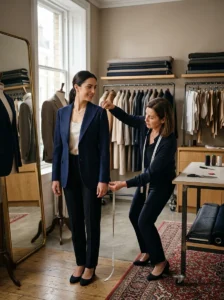
Waistband gapping reads as sloppy even when everything else fits. A waistband that sits away from the body at the back, common when hip-to-waist ratio doesn’t match a garment’s sizing block, undercuts an otherwise well-fitting pair of trousers or a skirt — this is a frequent, fixable issue that a simple tailoring adjustment resolves at relatively low cost.
Hem length relative to the shoe changes an entire outfit’s proportion. Trousers that break incorrectly — pooling too much or riding too short — alter the visual line of the leg in a way that’s immediately noticeable even to people who couldn’t articulate exactly what looks wrong. This is one of the most common and most fixable fit issues, often resolved with a basic and inexpensive hem alteration.
Sleeve length on jackets and shirts is a smaller but still noticeable checkpoint. A sleeve that ends significantly above or below the wrist bone disrupts an otherwise good fit, though this tends to register as a more subtle “something’s off” rather than the immediate visual signal a shoulder or hem issue creates.
Why Unbranded or Budget Pieces Can Look More Expensive Than They Cost

This isn’t a coincidence or a fluke — it follows directly from everything above, once fit is understood as the dominant visual factor.
A budget piece that happens to match your specific proportions will outperform an expensive piece that doesn’t, because the eye reads alignment and structure before it reads fabric quality from a normal viewing distance — most fabric quality differences are only apparent up close or under direct handling, while fit problems are visible from across a room.
Tailoring a budget piece is often more cost-effective than buying an expensive piece hoping it fits as-is. Basic alterations — hemming, taking in a waist, adjusting a sleeve — typically cost a fraction of the price difference between a budget and designer version of a similar garment, and the tailored budget piece frequently ends up fitting better than the untailored expensive one.
Simple silhouettes hide fit imperfections less than complex ones, which is actually an advantage for budget shopping. A plain, structured piece has fewer places to disguise a poor fit, which means it’s easier to evaluate accurately in a fitting room — complex draping or heavy pattern can visually mask fit issues temporarily, but they tend to reveal themselves in movement regardless of price point.
How to Actually Evaluate Fit Before Buying, Regardless of Brand
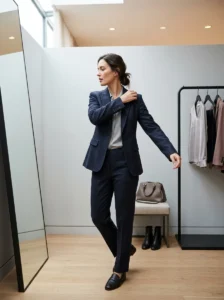
Since brand isn’t a reliable shortcut, having a direct evaluation process matters more than knowing which labels are “supposed” to fit well.
- Check the shoulder seam first on any structured top or jacket — this is the fit point least fixable by a tailor and most visually significant, so it should disqualify a piece immediately if it’s wrong.
- Move in the garment, not just stand in it. Sit down, raise your arms, take a full stride — a fit that only works in a static standing position isn’t a fit that will hold up through an actual day.
- Check the waistband from the back, not just the front. Gapping is far more visible from behind and is one of the most common issues missed when only checking a front-facing mirror view.
- Note what specifically doesn’t fit, rather than rejecting the whole piece outright. A shoulder problem is often disqualifying; a hem or waist issue is frequently a simple, affordable tailoring fix — distinguishing between these saves both money and good pieces that just need a small adjustment.
- Build a relationship with a tailor rather than treating alterations as a rare event. Regular, small alterations on otherwise well-chosen pieces consistently produce better results than exclusively buying and hoping for as-is fit, at any price point.
Key Takeaways
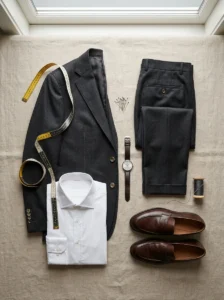
- Genuine fit means structural alignment at the shoulder, waist, and hem — not simply whether a garment closes or zips
- Expensive brands don’t guarantee better fit because most clothing, regardless of price, is built from standardized sizing blocks that represent an average, not individual proportions
- Shoulder seams are the highest-impact and least fixable fit point on structured garments, making them worth checking first at the point of purchase
- A budget piece that matches your proportions will visually outperform an expensive piece that doesn’t, since fit reads before fabric quality from a normal viewing distance
- Building a relationship with a tailor for small, regular adjustments consistently produces better results than relying on off-the-rack fit alone, at any price point
Frequently Asked Questions
If brand doesn’t guarantee fit, is there any reason to spend more on clothing at all? Yes, but the reasons shift once fit is taken out of the equation — higher-priced pieces often deliver better fabric quality, more durable construction, and finer details like finished seams and quality closures, all of which affect how a garment ages and holds up over repeated wear. These are legitimate reasons to spend more on a specific piece, but fit should be evaluated independently rather than assumed to come included with the higher price.
How do I know if a fit issue is worth a tailoring fix or if I should just return the item? Shoulder fit on jackets and structured tops is the main disqualifying factor — this is expensive and difficult to alter, so a shoulder that’s clearly wrong is generally worth returning rather than fixing. Hem length, waistband gapping, and minor sleeve length issues are typically inexpensive and straightforward for a tailor to resolve, which makes those specific issues worth keeping and adjusting rather than treating as reasons to reject an otherwise good piece.
Do certain brands actually fit specific body types better as a general pattern, even if it’s not guaranteed? This does happen in practice, since different brands base their sizing blocks on somewhat different average proportions, and some people’s bodies happen to align more closely with one brand’s block than another’s. This is worth noticing and remembering for future shopping, but it’s brand-specific pattern recognition based on your own body, not a rule that applies universally to how a brand fits everyone.
Is it realistic to get every single garment tailored, or is that only practical for special pieces? It’s most practical and cost-effective for pieces worn frequently and pieces that are structurally significant — trousers, blazers, coats, fitted dresses — rather than every single item in a closet. Casual, less structured pieces like t-shirts or loose knits generally don’t need the same level of tailoring investment, since their looser fit is often intentional rather than a fit problem to correct.
Does the “fit over brand” principle apply the same way to shoes and accessories, or mainly to clothing? The underlying logic extends to shoes in a real way — a shoe that fits the actual shape and width of the foot will look and feel better than an expensive shoe that doesn’t, and poor shoe fit is often more physically uncomfortable and more visually apparent (through posture and gait) than people expect. It applies less directly to accessories like bags or jewelry, where “fit” isn’t really the relevant category — quality of material and construction matter more there than any equivalent to garment fit.