

Smart casual is the wedding dress code that confuses people most, mixing formal expectations with casual freedom. Here’s how to actually get it right.
The Wedding Dress Code That Confuses Everyone on Purpose
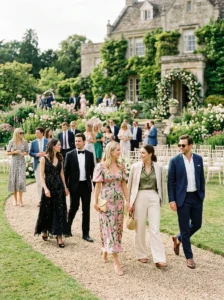
Every other wedding dress code gives you a clear boundary. Black tie means a gown or a tux. Cocktail means a shorter dress or a suit. Smart casual gives you almost nothing to hold onto, which is exactly why it causes more wardrobe anxiety than codes that sound far stricter. It’s a phrase that means something slightly different depending on the couple, the venue, and even the region — and getting it wrong in either direction is easy.
I’ve watched people overcorrect both ways at the same wedding — someone in a full ballgown standing next to someone in flip-flops and shorts, both technically responding to the same two words on the invitation. The fix isn’t finding a universal rulebook, because one doesn’t really exist. It’s understanding what “smart casual” is actually trying to communicate, and building an outfit that answers that specific intention rather than guessing at a fixed formula.
What “Smart Casual” Is Actually Asking For
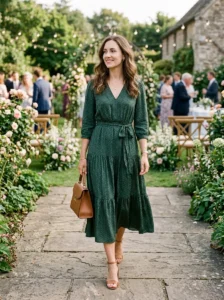
Before getting into specific outfit pieces, it helps to understand the purpose behind this particular phrase, because it’s doing a different job than stricter dress codes.
Smart casual signals a wedding that wants to feel relaxed without looking underdressed. It usually appears on invitations for daytime weddings, outdoor or destination settings, or couples deliberately avoiding a stiff, formal atmosphere — the phrase is a request for polish without rigidity, not an invitation to treat the event as fully casual.
It sits in the space between cocktail attire and everyday clothing, closer to the cocktail end than people initially assume. The most common miscalibration is treating “casual” as the operative word and “smart” as decoration, when the reverse reading is usually closer to what’s intended — smart casual for a wedding specifically skews more polished than smart casual for, say, a work happy hour.
Context clues on the invitation matter more than the two words alone. A daytime garden wedding’s smart casual and an evening venue wedding’s smart casual can call for genuinely different outfits, even though the stated dress code is identical — time of day, venue type, and season all adjust what “smart casual” should mean for that specific event.
The Overdressed Mistake, and Why It Happens
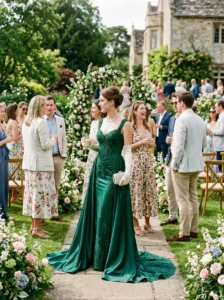
This mistake comes from a reasonable impulse — not wanting to be underdressed at someone’s wedding — but it consistently overshoots what smart casual is asking for.
A full-length formal gown or a black-tie-level suit reads as ignoring the dress code, not respecting it. Dress codes exist partly to help guests calibrate to the couple’s specific vision for the day; showing up in formalwear at a smart casual wedding can read as either not having read the invitation or deliberately overriding it, neither of which lands the way it’s intended.
Heavy formal fabrics — structured satin, heavy beading, floor-length silhouettes — visually clash with a setting the couple has specifically framed as relaxed, particularly at outdoor or daytime venues where the whole aesthetic is built around less rigid formality. The outfit ends up fighting the environment rather than fitting into it.
The Underdressed Mistake, and Why It’s More Common Than Expected
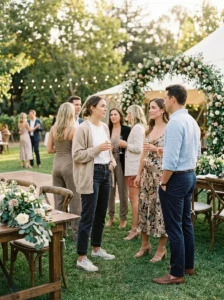
This is the more frequent error, largely because “casual” gets treated as permission to dress the way you would for an ordinary casual outing, without accounting for the “smart” half of the phrase.
Jeans, sneakers worn purely for comfort rather than style, and t-shirt-level tops read as too casual even when the invitation says “casual.” Smart casual for a wedding specifically still expects some elevation over daily-life casual — a nicer fabric, a more considered silhouette, or a dressier shoe, even within an overall relaxed outfit.
Shorts, flip-flops, and overly athletic pieces almost never satisfy a wedding’s version of smart casual, even for the most relaxed outdoor or beach ceremonies, because these read as vacation-casual rather than the polished-relaxed balance the dress code is actually requesting.
Underdressing tends to be more visually obvious at a wedding than at other smart casual events, since weddings have a built-in visual hierarchy — the couple and wedding party are dressed formally, and guests who go too casual create a noticeable gap in the room’s overall visual coherence in a way that’s less apparent at a smart casual office event or casual dinner.
What Actually Works: The Specific Pieces
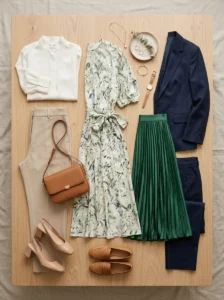
Rather than a vague middle ground, smart casual for a wedding has a fairly identifiable set of pieces that consistently land correctly.
For Dresses
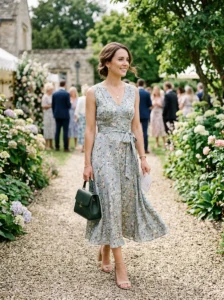
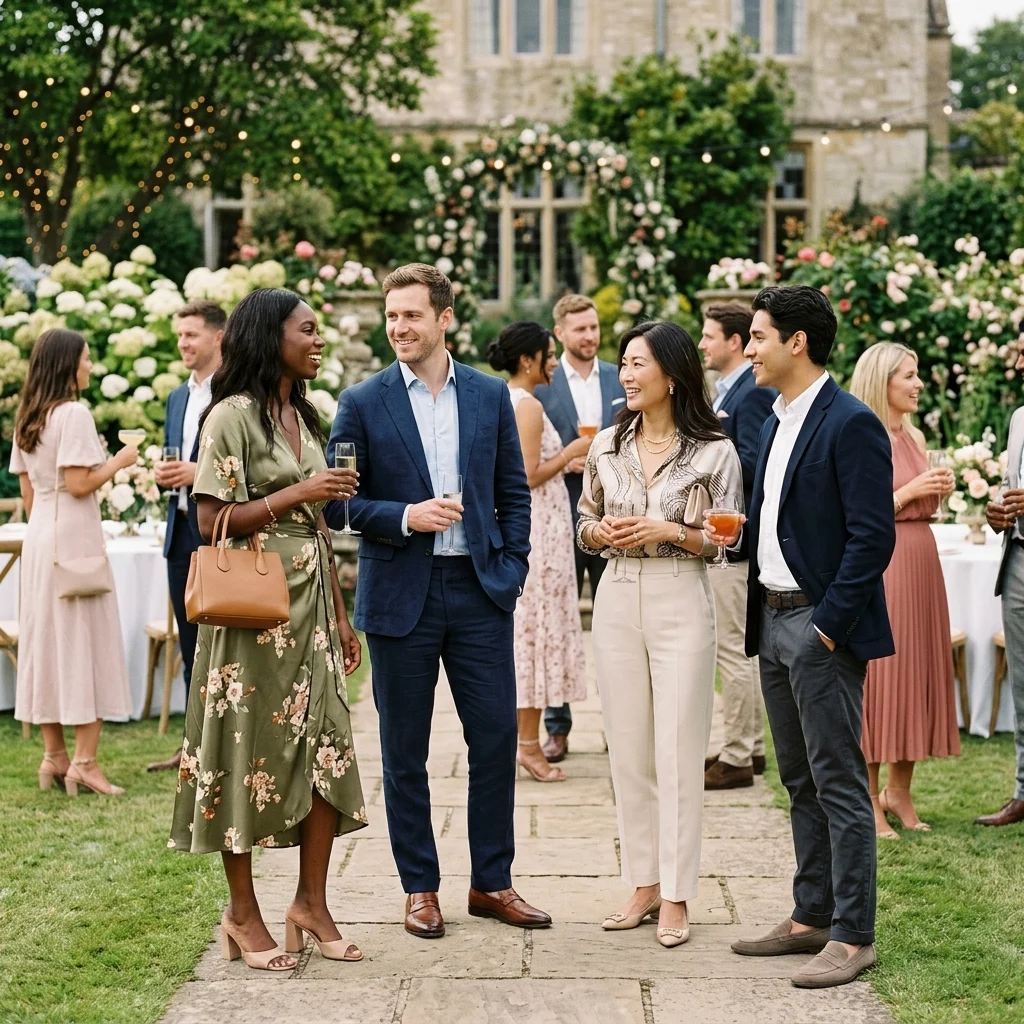
A midi-length dress in a quality fabric — not jersey, not overly casual cotton — is the most reliable smart casual wedding choice. Fabrics like a structured cotton blend, a light wool crepe, or a linen-silk blend read as elevated without tipping into formalwear the way satin or heavy embellishment would.
Florals, solid colors, and subtle prints all work, but avoid anything explicitly branded as “cocktail” or “evening” in cut. A cocktail dress with a heavily structured bodice or dramatic slit skews more formal than smart casual generally calls for, even in an otherwise appropriate fabric and length.
Sleeves and coverage should account for the venue and season, not just the dress code label. An outdoor daytime wedding in warm weather allows for sleeveless or short-sleeve options; an evening or cooler-season wedding benefits from a dress with sleeves or a layering piece, independent of what “smart casual” technically requires.
For Separates
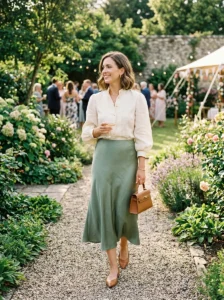
A structured blouse or fitted top with a midi or maxi skirt achieves the same balance as a dress, with more flexibility to adjust formality through fabric choice. A silk or silk-blend top with a tailored skirt reads more elevated than the same skirt with a casual knit top, allowing the outfit to be tuned toward either end of the smart casual range as needed.
Wide-leg or tailored trousers with a dressier top are an increasingly accepted smart casual wedding option, particularly for daytime or less traditional venues — this combination reads as intentional and elevated without requiring a dress at all.
For Suits and Menswear-Inspired Pieces
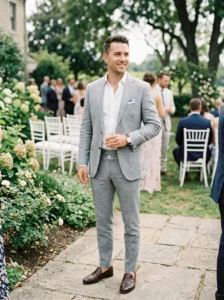
A lighter-weight suit in a non-black color — navy, tan, soft gray — reads as smart casual more accurately than a full black formal suit. Color and fabric weight do most of the work here; the same silhouette in a heavier, darker fabric shifts the read toward formal rather than smart casual.
Skipping the tie, or opting for an open collar, moves a suit from formal into smart casual territory quickly, without needing to change the suit itself — this single adjustment is often enough to recalibrate an entire outfit’s formality level.
Shoes and Accessories: Where the Calibration Actually Happens
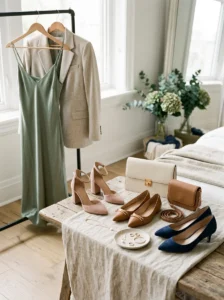
Shoes and accessories are frequently the deciding factor in whether an outfit reads as correctly calibrated, more so than the primary garment itself.
- Block heels, dressy flats, or low kitten heels read as smart casual appropriate; both stiletto heels and casual sneakers tend to fall outside the range on opposite ends. The middle ground in footwear formality mirrors the middle ground the entire dress code is asking for.
- A structured bag — a clutch or a small structured crossbody — elevates an outfit more efficiently than almost any other single accessory, since bags are one of the more visible formality signals guests use to calibrate their own outfits against everyone else’s in the room.
- Minimal, refined jewelry works better than either bare wrists or maximalist statement pieces — a few well-chosen pieces read as considered without pushing into the more elaborate territory reserved for black-tie or formal-tier dressing.
- Outdoor and daytime venues justify practical footwear choices without sacrificing the dressier read, such as a wedge or block heel that handles grass or uneven ground better than a stiletto while still reading more elevated than a flat sandal.
Adjusting for Venue and Time of Day
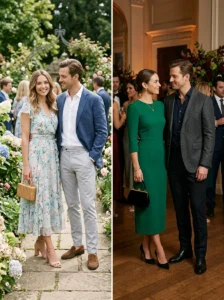
The same smart casual outfit can be slightly wrong for one wedding and exactly right for another, depending on details the dress code phrase alone doesn’t communicate.
Daytime and outdoor weddings shift the calibration toward lighter fabrics, brighter or softer colors, and more practical footwear, since the setting itself is already informal in character, meaning the outfit doesn’t need to work as hard to feel elevated within that context.
Evening weddings, even with a smart casual dress code, generally benefit from richer colors, slightly more structured fabric, and a dressier shoe, since evening settings carry more inherent formality regardless of the stated code, and outfits that read as smart casual at 2pm can read as slightly underdressed at 7pm in the same exact pieces.
Religious or cultural ceremony components should be checked separately from the reception dress code, since some ceremonies have coverage or formality expectations (shoulders covered, certain colors avoided) that exist independently of whatever the reception’s stated dress code communicates.
Key Takeaways
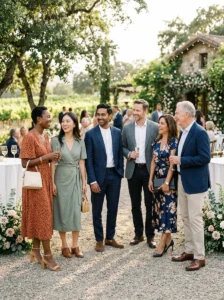
- Smart casual for a wedding sits closer to cocktail attire than to everyday casual, and skews more formal than the same phrase would suggest at a non-wedding event
- Overdressing (full formalwear) misreads the dress code as much as underdressing (jeans, athletic pieces) does, even though the two mistakes come from opposite impulses
- Fabric quality and cut, more than color or exact style, are what separate a smart casual piece from either an overly casual or overly formal one
- Shoes and accessories frequently do the most calibration work in a smart casual outfit, since footwear and bag formality are common visual cues other guests use to gauge appropriateness
- Venue and time of day should adjust the specific outfit even when the stated dress code phrase stays identical across different weddings
Frequently Asked Questions
Is it better to lean slightly overdressed or slightly underdressed if I’m still unsure? Leaning very slightly toward overdressed is generally the safer choice at a wedding specifically, since being a bit more polished than necessary is far less noticeable or uncomfortable than being visibly underdressed in a room where the couple and wedding party are dressed formally. That said, “slightly overdressed” within smart casual still means a nicer dress or elevated separates, not full formalwear — the goal is a small adjustment in the right direction, not overcorrecting into the wrong dress code entirely.
Can I wear black to a smart casual wedding, or is that too close to formal or funeral-associated? Black is generally acceptable at a smart casual wedding, particularly in a lighter fabric or a less severe silhouette — a black midi dress in cotton or linen reads differently than a heavy black formal gown. That said, checking the invitation or asking the couple directly is worth doing if there’s any indication the wedding has a specific color request, since some couples do ask guests to avoid black regardless of the formality dress code.
What if the wedding is smart casual but the venue is somewhere unusual, like a barn or a beach? Venue type should adjust footwear and fabric practicality more than it should lower the overall formality level — a barn or outdoor venue calls for a wedge or block heel instead of a stiletto, and a lighter, less precious fabric that won’t be ruined by grass or sand, but the dress code itself still applies at the same formality level. The venue changes the practical execution, not the underlying smart casual calibration.
Is it ever appropriate to ask the couple directly what they mean by smart casual? Yes, and it’s a completely reasonable question, particularly since the phrase genuinely varies between couples and there’s no universally fixed definition. A brief, direct question — often through whoever’s helping coordinate logistics, like a wedding party member or the invitation’s RSVP contact — is far less awkward than guessing incorrectly, and most couples appreciate a guest wanting to get the dress code right rather than being frustrated by the question.
Does smart casual mean the same thing for men and women at weddings, or does it differ by gender? The underlying calibration — more polished than daily casual, less formal than a full suit or gown — applies consistently, but the specific pieces differ by convention. For men, this typically means a suit without a tie or a blazer with dress trousers rather than a full formal suit; for women, it typically means a midi dress or elevated separates rather than a floor-length gown or fully casual pieces. The target formality level is the same even though the specific wardrobe pieces used to reach it vary.