


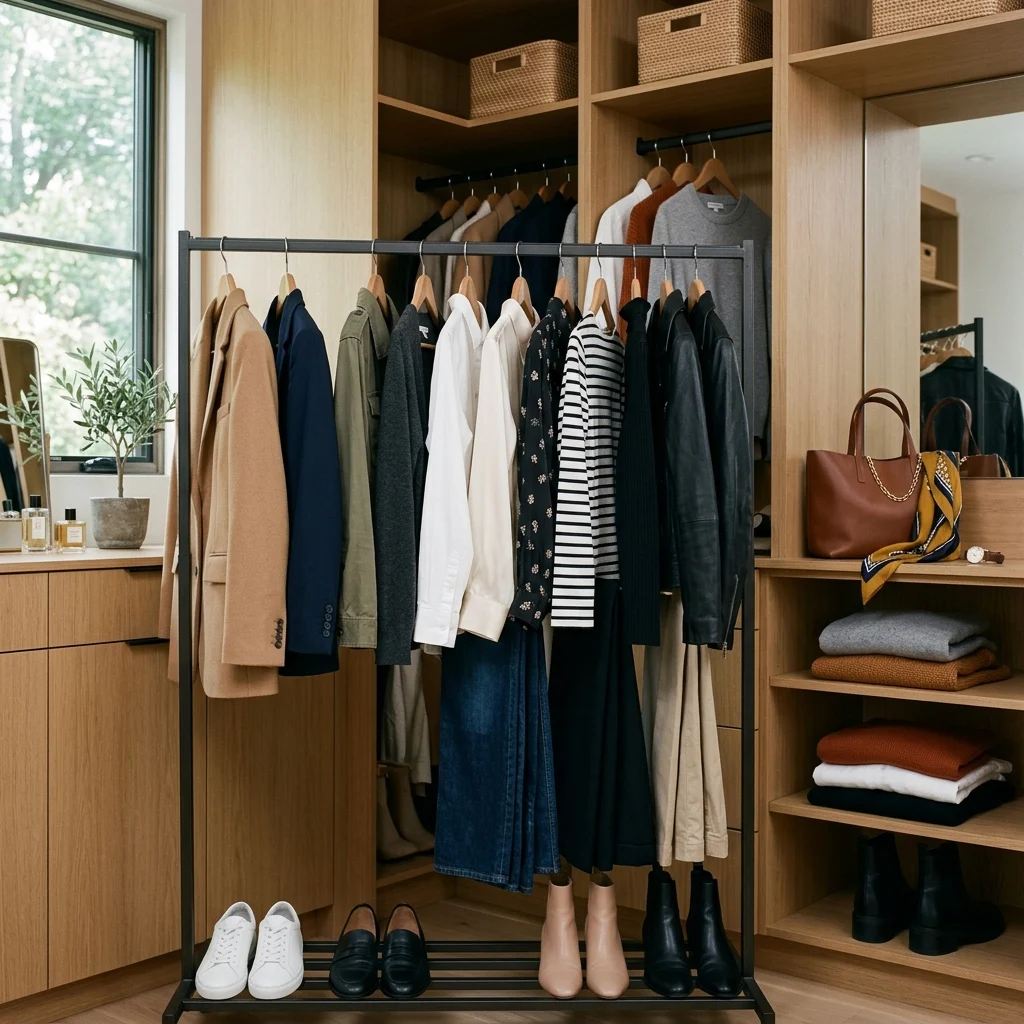
Capsule wardrobes promise less stress and more style. Here’s why they genuinely work, plus a real step-by-step process to build one that fits your life.
Most people don’t have a clothing problem — they have a decision-fatigue problem. Somewhere between the overstuffed closet and the “I have nothing to wear” moment every single morning, something in the system broke. A capsule wardrobe fixes that, not by owning less for the sake of it, but by owning things that actually work together.
I rebuilt my own wardrobe around this idea a few years ago, mostly out of frustration rather than any grand minimalist philosophy. What surprised me wasn’t how much closet space I freed up — it was how much mental space I got back. Getting dressed stopped being a daily negotiation.
What a Capsule Wardrobe Actually Is (And Isn’t)

A capsule wardrobe is a small, intentional collection of clothing where nearly every piece can be paired with nearly every other piece. It’s not a fixed number like “33 items” — that figure gets repeated online but it’s a starting template, not a rule.
The Real Definition People Miss

The core idea isn’t minimalism for its own sake. It’s about maximizing outfit combinations from a minimal number of pieces. A wardrobe of 30 items that only creates 10 usable outfits has failed the concept, even if the item count looks impressively low.
- The goal is combination efficiency, not just a small closet.
- Quality and fit matter more than quantity in every version of this approach.
- A true capsule flexes with your actual lifestyle — a parent’s capsule looks nothing like a corporate lawyer’s, and that’s the point.
Why Capsule Wardrobes Actually Work Psychologically

This isn’t just a styling trend — there’s real behavioral science behind why fewer, better choices lead to better outcomes.
Decision Fatigue Is Real

Psychologists have long studied how the quality of our decisions degrades the more choices we make in a day. Getting dressed is often the first decision-heavy task of the morning, and a closet with too many options — many of which don’t even go together — quietly drains willpower before the day starts.
A capsule wardrobe removes the mismatched, rarely-worn, “I don’t know what to do with this” pieces that create hesitation. What’s left is a closet where almost every combination works, so the decision becomes fast and low-stakes.
The 80/20 Rule Shows Up in Closets Too

Most people already wear roughly 20% of their wardrobe 80% of the time — the difference is that the other 80% of clothes still take up visual and mental space every time the closet door opens. A capsule wardrobe simply makes that ratio honest by removing the clutter that was never being worn anyway.
Step 1: Audit Before You Buy Anything
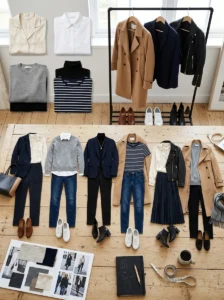
The biggest mistake people make when starting a capsule wardrobe is shopping first. The actual first step is a full closet audit, and it’s more revealing than most people expect.
- Pull every item out of the closet and drawers — everything, no exceptions.
- Sort into three piles: worn regularly, worn occasionally, and untouched in the last 6–12 months.
- Try on anything you’re unsure about rather than guessing from how it looks on the hanger.
- Set aside anything damaged, ill-fitting, or that you keep out of guilt rather than genuine use.
This step alone often cuts a wardrobe by a third or more before a single new item is purchased. It also reveals patterns — colors you actually gravitate toward, silhouettes that consistently fit well, and categories you’re either over- or under-stocked in.
Step 2: Define Your Personal Color and Style Palette

A capsule wardrobe only works if the pieces mix and match, and that’s a color problem as much as a style problem.
Building a Cohesive Palette

Pick 2–3 neutral base colors (think navy, black, camel, or gray) and 1–2 accent colors that complement them. Every new piece gets measured against this palette before it’s allowed in.
- Neutrals should make up roughly 70% of the wardrobe for maximum mix-and-match flexibility.
- Accent colors add personality without breaking compatibility across outfits.
- Patterns, when included, should share at least one color with the base palette to stay flexible.
This is the step most people skip, and it’s exactly why so many “capsule wardrobe” attempts quietly fail within a few months — the closet still fills up with pieces that don’t actually talk to each other.
Step 3: Build Around Core Categories, Not Trends
A functional capsule wardrobe is built from categories, not individual trendy pieces. Trend items age out fast and rarely combine well with anything else, which defeats the entire purpose.
The Core Category Framework

A reasonably complete capsule usually includes:
- Tops: 8–10 pieces spanning basic tees, blouses, and one or two statement options.
- Bottoms: 4–6 pieces covering at least two silhouettes (fitted and relaxed).
- Outerwear: 2–3 pieces suited to your actual climate, not an aspirational one.
- Shoes: 3–5 pairs covering casual, work, and one dressier option.
- Layering pieces: cardigans, blazers, or vests that stretch outfit versatility significantly.
The exact numbers matter less than the principle: each category should have just enough variety to prevent repetition fatigue, without duplicating function.
Step 4: Test the Math Before Committing
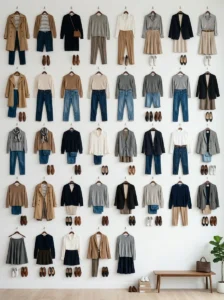
Before finalizing a capsule, do a quick mental (or literal) outfit-combination check. A well-built 30-piece capsule should realistically produce 40–50+ distinct outfit combinations, accounting for weather and occasion variation.
If a piece doesn’t pair with at least three other items in the collection, it’s not capsule-compatible yet — either it needs a supporting piece, or it doesn’t belong.
A Simple Test I Use Personally
Whenever I consider adding something new, I ask: “Can I picture at least three outfits with this in the next two weeks?” If the answer is no, it doesn’t come home with me, no matter how good it looks on the rack.
Step 5: Maintain It Seasonally, Not Constantly

A capsule wardrobe isn’t a one-time project — it’s a system that needs light seasonal maintenance to stay useful.
- Swap heavier layering pieces in and out with the seasons rather than keeping everything visible year-round.
- Reassess every 3–4 months: what’s been worn, what hasn’t, and why.
- Replace worn-out basics before they fail, not after, to avoid falling back into impulse shopping.
This maintenance rhythm is what separates a capsule wardrobe that lasts for years from one that quietly bloats back to its original size within twelve months.
Key Takeaways

- A capsule wardrobe is about combination efficiency, not a specific item count.
- Fewer, well-matched choices reduce daily decision fatigue and mental clutter.
- Start with a full closet audit before buying anything new.
- A tight 2–3 neutral, 1–2 accent color palette is what makes mixing and matching actually work.
- Build around functional categories, not trend pieces that age out quickly.
- Seasonal maintenance, not a one-time purge, is what keeps a capsule wardrobe working long-term.
Conclusion
A capsule wardrobe works because it solves a real problem — too many choices, not enough good ones. It’s not about owning as little as possible; it’s about owning things that actually work together, so getting dressed stops being a daily source of friction. Start with the audit, build the palette, and let the categories guide your choices from there. The closet gets smaller, but somehow getting dressed gets easier — and that trade is worth making.

Frequently Asked Questions
1. How many items should be in a capsule wardrobe? There’s no fixed number — 30 to 40 pieces is a common starting range, but the right count depends on your lifestyle, climate, and how often you do laundry. The real measure of success is how many usable outfit combinations the pieces create, not the total item count.
2. Do capsule wardrobes work for people with active social lives or varied work settings? Yes, but the category mix needs to reflect that. Someone attending frequent evening events needs more dressier pieces in their capsule than someone working from home, so the framework should be adapted to actual weekly needs rather than copied from a generic list.
3. Is a capsule wardrobe expensive to start? It doesn’t have to be. Most of the initial cost savings come from the audit step, since many people already own more usable pieces than they realize. New purchases should be added gradually and intentionally, which naturally spreads out the cost over time.
4. What do I do with the clothes I remove from my closet? Donate, sell, or repurpose items in good condition rather than discarding them outright. Selling gently used pieces through resale platforms or consignment stores can also offset the cost of any new capsule additions.
5. How often should a capsule wardrobe be updated? A light seasonal review every 3–4 months works well for most people, checking what’s been worn, what hasn’t, and whether anything needs replacing. A full rebuild usually isn’t necessary more than once a year unless your lifestyle changes significantly.