


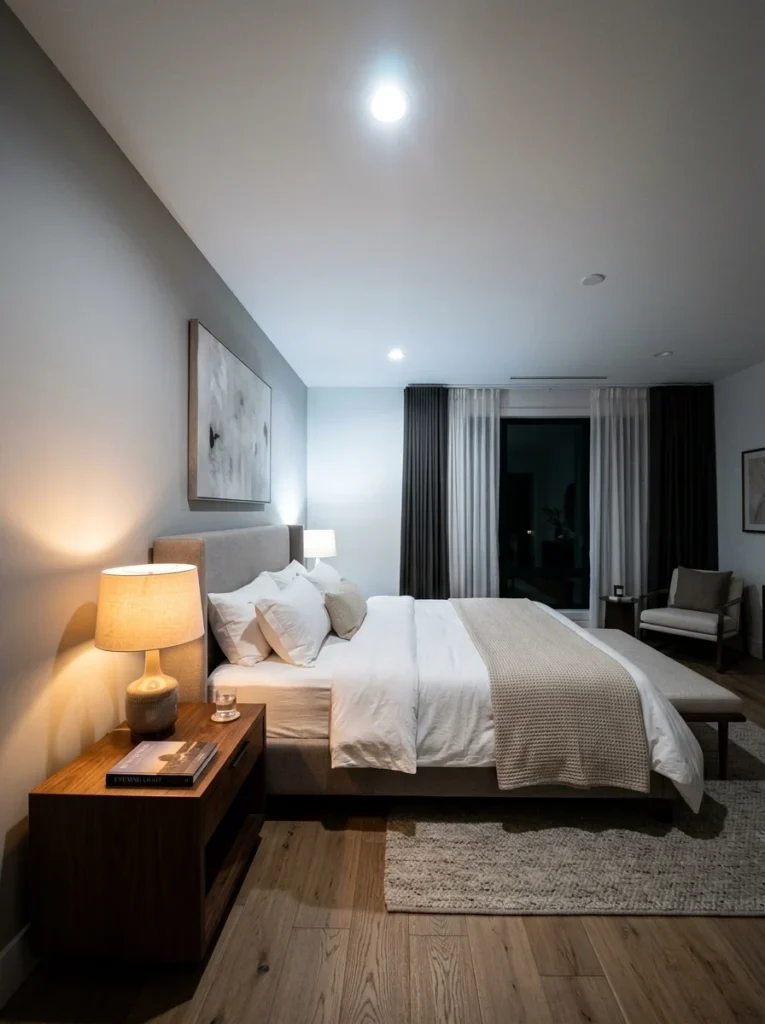
Most bedrooms are lit like small living rooms, which is exactly the problem. A bedroom has a specific job — helping the body wind down and sleep — that its lighting rarely supports. Here’s what actually works
Most bedrooms are lit with whatever combination of an overhead fixture and a bedside lamp came with the apartment or seemed reasonable at the time, without much consideration for what a bedroom’s lighting is actually supposed to accomplish. This is a meaningfully different job than what a living room’s lighting needs to do. A living room’s lighting supports a range of activities across a full day. A bedroom’s lighting has one primary evening job — helping the body transition toward sleep — and one primary daytime job during the hours it’s used for dressing or reading, and most bedroom lighting setups aren’t actually built around either of these specific functions.
A Single Overhead Fixture Works Against a Bedroom’s Purpose More Than in Any Other Room
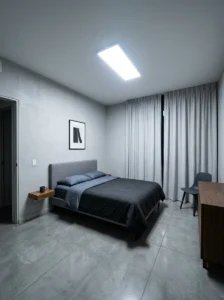
Overhead lighting reads as functional and alert in any room, but this specific quality works directly against a bedroom’s evening purpose in a way it doesn’t in a kitchen or a home office, where alertness is the goal rather than the obstacle. A bedroom lit by a single bright overhead fixture in the evening is being lit for wakefulness at exactly the time the room is meant to be supporting the opposite.
This matters more in a bedroom than the equivalent problem does in a living room, covered elsewhere in this series, because a living room serves many functions across the day and only some of them benefit from lower, warmer light. A bedroom’s evening use is almost entirely the wind-down function, which means the case against relying on overhead lighting as the primary evening light source is stronger and more consistent in a bedroom than in almost any other room in the house.
Light Exposure in the Evening Has a Real, Measurable Effect on Sleep Readiness

The body’s circadian rhythm — the internal clock that regulates sleep and wake timing — responds to light, and brighter, cooler light in the hours before bed measurably delays the release of melatonin, the hormone that signals to the body that it’s time to sleep. This isn’t primarily a mood or aesthetic consideration, the way most of the lighting discussion elsewhere in this series has been — it’s a physiological one, and it’s specific to the bedroom’s evening use in a way that doesn’t apply to the same degree in rooms not directly tied to the sleep cycle.
Bright, cool-toned overhead lighting used right up until the moment of trying to fall asleep works against this process directly, keeping the body in a more alert state later into the evening than dimmer, warmer light would. This is a specific, evidence-based reason — beyond simple coziness — for prioritizing low, warm light in a bedroom during the hour or so before sleep.
Screens — phones, tablets, laptops — compound this same effect and are frequently used in bed in the same window of time the room’s lighting is supposed to be supporting wind-down, which is worth acknowledging as a related but separate issue from the room’s fixed lighting: a well-designed bedroom lighting setup can still be undermined by a bright phone screen used in the same evening hours.
Task Lighting for Reading Needs to Be Genuinely Separate From Ambient Wind-Down Lighting

A bedroom used for reading in bed has a specific, different lighting need than the same room’s general wind-down lighting, and conflating the two — relying on the same low-level ambient light for both — usually serves neither well. Reading light needs to be bright enough and correctly positioned to actually read comfortably by, which is a genuinely higher light level than the low, warm ambient light appropriate for the room generally in the evening.
A dedicated reading lamp, positioned at the right height and angle relative to the reader’s position in bed, solves this without requiring the whole room to be lit at reading brightness. A wall-mounted or clip-on reading light aimed specifically at the book or device, rather than a general bedside lamp positioned for ambient light, provides adequate task light in a contained area while leaving the rest of the room’s lighting at the lower level appropriate for a partner who may be trying to sleep, or for the room’s general wind-down mood once reading is finished.
Bedside lamp height matters specifically for reading function. A lamp positioned too low, or with a shade that directs light downward onto the nightstand rather than up toward where a book is actually held, provides less usable reading light than the lamp’s wattage alone would suggest. The lamp’s light source should generally sit at or slightly above shoulder height for a person sitting up in bed, roughly in line with where a held book or device would actually need illumination.
Morning Light Deserves as Much Planning as Evening Light

A bedroom’s lighting conversation tends to focus entirely on the evening wind-down function, but morning light exposure plays an equally real role in the circadian rhythm, helping signal wakefulness and supporting a more consistent sleep-wake cycle over time. A bedroom with heavy blackout curtains that block all light, opened only well after waking, misses an opportunity that a bedroom with some access to morning natural light doesn’t.
This creates a genuine tension for households that want full darkness for sleep quality but also want natural light exposure upon waking, and the practical resolution is usually blackout curtains that can be opened promptly upon waking, rather than left closed through the morning, or a curtain setup — layered sheer and blackout, for instance — that allows some morning light in without eliminating the blackout option during the sleep period itself.
A sunrise-simulating alarm light, which gradually brightens over a set period before a target wake time, is a specific tool some households use to address this directly, particularly relevant for a bedroom without good natural morning light access, or for someone waking before natural sunrise for much of the year depending on location and season.
Dimmers Are as Essential in a Bedroom as They Are in a Living Room

A bedroom moves through a wider range of needed light levels across a single evening than almost any other room — bright enough to find something in a drawer or get dressed, moderate for a reading session, very low for the final wind-down before sleep, and off entirely once asleep. A fixed-brightness lighting setup can’t serve this full range well, which makes dimmers on both overhead and bedside lighting a particularly high-value addition in a bedroom specifically.
Smart bulbs that shift color temperature automatically by time of day, covered in more detail elsewhere in this series regarding living room lighting, are especially well suited to a bedroom, since the evening warm-shift directly supports the circadian and wind-down considerations that are more central to a bedroom’s function than to almost any other room.
What a Well-Lit Bedroom Actually Looks Like in Practice

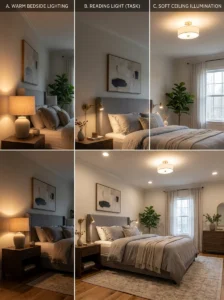
A bedroom lighting setup that actually supports its function typically includes: overhead or general ambient lighting, dimmed low or avoided entirely in the evening hours; a dedicated reading light at each side of the bed, positioned and angled for actual reading rather than general ambient glow; warm, low-level lighting — a bedside lamp on a dimmer, a plug-in sconce — for the wind-down period specifically; and a plan for morning light, whether through curtain choice, timing, or a sunrise-simulating alarm, that doesn’t conflict with the blackout needs of the sleep period itself.
This is a more layered setup than the single overhead-plus-one-lamp configuration most bedrooms default to, but each layer is solving a specific, real function rather than adding complexity for its own sake — and, as with the living room lighting discussion elsewhere in this series, a dimmer on the fixtures already present is often a more accessible first step than buying entirely new lighting.
Key Takeaways
- A bedroom’s evening lighting needs work against sleep readiness more directly than in any other room, since bright, cool light delays the body’s natural melatonin release
- Reading light and general ambient wind-down light are two separate needs that a single bedside lamp often tries and fails to serve simultaneously — a dedicated, well-positioned reading light solves this without brightening the whole room
- Bedside lamp height and shade direction affect how much usable reading light actually reaches a book or device, independent of the bulb’s wattage
- Morning light exposure matters as much as evening light for a consistent circadian rhythm, which creates a real tension with blackout curtains that a layered curtain approach or timed curtain-opening can resolve
- Dimmers on both overhead and bedside lighting are particularly high-value in a bedroom, given how widely the room’s needed light level shifts across a single evening
- A well-lit bedroom generally needs several distinct lighting layers — general ambient, task reading light, low wind-down light, and a morning light plan — rather than the single overhead-plus-one-lamp setup most bedrooms default to
Frequently Asked Questions
Does evening light really affect sleep, or is warm lighting just about mood? It’s a real physiological effect, not only a mood consideration — brighter, cooler light in the hours before bed measurably delays the release of melatonin, the hormone that signals sleep readiness to the body. This is a more evidence-based, sleep-specific reason for warm, low evening lighting in a bedroom than the general coziness argument that applies to living room evening lighting.
Should I use overhead lighting in my bedroom at all? It has a place for daytime use — dressing, cleaning, general tasks — but it’s worth avoiding as the default light source in the evening hours specifically, given how directly bright overhead light works against the room’s wind-down function. A dimmer on the overhead fixture allows it to remain useful without dominating the room’s evening lighting by default.
What’s the best way to get good reading light in bed without disturbing a sleeping partner? A dedicated reading light aimed specifically at the book or device — rather than a general ambient bedside lamp — contains the brighter task light to a smaller area, reducing how much it affects the rest of the room and a partner on the other side of the bed. Wall-mounted or clip-on reading lights, positioned and angled precisely, generally do this better than a standard bedside lamp positioned for general ambient light.
How do I balance wanting blackout curtains with wanting morning light exposure? A layered curtain approach — sheer curtains that allow some light alongside blackout curtains that can be opened promptly upon waking — is a common resolution, giving full darkness during the sleep period itself while still allowing morning light exposure once awake. A sunrise-simulating alarm light is another option, particularly useful for a bedroom with limited natural morning light or for waking before actual sunrise for much of the year.
Is it worth buying a completely new lighting setup for my bedroom, or can I improve what I already have? Often the existing fixtures can be improved considerably just by adding dimmers, switching to warmer and lower-wattage bulbs for evening use, and adding a dedicated reading light where one doesn’t already exist, rather than replacing the room’s lighting entirely. As with living room lighting, a dimmer on fixtures already in place is often the highest-value, lowest-cost first step before considering a full lighting overhaul.