



Rug size and placement under a bed is a more specific decision than most bedroom furnishing choices, with real trade-offs between look, feel, and practicality. Here’s how to actually get it right.
A rug under a bed has to solve a slightly different problem than a rug anywhere else in the house. It’s mostly hidden by the bed itself, which means a large portion of whatever’s purchased is never actually seen. It’s walked on with bare feet first thing in the morning, which makes texture and softness more relevant here than in almost any other room. And it interacts with a large, heavy piece of furniture sitting directly on top of a significant portion of it, which raises practical questions about pile height and durability that a rug under a coffee table doesn’t have to contend with in the same way.
Sizing and Placement: The Three Common Approaches
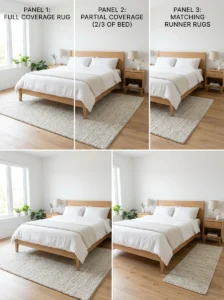
Full coverage, where the rug extends well beyond all sides of the bed, is the most visually generous option and the one that reads most similarly to a fully rugged, wall-to-wall-adjacent room. This requires the largest and most expensive rug of the three approaches, since a meaningful portion of it sits unseen beneath the bed itself, but it produces the most cohesive, grounded look and provides soft flooring on every side of the bed, not just the sides typically walked on.
Partial coverage, where the rug extends from beneath roughly the top third of the bed out to the sides and foot, leaving the rug visible on three sides while the head area of the bed remains on bare flooring, is a common middle-ground choice that requires a somewhat smaller rug than full coverage while still providing a substantial, grounding visual footprint and covering the areas most walked on getting in and out of bed.
Runners placed on each side of the bed, rather than one large rug extending beneath it, are the most economical option and the one that provides the most direct, targeted softness exactly where feet land getting in and out of bed, without the expense of a rug large enough to extend under the bed frame itself. This approach sacrifices some of the visually grounding effect a larger single rug provides, since the floor remains visible under and at the foot of the bed, but it’s a genuinely practical, lower-cost solution, particularly for a larger bedroom where a rug sized for full or partial coverage would be a significant expense.
Which Approach Suits Which Bed Size and Room

For a full or partial coverage rug, the general sizing guideline is that the rug should extend at least 18 to 24 inches beyond the sides and foot of the bed where visible, since a rug that only barely peeks out from under the bed reads as undersized in the same way an undersized living room rug does, covered in more detail elsewhere in this series regarding open-plan zoning.
A queen or king bed in a small to moderate bedroom often suits the partial coverage approach best, since a full-coverage rug sized appropriately for a larger bed can consume a disproportionate amount of an already-limited floor budget on the portion that sits entirely hidden beneath the bed frame. A larger bedroom with more floor area to spare can more comfortably accommodate the expense and visual scale of full coverage, since the rug’s total footprint is a smaller proportion of the room’s overall floor plan.
Runners work particularly well in a smaller bedroom where floor space and budget are both constrained, or in a bedroom with flooring the household doesn’t mind being partially visible — hardwood or a flooring material in good condition, rather than a floor genuinely in need of more comprehensive covering.
Pile Height Affects Both Comfort and Practicality

A higher pile, plush rug feels considerably softer underfoot, which matters more in a bedroom than in almost any other room, given how often bare feet make direct contact with the bedroom floor first thing in the morning and last thing before bed. This is a genuine, meaningful comfort factor worth prioritizing over some other rug considerations specifically in a bedroom context, unlike a living room or hallway rug where softness underfoot is a lower priority than durability or visual pattern.
However, high pile creates practical complications specifically where a bed frame’s legs sit on the rug, since heavy furniture on a thick, plush pile can create lasting indentations, and moving a heavy bed frame across high pile is considerably more difficult than moving it across a low-pile or flat-weave rug. For full or partial coverage rugs specifically, where the bed frame’s legs will sit directly on the rug, a lower or medium pile under the frame’s actual footprint — sometimes achieved with a rug that’s uniform in pile height throughout, sometimes by choosing an overall lower pile as a compromise — avoids this issue more effectively than a very high pile rug used for full coverage.
Runners placed only where feet land, rather than under the bed frame itself, don’t have this same furniture-weight consideration, and can prioritize maximum softness and pile height without the practical trade-off that a full or partial coverage rug faces.
Material Choice Balances Softness, Durability, and Cost
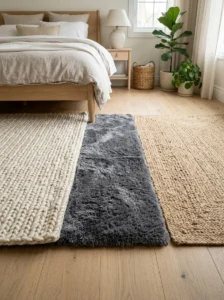
Wool is generally considered the strongest overall choice for a bedroom rug, combining genuine softness underfoot with durability and natural resilience against crushing under furniture weight, though it sits at a higher price point than many synthetic alternatives.
Natural fiber rugs like jute or sisal, popular in living rooms and other spaces for their durability and texture, are generally a poor fit for a bedroom specifically, since their coarse, scratchy texture works against the barefoot comfort that matters more in a bedroom than in most other rooms.
Synthetic and blended fibers, engineered specifically to mimic wool’s softness at a lower price point, are a reasonable choice for a budget-conscious bedroom rug, though quality varies considerably across price points within this category, and it’s worth testing a sample’s actual texture underfoot before committing to a large purchase, since synthetic softness can range from genuinely comparable to wool to noticeably inferior depending on the specific product.
Layering a Smaller Rug Over Existing Flooring or Carpet

In a bedroom that already has wall-to-wall carpet, a smaller accent rug — typically a runner or a smaller area rug at the foot of the bed — adds textural and visual interest rather than serving the primary soft-flooring function the carpet already provides. This is a different design goal than in a hard-flooring bedroom, where the rug is providing the primary softness rather than a supplementary layer, and rug choice can lean more toward visual interest and pattern in a carpeted bedroom, since the underlying carpet is already handling the comfort function.
Cleaning and Maintenance Considerations Specific to Bedroom Use

A bedroom rug accumulates less foot traffic and outdoor debris than a living room or entryway rug, but it does accumulate dust, skin cells, and allergens over time in the same way bedding does, which makes a rug that can be reasonably cleaned — either through vacuuming for a lower-pile option or professional cleaning for a higher-pile wool rug — a practical consideration alongside the softness and visual factors covered above.
Households with allergy concerns sometimes prefer a lower-pile or flat-weave bedroom rug specifically because it holds less dust and allergen buildup than a high-pile option, even though this trades away some of the barefoot softness that a higher pile provides — a genuine trade-off worth weighing against a specific household’s actual priorities and any relevant health considerations.
Key Takeaways

- Full coverage, partial coverage, and side runners are the three common approaches, trading off visual grounding, cost, and how much of the rug sits unseen beneath the bed frame itself
- A visible rug should extend at least 18 to 24 inches beyond the bed’s sides and foot to avoid reading as undersized, the same principle that applies to living room rug sizing
- High pile feels best underfoot but creates practical issues where a heavy bed frame’s legs rest directly on it — runners avoid this problem since they’re placed only where feet land, not under the furniture itself
- Wool is generally the strongest overall material choice for a bedroom rug, balancing softness and durability, though quality synthetic blends are a reasonable lower-cost alternative
- Coarse natural fiber rugs like jute or sisal, popular elsewhere in the home, are generally a poor fit for a bedroom specifically, given how much barefoot comfort matters in this room
- In an already-carpeted bedroom, a smaller accent rug serves a visual and textural role rather than the primary comfort function the existing carpet already provides

Frequently Asked Questions
Should a bedroom rug go all the way under the bed, or just around the sides? Both are common and valid approaches — full coverage under the bed provides the most visually cohesive, grounded look, while partial coverage or side runners are more economical and focus the rug’s softness specifically on the areas walked on getting in and out of bed. The right choice depends on budget, room size, and how much visual weight the household wants the rug to provide.
Does pile height actually matter for a rug under a bed frame? Yes, in a practical sense — very high pile can develop lasting indentations under a heavy bed frame’s legs and makes moving the furniture more difficult, while a lower or medium pile holds up better under sustained furniture weight. This is specifically relevant where the rug extends under the bed frame itself; runners placed only where feet land don’t face this same consideration.
What’s the best rug material for a bedroom specifically? Wool is generally considered the strongest overall choice, balancing genuine softness underfoot with durability and resistance to crushing under furniture. Quality synthetic and blended fiber rugs, engineered to approximate wool’s feel at a lower price point, are a reasonable budget alternative, though it’s worth testing a sample’s actual texture before committing to a larger purchase.
Is it worth buying a big, expensive rug if most of it will be hidden under the bed? It depends on the household’s priorities and budget — full coverage produces the most cohesive, grounded look and provides softness on every side of the bed, but a meaningful portion of that investment sits unseen. Partial coverage or runners are more budget-efficient ways to get comfort and visual interest specifically where they’re most noticed and used, without paying for a large hidden portion of rug.
Can I use jute or sisal rugs in a bedroom the way I might in a living room? Generally not recommended, despite their popularity and durability in other rooms — their coarse, scratchy texture works against the barefoot comfort that matters more in a bedroom than in most other spaces in the home. A softer wool or synthetic option is typically a better fit for a bedroom specifically, even though natural fiber rugs have real advantages in more heavily trafficked, shoe-worn areas of the house.