

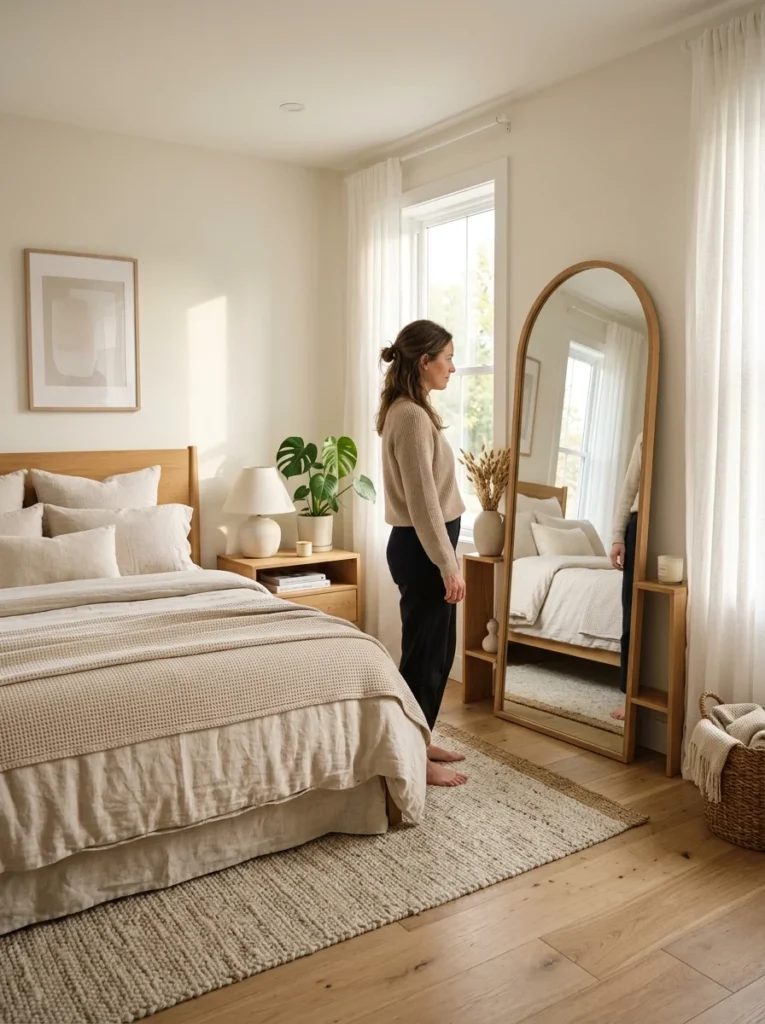
A mirror facing the bed has a long-standing bad reputation, and there are practical, non-superstitious reasons placement actually matters. Here’s what to consider before deciding where yours goes.A mirror facing the bed has a persistent reputation for being bad for sleep, most commonly associated with feng shui principles that advise against it. Whatever a household’s view on that specific tradition, there are also entirely practical, non-superstitious reasons a mirror’s placement in a bedroom can genuinely affect comfort and sleep quality, and these are worth understanding on their own terms, separate from any belief system attached to them. A mirror is a functional object with real optical properties — light reflection and visual doubling — and those properties interact with a bedroom’s specific purpose in ways that are worth considering regardless of whether the traditional feng zhui concern resonates with a given household.
Light Reflection Is the Most Concrete, Evidence-Based Concern
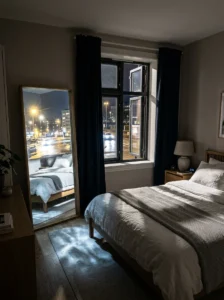
A mirror positioned to catch light from a window, a streetlight, headlights from a passing car, or even a hallway light under the door will reflect and amplify that light into the room, rather than simply letting it pass through unreflected. This is a genuinely measurable optical effect, independent of any belief system: a mirror positioned poorly relative to a bedroom’s light sources can meaningfully increase how much light disrupts sleep, particularly for stray or intermittent light sources like passing headlights or a streetlight that a curtain doesn’t fully block.
This is worth checking directly by considering what light sources exist in the room at night and where the mirror would sit relative to them — a mirror positioned to face away from windows and doorways, rather than directly toward them, avoids amplifying exactly the kind of unpredictable light exposure that’s most disruptive to sleep, since it’s the sudden, irregular flash of headlights or a hallway light — more than steady, dim ambient light — that tends to startle a sleeping or nearly-sleeping person awake.
A Mirror Facing the Bed Doubles the Room’s Visual Information
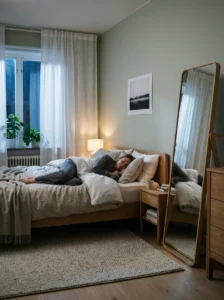
As covered in more detail elsewhere in this series regarding what makes a bedroom feel calm rather than empty, visual busyness and sensory load affect a room’s restfulness directly, and a mirror facing the bed literally doubles the amount of visual information in the room by reflecting everything on the bed’s side back into view. A room that’s otherwise calm and well-edited can feel busier than intended if a mirror is reflecting the bed, any clutter on the nightstands, and the ceiling directly back into the sleeper’s view.
This effect is more pronounced in a room already dealing with some visual clutter, since a mirror facing an untidy area doubles that clutter’s visual presence rather than simply adding a neutral reflective surface to the room. A mirror positioned to reflect a well-edited, calm area of the room — rather than the bed and nightstands directly — avoids this compounding effect while still providing the mirror’s functional benefits elsewhere in the room.
Peripheral Motion Detection During Sleep Has a Plausible Physiological Basis

Beyond the light and visual-doubling concerns, there’s a physiologically plausible reason some people report feeling unsettled by a mirror facing the bed specifically: peripheral vision remains somewhat active during lighter stages of sleep and particularly during the transition into and out of sleep, and a mirror creates the possibility of registering movement — one’s own movement, reflected back — as a separate, external motion in the peripheral field. This isn’t necessarily a large effect for most people, and plenty of households sleep perfectly well with a mirror facing the bed, but it’s a real, physiologically grounded possibility rather than a purely cultural or superstitious concern, and it may explain why the traditional advice against this placement has persisted across different cultural contexts independently.
A household that notices feeling more easily startled awake, or generally more restless, with a mirror facing the bed has a reasonable, evidence-adjacent reason to consider repositioning it, separate from whether they hold any specific belief about mirrors and sleep.
Functional Placement for Actual Mirror Use Matters Too
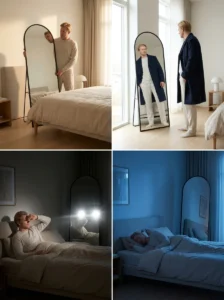
Separate from the sleep-specific concerns above, a mirror’s placement also determines how well it serves its actual daily function — dressing, grooming, a final check before leaving the room. As covered in more detail elsewhere in this series regarding bathroom lighting specifically, a mirror lit from the side rather than only from directly overhead provides more even, flattering light for the same grooming tasks that happen in a bedroom as much as a bathroom, and this is worth factoring into where a bedroom mirror is placed relative to the room’s windows and light fixtures.
A full-length mirror used primarily for checking an outfit benefits from placement with reasonable natural or artificial light and enough physical distance to see a full reflection comfortably, which sometimes competes with the light-avoidance and visual-clutter concerns above and requires a genuine trade-off decision based on which function matters more to a specific household.
Closet Door Mirrors Deserve Specific Consideration

A mirror built into a closet door is common and space-efficient, but it’s also frequently positioned without much choice in the matter, since it’s determined by where the closet itself is rather than by a deliberate mirror-placement decision. A household with a closet door mirror that happens to face the bed and is genuinely bothered by it — whether for light-reflection, visual-clutter, or simple personal preference reasons — has a few practical options: keeping the closet door closed when not in active use, adding a removable film or a curtain that can cover the mirror at night, or, for a household ready to invest in a change, replacing the mirrored closet door with a solid one and relocating a mirror elsewhere in the room.
Deciding What Matters for a Specific Household

None of the concerns above are universal — many people sleep perfectly well with a mirror facing the bed and notice no ill effect at all, and the traditional feng shui guidance against it is a belief system some households find meaningful and others don’t engage with at all. The practical, non-superstitious version of this guidance is worth taking on its own terms regardless of that belief question: checking where the room’s actual light sources are relative to the mirror, considering whether the mirror is reflecting a calm or a cluttered area of the room, and noticing directly whether sleep quality or restlessness seems to correlate with the mirror’s current position are all reasonable ways to evaluate this for an individual bedroom rather than following a rule without checking whether it applies to that household’s actual experience.

Key Takeaways
- A mirror positioned to catch light from windows, streetlights, or hallway light amplifies that light into the room, which is a genuine, measurable optical effect independent of any belief system
- A mirror facing the bed doubles the room’s visual information, which can undermine an otherwise calm, well-edited bedroom, particularly if it’s reflecting clutter rather than a tidy area
- Peripheral motion detection during lighter stages of sleep provides a physiologically plausible, non-superstitious explanation for why some people find a bed-facing mirror unsettling
- A bedroom mirror’s placement also affects its actual daily function — dressing and grooming light quality benefits from the same side-lighting principles covered elsewhere in this series regarding bathroom mirrors
- Closet door mirrors are often positioned by the closet’s location rather than deliberate choice, and a household bothered by one has practical options short of full replacement, including closing the door or covering the mirror at night
- The evidence and experience here vary by household — checking a specific bedroom’s actual light sources and noticing whether sleep quality correlates with the mirror’s position is more useful than following general guidance without testing it
Frequently Asked Questions
Is it true that a mirror facing the bed is bad for sleep, or is that just superstition? There’s a traditional feng shui belief against it, but there are also separate, practical, non-superstitious reasons worth considering on their own terms — a mirror can amplify disruptive light sources like passing headlights or a streetlight, and it doubles the room’s visual information by reflecting the bed and nightstand area back into view. Whether either of these actually affects a specific household’s sleep varies, and it’s worth checking directly rather than assuming either the traditional concern or its dismissal applies universally.
What should I do if my closet door mirror faces my bed and I don’t want to replace the door? Keeping the closet door closed when not in active use is the simplest fix, since it removes the mirror’s exposure to the room without any purchase or installation. A removable frosted film or a small curtain that can be drawn over the mirror at night are other low-cost options for a household that wants the mirror accessible during the day but covered while sleeping.
Does mirror placement actually affect how well a mirror functions for dressing, separate from the sleep concerns? Yes — a mirror lit from the side rather than only from directly overhead provides more even, flattering light for dressing and grooming, the same principle covered in more detail elsewhere in this series regarding bathroom mirror lighting specifically. This is worth weighing alongside the sleep-related placement concerns, since the ideal placement for daytime function and the ideal placement for minimizing nighttime light and visual disruption don’t always align.
Is there real science behind mirrors affecting sleep, or is this entirely anecdotal? There isn’t extensive direct research specifically on mirrors and sleep, but the underlying mechanisms — light amplification and reflection, and some retained peripheral motion sensitivity during lighter sleep stages — are both grounded in established, broader physiological and optical principles rather than being purely anecdotal or cultural. The specific degree to which these mechanisms affect any individual’s sleep varies and is worth evaluating personally rather than assuming a universal effect.
Should I just avoid having a mirror facing the bed to be safe? It’s a reasonable, low-cost precaution if repositioning is easy to do, but it’s not necessary for every household — many people notice no effect at all. If repositioning the mirror is simple, doing so removes a variable worth eliminating; if it would require significant furniture rearrangement or isn’t practical given the room’s layout, checking for light-reflection issues specifically and addressing those directly (better curtains, for instance) may resolve most of the practical concern without needing to move the mirror itself.