


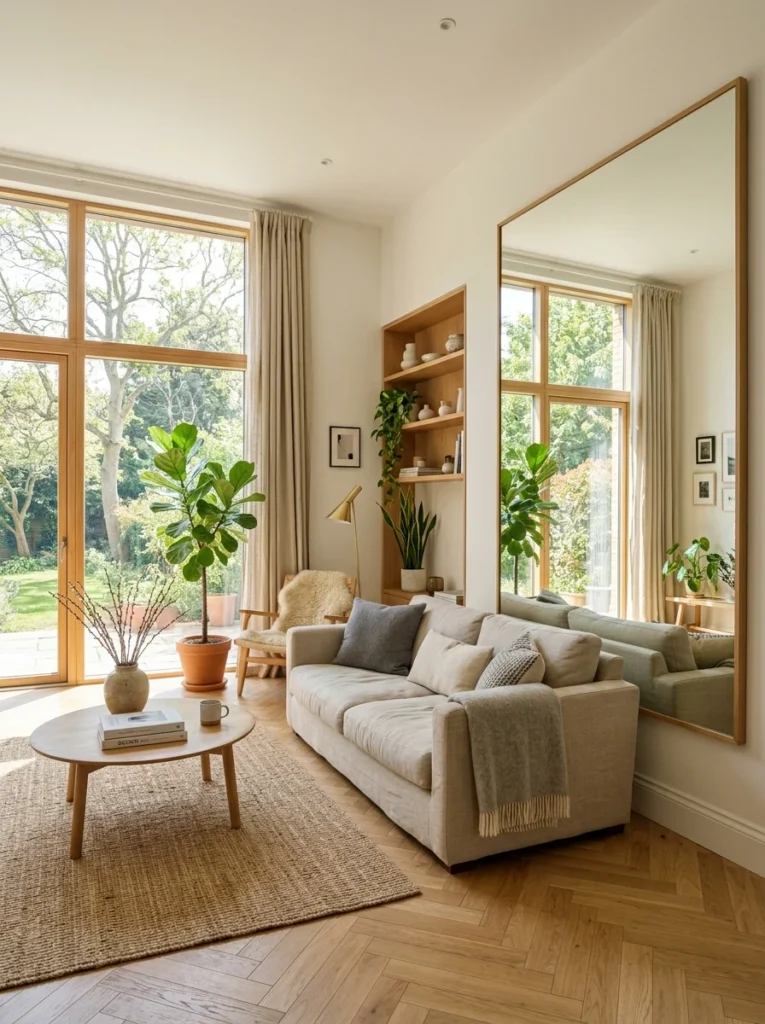
Several rooms in this series reference mirrors making a space feel larger without fully explaining the mechanism. Here’s the complete, practical breakdown of how and where it actually works.
The principle that mirrors make a room feel larger comes up throughout this series — in bathrooms, bedrooms, hallways, and entryways — usually as a brief supporting point in a discussion about something else. It’s worth explaining fully and on its own terms, since the effect isn’t simply “mirrors are reflective, therefore rooms feel bigger.” It’s a specific set of mechanisms — light amplification, visual doubling, and depth illusion — that work under certain placement conditions and fail under others, and knowing the difference is what separates a mirror that genuinely opens up a room from one that’s simply hanging there.
The Mechanism Is Light Amplification, Not Just Reflection
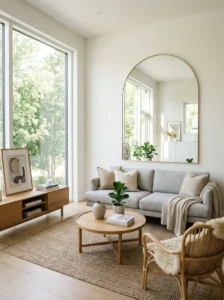
A mirror’s primary functional contribution to a room’s sense of spaciousness is light amplification — bouncing available light, whether natural or artificial, back into the room rather than letting it be absorbed by a wall. A room with more visible, evenly distributed light generally reads as more spacious than an identically sized room with the same total light output concentrated or partially absorbed, since brightness itself is a meaningful factor in how expansive a space feels, independent of its actual square footage.
This means a mirror’s placement relative to the room’s actual light sources determines how much of this effect is achieved. A mirror positioned to directly face a window captures and reflects the most light back into the room, maximizing the amplification effect, while a mirror positioned facing an interior wall with no direct light source to capture contributes far less to the room’s overall brightness, even though it’s still providing some visual depth effect through reflection.
Placement Relative to Windows Is the Single Most Important Variable
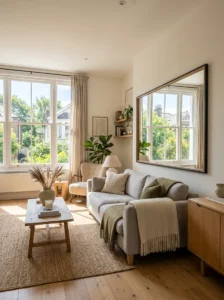
Directly opposite a window is the single most effective placement for a mirror intended to maximize a room’s sense of light and spaciousness, since this position captures the most direct light and reflects it back across the room’s full depth, effectively doubling the room’s apparent light exposure.
Perpendicular to a window — on a side wall, rather than directly opposite — is the second most effective placement, capturing meaningful light while also creating a sense of depth along the room’s width rather than only its length, and this placement is often more practical in rooms where the wall directly opposite the window is already occupied by furniture, doorways, or other fixed elements.
A mirror positioned with its back to the primary light source — reflecting only the room’s interior, away from the window — contributes the least to the light-amplification effect, though it still provides some visual depth and doubling benefit through reflecting whatever it does face, which may still be worthwhile in a room without a strong single light source to capture in the first place.
Size and Scale Determine How Strong the Effect Actually Is
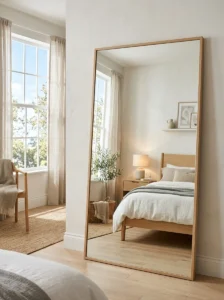
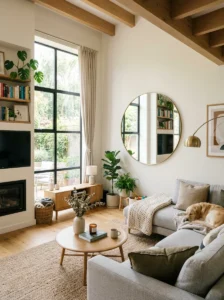
A small mirror, regardless of how well-placed, produces a proportionally small version of this effect — the room-expanding benefit scales directly with the mirror’s surface area, since a larger mirror captures and reflects more light and more of the room’s visual depth than a small one. This is why a single generously sized mirror generally outperforms several small decorative mirrors for the specific goal of making a room feel larger, even though multiple smaller mirrors might serve other decorative purposes well.
A full-length or oversized mirror leaning against a wall, rather than a smaller mirror centered at a standard hanging height, captures floor-to-near-ceiling reflection, which contributes to a sense of vertical spaciousness in addition to the light and depth effects a smaller, higher-mounted mirror provides on its own.
What the Mirror Reflects Matters as Much as Where It’s Placed
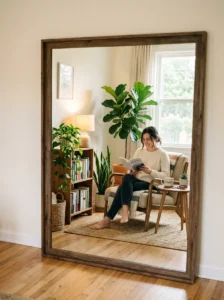
A mirror reflecting a calm, tidy, visually appealing area of the room amplifies that positive visual content, while a mirror reflecting clutter, an unattractive view, or a chaotic area doubles that negative visual content just as effectively — the amplification mechanism doesn’t discriminate between what’s being reflected, which means mirror placement needs to account for what’s actually in the reflection, not just where the light and depth benefits are strongest.
This is a genuine trade-off worth checking directly before finalizing placement: standing where the mirror will be viewed from and confirming what it actually reflects — the room’s best angle, a considered vignette, an appealing view through a window — rather than assuming the placement that’s technically optimal for light and depth is automatically the right choice regardless of its actual reflected content.
Groupings and Multiple Mirrors Create a Different Effect Than a Single Large Piece
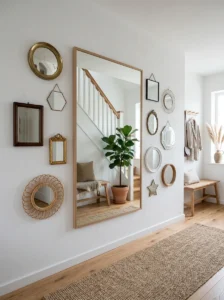
A cluster or gallery-style grouping of multiple smaller mirrors, rather than one large piece, creates a more fragmented, decorative visual effect — genuinely appealing in its own right, and useful in a hallway or gallery-wall context covered elsewhere in this series, but it doesn’t produce the same singular, strong sense of depth and light amplification that one well-placed, appropriately scaled mirror does. A household specifically prioritizing the room-expanding function is generally better served by a single larger mirror than by a decorative grouping of smaller ones, even though the grouping may have real aesthetic merit for other reasons.
Frame Style Affects the Perceived Boundary of the Reflection
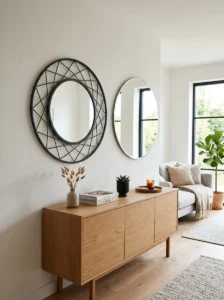
A frameless or minimally framed mirror creates a less distinct boundary between the actual room and the reflected space, which tends to enhance the illusion of continuous, expanded space more effectively than a heavily and ornately framed mirror, where the frame itself draws visual attention to the mirror as a distinct object rather than allowing the reflection to blend more seamlessly into the room’s actual visual field.
This doesn’t mean framed mirrors are the wrong choice — a substantial, well-chosen frame contributes real decorative value and can be the right choice when the mirror is meant to be a visible design statement in its own right, rather than purely a spaciousness tool — but it’s worth recognizing that frame prominence is a trade-off against the purely space-expanding function specifically.
Applying This Across the Rooms Covered Elsewhere in This Series
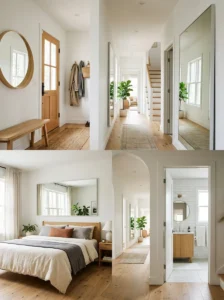
In a windowless bathroom, covered in more detail elsewhere in this series, a mirror’s placement opposite the primary light fixture rather than a window follows the same underlying principle — capturing whatever light source exists and reflecting it back into the room, since the light-amplification mechanism works the same way regardless of whether the captured light is natural or artificial.
In a bedroom, the placement considerations covered elsewhere in this series regarding mirror placement relative to the bed add a second layer of concern — sleep quality and light disruption — on top of the spaciousness principles covered here, which sometimes means the technically optimal placement for spaciousness isn’t the right choice once the bedroom-specific sleep considerations are factored in as well.
In a narrow hallway or a small entryway, both covered elsewhere in this series, the light-amplification and visual-doubling effects described here matter disproportionately, since these are precisely the spaces where a lack of natural light and a constrained sense of space are both actively working against the room, making mirror placement a particularly high-leverage tool in these specific contexts relative to a larger, already well-lit room.
Key Takeaways
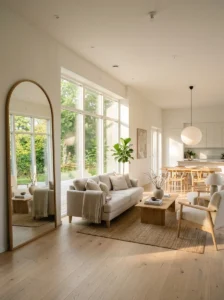
- A mirror’s room-expanding effect comes primarily from light amplification — bouncing available light back into the room — which means placement relative to actual light sources is the most important variable
- Directly opposite a window is the single most effective placement for maximizing this effect; perpendicular to a window is the next most effective when the opposite wall isn’t available
- The effect scales directly with mirror size — one generously sized mirror generally outperforms several small decorative ones for the specific goal of making a room feel larger
- What a mirror actually reflects matters as much as its placement, since the amplification effect applies equally to clutter or an unattractive view as it does to a calm, appealing one
- A single large mirror produces a stronger sense of depth and light than a gallery-style grouping of smaller mirrors, even though the grouping has its own separate decorative merit
- Frameless or minimally framed mirrors enhance the illusion of expanded space more than heavily framed ones, which draw attention to the mirror as an object rather than allowing the reflection to blend into the room
Frequently Asked Questions
Where’s the single best place to put a mirror if I want to make a room feel bigger? Directly opposite the room’s main window is generally the most effective placement, since it captures the most available natural light and reflects it back across the room’s full depth. Where that wall isn’t available, a perpendicular placement relative to the window is the next most effective option.
Does mirror size actually matter, or is any mirror better than none? Size matters significantly — the room-expanding effect scales with the mirror’s surface area, so a small decorative mirror produces a proportionally small version of the effect. A single generously sized mirror is generally more effective for this specific goal than several small mirrors, even if the smaller mirrors serve other decorative purposes well.
Is it bad to put a mirror somewhere that reflects clutter or a messy area? It works against the intended effect, since a mirror amplifies whatever it reflects, whether that’s a calm, appealing vignette or genuine clutter and mess. It’s worth checking what a mirror will actually reflect from its intended viewing position before finalizing placement, rather than assuming any reflective surface automatically improves the room.
Are multiple small mirrors as effective as one large mirror for making a room feel bigger? Not as effective for this specific function — a grouping of smaller mirrors creates a more decorative, fragmented visual effect rather than the strong, singular sense of depth and light amplification a well-placed, appropriately scaled larger mirror provides. Groupings have real aesthetic value in other contexts, like a hallway gallery wall, but a single larger mirror is generally the better choice when spaciousness is the primary goal.
Does the mirror’s frame style affect how well it makes a room feel larger? Yes, to a meaningful degree — a frameless or minimally framed mirror allows the reflection to blend more seamlessly into the room’s actual visual field, enhancing the illusion of continuous space, while a heavily framed mirror draws more attention to itself as a distinct decorative object, which works somewhat against the pure spaciousness effect even though it may be the right aesthetic choice for other reasons.