

A dining table that rarely hosts an actual meal still needs to look intentional and stay genuinely usable. Here’s how to style one that works both ways.
A dining table that mostly serves as a mail-sorting surface, a temporary desk, a spot for kids’ homework, or simply an empty, awkwardly large piece of furniture between the occasional holiday meal has a specific styling challenge that’s different from the coffee table staging problem covered elsewhere in this series. A coffee table is used constantly, in a room people occupy daily, and its styling has to survive genuine daily use. A rarely-used dining table has almost the opposite problem: it needs to look considered despite spending most of its time unused for its intended purpose, while still being genuinely ready to actually host a meal on the occasions it’s called on to do so, without a lengthy clearing process standing in the way.
Acknowledge the Table’s Actual Daily Function Before Styling Around It
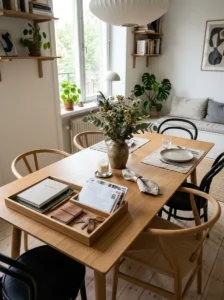
A dining table in a household that eats there rarely is almost never actually empty in daily life — it’s typically serving as informal storage for mail, school papers, keys, or whatever else needs a flat surface and doesn’t have another home, precisely because a large, otherwise-unused table is a natural landing spot for exactly this kind of accumulation. Styling advice that ignores this reality and simply describes an idealized, permanently clear tablescape sets up the same kind of failure covered elsewhere in this series regarding coffee table styling that doesn’t account for genuine daily use — the styled version gets pushed aside within days because it was never designed to coexist with the table’s actual function.
The more sustainable approach designates the table’s actual daily role explicitly, rather than pretending it doesn’t have one — if the table is genuinely serving as a mail-sorting or homework surface most days, a defined, contained zone for that function (a tray or organizer at one end, applying the same containment principle covered throughout this series) coexists with a styled centerpiece rather than competing against an unrealistic fully-clear ideal.
A Centerpiece Should Be Genuinely, Quickly Removable
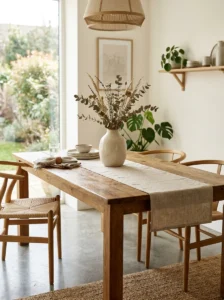
Since the table’s actual purpose is occasional real use, not permanent display, the centerpiece and any styling on it needs to be quick and easy to clear entirely — nothing so elaborate, fragile, or complicated to disassemble that setting up for an actual meal becomes a genuine chore that discourages using the table for its intended purpose in the first place.
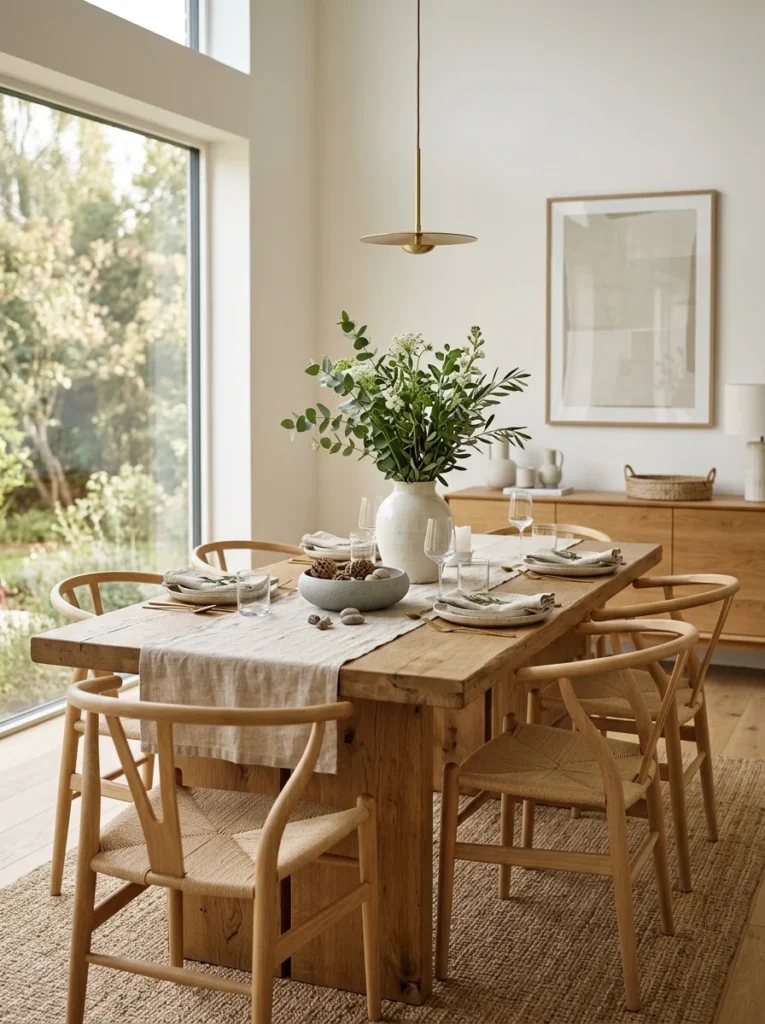
A single substantial element — a large bowl, a considered vase, a runner with a simple grouped arrangement — that can be lifted and moved to a sideboard, console, or counter in one motion is more practical than an elaborate, multi-piece styled arrangement that takes real time and care to disassemble and reassemble each time the table is actually needed for a meal. This is a direct parallel to the coffee table principle covered elsewhere in this series about leaving genuine negative space for actual use — here, the “use” being planned for is occasional but real, and the styling needs to accommodate it without friction.
Runners Work Better Than Full Tablecloths for a Dual-Purpose Table
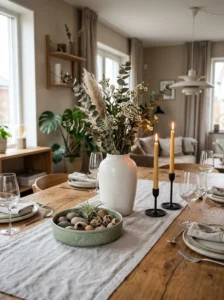
A table runner, rather than a full tablecloth, allows a styled centerpiece to sit along the table’s center while leaving the table’s actual surface visible and usable at either end — for the mail, the homework, or whatever the table’s genuine daily function happens to be — without needing to clear an entire tablecloth’s worth of surface to access that function.
This also makes the quick-clear transition to an actual meal considerably faster than a full tablecloth setup would, since a runner with a centered arrangement can be lifted as a single unit, while a full tablecloth typically requires clearing everything on top of it before the cloth itself can be removed or the table can be reset for dining.
Height Variation and Scale Appropriate to an Occasionally-Viewed Surface
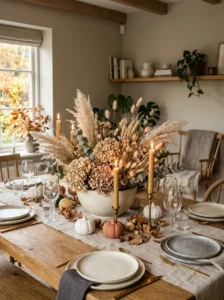
As covered throughout this series regarding shelving and coffee table styling, height variation between a few elements — a taller vase, a lower bowl or grouped candles — creates visual interest more effectively than a flat, uniform arrangement, and this applies to a dining table centerpiece as directly as it does to any other styled surface.
Scale matters more on a dining table than on a coffee table, given the larger surface area involved — a small, modest arrangement can look lost in the middle of a genuinely large dining table, the same undersized-relative-to-surface problem covered elsewhere in this series regarding art on a large wall. A centerpiece proportioned to the table’s actual length, rather than a single small object that reads as an afterthought on a large surface, produces a more resolved look, even on a table that’s rarely used for its primary function.
Seasonal and Occasion-Based Styling Is Easier With a Table That’s Already Minimally Used

A table that’s genuinely used for meals daily has less flexibility for elaborate seasonal styling, since any styled centerpiece needs to be cleared and reset constantly. A table used for meals only occasionally has more room to support a more seasonal or occasion-specific centerpiece that stays in place for weeks at a time between actual uses, since it’s not competing with daily mealtime clearing the way a primary-use dining table would.
This is a genuine advantage worth taking advantage of rather than treating the table’s infrequent use purely as a problem — a more elaborate, longer-lasting seasonal arrangement (a substantial dried or preserved botanical display, for instance) is more practical on a table that’s cleared for actual use only occasionally than it would be on a table needing to be reset for dinner every evening.
The Quick-Clear Test as a Practical Design Constraint
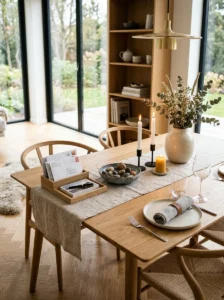
A useful practical test when finalizing a styled arrangement for an infrequently-used dining table: could this be fully cleared and the table made genuinely ready for a meal in under a few minutes, without needing to find storage for delicate or complicated pieces mid-process? An arrangement that fails this test — requiring careful disassembly, individual wrapping or storage of fragile pieces, or simply taking too long — works against the table’s actual occasional function and makes it more likely the table simply won’t get used for real meals when the opportunity arises, since the friction of clearing the styling becomes a genuine deterrent.
This test is worth applying before finalizing any centerpiece or styling choice specifically for a dining table with this dual-purpose reality, since it’s the detail most likely to be overlooked when styling is approached purely from a visual-composition standpoint without considering the table’s actual, if infrequent, functional requirement.
What This Looks Like in Practice
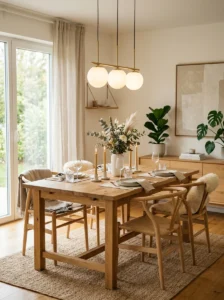
A workable version of this approach: a runner running most of the table’s length, a single substantial centerpiece element sized appropriately for the table’s scale, one or two lower flanking elements adding height variation without excessive fragility, and a contained tray or organizer at one end absorbing whatever daily-use function the table actually serves — mail, keys, homework — kept visually separate from the centerpiece so the two functions coexist without either one undermining the other.
Key Takeaways
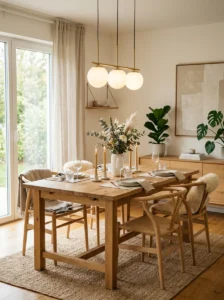
- A rarely-used dining table usually has a genuine informal daily function — mail, homework, general surface storage — and styling that ignores this reality tends to be quickly abandoned or pushed aside
- A centerpiece that can be lifted and cleared in one motion supports the table’s occasional real use far better than an elaborate, multi-piece arrangement that’s slow to disassemble
- Runners work better than full tablecloths for a dual-purpose table, since they leave the table’s ends genuinely usable without requiring a full surface clear
- Centerpiece scale should match the table’s actual length — a small, modest arrangement looks lost on a genuinely large surface, similar to undersized art on a large wall
- A table used for actual meals only occasionally has more flexibility for elaborate, longer-lasting seasonal styling than a table needing to be cleared for dinner every night
- The practical “quick-clear” test — can this be cleared for a real meal in a few minutes without hassle — should guide any styling choice for a table with this dual-purpose reality
Frequently Asked Questions
Is it okay for my dining table to have mail or other clutter on it if it’s not being used for meals? It’s realistic and manageable if that daily-use function is contained and kept visually separate from the styled centerpiece — a tray or organizer at one end, for instance — rather than left as loose, scattered accumulation across the whole surface. Acknowledging and containing this function tends to work better long-term than styling that ignores it entirely.
Should I use a full tablecloth or a runner on a table I don’t eat at often? A runner is generally more practical, since it leaves the table’s ends visible and usable for the table’s actual daily function while still supporting a styled centerpiece along the center. A full tablecloth requires clearing the entire surface to access it, which works against a dual-purpose table’s genuine daily use.
How elaborate can my centerpiece be if I only actually use the table a few times a year? More elaborate than a daily-use table could support, since it’s not competing with regular mealtime clearing — but it should still pass a practical “quick-clear” test, meaning it can genuinely be moved aside without hassle when the table is actually needed. An arrangement too delicate or complicated to clear quickly discourages actual use of the table when the occasion arises.
What’s the biggest styling mistake people make with a rarely-used dining table? Choosing a centerpiece too small for the table’s actual scale, which reads as an afterthought on a genuinely large surface, or choosing an arrangement so elaborate and fragile that clearing it for an actual meal becomes a genuine chore, discouraging the table’s real use. Both mistakes come from styling the table purely as a visual object without accounting for its actual, if occasional, function.
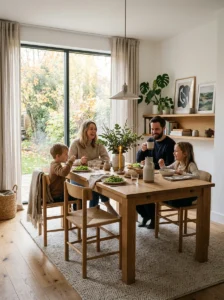
Can I still use my dining table for homework or work if I want it to look nice most of the time? Yes, and this is a very common and reasonable dual function — containing that daily-use activity within a defined zone or organizer, kept separate from a styled centerpiece elsewhere on the table, allows both functions to coexist without either one undermining the other.