
Growing out a bad haircut is rarely a matter of just waiting it out — the strategy used during the growing-out period determines whether it looks intentional or genuinely awkward. Here’s what actually works.
Growing out a bad haircut is often approached as a passive waiting game — avoid the scissors, endure the awkward months, eventually arrive at a better length. This approach works eventually, but it’s also the slowest and most visually difficult path through the process, since hair doesn’t grow evenly or predictably enough to simply look progressively better with no intervention at all. A more strategic approach, involving periodic small trims and specific transitional styling choices, produces a considerably more manageable and better-looking growing-out period than pure avoidance does.
Why Complete Avoidance of the Salon Actually Slows Down a Good Result
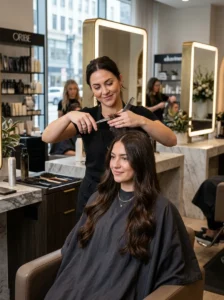
The instinct to avoid any haircut at all while growing out a bad one is understandable but usually counterproductive, since a haircut that was uneven, poorly shaped, or badly layered to begin with doesn’t correct itself simply through growth — the original cut’s problems (choppy layers, an asymmetrical line, a shape that doesn’t suit the person) generally persist and sometimes become more visually obvious as hair grows, rather than gradually resolving on their own.
Small, strategic trims — sometimes called “shape maintenance” trims — that remove minimal length while correcting the most problematic elements of the original cut (blending harsh layer lines, correcting asymmetry, removing split ends before they travel further up the hair shaft) allow hair to grow while looking progressively more intentional, rather than growing out a fundamentally flawed shape unchanged.
Communicating Clearly With a Stylist During the Growing-Out Process

A stylist appointment during a growing-out period requires different communication than a typical haircut appointment, since the goal is explicitly minimal length removal focused on shape correction rather than a standard cut — being direct about this goal (requesting a “shape-only trim” or explaining the specific growing-out objective) helps avoid a stylist defaulting to a more standard cut that removes more length than is actually wanted.
Bringing a clear photo reference of the eventual target length and style, even though it won’t be achieved in a single visit, helps a stylist understand the trajectory being aimed for and make trim decisions during the growing-out period that support that eventual goal, rather than trims that look fine in isolation but don’t actually build toward the intended end result.
Layering Adjustments Can Ease the Awkward Stage Considerably
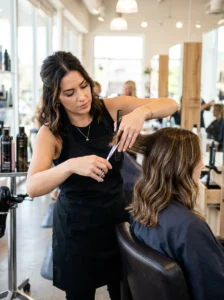
A common source of visible awkwardness during growing out is layers that were cut short and now sit at an in-between length that doesn’t blend well with the rest of the hair — a stylist can often adjust the layering structure itself during a growing-out trim (softening harsh transitions between length sections, blending rather than removing the problematic layers entirely) which addresses the visual awkwardness without requiring the overall length to be sacrificed.
This is particularly relevant for growing out a cut with short, face-framing layers or a heavily layered style into a longer, more uniform length, since the transitional period where short layers and longer lengths coexist is often the most visually challenging phase, and targeted blending trims can meaningfully ease this specific transition.
Transitional Styling Techniques That Work With the Awkward Stage Rather Than Against It
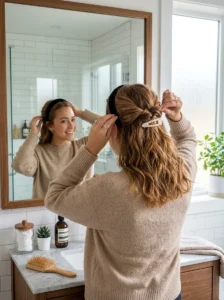
Accessories — headbands, clips, scarves — genuinely help manage the specific awkward-length stages where hair is too long for some styles and too short for others, by controlling flyaways and shorter pieces that don’t yet blend smoothly with the rest of the hair, and they’re worth treating as a legitimate styling strategy during this period rather than a last resort.
Updos and half-up styles are particularly useful during a growing-out period, since they can incorporate shorter, awkward-length pieces into the overall style rather than leaving them to hang separately and visibly at an in-between length — a low bun or a braided style, for instance, can absorb pieces that would otherwise stick out or fall at an inconvenient length if left down.
Texture and wave, whether natural or created through styling, generally disguises uneven length and blending issues more effectively than a very sleek, straight style does, since texture breaks up the visual line where different length sections meet, making transitions less visually obvious than they’d be in a smoother, more graphic silhouette.
Product Strategies for Managing the Specific Challenges of Growing-Out Hair
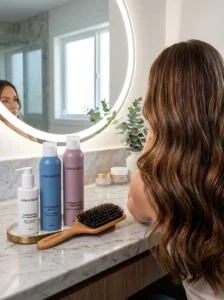
A lightweight, flexible-hold styling product helps manage shorter face-framing pieces or awkward layers without the stiffness that a stronger-hold product can create, which tends to make shorter transitional pieces look more deliberately styled rather than simply stuck out at an inconvenient length.
A texturizing spray or similar product, used specifically on the shorter or more awkward sections, helps those pieces blend into an updo or half-up style more successfully, since added texture gives the styling product something to grip rather than sliding out of a very smooth, freshly grown-out section.
Understanding the Realistic Timeline Involved

Hair grows at a widely cited average rate of roughly half an inch per month, though this varies by individual, which means growing out even a few inches of unwanted length or correcting a significant cut mistake is realistically a multi-month process, and setting this expectation clearly at the outset avoids the frustration that comes from expecting a faster timeline than hair growth actually allows.
The specific awkward-stage timeline also depends heavily on the original cut’s severity and the hair’s texture — a very short, choppy cut generally takes longer to grow into a cohesive longer style than a moderately uneven cut does, and curlier hair textures sometimes experience a more pronounced awkward stage during certain length transitions than straighter hair, given how curl pattern affects how different lengths visually interact with each other.
Reframing the Growing-Out Period as an Active Process Rather Than Passive Waiting

Approaching a growing-out period with a specific plan — scheduled shape-maintenance trims, a rotation of transitional styling techniques, realistic timeline expectations — produces a meaningfully more manageable experience than treating the entire period as something to simply endure until it’s over, since an active approach provides visible, incremental improvement and specific tools to manage the more difficult stages, rather than leaving the entire outcome to unmanaged, passive growth.
Key Takeaways

- Complete avoidance of the salon while growing out a bad haircut often slows down a good result, since a poorly shaped original cut doesn’t correct itself through growth alone
- Small, strategic shape-maintenance trims that remove minimal length while correcting problematic elements — asymmetry, harsh layer lines — allow hair to look progressively more intentional throughout the growing-out process
- Clear communication with a stylist about the specific growing-out goal, including a reference photo of the eventual target, helps ensure trims build toward that goal rather than simply looking fine in isolation
- Accessories, updos, and half-up styles are legitimate, effective strategies for managing awkward-length transitional stages, not last-resort options
- Texture and wave generally disguise uneven length and blending issues more effectively than a very sleek, straight style during a growing-out period
- Hair grows at roughly half an inch per month on average, which means growing out a significant length or correcting a substantial cut mistake is realistically a multi-month process worth planning for rather than rushing

Frequently Asked Questions
Should I really get trims while I’m trying to grow my hair out longer? Yes, generally — small, strategic shape-maintenance trims that remove minimal length while correcting problem areas like harsh layers or asymmetry help hair look progressively more intentional throughout the process, rather than growing out a fundamentally flawed shape unchanged. Complete avoidance of the salon often actually slows down achieving a genuinely good-looking result.
How do I ask for a trim without losing the length I’m trying to grow out? Be direct with your stylist about the specific goal — requesting a “shape-only” or “dusting” trim focused on correcting problem areas rather than a standard cut, and bringing a reference photo of your eventual target length and style, helps ensure the stylist understands you want minimal length removal focused on correction rather than a typical haircut.
What’s the fastest way to get through the awkward in-between length stage? There’s no way to speed up actual hair growth, but accessories, updos, half-up styles, and added texture through styling products all meaningfully ease the visual awkwardness of transitional lengths, allowing the growing-out period to look more intentional and managed in the meantime rather than simply waiting it out.
How long does it actually take to grow out a bad haircut? Hair grows at roughly half an inch per month on average, so growing out even a few inches of unwanted length is realistically a multi-month process, and a more significant cut correction can take considerably longer. The exact timeline also depends on the original cut’s severity and hair texture, with curlier textures sometimes experiencing a more pronounced awkward stage during certain transitions.
Does texture or curl pattern affect how difficult the growing-out process is? Yes — curlier hair textures sometimes have a more visible awkward stage during certain length transitions, given how curl pattern affects how different lengths interact visually, though texture and wave in general (whether natural or styled) tend to disguise uneven length and blending issues more effectively than very sleek, straight styles do.