

Fine hair and thin hair are often treated as the same problem, and the volume advice for one frequently makes the other worse. Here’s what’s actually happening with fine hair specifically, and what genuinely helps.
Fine hair and thin hair get conflated constantly, and this confusion is a major reason so much volume advice doesn’t actually work for the people trying it — fine hair refers to the diameter of each individual strand, while thin hair (or low density) refers to how many strands exist per square inch of scalp. A person can have fine hair that’s also high density (many thin strands, which can actually hold quite a lot of volume with the right approach) or coarse hair that’s low density (fewer strands, but each one thicker). Understanding which situation actually applies determines which volume strategies will work and which will just add weight without helping.
Fine Hair’s Actual Structural Problem Is Weight Sensitivity, Not a Lack of Hair
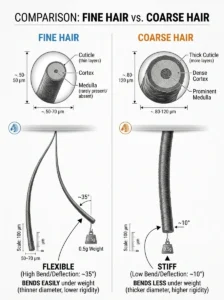
A single fine hair strand has a smaller diameter than a coarse or medium strand, which means it has less inherent structural rigidity and is more easily weighed down by product, natural oil, or even its own length, compared to a thicker strand carrying the same amount of weight. This is the core mechanical reason fine hair struggles to hold volume: it’s not necessarily that there’s too little hair, but that each individual strand has less capacity to resist being weighed down and pulled flat, which means volume strategies need to work with this weight sensitivity rather than ignoring it.
This is why heavy styling products — rich creams, thick oils, heavy-hold gels — that work well on coarse or thick hair frequently make fine hair look flatter and greasier rather than more voluminous, since the product’s weight exceeds what fine strands can structurally support without collapsing under it.
Root Lift Matters More Than Length or Overall Volume Product

Volume is primarily created and lost at the roots, not throughout the length of the hair, which means styling techniques and products focused specifically on the root area produce more noticeable, lasting volume than products applied throughout the length, where they add weight without addressing where volume actually needs to be created.
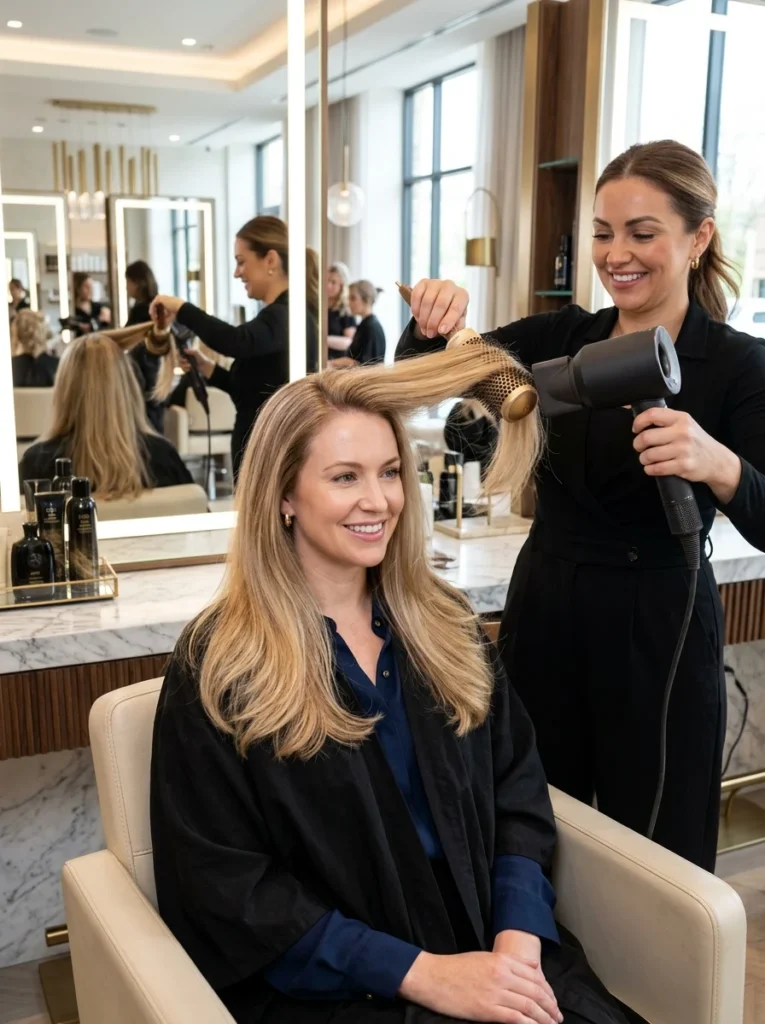
Blow-drying with the head tipped upside down, or at minimum directing airflow against the direction of hair growth at the roots specifically, lifts the hair away from the scalp while it dries, which creates a genuine structural lift at the root that styling product alone, applied after the hair is already dry and lying flat, generally can’t replicate.
Root-clipping — sectioning hair and clipping it away from the scalp at the roots while it air-dries or while other sections are being blow-dried — is a low-effort technique that achieves a similar root-lift effect without requiring active blow-drying the entire time, and it’s a particularly useful technique for someone without the time or interest in a full volumizing blow-dry routine every time.
Product Buildup Disproportionately Affects Fine Hair

Because fine hair has less structural capacity to carry weight, product buildup — the gradual accumulation of styling product, natural oil, and residue from hair care products that aren’t fully rinsed out — affects fine hair’s appearance more quickly and more noticeably than it affects coarser or thicker hair, which can tolerate more buildup before it becomes visually apparent as flatness or greasiness.
A clarifying shampoo, used periodically (though not so frequently that it strips necessary moisture, since overuse creates its own problems) removes this buildup and is a specifically valuable tool for fine hair given how much more sensitive it is to the weight this buildup adds compared to other hair types.
Using less product overall, rather than trying to compensate for flatness with more volumizing product, is often the more effective strategy for fine hair, since additional product frequently adds more weight than volumizing benefit once a certain threshold is exceeded — a small amount of the right product, applied specifically at the roots rather than throughout the length, generally outperforms a larger quantity applied broadly.
Product Formulation Matters More for Fine Hair Than for Other Textures

Lightweight, water-based volumizing products — mousses, root-lifting sprays, lightweight dry shampoos used proactively at the roots rather than purely reactively between washes — are specifically formulated to add lift and texture without the weight that cream or oil-based products carry, which makes them considerably better suited to fine hair’s weight sensitivity.
Ingredient lists heavy on oils, silicones, and rich emollients — genuinely beneficial for coarser, drier, or more textured hair types — tend to work against fine hair’s volume specifically, even when the product is marketed as a general “volumizing” product, since marketing claims don’t always account for how a specific formulation interacts with fine hair’s particular weight sensitivity.
Dry shampoo, used specifically at the roots rather than throughout the hair, serves a dual function for fine hair — absorbing the oil that weighs hair down while also adding a slight roughening texture at the root that helps create the appearance of lift, which is part of why dry shampoo is frequently recommended as a volumizing tool for fine hair specifically, beyond its more commonly known oil-absorbing function.
Cutting Technique Affects How Fine Hair Behaves Day to Day

Heavy layering, cut throughout the length of fine hair, can sometimes reduce rather than add perceived volume, since removing weight and bulk from the ends can leave fine hair with less structural support at the length, causing it to lie flatter than a blunter cut with less internal layering would.
A blunt or minimally layered cut, which keeps more weight and density concentrated at the same length rather than removing it through heavy layering, often creates the appearance of a fuller, denser style for fine hair, since the uniform, weighted ends provide a visual thickness that heavily layered, thinned-out ends don’t achieve.
This is worth discussing directly with a stylist familiar with fine hair specifically, since layering techniques that work well for thick or coarse hair — genuinely reducing bulk and adding movement — can have the opposite of the intended effect on fine hair, where there’s less bulk to reduce in the first place and layering primarily removes the weight that was providing apparent fullness.
Setting Realistic Expectations for What “Volume” Actually Means for Fine Hair

Fine hair, even with an optimized routine addressing root lift, product choice, and cutting technique, generally won’t achieve the same kind of dense, thick volume that naturally coarse or high-density hair produces without any specific effort — the realistic goal for fine hair is maximizing the volume that’s structurally achievable given the hair’s actual diameter and density, not replicating a fundamentally different hair type’s natural volume.
This distinction matters because it sets a more achievable, less frustrating target — a well-executed fine-hair volume routine produces a genuinely noticeable, satisfying improvement over the hair’s natural flat state, even though the end result will still read as fine hair styled well, rather than transforming into an entirely different hair texture and density.
Key Takeaways

- Fine hair (thin strand diameter) and thin hair (low density) are different, often-confused conditions, and understanding which actually applies determines which volume strategies will genuinely help
- Fine hair’s core issue is weight sensitivity — individual strands have less structural capacity to resist being weighed down by product, oil, or their own length, compared to coarser strands
- Volume is created and lost primarily at the roots, which means root-focused techniques (upside-down blow-drying, root-clipping) produce more noticeable results than volume products applied throughout the length
- Product buildup affects fine hair’s appearance more quickly than other hair types, making periodic clarifying shampoo use and generally lighter product application particularly valuable
- Lightweight, water-based formulations (mousses, root sprays, dry shampoo used at the roots) work with fine hair’s weight sensitivity, while oil and silicone-heavy products, even marketed as volumizing, often work against it
- Heavy layering can sometimes reduce rather than add perceived volume in fine hair, since it removes the weight and density that were providing apparent fullness — a blunter cut often creates a fuller-looking result

Frequently Asked Questions
Is my hair actually fine, or is it just thin? Fine refers to the diameter of each individual strand, while thin (or low density) refers to how many strands you have per square inch of scalp — these are genuinely different conditions, and a simple way to check is comparing a single strand of your hair to a sewing thread; if it’s noticeably thinner than the thread, your hair is likely fine, regardless of how many strands you actually have.
Why does volumizing product make my fine hair look greasy instead of fuller? This usually means the product’s weight is exceeding what your fine strands can structurally support, or that you’re using too much of it, or applying it throughout the length rather than concentrating it at the roots where volume actually needs to be created. Switching to a lighter, water-based formulation and applying it specifically at the roots, in a smaller quantity, generally produces better results than a heavier product applied broadly.
Should I get layers cut into my fine hair for more volume? Not necessarily — heavy layering can actually reduce perceived volume in fine hair by removing the weight and density that were providing apparent fullness, and a blunter, less heavily layered cut often creates a fuller-looking result for fine hair specifically. This is worth discussing directly with your stylist, since standard layering advice is often calibrated for thicker or coarser hair types.
How often should I use clarifying shampoo if I have fine hair? Periodically rather than at every wash, since fine hair is particularly sensitive to product buildup but overusing a clarifying shampoo can strip necessary moisture and create its own problems. A general guideline is every one to two weeks, though this varies based on how much product you use and your hair’s individual response.
Can fine hair ever have as much volume as naturally thick or coarse hair? Realistically, fine hair generally won’t replicate the same kind of dense volume that naturally thick or coarse hair produces without specific effort, even with an optimized routine — but a well-executed fine-hair volume approach produces a genuinely noticeable, satisfying improvement over the hair’s natural flat state, which is a more achievable and realistic goal than trying to fully replicate a different hair type’s natural volume.