


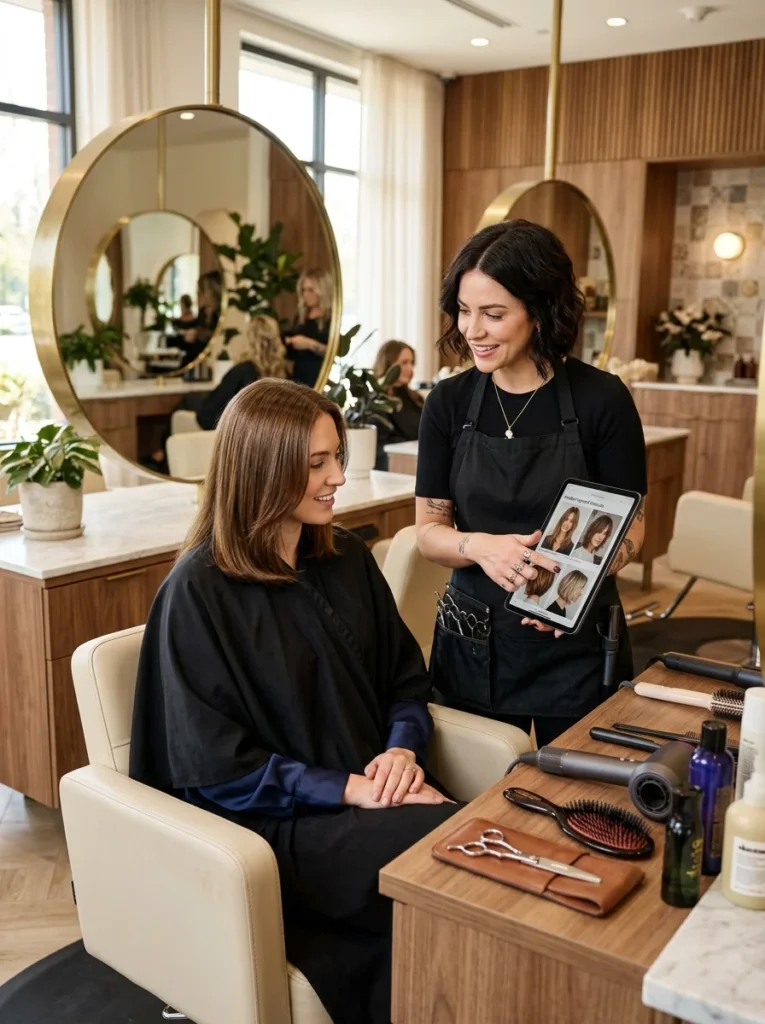
Most haircut disappointments trace back to a communication gap, not a skill gap. Here’s how to actually describe what you want in terms a stylist can execute precisely.
A significant portion of haircut disappointment traces back to a communication gap rather than a skill gap — the client and stylist walk away from the same conversation with genuinely different mental pictures of what was agreed upon, and this mismatch only becomes visible once the cut is finished and can’t be undone. This is worth taking seriously as a distinct problem from finding a skilled stylist, since even a highly skilled stylist will execute the wrong thing precisely if the communication going in was vague, contradictory, or relied on terminology that means different things to different people.
Inches Are a Less Reliable Communication Tool Than Most People Assume
Describing a desired length change in inches feels precise, but it’s actually one of the less reliable ways to communicate a haircut goal, since most people don’t have an accurate internal sense of what a specific number of inches actually looks like removed from their particular hair, and a stylist working purely from a stated number without additional context (current length, hair’s natural bend or curl, where exactly on the body the target length should fall) can end up executing a technically correct number that doesn’t match what the client actually pictured.
A more reliable approach combines a general directional statement (a bit shorter, a noticeable change, dramatically shorter) with a specific physical reference point — “to my collarbone,” “just above my shoulders,” “chin-length” — since a landmark on the body translates more consistently across different people’s hair length and body proportions than an abstract number of inches does.
Reference Photos Work Best When Paired With Specific Language About What’s Being Referenced

As covered in more detail elsewhere in this series regarding face shape and haircut selection, a reference photo is most useful when the specific elements being requested from it are identified explicitly — the length, a particular layering pattern, a fringe style — rather than presented as a literal, complete target the finished result should match exactly, since the same reference photo can be interpreted very differently without this clarification.
Bringing multiple reference photos that each represent a different element of the desired outcome (one for length, one for layering style, one for color if relevant) is often more effective than a single photo expected to communicate everything at once, since it reduces the ambiguity involved in figuring out which specific aspect of a single photo is actually the priority.
Describing Layering and Texture Requires Specific, Concrete Language

Vague terms like “some layers” or “add texture” mean genuinely different things to different stylists and can produce very different results depending on interpretation — being more specific about where layers should start (face-framing only, versus throughout the length), how much length variation is wanted between the shortest and longest layers, and how blended versus distinct the layering should look, produces a considerably more accurate shared understanding than a general request for “layers” alone.
Describing the desired end result in terms of how the hair should behave and move — “I want it to have more movement when I put it in a ponytail,” “I want less bulk at the ends,” “I want it to look intentional when it air-dries” — often communicates the actual goal more effectively than technical layering terminology, since it focuses on the functional outcome rather than requiring both parties to share an identical technical vocabulary.
Asking Direct Questions During the Consultation Reveals Misalignment Before Cutting Begins
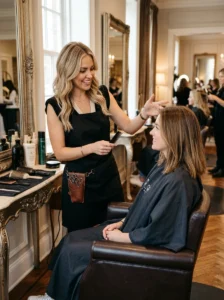
A stylist who explains their interpretation of the request back, describing specifically what they’re planning to do and why, before starting to cut, gives a client a genuine opportunity to catch a misunderstanding while it’s still fully correctable, and asking directly for this kind of restatement — “can you tell me what you’re planning to do?” — is a reasonable, non-confrontational way to surface a potential miscommunication before it becomes an unfixable result.
Asking specifically what the stylist would recommend, given the stated goal and the client’s actual hair type and texture, and listening carefully to any pushback or alternative suggestions, often surfaces useful information — a stylist experienced with a specific hair texture may know that a request as stated won’t produce the intended visual result on that particular hair, and this is more useful to learn during the consultation than after the cut is finished.
Being Honest About Styling Habits and Maintenance Willingness

A haircut that looks ideal in a photo but requires daily styling effort a client has no actual intention of investing will look considerably different in practice than the same cut on someone who does maintain that styling routine, which means being honest with a stylist about actual daily styling habits and time investment — not aspirational habits, but realistic ones — produces a cut better suited to how it will actually be worn day to day.
This is a genuinely useful piece of information for a stylist to have and isn’t something most clients volunteer unprompted, since there’s sometimes a sense that admitting limited styling time or skill reflects poorly, when in practice it’s exactly the information a stylist needs to recommend a cut that will look good with realistic maintenance rather than one that only looks its best immediately after a salon blowout.
Recognizing When a Stylist’s Pushback Is Worth Listening To

A stylist raising a specific, hair-texture-based concern about a requested cut — explaining why a particular length or layering choice may not achieve the intended look given the client’s actual hair — is different from a stylist simply overriding a client’s stated preference without explanation, and it’s worth distinguishing between these two situations rather than treating all pushback the same way.
A useful approach: asking a stylist to explain the specific reasoning behind their concern (how the hair’s texture, growth pattern, or density affects the outcome) rather than either dismissing the pushback outright or deferring entirely without understanding why — this produces a more collaborative result and helps a client build a more accurate understanding of their own hair’s behavior for future appointments as well.
Building a Longer-Term Relationship With a Stylist Improves Communication Over Time

A stylist who has cut a client’s hair multiple times develops a working understanding of that specific hair’s texture, growth pattern, and how it responds to different cuts, which meaningfully reduces the communication burden required at each subsequent appointment compared to a first visit with a new stylist, where more explicit, detailed communication is generally necessary to establish a shared understanding from scratch.
This is worth factoring into the broader decision of whether to try a new stylist for a specific desired change versus working with an established stylist who already has this accumulated knowledge — a new stylist may bring a genuinely different perspective or specific technical skill, but the communication gap covered throughout this discussion is generally larger with an unfamiliar stylist than with one who already has a working history with a client’s specific hair.
Key Takeaways

- Describing desired length in inches is less reliable than combining a general directional statement with a specific physical reference point, like a body landmark, since abstract numbers don’t translate consistently across different people’s hair and proportions
- Reference photos work best when the specific element being requested from them is identified explicitly, rather than expecting an entire photo to communicate a complete, unambiguous goal on its own
- Describing how hair should behave and move, rather than relying purely on technical layering terminology, often communicates the actual desired outcome more effectively
- Asking a stylist to restate their interpretation of the request before cutting begins gives a genuine opportunity to catch a misunderstanding while it’s still fully correctable
- Being honest about actual daily styling habits and time investment, rather than aspirational ones, helps a stylist recommend a cut suited to how it will realistically be worn
- A stylist’s pushback based on specific hair-texture reasoning is worth engaging with directly, asking for the reasoning behind it, rather than either dismissing it outright or deferring without understanding why

Frequently Asked Questions
Why did my stylist cut off more length than I asked for in inches? This often comes down to the unreliability of inches as a communication tool on their own — most people don’t have an accurate internal sense of what a specific number of inches actually looks like removed from their particular hair. Combining a stated number with a specific physical landmark, like “to my collarbone,” generally produces a more accurate shared understanding than a number alone.
Is it rude to ask my stylist to explain their plan before they start cutting? Not at all — asking a stylist to describe what they’re planning to do and why is a reasonable, non-confrontational way to catch a potential miscommunication while it’s still fully correctable, and most stylists are receptive to this kind of clarifying conversation before cutting begins.
Should I always defer to my stylist if they push back on what I asked for? Not automatically, but it’s worth asking for the specific reasoning behind their concern — a stylist’s pushback based on how your particular hair’s texture or growth pattern will affect the outcome is genuinely useful information, different from an unexplained override of your stated preference. Understanding the reasoning helps you make a more informed decision either way.
Does it actually matter if I tell my stylist how much effort I put into styling my hair day to day? Yes, genuinely — a cut that looks ideal with daily styling effort will look considerably different in practice if you don’t actually intend to invest that time, and being honest about your realistic habits, not aspirational ones, helps your stylist recommend a cut that will look good with the maintenance you’ll actually do.
Is it better to see the same stylist repeatedly, or try someone new for a different look? Both have genuine value — an established stylist develops accumulated knowledge of your specific hair’s texture and behavior that reduces the communication burden at each visit, while a new stylist may bring a different perspective or specific skill. The communication gap covered throughout this piece is generally larger with an unfamiliar stylist, which is worth factoring in when deciding, particularly for a significant change.