


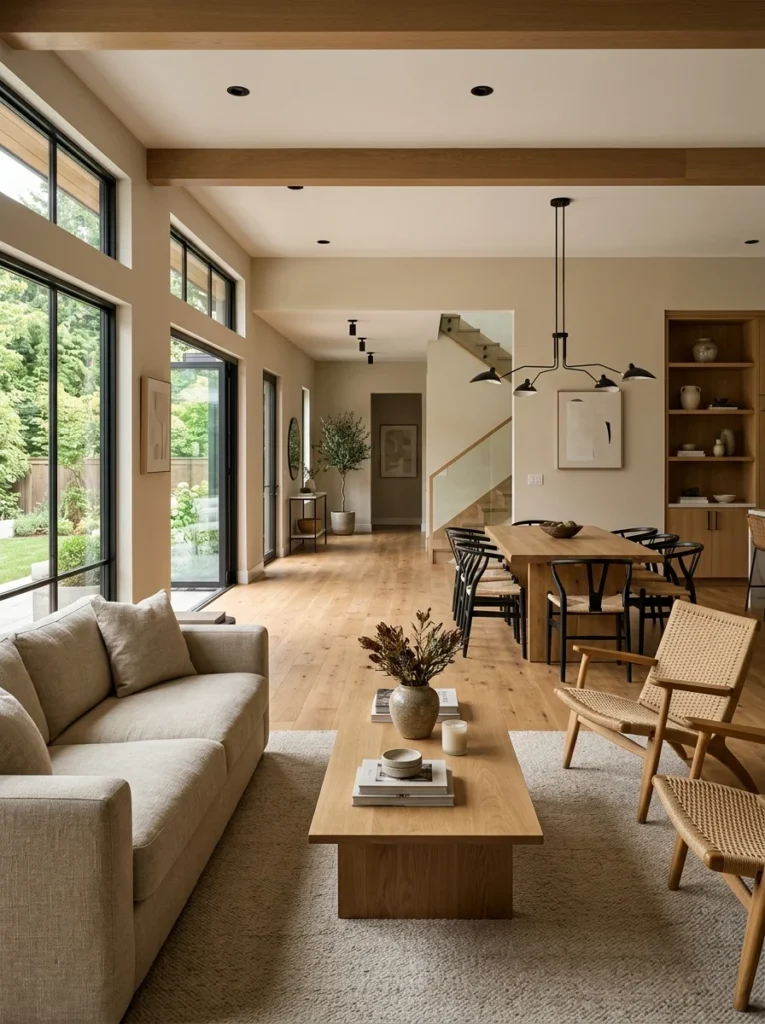
Most homes weren’t decorated all at once, which means most homes have a real cohesion problem hiding in plain sight. Here’s how to connect rooms that were never planned together, without redoing any of them.
Almost no home is genuinely decorated all at once — rooms get furnished and refreshed in whatever order life actually demands, over years, on different budgets, sometimes reflecting genuinely different phases of taste. This is the normal, realistic state of most homes, and it creates a specific challenge that’s different from the matched-furniture-set problem covered elsewhere in this series, which is about avoiding excessive uniformity within a single room. This is closer to the opposite issue: connecting genuinely different rooms, decorated at different times with different priorities, into something that reads as one considered home rather than a series of unrelated spaces that happen to share a floor plan.
A Home Doesn’t Need to Match to Feel Cohesive — It Needs Repeating Threads
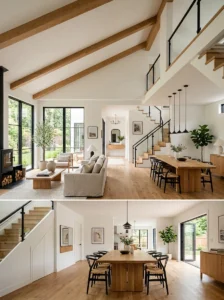
Cohesion across an entire home doesn’t require every room to share the same color palette, furniture style, or material choices — that level of uniformity is neither realistic for most households nor actually desirable, given the flatness that excessive matching produces, covered elsewhere in this series regarding furniture sets specifically. What creates genuine whole-home cohesion is a smaller number of deliberate, repeating threads that appear across multiple rooms, connecting spaces that are otherwise genuinely different from each other in most respects.
A repeating thread can be almost anything consistent and intentional: a specific metal finish used for hardware and fixtures throughout the home, a particular wood tone that recurs in furniture across different rooms, a color that appears as an accent in every room even when each room’s dominant palette differs, or a consistent style of light fixture used with variation in scale but consistency in overall character. The specific thread matters less than the fact that it repeats deliberately and is recognizable across the rooms it appears in.
Hardware and Fixture Finish Is Often the Easiest Thread to Establish Retroactively
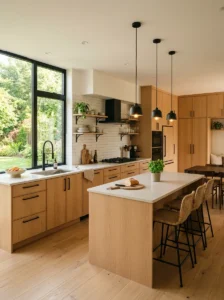
As covered throughout this series regarding low-cost refreshes, hardware and fixture finish is comparatively inexpensive and straightforward to update, which makes it one of the most practical threads to establish retroactively across a home where different rooms were decorated at different times with different, inconsistent finishes.
Standardizing on a single metal finish — or a small, deliberately coordinated set of two finishes used consistently — across cabinet hardware, faucets, and light fixtures throughout the home creates a genuinely perceptible sense of connection between rooms that otherwise have very little in common stylistically, since this specific detail is visible in nearly every room and repeats at a scale that’s noticeable without requiring any of the rooms’ larger furniture or color decisions to change at all.
Flooring Continuity Provides a Foundation-Level Thread
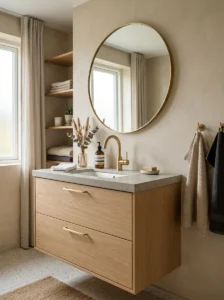
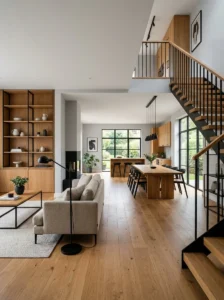
Where a household has control over flooring choices — during a renovation, or when selecting flooring for a newly finished space — using a consistent flooring material and tone throughout connected areas of the home provides an unusually powerful cohesion thread, since flooring is visible in every room simultaneously and creates a literal, physical continuity between spaces that variable furniture and decor choices don’t achieve on their own.
For a household without the ability to change existing flooring, a consistent approach to area rugs — not identical rugs, but rugs that relate through a shared color or material logic — can approximate some of this same connective effect without requiring the underlying flooring itself to change.
An Accent Color That Appears, in Varying Intensity, Across Multiple Rooms
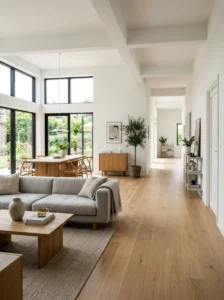
As covered in more detail elsewhere in this series regarding accent color for a living room specifically, a color that repeats as a smaller accent across several rooms — even rooms with otherwise quite different dominant palettes — creates a sense of intentional connection between them, since the recurring color reads as a deliberate thread rather than a coincidence.
This doesn’t require every room to feature the color prominently — a small accent object in one room, a stronger presence in another, a subtle touch in a third — the consistency of the color’s presence across multiple spaces, at whatever intensity fits each individual room, is what creates the connective effect, not uniform intensity in every location.
Sightlines Between Rooms Deserve Particular Attention
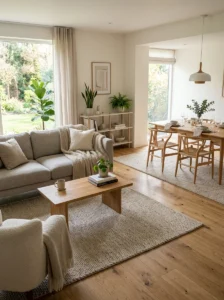
As covered in more detail elsewhere in this series regarding shared living and dining spaces, rooms that are directly visible from each other — an open floor plan, or simply a sightline from one room’s doorway into an adjacent space — benefit disproportionately from cohesion efforts, since these are the specific room pairings where a lack of connection is most immediately, visually apparent.
Prioritizing the repeating-thread strategy specifically in rooms with direct sightlines to each other, before addressing more separated, less visually connected rooms, produces a disproportionate improvement in overall perceived cohesion relative to the effort involved, since this is where disconnection is most noticeable to anyone actually moving through the home.
Retrofitting Cohesion Without Replacing Existing Furniture
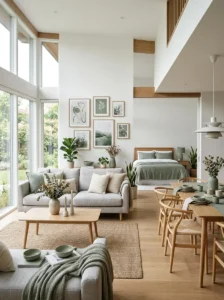
A household with a home genuinely decorated at different times, containing furniture and decor from different periods that aren’t inherently unified, doesn’t need to replace this existing furniture to achieve meaningfully more cohesion — introducing a repeating thread through smaller, additive elements works alongside what already exists rather than requiring its replacement.
A consistent throw pillow or textile color introduced across several rooms, a repeated small object or art style appearing in variation throughout the home, or the hardware standardization covered above are all retrofit-friendly strategies that layer a connective thread onto an existing, varied collection of furniture rather than starting over.
How Many Threads Are Actually Necessary
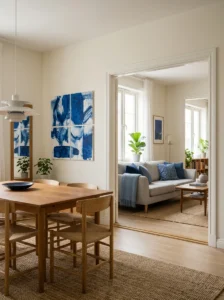
A single, well-executed repeating thread — hardware finish alone, for instance — is often sufficient to create a noticeable improvement in perceived whole-home cohesion, and a household doesn’t need to establish several simultaneous threads to achieve a meaningfully more connected feeling. Two or three well-chosen threads, applied consistently, generally produce a strongly cohesive result without requiring the kind of comprehensive, all-at-once redecoration that most households, decorating rooms individually over time as circumstances allow, aren’t actually positioned to undertake.
Attempting too many simultaneous threads, particularly ones that don’t relate well to each other, risks creating a different kind of incoherence — a home trying to enforce several unrelated connective patterns at once can end up feeling as disjointed as a home with no connective threads at all, which is why a smaller number of well-chosen, complementary threads generally outperforms an ambitious attempt at comprehensive, multi-layered coordination.
Key Takeaways
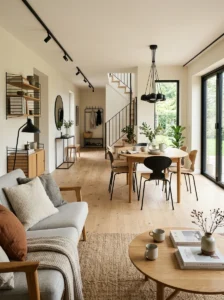
- Whole-home cohesion doesn’t require every room to match — it requires a smaller number of deliberate, repeating threads that connect otherwise genuinely different rooms
- Hardware and fixture finish is one of the most practical threads to establish retroactively, since it’s comparatively inexpensive to update and visible in nearly every room throughout the home
- Flooring continuity, where a household has control over it, provides an unusually powerful, literal, physical connection between spaces that furniture and decor alone can’t replicate
- A color that repeats as an accent across multiple rooms, at varying intensity appropriate to each room, creates a sense of intentional connection without requiring uniform color schemes throughout
- Rooms with direct sightlines to each other benefit disproportionately from cohesion efforts, since disconnection is most immediately apparent in these specific pairings
- A single well-executed thread, or two to three complementary ones, is generally sufficient — attempting too many unrelated simultaneous threads risks creating a different kind of incoherence
Frequently Asked Questions
Do I need to redecorate my whole home to make it feel cohesive? No — introducing a smaller number of deliberate, repeating threads, like consistent hardware finish or a recurring accent color, works alongside existing furniture and decor from different periods rather than requiring full replacement. This retrofit approach is considerably more achievable than a comprehensive, all-at-once redecoration.
What’s the single easiest thread to establish across a home that was decorated at different times? Hardware and fixture finish is generally the most practical starting point, since it’s comparatively inexpensive to update, appears in nearly every room, and doesn’t require any of the rooms’ larger furniture or color decisions to change at all.
Should every room have the exact same accent color to feel connected? Not necessarily at the same intensity — a color that repeats across multiple rooms, appearing prominently in one and as a smaller touch in another, still creates a genuine sense of connection, since the consistency of the color’s presence is what matters, not uniform intensity in every single space.
Which rooms should I prioritize for cohesion efforts if I can’t address my whole home at once? Rooms with direct sightlines to each other — an open floor plan, or spaces visible from each other’s doorways — benefit disproportionately from cohesion efforts, since a lack of connection is most immediately apparent in exactly these pairings. Addressing these first produces a larger perceived improvement relative to the effort involved than addressing more separated, less visually connected rooms.
Is it possible to have too many connecting threads across a home? Yes — attempting several unrelated simultaneous threads at once can create its own kind of incoherence, since a home trying to enforce multiple unconnected patterns can feel as disjointed as one with no connective threads at all. A smaller number of well-chosen, complementary threads generally produces a more successful result than an overly ambitious, multi-layered coordination attempt.