

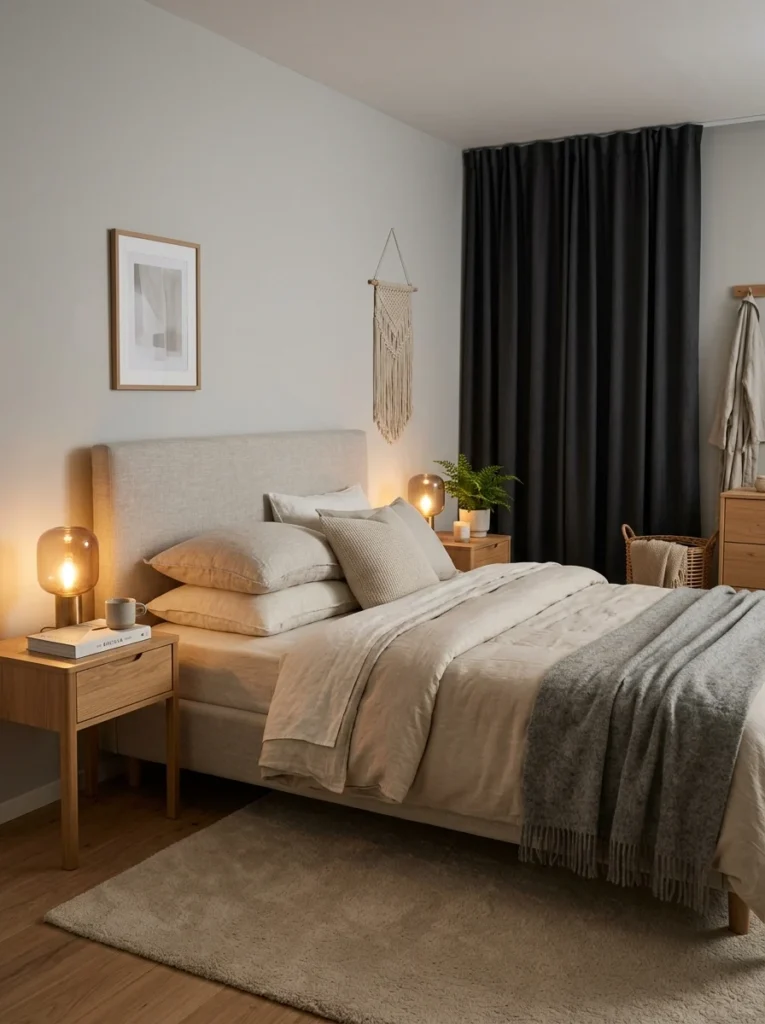
A bedroom that looks nice but doesn’t feel restful is failing at its only essential job. Here’s what actually prevents sleep-quality rest and how to fix each specific cause.A bedroom has one job that no other room in the house has: it must persuade your nervous system to switch off. Every other room is designed for doing something — cooking, eating, working, talking, watching. The bedroom is for stopping. And a room that looks beautiful but doesn’t accomplish that specific function has failed at the thing that matters most in the space where you spend roughly a third of your life.
This distinction between looking nice and feeling restful is the source of most bedroom dissatisfaction. People invest in good bedding, choose a calm wall color, keep the room reasonably tidy, and still find themselves lying awake in a room that looks like a bedroom should and doesn’t feel like one. The problem isn’t aesthetics. It’s a set of specific sensory and environmental conditions that the brain processes before sleep — conditions that either support or undermine the transition from alert to rest.
Understanding which conditions are present and which are absent in a specific bedroom, and what to change to shift the balance, is more useful than any amount of styling advice.
What “Restful” Actually Requires

A restful bedroom produces a specific physiological response: a drop in cortisol, a lowering of heart rate, a reduction in cognitive activity. These aren’t metaphors — they’re measurable biological changes that the environment either supports or impedes.
The conditions that support this response are specific: lower temperature, lower light levels, minimal sensory stimulation, soft tactile surfaces, acoustic quiet, and an absence of content that the brain processes as requiring action or attention. A bedroom that meets these conditions produces rest regardless of whether it looks nice. A bedroom that fails to meet them doesn’t produce rest regardless of how carefully it was decorated.
Most bedroom design advice focuses on the visual layer — colors, bedding, furniture arrangement — while most restfulness problems exist in the sensory layer: light, temperature, sound, tactile quality, and the processing load the room places on the brain during the hours before and during sleep.
Light: The Most Direct Disruption of Rest
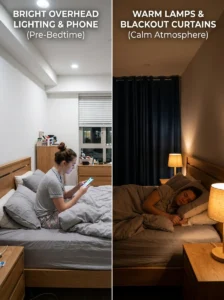
Light is the primary environmental signal the brain uses to regulate circadian rhythm. Bright light — particularly blue-spectrum light — tells the brain to suppress melatonin production and remain alert. Low, warm light tells the brain that nighttime is approaching and that melatonin production is appropriate.
This means the bedroom’s light environment in the two to three hours before sleep has a direct effect on sleep quality, and most bedrooms have light environments that work against sleep without the occupants connecting the two.
Overhead bedroom lighting at full brightness in the hour before bed is telling the brain to stay awake. Not metaphorically — literally, through the suppression of melatonin by high-intensity bright light. Switching to low, warm-toned bedside lamps (2700K or lower) rather than overhead light for the pre-sleep period is one of the most directly effective sleep-quality changes available.
Screen light — phones, tablets, laptops — emits blue-spectrum light at close range directly into the eyes in the specific hours when melatonin suppression has the most effect. The advice to avoid screens before bed is not a lifestyle preference; it’s a statement about how specific light wavelengths at specific times affect a specific biological system. The bedroom as the location where this occurs (lying in bed on a phone) is a direct disruption of the room’s function.
Light from outside — streetlights, car headlights, early morning light in summer — penetrates windows and disrupts both sleep onset and sleep quality. Blackout curtains or lined blackout blinds that prevent external light from entering the sleeping space directly improve sleep quality in a way that no other bedroom aesthetic change can replicate.
The morning light question. Some people benefit from morning light entering the bedroom as a natural wake signal. Others are disrupted by early light that wakes them before intended. The right window treatment depends on which situation applies — room-darkening (not fully opaque) for those who benefit from gradual morning light, full blackout for those disrupted by early light.
Temperature: The Physical Condition Nobody Designs For

Core body temperature drops during sleep — this drop is part of the biological mechanism that initiates and maintains sleep. A bedroom that’s too warm prevents or reduces this drop, making sleep harder to initiate and reducing deep-sleep quality.
The research-supported temperature range for optimal sleep is between 60 and 67 degrees Fahrenheit (15.5 to 19.4 Celsius) — considerably cooler than most people keep the rest of their home. Many people sleep in rooms that are 70 degrees or higher because the thermostat is set for the living areas and the bedroom is on the same system.
Bedding choices are a temperature management tool as much as a comfort choice. Heavy duvets in warm rooms trap heat that prevents the body temperature drop associated with deep sleep. Layered bedding — a sheet, a light blanket, and a heavier layer available but not necessarily used — allows temperature regulation during the night without waking fully to adjust.
Air circulation — even a ceiling fan at low speed or a window cracked slightly — affects how warm the immediate sleeping environment feels regardless of the room’s absolute temperature. The sensation of moving air allows higher absolute temperatures to feel comfortable in a way that still air at the same temperature doesn’t.
Foot temperature specifically is associated with sleep quality: warm feet promote faster sleep onset by increasing peripheral blood flow, which assists in the core temperature drop. Thin socks or warming feet briefly before bed — a specific, evidence-based recommendation — can assist sleep onset in people who run cold peripherally.
Sound: The Variable That Continues During Sleep

Unlike light, which the closed eye can somewhat filter, and temperature, which the body adapts to over time, sound is processed by the brain continuously during sleep. Sudden noises that exceed the sleep-noise threshold reliably disrupt sleep stages, and this disruption has measurable effects on daytime cognitive function and mood even when the person doesn’t fully wake.
The specific acoustic interventions that improve a bedroom’s sleep quality:
Heavy curtains do double duty: they block light and, because of their mass and fabric density, absorb some sound that would otherwise enter through the window. This is a small but real contribution to the acoustic environment.
Rugs and soft furnishings reduce the reverberation of sound within the room — the acoustic equivalent of the bookshelf’s sound-absorption function in the living room article. A bedroom with hard floors, bare walls, and minimal soft furnishings reverberates sound; a bedroom with rugs, curtains, upholstered headboard, and textiles absorbs it.
White noise or background sound — fans, air purifiers, dedicated white noise machines, or sound apps — masks the variation in ambient sound that triggers the brain’s wake response. The brain responds to change in sound levels more than to absolute sound levels. A constant background sound reduces the relative contrast of sudden noises, reducing the sleep disruption they cause. This is the reason so many people report sleeping better with a fan on even when the temperature doesn’t require it.
Partner noise — snoring, movement — is the most commonly cited sleep disruption in shared bedrooms and the hardest to resolve through environmental design. Earplugs are the most direct intervention; separate sleep schedules for people with significantly different circadian preferences is another; white noise masks some but not all of the disruption.
Visual Clutter and the Brain’s Pre-Sleep Processing
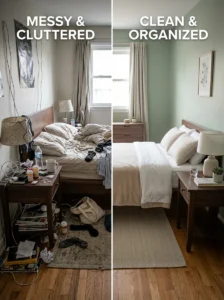
A bedroom with many visible, unresolved objects — the laptop left on the dresser, the laundry to be dealt with, the paperwork on the nightstand, the half-finished project — is a bedroom full of unfinished loops that the brain continues to process as it approaches sleep.
This processing happens below the level of conscious thought. You’re not lying in bed consciously worrying about the laundry. But the visual presence of the pile registers as an unresolved task that maintains low-level activation in the brain systems responsible for task management, which is the opposite of what a restful bedroom needs.
The specific bedroom visual environment that supports rest:
Clear, flat surfaces. The dresser top, the nightstand, the bedroom floor, and any other horizontal surfaces visible from the bed should be as clear as practicable. Objects left in view that represent tasks are the most disruptive; purely decorative objects with no task association are less so.
Closed storage. As with every other room, closed doors and drawers hide the visual representation of unresolved tasks. A wardrobe with doors shows a clear surface; a wardrobe without doors shows every item of clothing and the state of the organization within.
Electronics out of the bedroom. The laptop, the work bag, the exercise equipment — objects that belong to specific activities other than sleep introduce those activities’ associations into the bedroom space. The bedroom that contains a laptop is a bedroom that also contains work, and the brain maintains both associations simultaneously.
Nightstand discipline. The nightstand is the last visible surface before sleep and the first visible surface on waking. A nightstand with three to four specific items (a lamp, water, a book if used, an alarm) produces less pre-sleep processing than a nightstand holding a device, several items of unrelated clutter, medications, charging cables, and accumulated objects with no specific purpose.
Bedding: Where Tactile Quality Meets Sleep Quality

The bed’s tactile environment — the feel of sheets and pillowcases against skin, the weight and temperature regulation of the duvet, the support and give of the mattress — affects sleep quality through the body’s sensory processing, not just through appearance.
Thread count is a widely marketed but partly misleading bedding quality indicator. What matters more: the fiber type (long-staple cotton, linen, Tencel/lyocell, silk each have different tactile and temperature-management properties), the weave (percale is crisp and cool, sateen is silky and warm), and the finish quality (a well-finished seam and even weight distribution throughout the duvet).
Linen bedding is particularly worth noting for its temperature-management properties: linen breathes exceptionally well, gets softer with use, and is more comfortable in a wide temperature range than cotton or synthetic bedding. Its look is also more relaxed and lived-in than crisp cotton percale, which some people find contributes to a less formal, more restful bedroom feeling.
Duvet weight should match the room’s sleep temperature — a heavy duvet in a warm room creates the trapped-heat condition that reduces deep sleep. A lighter duvet in a well-cooled room, with a blanket available, serves most people better than one heavy duvet across all seasons.
Pillow support affects sleep quality through neck and head position. The right pillow height depends on sleep position (side sleepers typically need a higher loft than back sleepers; stomach sleepers typically need low or no pillow). Pillows used past their supportive life — compressing to little more than a thin pad — should be replaced rather than kept because they’re familiar.
The Bedroom as a Single-Purpose Room

The most consistent predictor of whether a bedroom will function as a restful space is whether it’s used as one. A bedroom that’s also used for working, television watching, eating, and phone use throughout the day and evening is a room the brain has learned to associate with all of those activities, not just sleep. The association makes rest harder to achieve, because the brain doesn’t automatically switch to sleep mode on entering a space where it regularly does other things.
Work out of the bedroom entirely is the most direct intervention for people who use the bedroom for work. Even moving the laptop to the living room or a dedicated work area changes the bedroom’s association profile over time.
Television in the bedroom is a specific case. Beyond the screen light and content stimulation, the presence of a television keeps the brain in the same mode as evening living room use — content consumption, passive but alert — rather than transitioning it toward rest.
The phone before bed was covered in the light section but deserves a behavioral note: the specific practice of charging the phone outside the bedroom and using a dedicated alarm clock removes both the light disruption and the behavioral pattern of final-hour phone use that is both the cause and the effect of poor bedroom rest quality.

Key Takeaways
- A bedroom that looks nice but doesn’t feel restful is usually failing at specific sensory conditions — light, temperature, sound, visual processing load — not aesthetic ones
- Pre-sleep overhead bright light directly suppresses melatonin; switching to low, warm-toned lamps in the hour before sleep is one of the most directly effective sleep-quality changes available
- Blackout curtains or blinds prevent external light from disrupting sleep and are worth prioritizing over purely decorative window treatments in a bedroom
- The optimal sleep temperature (60-67°F / 15.5-19.4°C) is cooler than most people maintain; bedding choices and air circulation help manage this without thermostat-wide changes
- Visual clutter — especially objects representing unresolved tasks — maintains low-level brain activation that resists the rest state; clear surfaces and closed storage reduce this
- Bedding quality (fiber type, weave, duvet weight matched to room temperature) affects sleep quality through tactile experience and temperature management
- The bedroom used for working, screen consumption, and eating has multiple activity associations that compete with the sleep association the room needs to function well
- White noise — fan, air purifier, dedicated machine — masks sound variation that triggers the brain’s wake response, particularly in loud environments
Frequently Asked Questions
My bedroom looks calm and minimal but I still can’t sleep well in it. What am I missing? Temperature and sound are the most commonly overlooked variables in rooms that have been addressed aesthetically. If the room is visually calm but physically warm (above 67°F), the body isn’t getting the temperature drop that initiates deep sleep. If the room is visually calm but acoustically variable — traffic noise, building noise, partner sounds — the brain is still processing those stimuli during sleep. Audit the temperature and acoustic environment specifically, not just the visual one.
Does bedroom color affect sleep quality? Color affects sleep quality less directly than light, temperature, and sound, but it does affect the visual processing load the brain does in the bedroom. Colors that are visually active — high saturation, strong contrast, patterns with a lot of movement — give the eye and brain more to process, which is the opposite of what the pre-sleep period benefits from. Calm, low-saturation colors in warm or neutral tones are most consistent with a restful bedroom environment, though the effect is smaller than most people expect.
Is it bad to have mirrors in the bedroom? Mirrors in bedrooms have a mixed reputation, but the practical concern is specific: a mirror that reflects the bed, or that is visible from the bed, can disrupt sleep in some people by producing visual stimulation (reflection of movement) during lighter sleep stages. A mirror positioned where it’s not visible from the bed doesn’t produce this issue. The feng shui-based concerns about bedroom mirrors go beyond this article’s scope, but the practical design concern is mirror position relative to the sleep position.
How important is mattress quality compared to other bedroom factors? Mattress quality has a direct and significant effect on sleep quality through spinal support, pressure point relief, and temperature regulation (some mattresses trap heat considerably more than others). An inadequate mattress that creates pain, pressure points, or overheating affects sleep quality in ways that no environmental change to the room fully compensates for. Mattress investment is worth prioritizing before many other bedroom changes, as its effect on sleep quality is both direct and substantial.
What’s the most impactful single change for a bedroom that feels nice but not restful? Blackout window treatment, for rooms where external light enters during sleeping hours. If the room is dark enough, switching to warm-toned lamp-only pre-sleep lighting rather than overhead lighting. Either of these changes — light elimination from outside, or light reduction from within — has the most consistent and direct effect on sleep quality of any bedroom environmental change that doesn’t involve the mattress or bedding.