


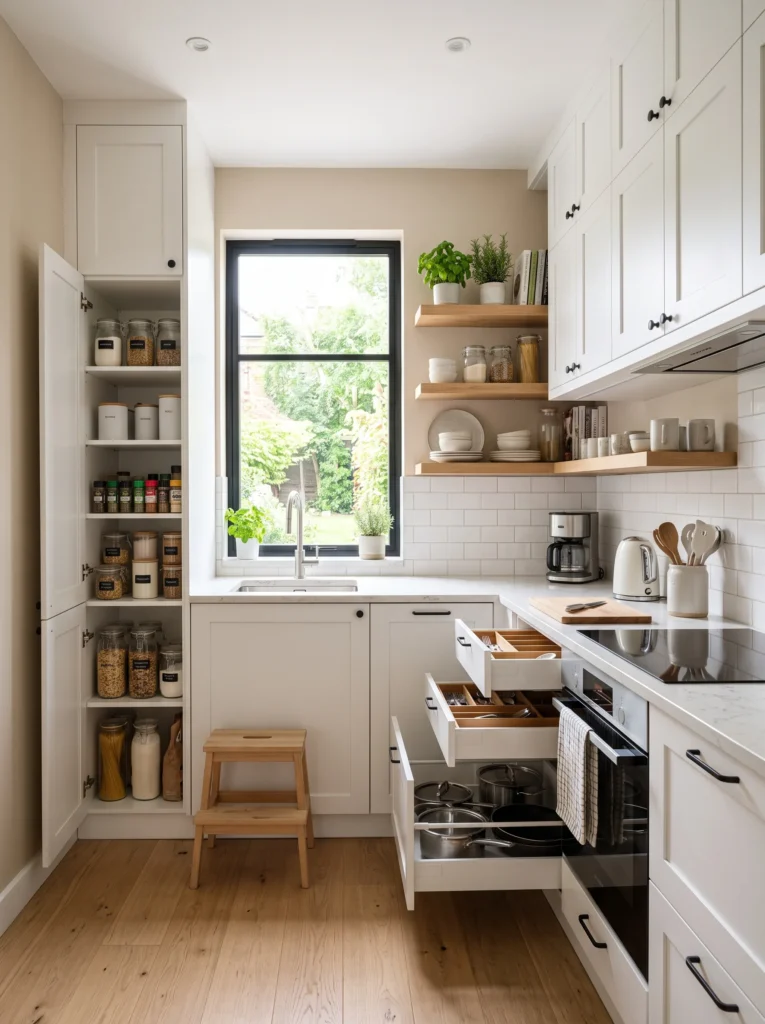
A kitchen with no storage space almost always has more storage than it looks like. Here’s how to find it, use it, and stop buying solutions that make the problem worseThe most common response to a kitchen with insufficient storage is to buy more storage. A rolling cart here, a wall-mounted rack there, a set of stackable bins for the pantry items that don’t have a home. And then the kitchen has roughly the same amount of usable space it started with, plus several new objects in it.
This is the storage trap — solving a density problem by adding more things to a dense space. It works occasionally, when the specific new addition creates genuinely more capacity than it consumes. More often, it makes the kitchen feel more crowded while solving only a portion of the problem, because the real issue wasn’t the absence of storage products. It was the absence of a system for using the storage that already exists.
Real kitchen storage improvement comes in a specific sequence: find what’s already there, use it better, then and only then add what’s genuinely missing. Most kitchens that feel like they have no storage reach a substantially different conclusion after the first two steps, before a single new product is purchased.
Step One: The Edit That Creates Space Before Anything Else
Every kitchen storage conversation should start here, and almost none of them do.
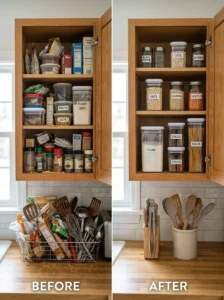
Pull open any cabinet in a kitchen that “has no storage” and there’s a reasonable chance you’ll find at least one of the following: canned goods past their expiry date, a gadget bought for one specific recipe and never used again, duplicate items purchased because the original couldn’t be found, takeout containers without matching lids, a set of dishes used perhaps twice a year that occupies prime accessible space, or enough plastic bags to fill a medium-sized recycling bin.
None of this is unusual. It accumulates in every kitchen at a predictable rate, and it is occupying storage space that then gets classified as “used” even though it’s serving no active purpose.
A thorough edit — pulling everything out of every cabinet and returning only what earns its place — typically recovers between a quarter and a third of existing cabinet volume in most households. This is storage space that already exists, costs nothing, and requires no installation. It simply requires the discipline of removing what has settled there without an active decision to keep it.
The edit items that free up the most space, consistently:
- Expired or very-old pantry goods — canned goods, spices more than two years old, grains and cereals past date
- Appliances used fewer than six times per year — if it was bought with good intentions and barely used, it’s taking cabinet space that costs more than storage elsewhere would
- Duplicate or near-duplicate tools — most kitchens have more spatulas, wooden spoons, and mixing bowls than any cooking session requires
- Dishware used only for special occasions — serving platters, seasonal dishes, the formal china — these belong in a dining room hutch, a hall closet, or a high, difficult-to-reach shelf rather than in accessible kitchen cabinet space
- Items that don’t belong in the kitchen at all — toolboxes, paperwork, random household objects that migrated into the kitchen because it’s a common gathering point
After the edit, measure again. In the majority of kitchens, the storage problem has either disappeared or reduced significantly enough that the remaining gap is small and specific rather than general and overwhelming.
The Vertical Space Inside Cabinets That Goes Unused
Standard kitchen cabinets are designed with fixed shelves at factory-set heights that work adequately for an average mix of items but waste significant vertical space for most specific real-world inventories.
A shelf set at 12 inches of clearance for a soup can that’s only 5 inches tall leaves 7 inches of air above every item on that shelf. Multiplied across several shelves in several cabinets, this represents substantial unused cubic volume that organizing alone can recover.
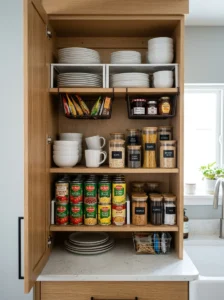
Shelf risers are the most accessible solution — wire or solid risers that sit inside an existing shelf and create a raised second tier at the back, allowing a front row and a back row at different heights within the same shelf space. These cost very little, require no installation, and effectively double the usable surface of any shelf where items are short enough to allow the addition of a second layer.
Adjustable shelf pins — present in most modern cabinet boxes as small holes drilled into the interior sides — allow shelves to be repositioned. If the existing shelf heights don’t match what’s being stored, moving the shelves to eliminate wasted air above items is the zero-cost version of the same gain. Most homeowners never adjust these despite them being available for exactly this purpose.
Under-shelf baskets clip onto an existing shelf and hang below it, creating an additional layer of storage in the air space underneath without requiring any drilling or modification. Particularly useful for mugs, light pantry items, and foil or wrap boxes.
The Inside of Cabinet Doors: Reliable, Underused Real Estate
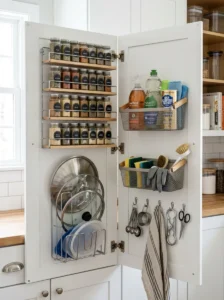
The interior face of every cabinet door is a flat, vertical surface that comes included with every cabinet and is used for storage in a small minority of kitchens.
Door-mounted storage is especially effective for specific categories of items:
Spice racks mounted on the inside of a pantry or deep cabinet door move a category that typically occupies significant shelf real estate into a narrow profile that uses only the door’s depth — usually around two inches — rather than shelf depth.
Lid organizers on the inside of the cabinet holding pots and pans solve one of the most universally frustrating kitchen storage problems: where lids go. A simple vertical divider or tension rod mounted inside the door holds lids upright and accessible without requiring the excavation of a pile of nested cookware.
Small baskets or wire pockets on the inside of cabinet doors under the sink hold cleaning products, sponges, and small tools that otherwise create an unstable pile at the base of the cabinet.
The limit of door-mounted storage is the depth of what’s being stored on the adjacent shelf — the door needs to close fully with the addition. Shallow items (spices, foil boxes, small tools) are well-suited; deeper items need to be matched against the available clearance before mounting anything.
The Wall Space That Most Kitchens Ignore
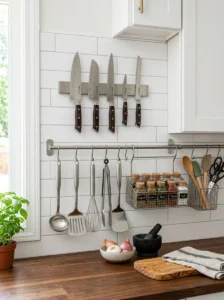
A kitchen wall between cabinets and countertop — typically the backsplash zone — is sometimes used for a backsplash and rarely used for storage despite being one of the most accessible vertical surfaces in the room.
A magnetic knife strip mounted on this surface removes the knife block from the counter (recovering meaningful counter space) and keeps knives more accessible, better maintained, and visible at a glance. It’s one of the few storage upgrades that simultaneously creates storage and reclaims counter space.
A mounted rail system — a horizontal rod with adjustable hooks, small baskets, and clips — along the backsplash provides customizable storage for frequently used tools, spices, small appliances, and produce in a space that the backsplash tile already occupies anyway. The visual tradeoff (it makes the backsplash busier) is real; whether it’s worth making depends on how pressed for space the kitchen is and how much the busy visual matters to the household.
Pegboards mounted on a kitchen wall, while associated with garages and workshops, function effectively as kitchen storage for pots, pans, and utensils in households where the visual fits the kitchen’s character. They offer the same flexibility as a rail system with more total coverage.
Above the Cabinets: The Storage Zone Everyone Overlooks
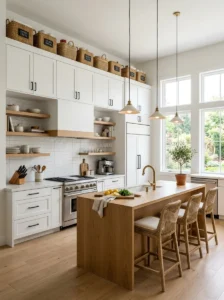
In kitchens with cabinets that don’t reach the ceiling, the space above the cabinet tops is a storage zone so consistently available and so consistently ignored that it deserves its own section.
The limitation of above-cabinet storage is genuine: the items stored there must be retrievable without too much difficulty, which means large, light items accessed rarely work better than small, heavy items needed frequently. The zone is not suited to daily-use storage.
What works well above cabinets:
- Large serving pieces — cake stands, holiday platters, oversized bowls used for parties
- Infrequently used appliances stored in their original boxes or in labeled bins
- Seasonal items — holiday bakeware, specialty serving pieces used a few times per year
- Labeled storage bins with lids that keep contents clean and protected
A consistent container style above the cabinets — matching baskets, labeled boxes in the same material — keeps the above-cabinet zone from reading as chaotic even when it’s actively used for storage.
Moving Things Out of the Kitchen Entirely
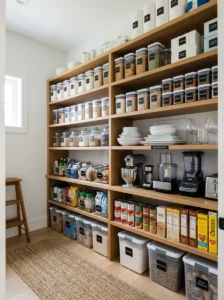
This is the most overlooked kitchen storage strategy and also, for some households, the most effective one.
Not everything that currently lives in the kitchen needs to live in the kitchen. The kitchen is where cooking happens. It is not obligated to also serve as the home for every item that touches food at any point in its journey from store to plate.
Dining room or sideboard: Extra serving pieces, linens, holiday dishware, and special-occasion tableware can live in an adjacent dining room without meaningful inconvenience. The three steps to retrieve a serving platter from a sideboard are not a hardship worth trading significant cabinet space to avoid.
Pantry closet or hall closet: Bulk goods, backup supplies, large quantities of dry goods, and paper products — all of these can live in any closet located reasonably near the kitchen without creating real friction. Treating a nearby closet as a kitchen pantry extension is one of the most capacity-expanding moves available without touching the kitchen itself.
Basement or utility area: Appliances used seasonally — a large roasting pan, a turkey fryer, holiday bakeware — have no reason to occupy kitchen cabinet space year-round when a basement or utility room is available.
Garage: For households with attached garages, large items like extra cooking pots, beverage coolers, and bulk warehouse purchases can live there without meaningful inconvenience for the rare occasions they’re needed.
The instinct to keep everything in the kitchen comes partly from convenience and partly from not having thought through which items actually need to be arm’s reach away versus which just end up there because that’s where they’ve always been.
Specific Storage Problems Worth Solving Individually
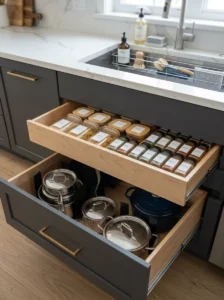
Some categories generate disproportionate storage friction because they’re awkward shapes, easily lost, or inherently difficult to store neatly. Solving these individually, rather than trying to solve them with general storage additions, returns more usable space per effort than most other interventions.
Pots and pans: The nested stack that requires removing four items to reach the one at the bottom is one of the most common kitchen friction points. Solutions that work: a hanging pot rack (removes them from cabinets entirely), a pull-out lower cabinet drawer (expensive but extremely functional), or vertical pot dividers that allow pots to stand upright rather than nest. The problem is almost always about retrieval, not volume.
Pan lids: Almost universally managed poorly. A tension rod stood vertically inside a deep drawer, or a door-mounted lid rack as described above, costs very little and eliminates the avalanche that typically follows any attempt to reach into the lid cabinet.
Plastic containers: The source of more storage complaints per cubic foot than almost any other kitchen item. The most effective solution for most households is replacing a mixed-brand collection with one brand and system that stacks reliably with itself, and then editing aggressively — keeping only as many containers as the household actually uses in a typical week, with a matched quantity of lids.
Cleaning supplies under the sink: The under-sink cabinet is typically the most poorly organized space in any kitchen — a dark, awkward shape with a drain pipe interrupting the center. A two-tier under-sink organizer sized around the pipe, combined with a door-mounted rack for smaller items, typically doubles the functional capacity of this cabinet without changing its physical dimensions.
Spices: Require a full-length piece of this article on their own, but the short version: alphabetical order is the wrong system (organize by cooking type instead), and the biggest spice storage problem is usually not volume but visibility. A tiered rack, drawer insert, or door-mounted solution that lets you see every spice at once eliminates the duplicate-buying problem that makes spice collections larger than they need to be.
Key Takeaways
- Buying more storage products into an already-crowded kitchen makes it more crowded, not more organized — the sequence matters
- A thorough edit of existing cabinet contents typically recovers 25-33% of current cabinet volume before anything else changes
- Vertical space inside cabinets is almost always wasted — shelf risers and adjustable shelf height cost nothing and create meaningful new capacity
- Cabinet door interiors are reliable, unused storage real estate suited to spices, lids, and small tools
- Wall-mounted magnetic strips and rail systems free counter space while adding vertical storage in the backsplash zone
- Above-cabinet space works well for rarely-used large items stored in consistent, labeled containers
- Moving items out of the kitchen to adjacent spaces is the highest-capacity strategy available and the one least commonly considered
- Specific awkward categories — lids, plastic containers, under-sink supplies — are worth solving with dedicated solutions rather than general storage additions
Frequently Asked Questions
How do I figure out what’s actually causing my kitchen storage problem before trying to fix it? Spend one week paying close attention to the moments you can’t find something, run out of space, or feel frustrated by the storage. Write down specifically what you were looking for and where the friction happened. Patterns will emerge — it might be a specific category of items, a specific zone of the kitchen, or a specific time of day. A storage problem that’s been diagnosed specifically is much cheaper and easier to solve than a general “not enough room” feeling.
Is a rolling kitchen cart worth it for a small kitchen? Only if it genuinely creates more capacity than it occupies in floor space, and if it can be moved fully out of the walking path when not in use. A cart that narrows the main kitchen walkway when in use creates a new problem while solving an old one. The best carts for small kitchens are those that tuck fully under a counter or into a corner — adding accessible surface and storage without claiming permanent floor real estate.
Should I invest in custom cabinet organizers or are standard products sufficient? Standard products from any decent kitchen or home organization store are sufficient for most storage problems. Custom organizers — built into the cabinet box — provide better fit and often better function, but at meaningfully higher cost. The cases where custom organizers are worth the premium are deep lower cabinets (where pull-outs are significantly more functional than fixed shelves) and corner cabinets (where the geometry genuinely requires custom solutions to work well).
How do I add storage to a rental kitchen where I can’t make permanent changes? Freestanding and removable solutions cover most scenarios: adhesive-mounted hooks rated for the relevant weight, tension rods inside cabinets for lid storage, freestanding shelf risers, door-mounted organizers that hook rather than mount with screws, and a rolling cart that leaves when you do. The edit step matters even more in rentals — working with exactly what’s there requires using it as efficiently as possible, which means removing anything that doesn’t earn its place with certainty.
What’s the single highest-impact storage improvement for a kitchen with no obvious unused space? Almost always: the thorough edit. Before purchasing or installing anything, removing everything that doesn’t have an active, current reason to be in the kitchen recovers more usable space than any product or installation reliably does. It’s also reversible — if something was removed that turns out to be needed, it can be returned. The cost is time and honesty about what’s actually used versus what’s just stored.