

Luxury in a bathroom has almost nothing to do with size and everything to do with specific sensory details. Here’s exactly what creates the feeling and how to replicate it affordably.Luxury in a bathroom has almost nothing to do with square footage. The most luxurious bathroom experiences most people describe — a hotel room in Tokyo, a spa changing room, a friend’s newly renovated en-suite — tend to be moderate in size and extraordinary in a very specific set of details. The size is irrelevant once those details are present. The details are irrelevant in their absence, regardless of the size.
What those details are, exactly, is the more interesting question. And the answer is more specific than “nice things” — it’s a precise set of sensory signals that the brain reads as comfort, quality, and care. Once you know which signals they are, the work of producing them in a small bathroom becomes less about spending money and more about making deliberate choices where careless ones currently exist.
What “Luxury” Is Actually Made Of
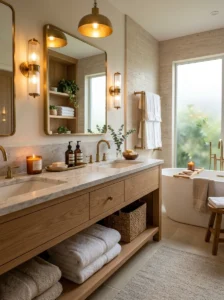
Walk into a genuinely luxurious bathroom — in a well-designed hotel, a spa, or a thoughtfully renovated home — and pay attention to what’s happening across your senses before you’ve consciously evaluated anything.
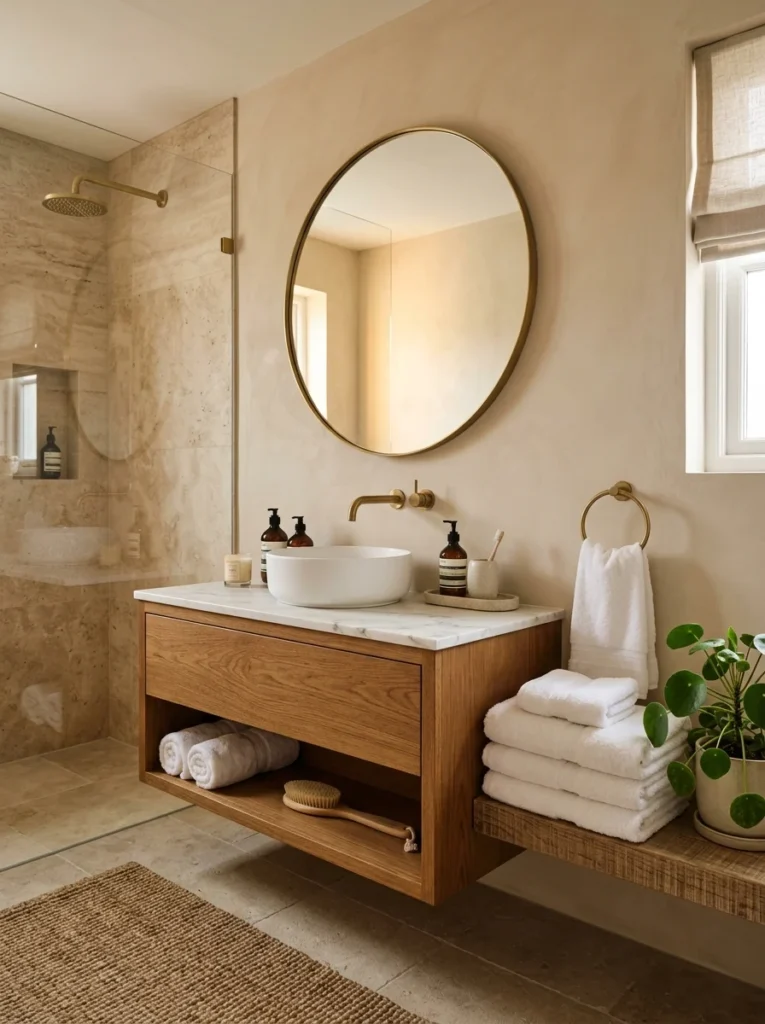
The air has a faint, clean scent. The lighting is warm and coming from more than one source. The floor doesn’t feel cold underfoot. The towel within reach is thick enough to feel substantial when you touch it. Every surface you can see is clean-lined and uncluttered. The fixtures — the faucet, the towel rail, the mirror frame — share a material logic. Nothing is competing for attention, and nothing looks like it ended up there by accident.
None of these things are large. None require a big bathroom. What they require is a specific kind of intentionality — an attention to what the room is communicating at a sensory level, rather than what it contains.
This is the working definition of bathroom luxury: an environment where every sensory input has been considered, and where the room communicates care rather than neglect or indifference.
Uncluttered Is the Non-Negotiable Starting Point
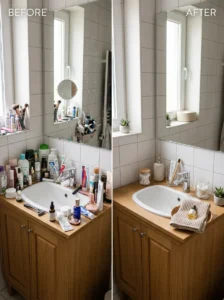
Every luxury bathroom environment — without exception — is visually uncluttered. There is no version of a luxurious bathroom that has a crowded countertop, a collection of half-empty bottles on the shower ledge, and a chaotic under-sink arrangement. The clutter-free condition isn’t one element of luxury among several. It’s the prerequisite for every other element to register correctly.
This is partly visual — a cluttered bathroom simply cannot read as luxurious because the brain is too busy processing competing visual information to settle into comfort. But it’s also functional: a bathroom where you know exactly where everything is, where every item has a home and is in it, functions more smoothly and the ease of that function contributes to the feeling of luxury as much as any aesthetic choice does.
Before purchasing a single item or making any change to a small bathroom, the first work is the edit. Remove everything from every visible surface, every shower ledge, every cabinet. Return only what is genuinely used within the last two weeks, and only in a quantity that doesn’t require stacking or crowding.
In most bathrooms, this edit alone removes enough visual noise to demonstrate what the bathroom is actually capable of feeling like. The bones become visible. The work of adding luxury becomes much smaller once the accumulation is cleared.
The Textile Quality Difference That Changes Everything
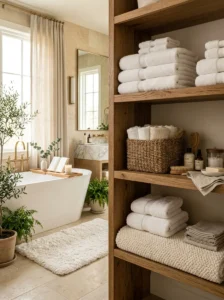
More than almost any other single change in a bathroom, the quality of the towels and bath mat changes the sensory experience of using the space.
This is not a subjective or aesthetic point — it’s physical. A towel that absorbs moisture properly, that feels substantial when held, that doesn’t scratch or pill on the skin, changes the post-shower experience in a way that the room’s color palette or tile choice doesn’t. Luxury hotels understand this completely. The towels are often the first thing guests mention, not because the towels are beautiful but because they’re physically superior to what people have at home.
The upgrade here doesn’t require spending an extreme amount. It requires replacing thin, worn, polyester-blend towels with a reasonable quantity of genuinely good ones — 100% cotton with a weight that reads as substantial when folded. Fewer, better towels stored neatly produce a considerably more luxurious bathroom than many average towels stacked haphazardly.
The same principle applies to the bath mat. A mat thick enough to genuinely cushion and insulate the foot, in a neutral or warm tone that works with the bathroom’s palette, is a different object from a thin, rubber-backed mat that compresses immediately and reads as purely functional.
Color and Display of Textiles
How towels are displayed is as important as the towels themselves. A folded stack of matching towels on an open shelf or a clean rail communicates that the bathroom is managed with care. A jumble of mismatched towels in different colors does the opposite, regardless of their quality.
A simple rule: limit towel colors to one or two tones that agree with each other and with the bathroom’s palette. Warm whites, creams, natural linen tones, and soft stone grays are the most versatile and most easily read as intentional.
Lighting: The Single Fastest Luxury Upgrade
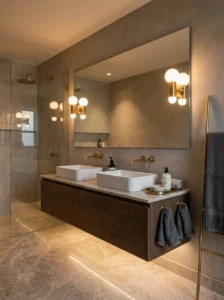
Bathroom lighting in most homes is designed for function and nothing else. A single overhead fixture, usually a bright white or cool-white LED, illuminates the room evenly and makes every surface look flat and clinical.
Luxury bathroom environments are almost never lit this way. They layer light — ambient, task, and accent — and they almost always include at least one source in a warm tone that produces the quality of light associated with comfort rather than efficiency.
The wall-mounted light or sconce flanking the mirror is the change with the most impact on how the bathroom looks and functions simultaneously. Side-mounted mirror lighting eliminates the shadowing that an overhead fixture creates on the face — the shadows under the nose, chin, and eye sockets that make any overhead-only bathroom feel like a dressing room for a horror film. Even in a very small bathroom, two small sconces flanking a mirror, or a single horizontal bar above it, produces a light quality that reads as considered.
A dimmable circuit adds the ability to shift the bathroom between full-function brightness and a quieter, warmer setting. This single feature is one of the things people notice most in well-designed bathrooms because it allows the room to feel different depending on the time of day and the purpose — bright for morning routines, softer for an evening bath or winding down.
Warmer color temperature bulbs throughout the bathroom — shifting from the cool white that most bathroom fixtures default to — change how skin reads, how tile reads, and how the room feels in total. This is a bulb swap, not a fixture change, and it costs almost nothing.
One Statement Element Instead of Many Ordinary Ones
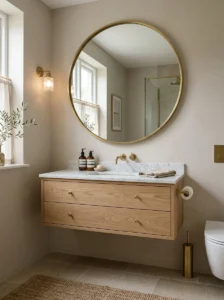
A specific principle that separates well-designed small bathrooms from ones that feel busy despite effort: the room benefits from one thing that draws the eye intentionally, surrounded by elements that stay quiet.
In a small bathroom, this statement element could be:
- A mirror with a genuinely beautiful frame — wood, unlacquered brass, an aged or textured finish — rather than a frameless builder mirror
- A single piece of art appropriately sized for the wall space, chosen with the same care as art in a living room
- Faucet and hardware in a distinctive finish — a matte black faucet on white porcelain, a brushed gold fixture in a neutral bathroom — that reads as a deliberate choice
- A wall treatment on one surface — a graphic tile behind the vanity, a painted accent, a textured panel — while the remaining surfaces stay quiet
The failure mode this principle prevents is the bathroom that has several would-be statement elements competing — an interesting mirror, colorful towels, patterned tile, decorative objects on the counter, a vibrant rug — where none of them reads as intended because they’re all fighting. One element leads. Everything else supports.
Scent: The Sensory Layer Most Bathroom Design Ignores
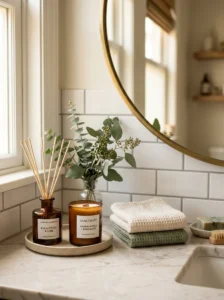
Luxury environments almost universally have a considered scent. Not perfume or heavy fragrance — something clean, faint, and consistent that registers below conscious thought as “this is a cared-for place.”
In a small bathroom, scent is more concentrated and therefore more powerful than in larger spaces. The wrong scent — a bathroom that smells musty, or has the harsh chemical note of cleaning products that weren’t properly rinsed — immediately undermines every visual upgrade.
Practical approaches that work without overwhelming a small space:
- A single reed diffuser in a clean, simple scent — eucalyptus, white tea, cedar, unscented but fresh — placed where it won’t be knocked over
- A candle used occasionally and stored neatly rather than left out as permanent décor
- Ensuring the bathroom genuinely ventilates properly after use, so no residual moisture odor develops in the grout or under the mat
- A small, living plant — pothos or a fern that tolerates humidity — which contributes a faint clean greenness and simultaneously improves air quality
Scent in a bathroom is a layer that guests always notice and hosts rarely think about. Getting it right adds something to the room that no amount of visual improvement can fully replace.
Plants: The Living Detail That Changes a Bathroom’s Character
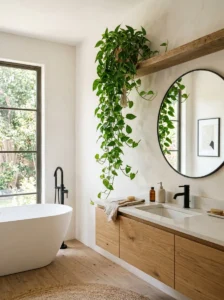
A small bathroom with one thriving plant reads as cared for in a specific way that inanimate objects can’t replicate. Something growing in a bathroom communicates that someone tends to it — that the room is maintained rather than merely cleaned.
Plants that tolerate bathroom humidity well:
- Pothos — nearly indestructible, trails beautifully from a shelf or ledge, grows well in low-to-medium light
- Peace lily — tolerates low light, produces occasional white flowers, actively filters air
- Ferns — particularly Boston fern, thrive in the humidity a shower produces and look particularly lush
- Bamboo in water — requires no soil, works on a counter or windowsill, very low maintenance
The placement matters. A plant on the floor reads as practical. A plant on a shelf at eye height or trailing from a higher position reads as decorative and intentional. In a small bathroom, a single well-placed plant in the right pot for the room’s aesthetic — a simple ceramic, a natural woven basket liner, something that doesn’t shout — is more than sufficient.
The Details That Signal Quality at Close Range
In a small bathroom, everything is close. There’s no distance at which details disappear into the background the way they might in a larger room. This means the signals of care and quality — or the absence of them — are visible at the range where they register most strongly.
The specific details worth addressing before anything else:
Caulk lines — yellowed, cracked, or visibly separating caulk around the tub, shower, sink, and floor edges is one of the strongest signals of a neglected bathroom. Fresh, clean caulk lines are a several-hour project that costs the price of a tube of caulk and produce a dramatic visible result.
Grout condition — discolored or deteriorating grout ages tile visually faster than almost anything else. A deep clean with a grout-specific cleaner, or regrouting where the condition has deteriorated past cleaning, changes the read of the tile entirely.
Hardware consistency — as with kitchens, a bathroom where towel rails, toilet hardware, faucet, and mirror frame are all in different metal finishes reads as accumulated rather than designed. Consistent hardware finish is one of the cheapest and most effective cohesion improvements available.
Clean, matching accessories — a soap dispenser, toothbrush holder, and any other countertop item in consistent materials or tones reads as considered. Mismatched plastic dispensers and worn accessories tell a different story about how much care the room receives.
Key Takeaways
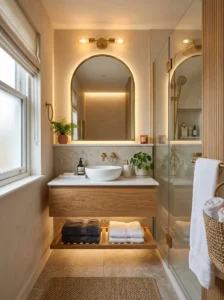
- Luxury in a bathroom is made of specific sensory signals, not square footage — these signals are learnable and replicable in any size space
- Uncluttered is the prerequisite, not one option among many — no luxury reading is possible in a visually chaotic room
- Towel and bath mat quality is the most physically felt upgrade in a bathroom — fewer, better textiles in consistent colors produce a measurable sensory difference
- Layered lighting with at least one warm source, a dimmable option, and side-mounted mirror lighting changes both function and atmosphere significantly
- One intentional statement element with quiet supporting elements reads as designed; multiple competing elements read as busy
- Scent is a layer that luxury environments never ignore and home bathrooms almost always do
- Close-range details — caulk, grout, hardware consistency — signal care or neglect at the distance small bathrooms create with every surface
Frequently Asked Questions
Do I need to renovate to make a small bathroom feel luxurious? In most cases, no. The elements that create a luxury feeling in a bathroom — quality textiles, layered lighting, an uncluttered environment, consistent hardware, a single well-chosen plant, fresh caulk and grout — are all achievable without structural change. Renovation can raise the ceiling of what’s possible, but it’s not required to produce a meaningfully more luxurious experience from the room as it currently exists.
What’s the fastest single change that makes a small bathroom feel more luxurious? Replacing the overhead fixture with warmer-temperature bulbs and adding a mirror light or sconce costs relatively little and changes the room immediately and completely. Second to that: replacing worn, mismatched towels with a set of quality matching ones in a warm neutral tone. Both changes take less than an afternoon and change the sensory experience of the room every day.
How do I make a small bathroom look bigger and feel more luxurious at the same time? These two goals share a common solution set: clear surfaces, consistent light-toned materials, large mirrors, and vertical lines rather than horizontal divisions. The changes that make a small bathroom read as larger — more visual coherence, less clutter, light-reflecting surfaces — are almost identical to the changes that make it feel more luxurious. They’re mutually reinforcing rather than competing goals.
Can I add luxury to a bathroom I’m renting and can’t change structurally? Almost entirely yes. The luxury signals that have the most impact — textiles, lighting (within existing fixtures), scent, plants, uncluttered surfaces, consistent accessories, a quality bath mat — are all moveable and don’t require any structural change. A frameless mirror swap or new hardware involves a small amount of installation but is reversible. The room that can’t be renovated can still be furnished and maintained with the deliberateness that luxury environments require.
How important is the toilet and vanity to the overall luxury feeling? Less important than most people assume. A dated toilet or vanity in a room that’s otherwise uncluttered, well-lit, and furnished with care reads considerably better than a renovated toilet and vanity in a room that’s visually chaotic and poorly maintained. The permanent fixtures set the floor of what’s possible, but how the room is managed day to day determines how it actually reads. Clean, functioning fixtures in a beautifully maintained room feel more luxurious than premium fixtures in a neglected one.