

A bathroom that always feels cold is usually two separate problems happening at once. Here’s how to identify which one you’re dealing with — and how to fix both without a full renovation.Six in the morning, the middle of January. You step out of the shower into a bathroom that’s technically the same temperature as the rest of the house, and it still feels ten degrees colder. The towel is cold. The floor pulls heat out of your feet the moment you stand on it. The mirror is fogged and the room has a particular chill that a warm shower never quite manages to resolve.
Most people assume this is just what bathrooms are. They’re tiled rooms. They’re ventilated. They’re small. Of course they’re cold.
Except some bathrooms aren’t. There are bathrooms that feel genuinely warm — not overheated, just comfortable — where stepping out of a shower doesn’t feel like stepping outside. The difference between those bathrooms and the one described above is almost never the building or the climate. It’s a set of specific, addressable problems that most bathrooms have and most people live with indefinitely because nobody explained what’s actually causing the chill.
The Two Types of Cold a Bathroom Can Have
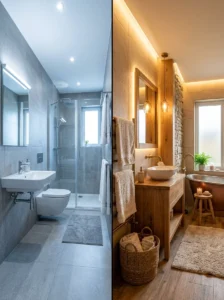
This is the starting point, because the fix for one type doesn’t work on the other, and most bathrooms have both happening simultaneously.
Physical cold is about actual temperature — air that genuinely is colder than the rest of the house, surfaces that conduct heat away from the body rapidly, ventilation that removes warm humid air and replaces it with cooler air. This is a thermal problem with thermal solutions.
Perceptual cold is about how the room reads visually and materially — the blue-white light, the expanse of hard tile, the absence of soft materials, the clinical feel of a room that functions beautifully but doesn’t feel warm to be in. This is a design problem with design solutions.
The reason most bathrooms feel cold even after thermal problems are addressed is that the perceptual dimension remains untouched. And the reason some people renovate their bathroom and still find it chilly is that they addressed the aesthetics without addressing the thermal reality underneath.
Getting both right produces a bathroom that’s actually comfortable. Getting only one right produces a bathroom that’s warmer on paper or warmer on a paint chart, but still cold to wake up in.
The Physical Cold: Where the Heat Is Actually Going
The Floor Is the Biggest Single Problem
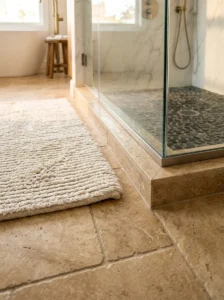
Tile is a highly conductive material. When you step on it barefoot, it draws heat away from your body rapidly — not because it’s cold in absolute temperature terms, but because of how quickly it conducts thermal energy away from the point of contact. The perceived coldness of a tile floor is significantly more intense than the actual air temperature in the same room.
This single material property is responsible for a large portion of bathroom cold complaints, and it has two reliable solutions:
Underfloor heating (radiant floor heating) is the complete solution — electric heating elements installed beneath the tile that bring the floor surface to a comfortable temperature. In many bathrooms, underfloor heating is the single most transformative comfort upgrade available. The floor stops drawing heat from your feet and instead provides gentle warmth across the entire surface. It’s available as a retrofit in most tiled bathrooms and is less expensive to install than most people assume — the materials for a bathroom-sized area are relatively affordable, with the primary cost being the labor of tile removal and reinstallation if the existing tile is staying.
A quality bath mat is the immediate, low-cost solution. Not the thin rubber-backed mats that compress to almost nothing within months, but a substantial, thick mat that genuinely insulates the foot from the tile surface. A well-made bath mat placed at the point of exit from the shower — where bare feet first meet the floor — removes the most acute cold sensation without any installation at all.
Ventilation Is Removing the Warmth You Just Created
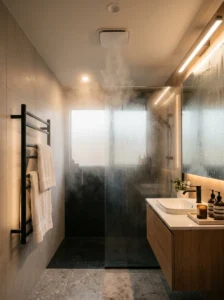
This is the thermal paradox most bathrooms operate under: the ventilation fan that removes steam and humidity is also removing the warm, humid air that the shower generated and replacing it with cooler air from the rest of the house or from outside.
The fan is necessary — without adequate ventilation, bathrooms develop mold, mildew, and moisture damage to surfaces and structure. But running the fan during the shower and immediately after without any thermal offset means the bathroom air temperature has dropped significantly by the time you step out.
Two adjustments that help without compromising ventilation function:
Run the fan after you’ve dried and left, rather than during the shower. The fan’s job is primarily to remove the residual moisture after bathing, not necessarily to run throughout. Running it for fifteen to twenty minutes after the shower rather than during keeps more warm air in the bathroom during the period when you’re most exposed.
A heated towel rail or a small bathroom-rated radiant panel provides an independent heat source that compensates for what the ventilation removes. A heated towel rail serves double duty — warming towels and providing low-level background heat — and in many bathrooms is enough to maintain a comfortable ambient temperature throughout the morning routine.
Towel Temperature: The Detail That Changes the Whole Experience
A cold towel applied to a warm, wet body after a shower drops the body’s surface temperature immediately and intensifies the sense of cold in the room, regardless of the air temperature.
A heated towel rail, even one that doesn’t dramatically change the room’s ambient temperature, produces warm towels that fundamentally change the post-shower experience. This is not a luxury — it’s a direct fix for one of the most acutely uncomfortable aspects of a cold bathroom. Small, wall-mounted heated towel rails are available across a wide price range and can often be installed without professional help in bathrooms that already have a nearby electrical outlet.
Drafts and Gaps: The Less Obvious Heat Loss
In older bathrooms particularly, cold air can enter through gaps around window frames, under doors, or through poorly sealed penetrations in exterior walls. These drafts are easy to overlook because they’re not visually obvious, but they continuously replace the warm air generated by the shower with cooler air from outside.
A simple draft check: hold a thin strip of paper near window frames, the gap under the door, and any visible penetrations in exterior walls. Movement indicates a draft. Weatherstripping, draft excluders, and gap sealant address these inexpensively and can make a meaningful difference in bathrooms on exterior walls, particularly older construction.
The Perceptual Cold: Why the Room Reads as Chilly Even When It Isn’t
The Tile Problem — and What to Do Without Replacing It

Large expanses of hard, smooth, cool-toned tile are the primary visual source of bathroom coldness. White, gray, and blue-toned tile reads as cold because those tones are associated with cold environments at a deep perceptual level. The glossy surface of most tile compounds this by reflecting light in a way that reads as clinical rather than warm.
Replacing tile is expensive and disruptive. But the visual impact of tile can be significantly modified without touching the tile itself.
Warm-toned grout — where tile replacement isn’t planned — adds warmth at the lines between tiles, which are more visually present than people realize until they change them. A cool white grout between white tiles reads colder than a warmer ivory or greige grout between identical tiles. Regrout alone can shift the warmth perception of a tiled surface measurably.
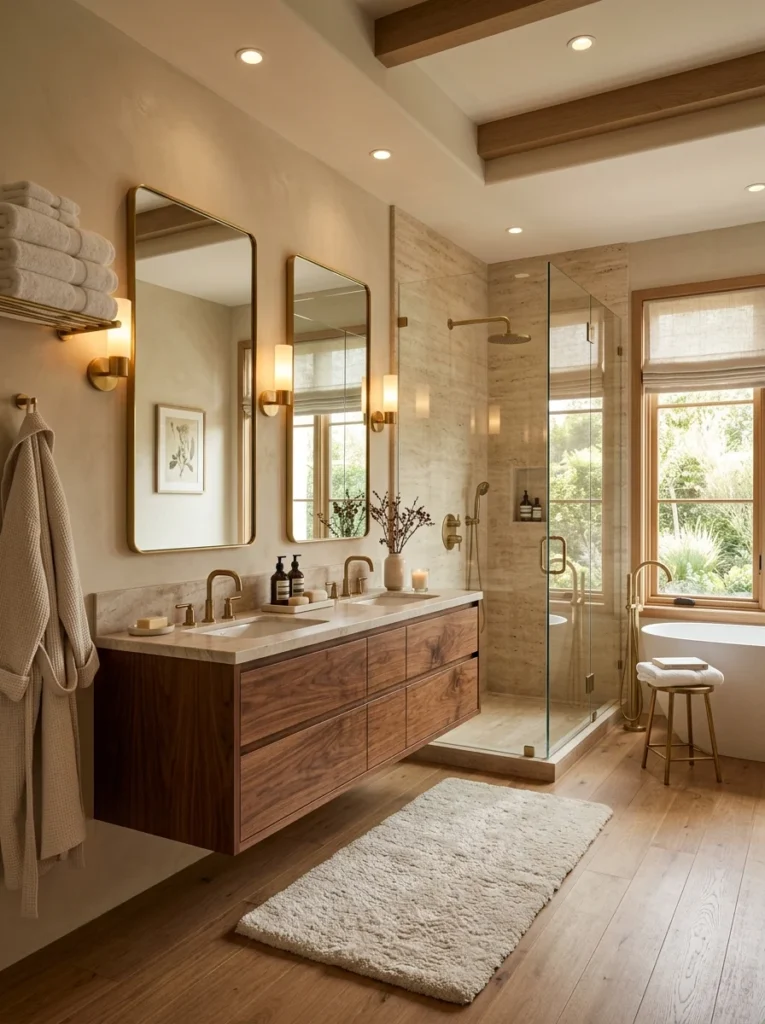
Soft furnishings against hard tile create contrast that visually softens the room. A substantial bath mat, a linen window treatment, towels in warm neutral tones rather than cool white — each of these reduces the proportion of the visual field occupied by hard, cool tile.
Wooden elements — a teak bath mat, a wooden stool, a wooden shelf — interrupt the all-hard, all-tile visual field with organic material that reads as warm by nature. Even a small wooden accessory in a heavily tiled bathroom visually anchors the room differently.
Lighting: The Fastest Visual Warmth Fix

Bathroom lighting is almost universally cool-toned — bright white or blue-white light that provides clear illumination but removes every trace of warmth from the space. Under this light, skin looks slightly pallid, tile looks colder than it is, and the room reads as clinical regardless of the material choices.
Switching to bulbs in a warmer color temperature — not so warm that the room goes dim and amber, but enough to shift the light toward a more natural, flattering white — changes how every surface in the room reads. The tile looks warmer. The skin tone looks healthier. The room feels less like a lab.
A dimmer on bathroom lights adds a second dimension: the bright functional light available when needed for detail tasks, and a softer, warmer setting for the post-shower routine or early morning use when the harsh bright light actively contributes to the cold, jarring feeling of a bathroom at that hour.
Mirrors and Their Role in Perceived Temperature
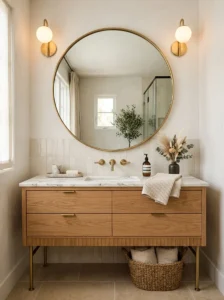
A large bathroom mirror reflects whatever is across from it — usually more tile. In a heavily tiled bathroom, the mirror doubles the perceived amount of hard, cold surface by reflecting it back across the room.
The perception shift available here isn’t about changing or removing the mirror — mirrors are functionally necessary and visually expand small bathrooms. It’s about what surrounds the mirror. A mirror framed in a warm material — wood, brushed brass, an aged metal — reads differently than the same mirror frameless or in a chrome frame. The frame changes the character of the largest single reflective surface in the room.
Color and Paint in the Non-Tiled Zones
Most bathrooms have at least some painted surface — a ceiling, the upper half of a wall above tile, a section around a window. In heavily tiled bathrooms, these painted areas are a small proportion of the total visual surface, but their color still affects the room’s perceptual temperature.
Cool-toned paint — blue-white, gray, or stark white — in these areas reinforces the cold reading of the tile. Warm white, soft cream, or any paint with a warm rather than cool undertone counteracts it even in a small area.
The ceiling in particular is often painted the same cool white as the walls without consideration, when a warmer ceiling tone — even just one tone warmer than the walls — would visually close the room in a comfortable way rather than leaving it feeling open and cold overhead.
Textiles: The Highest Warmth-Per-Dollar Category in a Bathroom
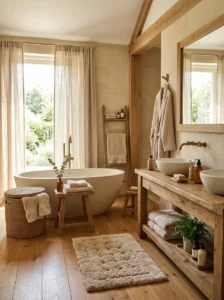
A bathroom is a room where almost every surface is hard, cold, and impermeable by necessity. Adding soft materials — fabric, fiber, anything that drapes, folds, or compresses underfoot — has disproportionate visual impact precisely because it’s introducing a category of material almost entirely absent from the room’s default palette.
The specific textiles that do the most work in a bathroom:
- Towels in warm, earthy tones — cream, linen, soft terracotta, warm gray — rather than stark white or cool blue. Hung where they’re visible, they’re a significant warm element in the visual field.
- A window treatment — even a simple linen or cotton panel, or a Roman shade in a warm neutral — covers the cold glass and frame of a window and replaces a hard, reflective surface with a soft, warm-toned one.
- A substantial bath mat — thick enough to insulate as well as look warm. Jute, wool, or a thick cotton loop pile all read as warm in addition to functioning as thermal insulation between the foot and the tile.
None of these are expensive, and together they change the proportion of soft-to-hard material in the room enough to measurably shift how the bathroom reads at a glance.

Key Takeaways
- Bathroom coldness is almost always two separate problems: physical temperature loss and visual/perceptual coldness — both need addressing for the room to feel genuinely warm
- Tile floor conductivity is the most acutely uncomfortable physical cold source — underfloor heating solves it completely; a quality bath mat solves the acute feeling immediately
- Ventilation removes warm air — running the fan after bathing rather than during, combined with a heated towel rail, maintains more warmth during the period of greatest exposure
- Warm towels are not a luxury — they address one of the most physically cold moments in the bathroom routine and change the overall experience significantly
- Light color temperature is the fastest visual warmth fix — warm white bulbs plus a dimmer transform how every surface in the room reads
- Textiles — towels, bath mats, window treatments — have disproportionate warmth impact because they’re introducing a soft material category almost entirely absent from the room’s default palette
- Wood or warm-metal accents interrupt the all-hard-all-tile visual field and anchor the room’s warmth reading
Frequently Asked Questions
Is underfloor heating expensive to run in a bathroom? Less than most people expect. A bathroom is a small space, and electric radiant floor heating in a typical bathroom uses roughly the same power as a hair dryer while operating. Most people run it on a timer — set to warm the floor in the hour before typical morning use — rather than continuously, which keeps running costs modest. The upfront installation cost varies significantly depending on whether existing tile needs to be removed, but the ongoing operational cost is rarely a concern once installed.
What’s the minimum change that makes a cold bathroom meaningfully warmer? For physical warmth: a heated towel rail and a thick bath mat address the two most acute cold moments — the cold towel and the cold floor — without any structural change. For perceptual warmth: replacing the light bulbs with a warmer color temperature and adding warm-toned towels costs almost nothing and changes how the room reads immediately. Together, these four changes are the minimum viable update for a bathroom that feels cold.
Does painting bathroom walls a warm color actually make the room feel warmer? In bathrooms that are heavily tiled, the painted area is a small proportion of the total visual surface, so paint color has less impact than in a room with more painted walls. It still contributes — particularly at the ceiling and in any significant wall areas above tile — but it’s one of several changes rather than a standalone fix. In bathrooms with more painted surface than tile, color choice has a more significant effect.
Why does my bathroom feel cold even though the thermostat reads the same temperature as the rest of the house? Because thermostat readings measure air temperature, and bathroom coldness is substantially about surface temperature rather than air temperature. Tile floors and walls are in contact with the air but have different thermal properties — they conduct heat away from the body rapidly on contact, which the air temperature reading doesn’t capture. A bathroom can be the correct air temperature and still feel significantly colder than adjacent rooms because of the thermal conductivity of the surfaces in it.
Can a bathroom feel warm without underfloor heating or major renovation? Yes, and for most bathrooms, the non-renovation fixes produce a meaningful enough improvement that underfloor heating remains optional rather than necessary. The combination of a heated towel rail, a quality bath mat, warmer lighting, warm-toned textiles, and a draught check on windows and doors addresses the majority of bathroom cold complaints without touching the structure. Underfloor heating is the complete solution to floor coldness — but it’s the premium solution, not the only one.