

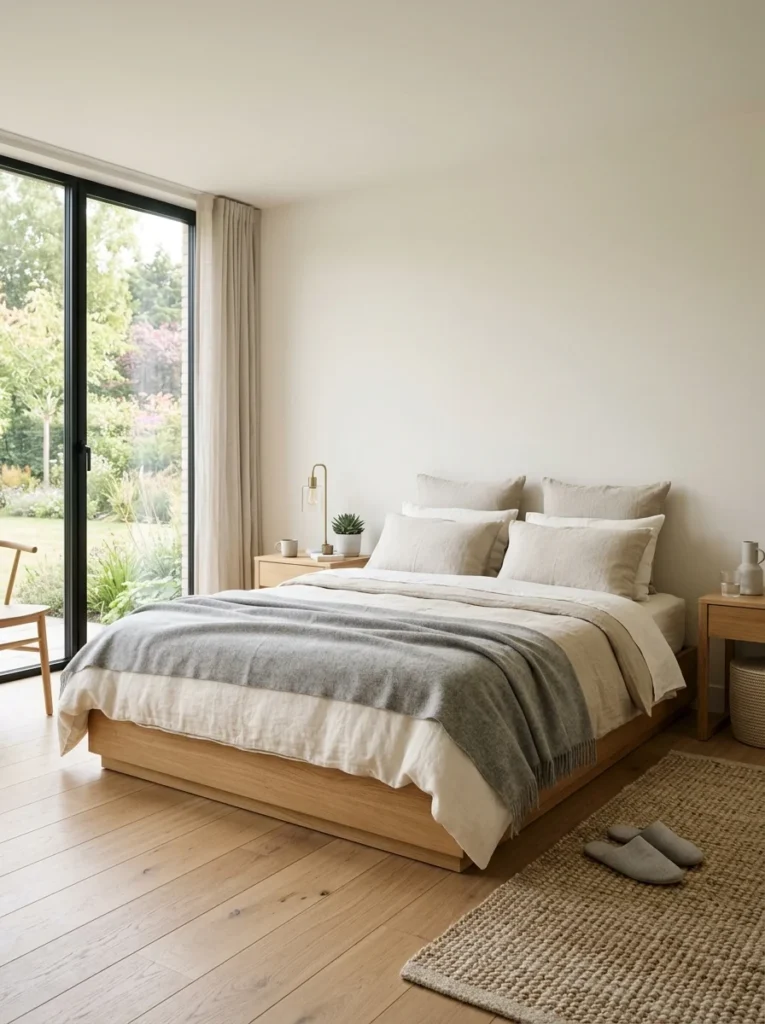
A bed without a headboard is visually unfinished — but there are specific approaches that create the wall relationship and visual anchor a headboard provides. Here’s what works.A bed without a headboard is not a finished bed. That’s not a stylistic opinion — it’s a structural description. The headboard is what visually connects the bed to the wall behind it, anchors the sleeping zone as a distinct space within the room, and gives the eye somewhere to arrive when looking at the bed from the doorway. Without it, the wall above the bed is an unrelated surface, and the bed floats against it without connection — present in the room, but not belonging to it.
This sounds bleak if you currently have a bed without a headboard, or if you’ve deliberately chosen a minimal bed frame that doesn’t include one. It shouldn’t. “Not finished” is a starting point, not a permanent condition. Everything a headboard provides — wall relationship, visual weight at the bed’s head, a defined zone around the sleeping area — can be created through other means. The difference is that these substitutes require more deliberate thought than buying a headboard does, and each works under different conditions.
This article is the honest version of headboard-alternative advice: what actually works as a visual substitute, what the limitations of each approach are, and what each requires to be effective rather than just present.
What the Headboard Is Actually Doing
Before looking at alternatives, understanding precisely what function th
e headboard serves makes it clearer which substitutes can replicate which parts of that function.
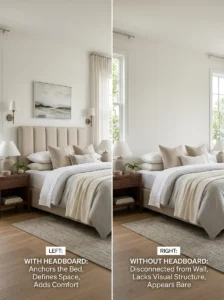
It anchors the bed to the wall. The headboard creates a visual connection between the horizontal sleeping surface and the vertical wall — the bed reads as being against the wall rather than placed in front of it.
It provides visual weight at the head of the bed. The sleeping zone needs visual mass at the top to be balanced — without it, the lower half of the bed (the duvet, the footboard or frame) has all the visual weight, and the arrangement reads as bottom-heavy.
It defines the head of the bed as distinct from the foot. A bed with no headboard and no footboard is a rectangle that has no visual beginning or end. The headboard creates directionality — the head is here, the foot is there.
It provides scale and proportion at eye level. The wall above a bed occupies the eye-level zone when viewed from across the room. A headboard fills this zone proportionally. Without it, a disproportionate amount of empty wall exists at the position where the eye naturally arrives.
Effective headboard alternatives do most or all of these. Ineffective ones do only some, or do them at the wrong scale.
Large-Scale Art: The Most Accessible Substitute

A large piece of art hung above the bed — centered on the sleeping zone and sized to provide visual weight comparable to what a headboard would — is the most accessible headboard substitute and the one most consistently effective.
The sizing requirement: the art should be a minimum of two-thirds the width of the mattress and wide enough that it reads as the wall’s anchor point rather than as a piece floating on the wall above the bed. For a queen bed, this means a minimum of roughly 38-40 inches wide; for a king, 50 inches or wider. Smaller art above a bed reads as an inadequate substitute — the proportional gap between the bed’s size and the art’s size is what the eye reads as “not enough.”
The hanging height: the bottom of the art should be approximately 8-10 inches above the top of the pillow line (roughly where the headboard top would be). Art hung too high loses the connection to the bed; art hung too low risks being damaged by pillows or obscured by bedding.
What makes this work: a single large piece rather than a collection of small ones. Multiple small pieces at the headboard position read as a gallery wall, not as a headboard substitute — they have different visual weight distribution and don’t anchor the head of the bed with the same solidity. One large piece does.
What limits this: art is fragile in that position — dust from pillows, potential contact damage. A canvas or metal print is more practical than glass-framed works directly above the sleeping position.
Gallery Wall Above the Bed: When It Works and When It Doesn’t

A gallery wall above the bed is different from a large single piece in how it functions as a headboard substitute — and understanding the difference determines when each is appropriate.
A gallery wall provides visual weight and complexity through multiple elements, which can be effective but requires that the grouping be treated as a single large element rather than as multiple individual pieces.
The conditions for a gallery wall to substitute for a headboard:
- The outer dimensions of the grouping should be at least as wide as the bed (for a queen, at least 60 inches total span)
- The grouping should be dense enough that the eye reads it as one composed element, not as scattered art
- The bottom edge of the grouping should align approximately where a headboard top would be
- A consistent frame finish across all pieces helps the grouping read as unified
When a gallery wall fails as a headboard substitute: when the outer dimensions are too narrow for the bed width, when the pieces are too spread out and don’t read as one grouping, or when the variety of frames, sizes, and styles reads as random accumulation rather than composed collection.
Wall Treatment Behind the Bed: The Most Architecturally Convincing Substitute

A wall treatment applied only to the wall behind the bed — a different paint color, a wallpaper, a wood panel treatment, a limewash or plaster finish — creates the visual distinction between the headboard wall and the surrounding walls that a headboard provides, without requiring the headboard itself.
This is the approach most commonly used in professionally designed bedrooms that forego a traditional headboard, because it’s permanent, architectural in feeling, and produces the zone-definition that a headboard creates in a way that art doesn’t.
How it works: the headboard wall in a different finish reads as the bed’s designated wall — the place the bed belongs — in a way that a white wall with art on it doesn’t quite achieve. The treatment is the anchor. The bed reads as placed against this specific wall intentionally.
Specific approaches:
- Paint in a deeper tone: the most accessible option. A headboard wall painted in a tone two to three shades deeper than the other walls creates the visual distinction without wallpaper expense or installation.
- Wallpaper on the headboard wall only: a deliberate wallpaper accent wall behind the bed is architecturally convincing and can be as calm or expressive as the aesthetic requires. A subtle texture, a tonal pattern, or a botanical print all work — the key is that the pattern is on the headboard wall and nowhere else.
- Wood panel treatment: horizontal or vertical wood slats, a shiplap-style treatment, or wood-look wall panels create a warm, tactile headboard wall that reads as specifically designed for the sleeping zone.
- Limewash or textured plaster finish: applied only behind the bed, these finishes create a visual texture that distinguishes the headboard wall without a specific color choice.
The limitation: wall treatments are more commitment than a headboard — they require work to change, and painting over wallpaper has its own complications. For renters or anyone uncertain about permanence, other approaches may be more suitable.
Floating Shelves at Headboard Height
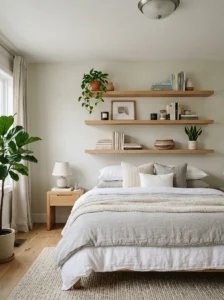
Two floating shelves on either side of the bed’s center — positioned at approximately headboard height, extending from where the headboard sides would be toward the center — create a frame effect around the head of the bed without a traditional headboard.
This approach works best with shelves that have some visual weight to them — a solid wood shelf rather than a thin metal bracket shelf — and works best when the shelves hold specific items (small plants, a lamp, a single object) rather than being empty or overloaded.
The visual logic: the two shelves create the framing function of a panel headboard’s sides, defining the head zone even without the solid central panel. The bed reads as placed within the frame the shelves create.
The limitation: floating shelves at headboard height can collect dust easily, and objects on shelves above a sleeping position (particularly heavy objects) require secure mounting. This approach suits renters who can mount shelves but can’t install a headboard, and households with adults who don’t mind the upkeep.
Woven and Textile Wall Hangings
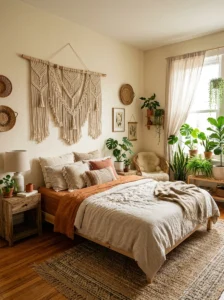
A large macramé, woven tapestry, or textile hanging centered above the bed, sized to provide adequate visual weight, creates warmth and texture at the headboard position that a piece of art or a shelf doesn’t.
What makes textile hangings work: size large enough to anchor the bed (the sizing rules from the art section apply here), a hanging position low enough to read as connected to the bed rather than floating on the wall above it, and a material that adds warmth and texture to the sleeping zone rather than just visual pattern.
What makes them fail: undersizing is the most common problem — a small macramé piece above a queen bed reads as decorative accent rather than headboard substitute. Insufficient visual weight is the second — a loose, sparse weave that doesn’t have enough visual mass to anchor the bed position.
The aesthetic range: this approach suits specific aesthetics — bohemian, natural, warm — more than others. A macramé hanging above a minimalist bed in a contemporary room creates a style conflict rather than a design solution. The textile hanging’s warmth and texture need to suit the room’s direction.
Sconce Lights as Structural Elements

Wall-mounted sconces on either side of the bed, positioned at headboard height, don’t substitute for a headboard visually but they do create a structural relationship between the wall and the bed — the sconces mark the bed’s position on the wall and provide the functional directional light that a table lamp on a small nightstand would otherwise provide.
Two sconces flanking the bed, with some visual weight to them (substantial shades, visible hardware), contribute to the sense that the bed belongs in that specific wall position without a physical headboard. They don’t fully replace the headboard’s visual mass, but they supplement other approaches (a wall treatment, art, or a textile hanging) by adding a functional architectural element.
The practical benefit: swinging arm sconces mounted at the wall free up the nightstand’s entire surface — no lamp base, no lamp cable — which is particularly valuable on small nightstands.
Temporarily: The Bed Against the Wall
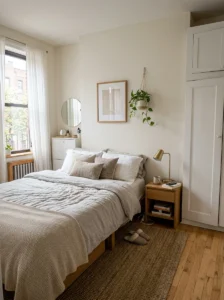
The simplest short-term approach for a headboard-less bed: position the bed with one side against a wall, so the side wall provides physical support and some visual relationship. This works better than floating the bed away from all walls, and the adjacent wall can hold art or a shelf that partially substitutes for the missing headboard.
This is a transitional approach rather than a designed solution, and it works best in smaller bedrooms where the single-side-wall configuration doesn’t create awkward asymmetry in the room’s layout.
The Honest Assessment: When to Get a Headboard Instead
All of the above approaches work under specific conditions. Each has real limitations. And for many bedrooms, the most honest advice is the one the previous article already gave: a headboard is the cleaner, more structurally complete solution that accomplishes in one purchase what several of these substitutes accomplish with more effort and less certainty.
If the reason for not having a headboard is budget: a simple upholstered headboard (just the headboard panel, not a bed-and-headboard set) can be found at low to moderate prices, can be installed against most bed frames, and produces a clearer result than most of the alternatives at comparable cost.
If the reason is renting and not wanting to install one: fabric headboards that stand independently or are tied to the bed frame slats require no installation.
If the reason is aesthetic preference for a minimal, low-profile look: a headboard wall treatment is the most effective substitute.

Key Takeaways
- A bed without a headboard lacks visual anchoring to its wall — the alternatives work by creating the same wall relationship and visual weight through different means
- Large-scale art above the bed (minimum two-thirds the bed’s width) is the most accessible substitute; undersized art makes the absence of a headboard more obvious, not less
- A gallery wall works as a headboard substitute when its outer dimensions span the bed’s width and the grouping reads as one composed element
- A wall treatment on the headboard wall alone — a deeper paint color, wallpaper, wood panels — is the most architecturally convincing substitute, because it creates zone differentiation at the structural level
- Floating shelves at headboard height create a frame effect without a solid panel, but require secure mounting and upkeep of displayed items
- Textile wall hangings suit specific aesthetics and require adequate size to work — undersized pieces make the bed look incomplete
- Sconces mounted at headboard height add structural relationship between bed and wall, and are most effective as supplements to other approaches
- For many headboard-less bedrooms, the clearest and most efficient solution remains purchasing a headboard

Frequently Asked Questions
Can a regular headboard be added to a bed frame that didn’t come with one? Yes, in most cases. Standard headboards are designed to attach to a bed frame using bolts through pre-drilled holes that most frames include at the head end. A universal headboard bracket is available where the frame’s bolt positions don’t match the headboard’s. Headboard-only purchases (not a bed set) are widely available at furniture retailers, ranging from simple wood or metal options to upholstered panels.
What size art is actually needed above a queen vs king bed? For a queen (60″ wide): the art should be at minimum 40 inches wide, ideally 48-54 inches for better visual balance. For a king (76″ wide): the art should be at minimum 50 inches wide, ideally 60 inches or wider. The measurement that matters is the art’s width relative to the mattress width, not the frame or overall bed width including side tables.
Does a floating or platform bed look worse without a headboard than a traditional frame? In some ways, yes. A traditional frame with visible legs has a lighter, airier profile that the absence of a headboard is less visually prominent against. A floating or low-profile platform bed has more visual mass already — the bed reads as a substantial horizontal element — and the absence of anything at the head is more noticeable because there’s more bed to contrast against. Platform beds without headboards particularly benefit from strong headboard-wall treatment to compensate.
Is a DIY headboard a realistic option for someone without woodworking skills? Yes, with the right approach. The most DIY-accessible headboard options: a large piece of plywood cut to size and wrapped in fabric or foam-and-fabric (a truly achievable project), a set of wooden boards painted or stained and mounted as a board-and-batten headboard panel, or a premade headboard panel purchased and finished with paint. These approaches require minimal tools and produce results comparable to mid-range purchased headboards.
Does the style of headboard substitute need to match the rest of the bedroom? The substitute needs to be aesthetically compatible with the room’s direction, not identical to it. Art above a contemporary bed should have contemporary character. A textile hanging suits a warmer, more organic aesthetic than a minimalist one. A wood panel wall treatment suits bedrooms with natural material elements better than those without. The test is whether the substitute reads as chosen for this specific room or as an available option placed here by necessity.