


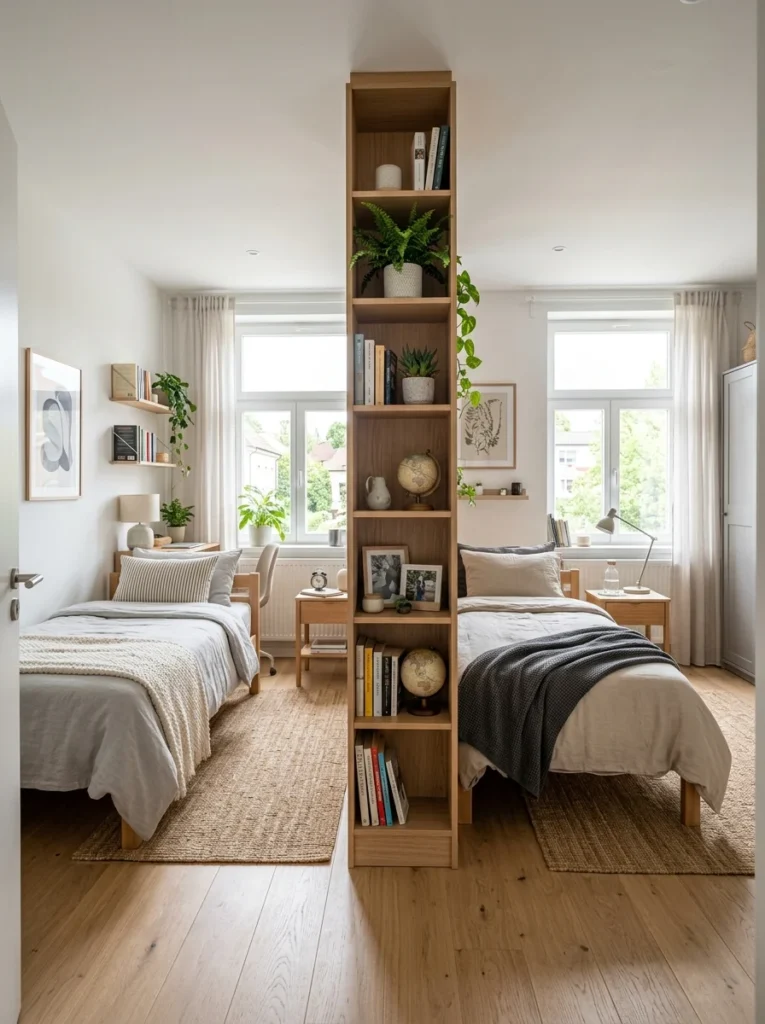
A shared bedroom has to serve two different people’s needs from one room, which is a different problem than zoning an open living space. Here’s how to divide it so it actually works for both.
A shared bedroom — two siblings, two roommates, sometimes two partners with meaningfully different schedules or preferences — has a specific challenge that the open-plan zoning discussed elsewhere in this series doesn’t fully address: a living room shared between functions mostly needs to separate activities, but a shared bedroom needs to separate two individual people, each with their own preferences, possessions, and need for some sense of personal territory within a single room. This is a more personal, more sensitive version of the zoning problem, and getting it wrong tends to create ongoing daily friction rather than just a visually unresolved room.
Physical Division Gives Each Person Something the Room Otherwise Can’t
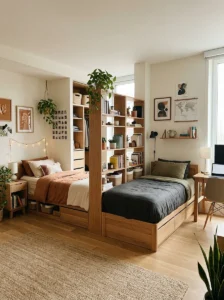
A visible, physical boundary — even a partial one — gives each person a genuine sense of their own defined space within a shared room, which matters more in a bedroom than in almost any other shared space, given how personal and how frequently used a bedroom is. This doesn’t require a full wall; partial dividers accomplish most of the psychological benefit of a boundary without the cost or permanence of construction.
A bookshelf, positioned perpendicular to the room’s length and open on both sides, functions as a partial wall while still adding storage capacity to a room that likely needs it for two people’s belongings. This is generally the most practical divider option for a shared bedroom, since it does real functional work — storage — in addition to its dividing function, rather than being purely a boundary marker.
A curtain, hung from a ceiling-mounted track, provides a fully closable divider that can be opened during the day for a more connected, open room and closed at night or when privacy is wanted — offering more flexibility than a fixed divider, at a considerably lower cost than a permanent wall or partition.
A folding screen offers similar flexibility to a curtain with a more solid, opaque boundary when closed, and the advantage of being fully repositionable without any ceiling mounting or installation.
Symmetry Solves Fairness; Individuality Solves Belonging — Both Matter
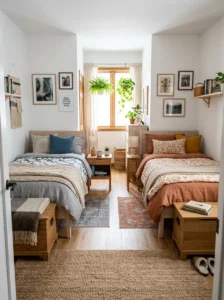
A shared bedroom benefits from a genuinely symmetrical baseline — matching furniture, equal floor area, equal storage capacity for each person — since an unequal division, even if unintentional, tends to become a source of ongoing friction between two people sharing the same room. This is worth being deliberate about from the outset, particularly for children sharing a room, where perceived unfairness in the division is a common and persistent source of conflict that’s easier to avoid at the planning stage than to resolve after the fact.
Within that symmetrical baseline, each person’s individual zone benefits from being visibly and meaningfully personalized — their own art, their own bedding choice, their own arrangement of personal objects — since a shared room that’s identical on both sides in every detail can feel less like each person’s own space and more like an undifferentiated shared area that happens to be split in half. The combination of equal structure with individual personalization tends to work better than either pure symmetry or pure individuality alone.
This same principle — equal footing with room for individual expression — applies to color and finish choices as much as furniture. A shared accent wall color, with each side’s bedding, art, and personal objects allowed to vary more freely, is a common and effective way to give the room a cohesive shared identity while still letting each occupant’s side feel genuinely their own.
Storage Needs to Be Clearly and Fairly Allocated
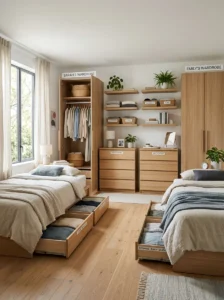
As covered in more detail elsewhere in this series regarding bedrooms without adequate closet space, storage is already a common bedroom constraint, and a shared bedroom compounds this by needing to fit two people’s belongings into what’s often the same total storage capacity a single occupant’s bedroom would have.
Clearly assigned storage — each person’s own section of closet, their own dresser or set of drawers, their own defined storage zone — prevents the ongoing ambiguity and minor conflict that comes from shared, undivided storage in a room occupied by two people with their own separate belongings. This is worth establishing explicitly rather than assuming it will sort itself out naturally, particularly in a room shared by children or by roommates who aren’t otherwise closely coordinating their daily routines.
Vertical storage solutions and under-bed storage, covered in more detail elsewhere in this series, are particularly valuable in a shared bedroom specifically, since the room’s total storage capacity needs to serve two people rather than one, and any storage that doesn’t consume additional floor space is proportionally more valuable in this context than in a single-occupant bedroom.
Lighting and Environmental Control Need to Accommodate Two Different Preferences
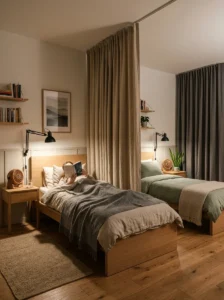
Two people sharing a bedroom frequently have different preferences around light, temperature, and even bedtime schedule, and a shared bedroom’s environmental controls need to accommodate this rather than forcing a single compromise setting that doesn’t fully satisfy either person.
Individual bedside lighting on separate switches, rather than a single shared overhead fixture as the only light source, allows one person to have reading light while the other sleeps, which is a genuinely practical necessity in a room shared by two people on different schedules. This is a direct application of the general bedroom lighting principles covered elsewhere in this series, made more essential in a shared context where a single shared light source can’t serve two independent needs.
For roommates or partners with meaningfully different sleep schedules, blackout options that can be applied to one side of a shared window, or a curtain divider that also blocks light from a later-active roommate’s side, address a specific practical conflict that a single shared window treatment doesn’t solve.
Where temperature preference differs significantly between two occupants, a personal fan or small space heater on the cooler-preferring or warmer-preferring person’s side respectively is a common practical accommodation that avoids requiring either person to fully defer to the other’s preference for the whole room.
Negotiating the Division Itself Matters as Much as the Physical Result

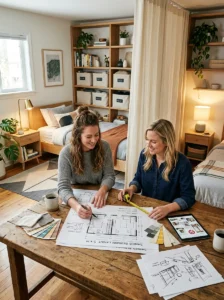
For a bedroom shared by two people old enough to participate in the decision, involving both people directly in how the room is divided — rather than one person unilaterally deciding — produces both a more workable practical result and a greater sense of ownership over the final arrangement for both occupants. This is particularly relevant for children sharing a room, where age-appropriate input into their own half of the space contributes to their sense that it’s genuinely theirs, not simply an assigned portion of a room someone else designed.
Where preferences genuinely conflict — one person wants more light, the other wants more privacy; one keeps a later schedule than the other — the physical and environmental accommodations covered above are generally more effective and more sustainable than expecting one person to simply defer to the other’s preference indefinitely, which tends to produce resentment over time even if the initial compromise seemed reasonable.
Key Takeaways
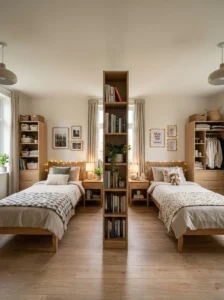
- A physical divider — a perpendicular bookshelf, a curtain, a folding screen — gives each person a genuine sense of personal territory within a shared room, and this matters more in a bedroom than in most other shared spaces
- A symmetrical baseline in furniture and floor area, combined with room for individual personalization within each person’s zone, tends to work better than either pure symmetry or pure individuality alone
- Storage should be clearly and explicitly allocated between the two occupants rather than left as shared, undivided space, which tends to produce ongoing ambiguity and minor conflict
- Individual bedside lighting on separate controls is a practical necessity in a room shared by two people who may keep different schedules or reading habits
- Environmental accommodations for differing temperature or light preferences — personal fans, targeted blackout options — are generally more sustainable than expecting one person to defer to the other’s preference indefinitely
- Involving both occupants in how the room is divided, particularly for children old enough to participate, produces a more workable result and a greater sense of ownership for both people
Frequently Asked Questions
Is a physical divider necessary, or can a shared bedroom work with just separated furniture zones? A physical divider isn’t strictly necessary, but it provides a genuine sense of personal boundary that furniture placement alone often doesn’t fully achieve, particularly for children or for two people who value more privacy from each other. A perpendicular bookshelf is a reasonable middle ground, providing a partial boundary and functional storage without the cost or permanence of a full wall.
How do I keep a shared bedroom fair between two kids without making it feel identical and impersonal? A symmetrical baseline — matching furniture, equal floor area and storage — combined with genuine freedom for each child to personalize their own side with their own art, bedding, and objects, tends to balance fairness with each child’s sense that their side is truly their own. Pure identical matching on both sides, extended into every detail, often removes the individuality that makes a space feel personally theirs.
What’s the best way to handle two roommates with very different sleep schedules? Individual bedside lighting on separate controls, combined with a curtain divider or targeted blackout solution that can block light from a later-active roommate’s side, addresses the most common practical friction point directly. This is generally more sustainable than expecting the earlier-sleeping roommate to simply tolerate disruption, or the later-active roommate to forgo light entirely.
Should storage be divided exactly equally in a shared bedroom? Generally yes, or as close to equally as the room’s layout allows, since an uneven storage division — even if unintentional — is a common source of ongoing friction between two people sharing a room. Clearly assigning each person’s own closet section, dresser, or drawers from the outset avoids the ambiguity that shared, undivided storage tends to create.
Is it worth letting kids help decide how a shared bedroom is divided? For children old enough to meaningfully participate, yes — involvement in the decision tends to produce both a more practically workable arrangement and a stronger sense that their side of the room is genuinely their own, rather than simply an assigned portion of a space someone else designed without their input.