


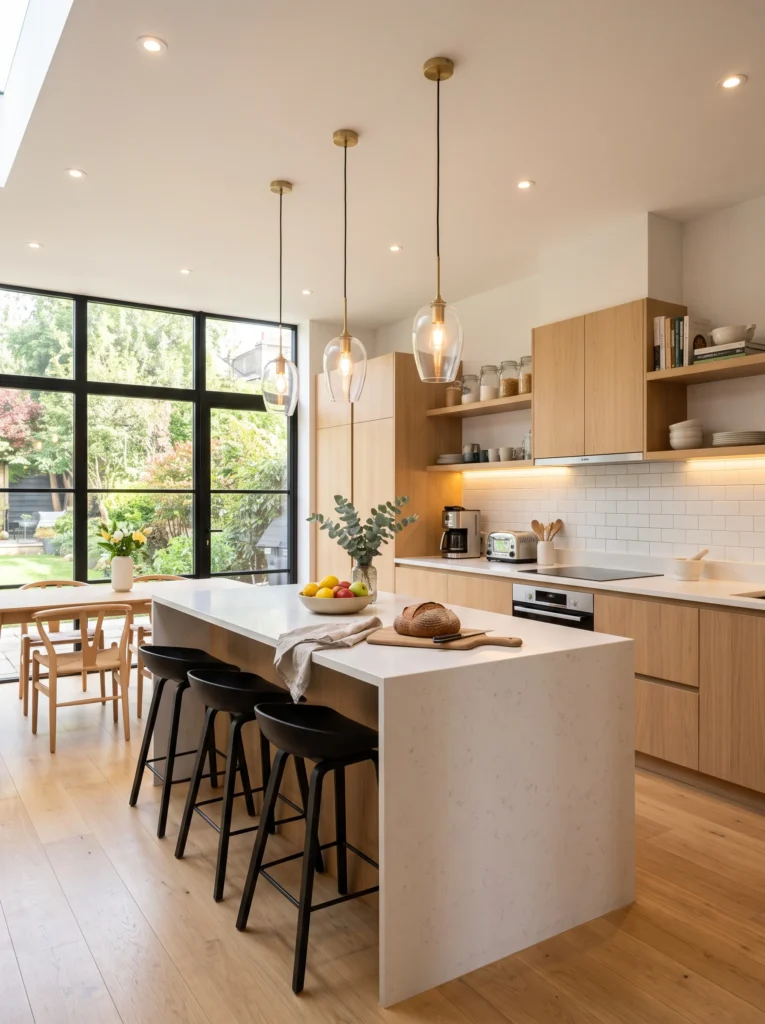
Stand in your kitchen right now and look up. Chances are there’s a single ceiling fixture doing all the work — one source of light trying to cover prep, cooking, cleaning, and everything in between. That’s the root of almost every kitchen lighting complaint I’ve ever heard, and almost nobody connects the dots back to it.
I spent a long time blaming my old kitchen’s “dull” feeling on the wall color, the cabinets, even the size of the room. Turns out it was none of that. It was one tired overhead bulb trying to do a four-person job, alone.
Why One Light Source Never Works in a Kitchen
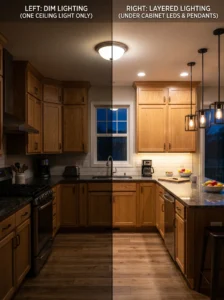
A bedroom or living room can often get away with a single main light because the activities happening there are simple — sitting, relaxing, reading on a couch with a side lamp nearby. A kitchen asks for more.
You’re chopping under one section, reading a recipe at another, washing dishes somewhere else, and standing at the stove watching for the moment something starts to burn. Each of these tasks needs light aimed at a different spot, at a different angle, and a single ceiling fixture simply can’t reach all of them evenly.
This is why kitchens lit by one source almost always have areas that feel slightly dim or shadowed, even when the room overall seems “bright enough.”
The Three Layers Every Functional Kitchen Lighting Plan Needs
Lighting designers talk about this in layers, and once I understood the concept, my own kitchen’s lighting problems made a lot more sense.
Layer One: Ambient Light
This is your general, whole-room light — usually the ceiling fixture or recessed lighting. Its job is simply to make the room usable when you walk in, not to handle any specific task.
Most kitchens have this layer and stop there, which is exactly why they feel flat or oddly shadowed despite having “enough” light technically.
Layer Two: Task Light
This is light aimed directly at where work happens — under cabinets lighting the counter below, a fixture over the sink, a light specifically over the stove. Task lighting is the layer most kitchens skip entirely, and it’s also the one that makes the biggest practical difference.
I added a single under-cabinet LED strip over my main prep counter, and it solved a problem I’d been blaming on “bad eyesight” for over a year — I genuinely couldn’t see what I was chopping clearly before that.
Layer Three: Accent Light
This is the smallest layer and the most optional — light that highlights a feature rather than helping you function. A small light inside a glass cabinet, a fixture that highlights open shelving, something purely visual.
Accent lighting won’t fix a dim kitchen on its own, but it’s what takes a functionally well-lit kitchen and makes it feel finished rather than just adequate.
Under-Cabinet Lighting: The Upgrade With the Best Return
If I had to recommend exactly one lighting change to someone with a tight budget, it would be this one, without hesitation.
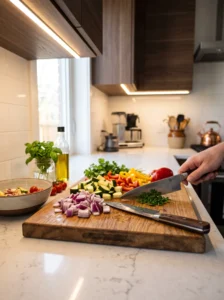
Under-cabinet lights solve the single most common kitchen lighting problem: your own body casting a shadow over your work surface when the only light comes from the ceiling above you. Standing at the counter, you block the overhead light from reaching exactly where your hands are.
A thin LED strip tucked under the upper cabinets removes that shadow completely, because the light source is now positioned right above the work, not across the room from it.
What Makes This Upgrade Especially Worth It
- Plug-in versions exist, so renters don’t need any wiring work
- Installation typically takes under thirty minutes with adhesive-backed strips
- The visual difference is immediate and obvious, unlike some upgrades that are subtle
Color Temperature Changes the Mood More Than Brightness Does
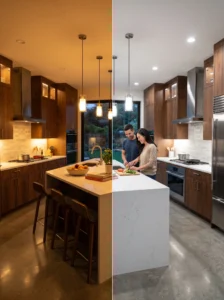
This is the detail most people get wrong when shopping for bulbs, and it has nothing to do with wattage.
Light bulbs are rated in Kelvin, and that number affects how a space feels far more than how bright it technically is. Warm light, in the lower Kelvin range, gives off a yellowish, cozy tone. Cool light, in the higher range, looks white to slightly blue and feels more clinical or energizing.
A kitchen lit entirely in warm tones can feel dim and slightly murky even at a reasonably high brightness, simply because the yellow cast reads as “low light” to our eyes. The opposite problem happens with overly cool light — technically bright, but harsh and uninviting, more like a hospital hallway than a home.
A Practical Middle Ground
For most kitchens, a neutral-to-slightly-cool white in the mid-range tends to balance both problems — bright enough to work under, warm enough to still feel like a kitchen rather than an exam room. Task areas can lean slightly cooler for clarity, while any ambient or accent lighting can stay a touch warmer for comfort.
The Stove Light Nobody Thinks About Until It’s Missing
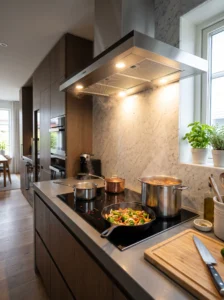
Most range hoods come with a built-in light, and most people never think about it until it burns out and they’re suddenly cooking half-blind. This is a small detail, but it matters more than its size suggests.
The stove is the one spot in a kitchen where poor lighting has real consequences — judging whether food is browning correctly, whether oil is too hot, whether something’s about to burn. A weak or broken hood light quietly makes cooking harder in a way most people just tolerate instead of fixing.
If your hood light feels dim, replacing the bulb with a brighter, neutral-white option is one of the cheapest, fastest lighting fixes available in any kitchen.
Dimmers Solve a Problem You Didn’t Know You Had
A kitchen needs bright, even light for chopping and cooking, but that same brightness can feel harsh during a slower moment — a quiet morning coffee, a late dinner conversation at the island. Most kitchens are stuck with one fixed brightness level for both situations.
Adding a dimmer, even just to the main ambient layer, lets the room shift between “fully functional” and “comfortable to sit in” without needing two separate lighting systems. This is a small, often overlooked upgrade that changes how a kitchen feels at different times of day far more than people expect.
A Simple Way to Audit Your Own Kitchen’s Lighting

Walk through your kitchen at the time of day you use it most and check each of these:
- Stand at your main prep counter — is your own shadow falling across the surface?
- Look at the stove — can you clearly judge color and texture while cooking, or does it feel dim?
- Sit at the table or island — does the lighting feel comfortable, or too bright and clinical for sitting?
- Check bulb color — does everything look slightly yellow-murky, or harsh and blue-white?
- Count your light sources — is there genuinely more than one, or is a single fixture doing everything?
Most kitchen lighting problems show up clearly once you ask these questions directly, rather than just vaguely sensing something feels “off.”
Key Takeaways
- A single ceiling fixture almost never lights a kitchen properly on its own
- Three layers — ambient, task, and accent — work together for a kitchen that’s both functional and comfortable
- Under-cabinet lighting offers the best practical improvement for the lowest cost and effort
- Color temperature affects mood and usability more than raw brightness does
- A weak hood light over the stove quietly makes cooking harder than it needs to be
- Dimmers let one space serve both bright cooking moments and softer downtime moments
Conclusion
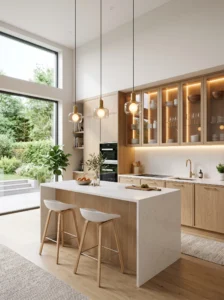
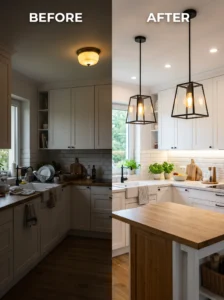
Most kitchens aren’t poorly designed when it comes to lighting — they’re just incomplete. One ceiling fixture was never meant to handle chopping, cooking, cleaning, and sitting all by itself, and once you add the missing layers, particularly task lighting under the cabinets, the entire room tends to feel different without anything structural changing at all.
If you only fix one thing from this list, make it the under-cabinet lights. It’s the change that solves the most common, most invisible problem — your own shadow blocking your own work — and it’s also the easiest one to do yourself in an afternoon.
Is it worth hiring an electrician for kitchen lighting, or can most of this be DIY? Plenty of it can be DIY, especially plug-in or adhesive under-cabinet strips and simple bulb swaps. Hardwired recessed lighting or new ceiling fixtures generally do need an electrician, particularly in older homes where wiring may need updating to handle additional circuits.
What Kelvin range is best for kitchen lighting? A neutral-to-slightly-cool range tends to suit most kitchens best, balancing enough brightness for tasks with enough warmth to still feel inviting. Going too warm can make a space feel dim despite adequate brightness, while going too cool can feel sterile rather than comfortable.
Do I really need three separate types of lighting, or is that overkill for a small kitchen? Even small kitchens benefit from at least two layers — ambient and task. A small kitchen may not need a dedicated accent layer, but skipping task lighting entirely, especially under cabinets, tends to leave even compact kitchens with the same shadow and visibility problems larger kitchens have.
Will changing my lighting actually make my kitchen feel bigger, not just brighter? Yes, to a meaningful degree. Even, well-distributed light reduces harsh shadows in corners, and a room without dark, shadowed pockets generally reads as more open than the same space lit unevenly by a single source.
How often should range hood and other kitchen bulbs be replaced? LED bulbs typically last several years under normal kitchen use, but heat and grease near the stove can shorten that lifespan somewhat. If a hood light starts looking noticeably dimmer or more yellow than it used to, it’s worth swapping it out rather than waiting for it to fail completely.