

A kitchen island is supposed to be the centerpiece of the room. Instead, in most homes I’ve walked into, it’s where mail, school forms, half-charged phones, and a fruit bowl nobody eats from all collide. The island isn’t the problem. How people style it is.
I’ve redone the styling on my own island four separate times over the years, and I’ve watched friends do the same — buy a bowl, add some candles, call it done, then wonder two weeks later why it already looks messy again. There’s a pattern to what goes wrong, and once you see it, it’s hard to unsee.
The Mistake: Treating It Like a Shelf Instead of a Workspace
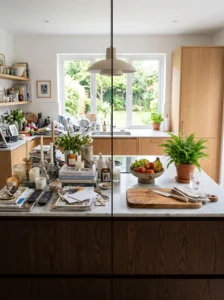
This is the root issue behind almost every badly styled island. A shelf just needs to look nice. An island needs to look nice and still function as the busiest surface in the kitchen — prep space, landing zone, sometimes a dining spot.
When people style an island purely for looks, they fill it with décor that has no job. The first time someone needs counter space to roll out dough or set down groceries, all that décor gets shoved aside, and the “styled” look collapses within a day.
The fix isn’t less styling. It’s choosing styling that earns its place.
Rule One: Everything On It Should Justify Being There
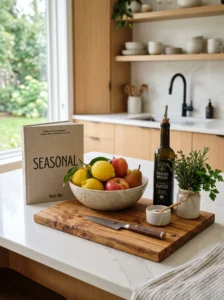
Before adding anything to your island, ask whether it does something or just sits there. This isn’t about minimalism for its own sake — plenty of beautiful islands have several objects on them. The difference is each object has a reason.
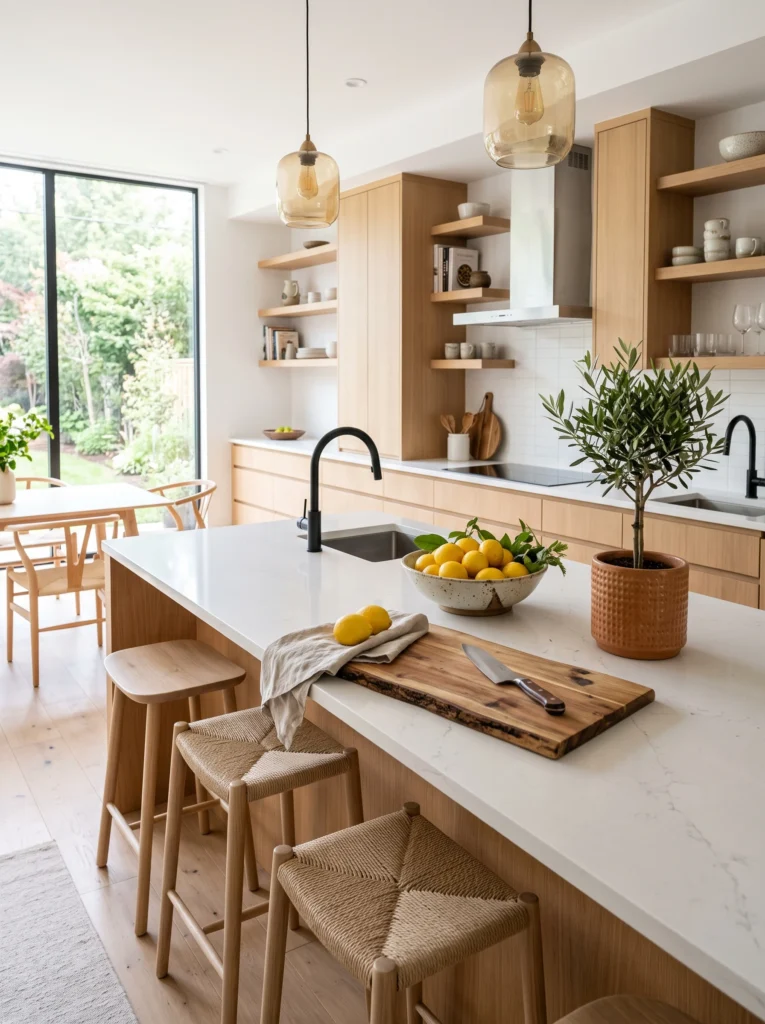
A wooden cutting board left out works because you actually use it weekly. A fruit bowl works if you actually eat the fruit, not if it’s there purely for color. A stack of cookbooks works if you cook from them, not if they’re props.
A Simple Test I Use
I ask myself: if I picked this item up right now, would I be more likely to use it or just move it somewhere else later? If the honest answer is “move it,” it doesn’t belong on the island permanently.
Rule Two: Group in Threes, Not Rows
Lining objects up in a straight row along the island reads as inventory, not styling — like items waiting to be sold rather than a space someone actually lives in.
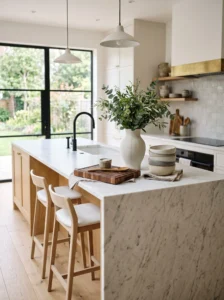
Grouping in clusters of three, with varying heights, reads as intentional instead. A tall item, a medium item, and something low and flat, placed close together rather than spread evenly, creates a small visual moment instead of a flat list.
A cutting board laid flat, a small plant slightly taller, and a stack of two bowls beside it does more visual work together than the same three items spaced out individually across the island.
Rule Three: Respect the Negative Space
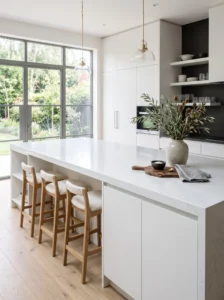
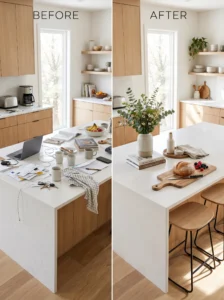
This is the rule almost everyone breaks, usually without realizing it. An island that’s “filled” edge to edge, even with genuinely nice items, looks cluttered regardless of how good each piece is on its own.
Empty space on an island isn’t wasted space — it’s what lets the eye rest and what keeps the island functional as an actual workspace. As a rough guide, roughly half the island’s visible surface should stay clear at any given time, especially the section closest to the stove or sink where prep actually happens.
I learned this by accident. I once removed two-thirds of what was sitting on my island just to clean underneath everything properly, and never put most of it back. The island looked better — not worse — with less on it.
Rule Four: Texture and Material Matter More Than Color
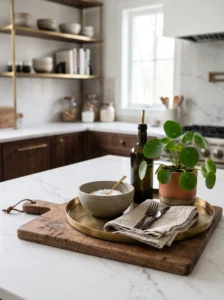
People reach for matching colors first, but texture variety is what actually makes a styled island feel layered rather than flat. Wood, ceramic, metal, and a touch of greenery together create depth that color-matching alone can’t.
A wooden board, a matte ceramic bowl, and one metal element — a pepper mill, a small tray — paired with something living, like a small plant or fresh produce, covers most of the texture range a styled island needs without looking overdone.
Where People Overdo This
Adding too many textures at once is its own mistake. Three to four distinct materials is usually the upper limit before an island starts to feel busy rather than layered.
What Actually Belongs on a Daily-Use Island
This is where styling advice usually gets too precious and forgets that islands are meant to be used, not just looked at. Here’s what tends to hold up under real daily use:
- A cutting board you genuinely use, left out because you’ll need it again within a day or two
- A small bowl for fruit or onions/garlic that gets refilled regularly
- One low-maintenance plant — something that survives neglect, not something fussy
- A tray that corrals smaller items like salt, pepper, and oil into one zone instead of scattering them
Anything beyond this short list should earn a strong, specific reason for staying out permanently. Seasonal items — a pumpkin in October, fresh flowers for a week — are fine precisely because they’re temporary, not permanent fixtures.
A Five-Minute Reset Routine
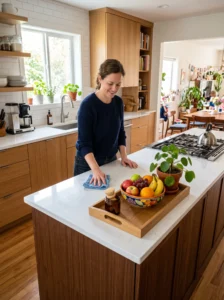
Styled islands don’t stay styled on their own. The ones that look consistently good belong to people who reset them in small, frequent passes, not big occasional overhauls.
- Clear the island completely once a week
- Wipe it down properly — this rarely happens when items are always in the way
- Put back only what passed the “use it or move it” test from Rule One
- Re-cluster remaining items in groups of three rather than scattering them back individually
- Leave at least half the surface empty before calling it done
This takes less time than people expect, mostly because removing things is fast — the slow part is deciding what’s actually allowed to come back.
Key Takeaways
- An island needs styling that survives daily use, not styling built purely for photos
- Every object on it should have a real, current reason to be there
- Group decorative items in threes with varied height instead of straight rows
- Leave roughly half the surface clear at all times for it to still function
- Mix textures — wood, ceramic, metal, a touch of greenery — rather than matching colors
- A short weekly reset keeps the styling from sliding back into clutter
Final Thoughts
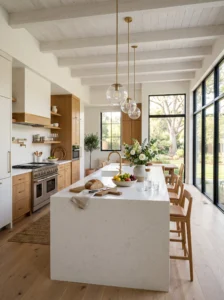
Most kitchen islands aren’t badly designed — they’re badly maintained as styled spaces, because the styling advice people follow treats the island like a static display shelf instead of the busiest surface in the house. The islands that actually stay nice week after week are the ones where every object has a job, the empty space is treated as part of the design, and someone resets it regularly instead of letting it slowly fill up with whatever lands there.
Get those three things right, and the island styles itself, more or less, every single day.
FAQ
Should a kitchen island always have a centerpiece? Not necessarily. A centerpiece works well on islands rarely used for prep, but on a heavily used island, a flexible cluster of functional items — a board, a bowl, a small plant — usually holds up better day to day than a fixed centerpiece that has to be moved constantly.
Is it okay to leave small appliances on the island? Generally no, if the goal is a styled, open look. Small appliances tend to visually compete with decor and quickly turn an island into overflow counter space. If one absolutely needs to stay out, keep it to a single item, positioned at one end rather than the center.
How do I style an island if I rarely cook or prep on it? You have more freedom here since function matters less. A single larger centerpiece — a bowl of fresh produce, a vase, a tray with a few grouped objects — can work well, but the same texture-variety and negative-space rules still apply for it to look intentional rather than random.
What’s the biggest sign an island is over-styled? If you find yourself moving items aside just to set down groceries or a cutting board, the island has crossed from styled into cluttered. Function should never be the casualty of decoration on a surface this central to daily kitchen use.
Does the size of the island change these styling rules? The principles stay the same, but smaller islands need fewer items overall to maintain the same proportion of empty space. A small island can usually only support one cluster of two to three objects before it starts to feel crowded, compared to two clusters on a larger one.